Page 296 of 420
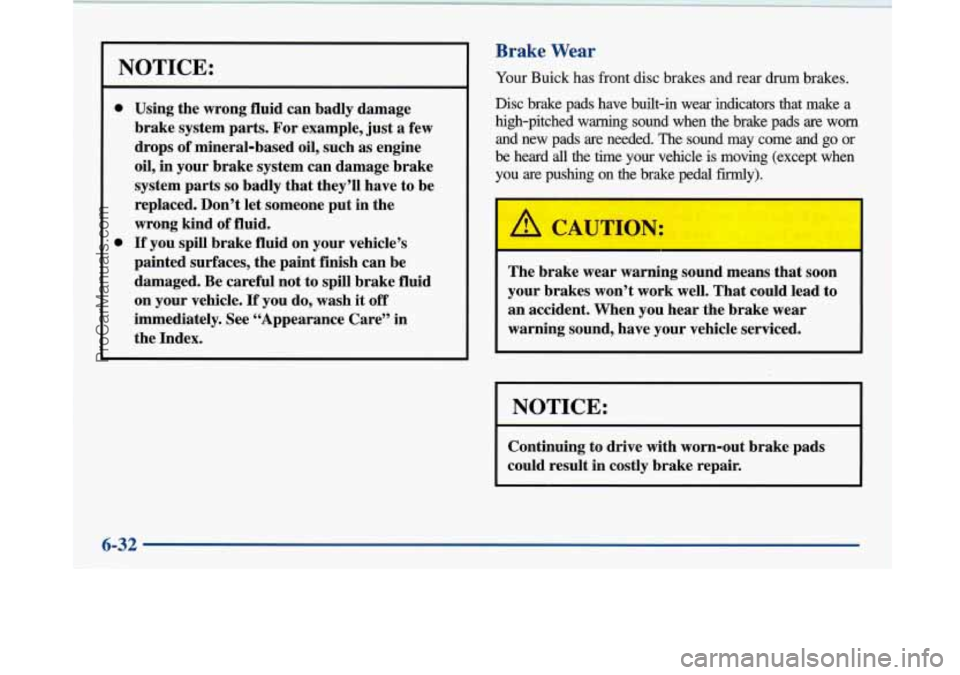
Brake Wear
Using the wrong fluid can badly damage
brake system parts. For example, just
a few
drops of mineral-based
oil, such as engine
oil, in your brake system can damage brake
system parts
so badly that they’ll have to be
replaced. Don’t let someone put in the
wrong kind of fluid.
If you spill brake fluid on your vehicle’s
painted surfaces, the paint finish can be
damaged. Be careful not to spill brake fluid
on your vehicle.
If you do, wash it off
immediately. See “Appearance Care” in
the Index.
Your Buick has front disc brakes and rear drum brakes.
Disc brake pads have built-in wear indicators that make a
high-pitched warning sound when the brake pads
are worn
and new pads
are needed. The sound may come and go or
be heard all the time your vehicle is moving (except when
you are pushing on the brake pedal
firmly).
A CA, TION:
The brake wear warning sound means that soon
your brakes won’t work well. That could lead to
an accident. When you hear the brake wear
warning sound, have your vehicle serviced.
I NOTICE: I
Continuing to drive with worn-out brake pads
could result in costly brake repair.
6-32
ProCarManuals.com
Page 330 of 420
Vehicle Identification Number (VIN) Engine Identification
- -1 I. 11111.11 1.11 111 111111 II.111111.. 1111111.111.111..1111II- 0
SAMPLE4UXVM072675
-
I 11111111 1111 lllllmmmmnmmnllllllllll11llll111 I IIIIIIIII IIII 11l1111111111I IIIIIIIIIIIIIIIIIIIIIIIIIIIIIIII I
ENGINEA997 7 ASSEMBLY
CODE MODEL YEAR PLANT
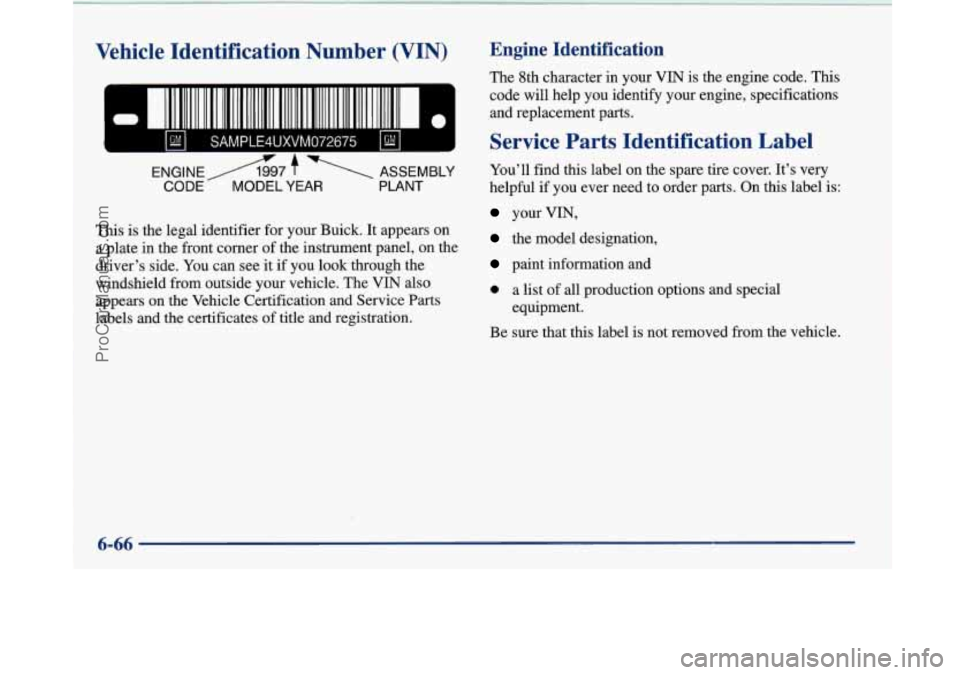
This is the legal identifier for your Buick. It appears on
a plate in the front corner of the instrument panel, on the
driver’s side. You can see it if you look through the
windshield from outside your vehicle. The VIN also
appears on the Vehicle Certification and Service Parts
labels and the certificates
of title and registration. The 8th
character in your
VIN is the engine code. This
code
will help you identify your engine, specifications
and replacement parts.
Service Parts Identification Label
You’ll find this label on the spare tire cover. It’s very
helpful
if you ever need to order parts. On this label is:
your VIN,
the model designation,
paint information and
0 a list of all production options and special
equipment.
Be sure that this label is not removed from the vehicle.
6-66
ProCarManuals.com
Page 332 of 420
Fuses and Circuit Breakers
The wiring circuits in your vehicle are protected from
short circuits by a combination of fuses and circuit
breakers. This greatly reduces the chance of damage
caused by electrical problems.
Look at the silver-colored band inside the fuse. If the
band is broken or melted, replace the fuse. Be sure
you
replace a bad fuse with a new one of the identical size
and rating.
There are three fuse blocks in your vehicle: the
Instrument Panel Fuse Block located under the
instrument panel, the Underhood Fuse Block located on
the passenger’s side engine compartment, and the Rear
Fuse Block located under the rear seat.
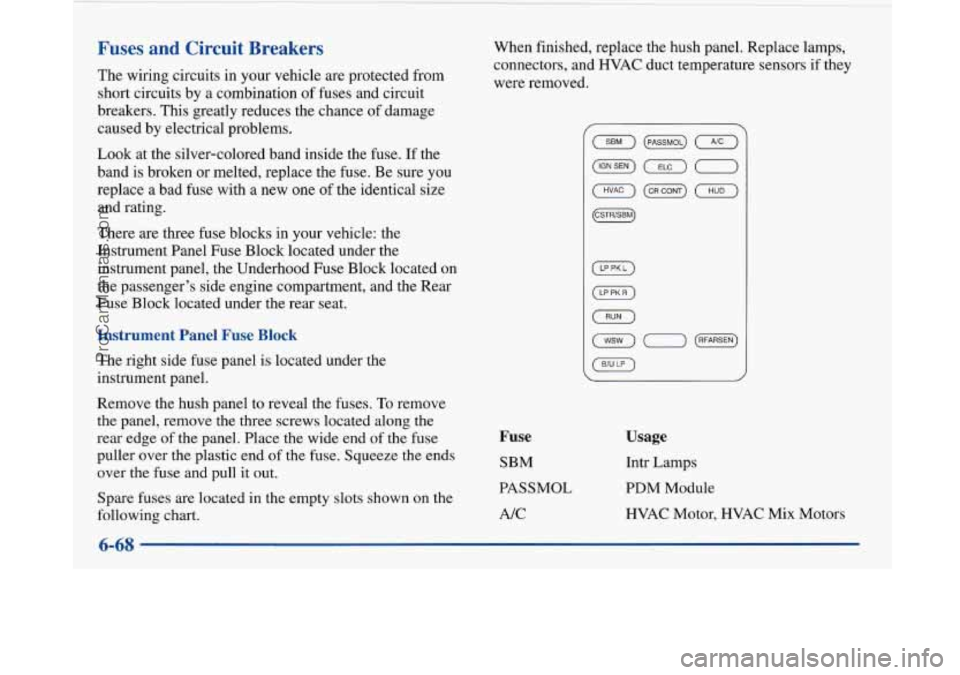
Instrument Panel Fuse Block
The right side fuse panel is located under the
instrument panel.
Remove the hush panel to reveal the fuses.
To remove
the panel, remove the three screws located along the
rear edge of the panel. Place the wide end
of the fuse
puller over the plastic end
of the fuse. Squeeze the ends
over the fuse and pull it out.
>pare fuses are located
in the empty slots shown on the
following chart. When finished, replace
the hush panel. Replace lamps,
connectors, and HVAC duct temperature sensors if they
were removed.
Fuse
SBM
PASSMOL
NC
(SEN) (ELC) (-)
(x) (KT) (TI
(K)
(LPPKR 1
Usage
Intr Lamps
PDM Module
HVAC Motor, HVAC Mix Motors
ProCarManuals.com
Page 334 of 420
I !
Underhood Fuse Block
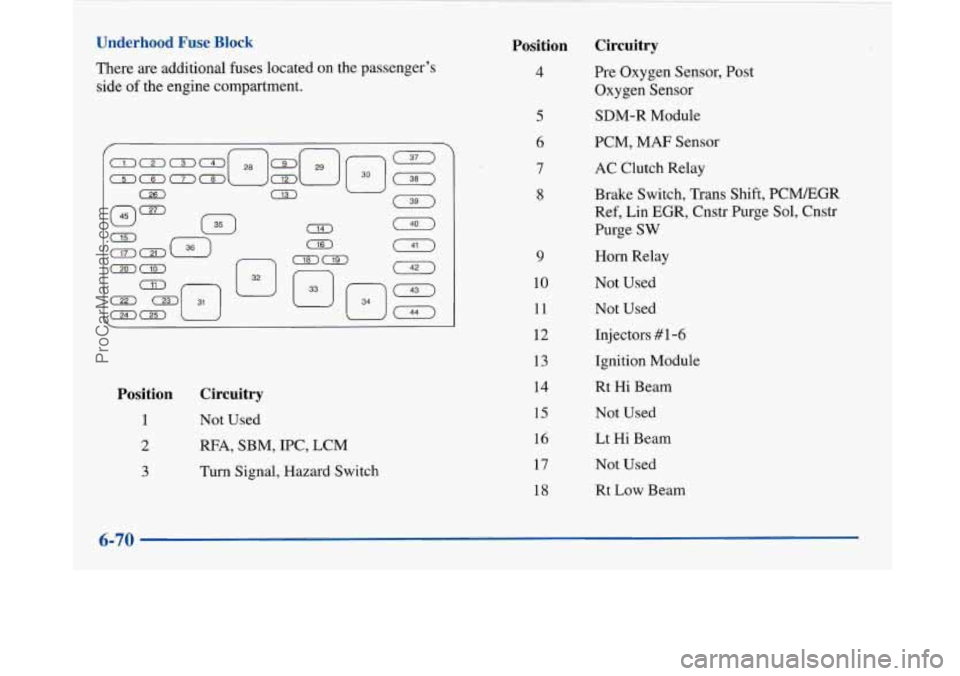
There are additional fuses located on the passenger’s
side
of the engine compartment.
Position
1
2
3
Circuitry
Not Used
RFA, SBM, IPC, LCM
Turn Signal, Hazard Switch
Position Circuitry
4
9
10
11
12
13
14
15
16
17
1s Pre Oxygen Sensor,
Post
Oxygen Sensor
SDM-R Module
PCM, MAF Sensor
AC Clutch Relay
Brake Switch, Trans Shift, PCMEGR
Ref, Lin EGR, Cnstr Purge Sol, Cnstr
Purge
SW
Horn Relay
Not Used Not Used
Injectors #1-6
Ignition Module
Rt Hi Beam
Not Used
Lt Hi Beam
Not Used
Rt Low Beam
6-70
ProCarManuals.com
Page 340 of 420
Capacities and Specifications
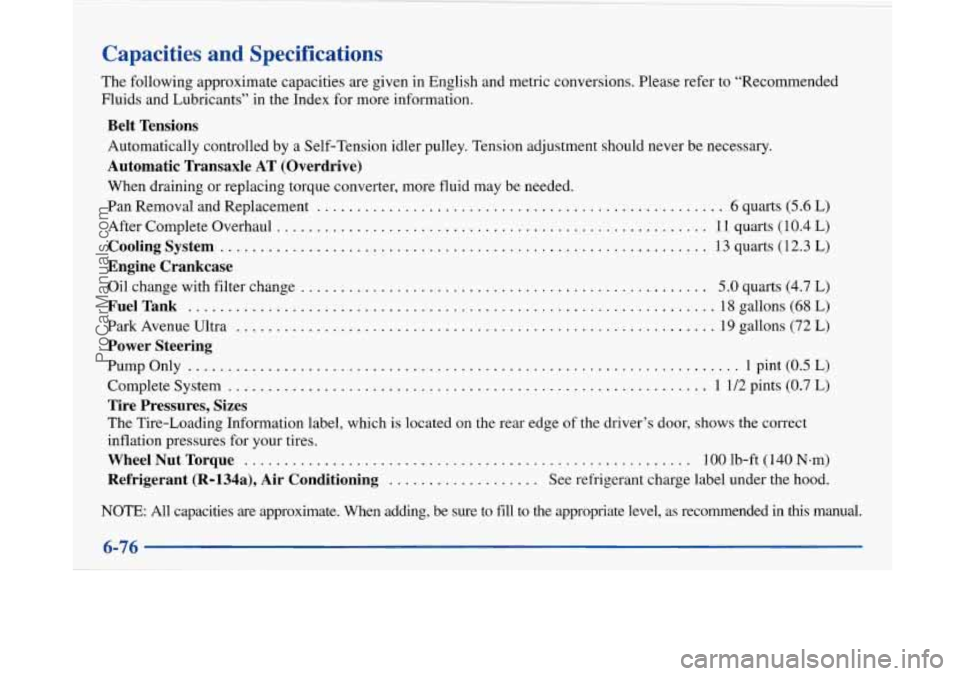
The following approximate capacities are given in English and metric conversions. Please refer to “Recommended
Fluids and Lubricants” in the Index for more information.
Belt Tensions
Automatically controlled by a Self-Tension idler pulley. Tension adjustment should never be necessary.
Automatic Transaxle AT (Overdrive)
When draining or replacing torque converter, more fluid may be needed.
Pan Removal and Replacement
................................................... 6 quarts (5.6 L)
After Complete Overhaul
...................................................... 11 quarts (10.4 L)
Cooling System ............................................................. 13 quarts (12.3 L)
Oil change with filter change ................................................... 5.0 quarts (4.7 L)
Park Avenue Ultra
............................................................ 19 gallons (72 L)
Engine Crankcase
FuelTank
......................,...........................................18gall\
ons (68L)
Power Steering
PumpOnly .....................................................................lpi\
nt (0.5L)
Tire Pressures, Sizes
The Tire-Loading Information label, which is located on the rear edge of the driver’s door, shows the correct
inflation pressures for your tires.
WheelNutTorque ........................................................ lOOlb-ft(140N~m)
Complete System
............................................................ 1
1/2 pints (0.7 L)
Refrigerant (R-l34a), Air Conditioning ................... See refrigerant charge label under the hood.
NOTE: All capacities are approximate. When adding, be sure to \
fill to the appropriate level, as recommended
in this manual.
ProCarManuals.com
Page 341 of 420
Air Conditioning Refrigerants
Not all air conditioning refrigerants are the same.
If the air conditioning system in your vehicle needs
refrigerant, be sure the proper refrigerant
is used.
If you're not sure, ask your Buick dealer.
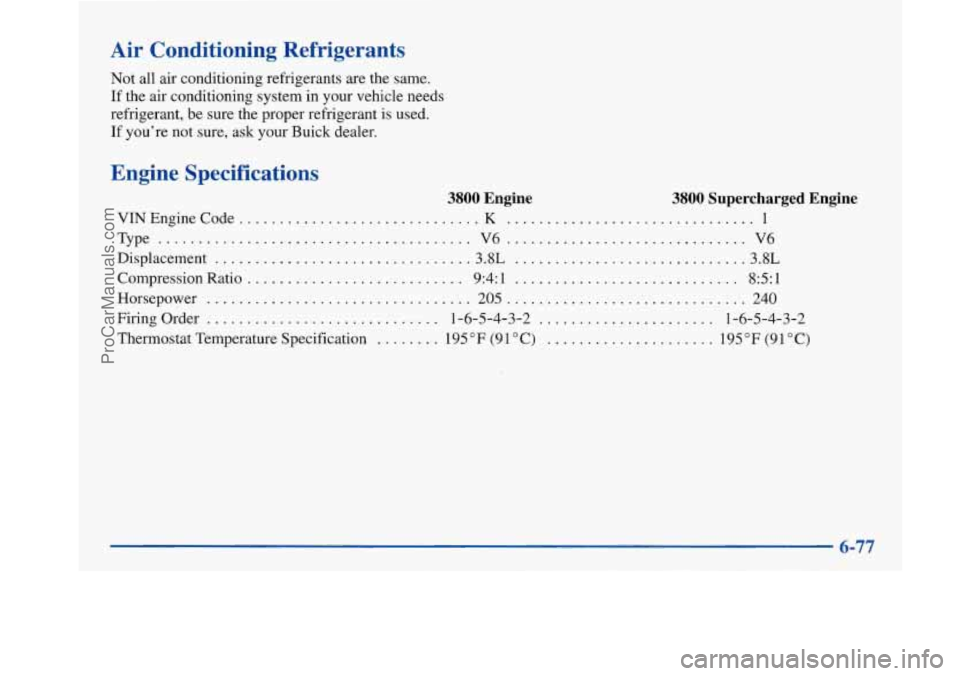
Engine Specifications
3800 Engine 3800 Supercharged Engine
VINEngineCode .............................. K ............................... 1
Type
....................................... V6 .............................. V6
Displacement
................................ 3.8L ............................ .3.8L
Compression Ratio
........................... 9:4: 1 ............................ 85: 1
Horsepower ................................. 205 .............................. 240
Firing Order
............................. 1-6-5-4-3-2 ...................... 1-6-5-4-3-2
Thermostat Temperature Specification
........ 195 "F (91 "C) ..................... 195°F (91°C)
6-77
ProCarManuals.com
Page 342 of 420
Vehicle Dimensions
Overall
Length ................. 206.8 inches (525.3 cm)
Width
................... 74.7 inches ( 189.7 cm)
Height
................... 58.1 inches (147.6 cm)
Wheelbase
.............. 113.8 inches (289.1 cm)
Front Tread
............... 62.7 inches (159.3 cm)
Rear Tread
............... 62.3 inches ( 15 8.2 cm)
Normal Maintenance
Replacement Parts
Air Cleaner Element .......... AC Type A- 1096C
Engine Oil Filter
................ AC Type PF-47
Fuel Filter
.................... AC Type GF-627
Spark Plugs
................... AC Type 41-921
Gap: 0.060 inch
(. 152 cm)
Windshield Wiper Blades
Type
............................ Hook Style
Length
..................... 22 inches (56 cm)
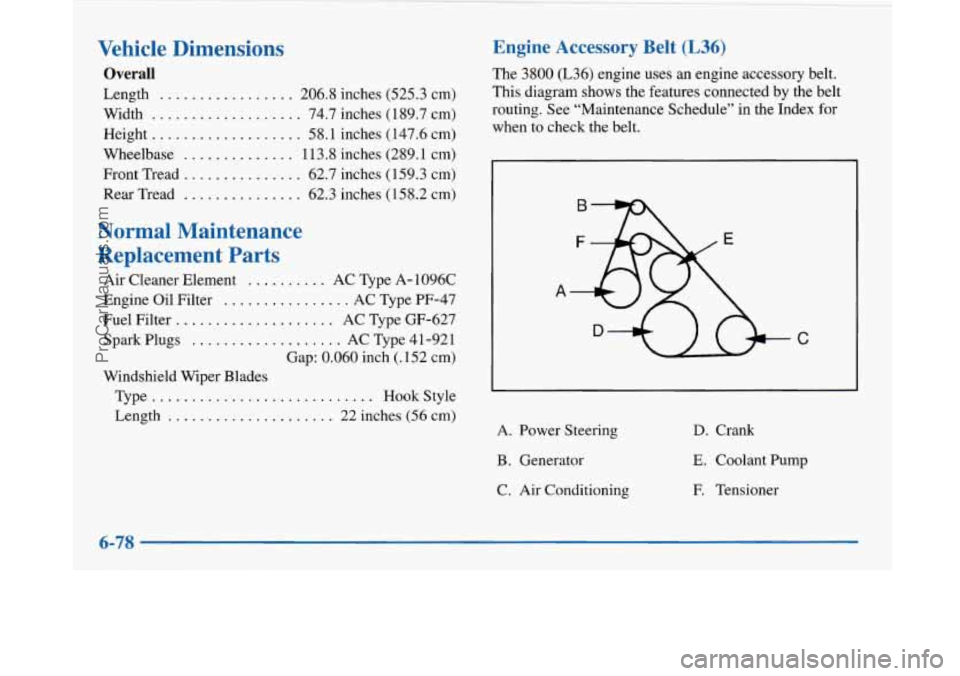
Engine Accessory Belt (L36)
The 3800 (L36) engine uses an engine accessory belt.
This diagram shows the features connected by the belt
routing. See “Maintenance Schedule” in the Index for
when to check the belt.
A
C
A. Power Steering
B. Generator
C. Air Conditioning
D. Crank
E. Coolant Pump
F. Tensioner
6-78
ProCarManuals.com
Page 343 of 420
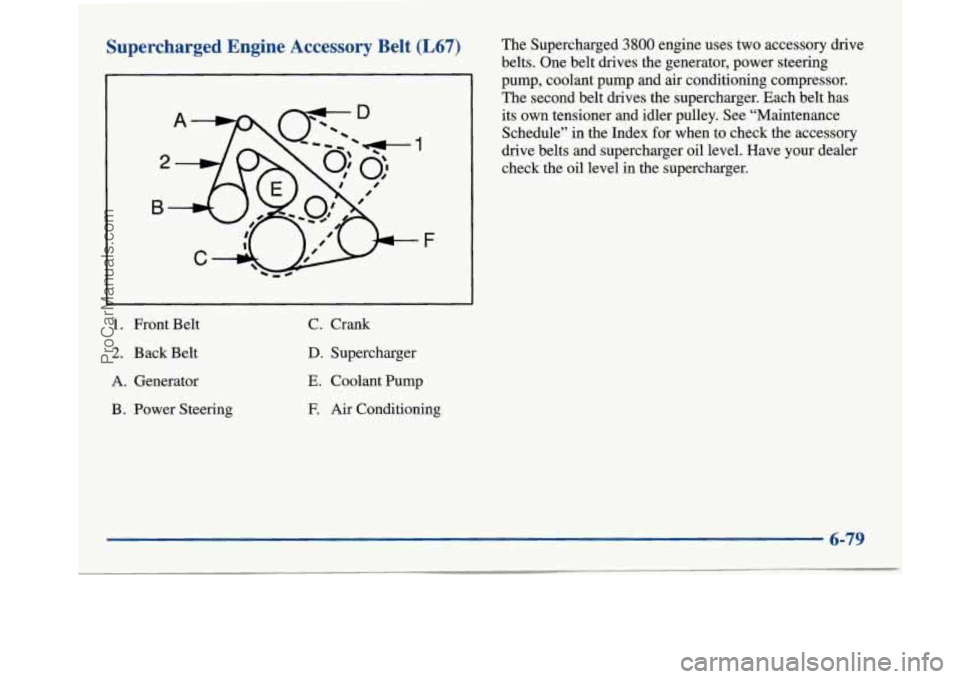
Supercharged Engine Accessory Belt (L67)
c
1. Front Belt C. Crank
2. Back Belt D. Supercharger
A. Generator E. Coolant Pump
B. Power Steering
E Air Conditioning The
Supercharged
3800 engine uses two accessory drive
belts. One belt drives the generator, power steering
pump, coolant pump and air conditioning compressor.
The second belt drives the supercharger. Each belt has
its own tensioner and idler pulley. See “Maintenance
Schedule” in the Index
for when to check the accessory
drive belts and supercharger oil level. Have your dealer
check the oil level in the supercharger.
6-79
ProCarManuals.com