1997 BUICK CENTURY stop start
[x] Cancel search: stop startPage 93 of 406
New Vehicle “Break-In”
NOTICE:
Your modern Buick doesn’t need an elaborate
“break-in.” But it will perform better in the long
run if you follow these guidelines:
0 Don’t drive at any one speed -- fast or
slow
-- for the first 500 miles (805 km).
Don’t make full-throttle starts.
200 miles (322 km) or so. During this time
your new brake linings aren’t yet broken
in. Hard stops with new linings can mean
premature wear and earlier replacement. Follow this breaking-in guideline every
time you get new brake linings.
See “Towing
a Trailer’’ in the Index for
more information.
Avoid making hard stops for the first
0 Don’t tow a trailer during break-in.
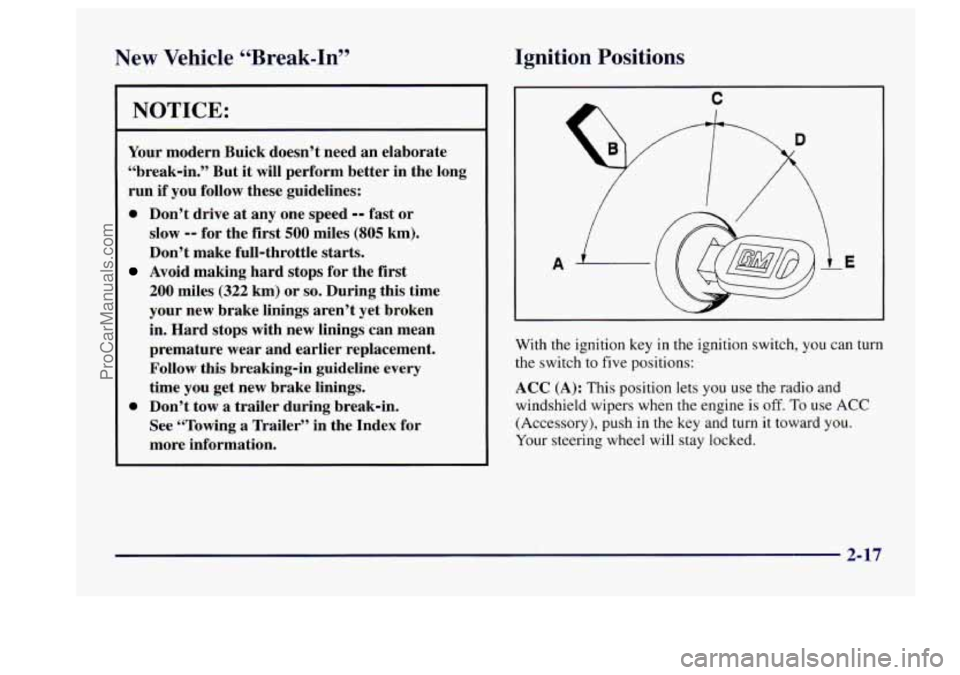
Ignition Positions
A L
With the ignition key in the ignition switch, you can turn
the switch
to five positions:
ACC
(A): This position lets you use the radio and
windshield wipers when the engine is off. To use
ACC
(Accessory), push in the key and turn it toward you.
Your steering wheel will stay locked.
2-17
ProCarManuals.com
Page 95 of 406
Starting Your Engine
Move your shift lever to PARK (P) or NEUTRAL (N).
Your engine won’t start in any other position -- that’s a
safety feature. To restart when you’re already moving,
use
NEUTRAL (N) only.
I NOTICE:
Don’t try to shift to PARK (P) if your Buick is
moving.
If you do, you could damage the
transaxle. Shift to
PARK (P) only when your
vehicle
is stopped.
1. Without pushing the accelerator pedal, turn your
ignition key
to START. When the engine starts, let
go
of the key. The idle speed will go down as your
engine gets warm.
NOTICE:
Holding your key in START for longer than
15 seconds at a time will cause your battery to be
drained much sooner. And the excessive heat can
damage your starter motor.
2-19
ProCarManuals.com
Page 96 of 406

2. If your engine won’t start (or starts but then stops), it
could be flooded with too much gasoline. Try
pushing your accelerator pedal all the way to the
floor and holding it there as you hold the key in
START for up to 15 seconds. This clears the extra
gasoline from the engine.
NOTICE:
Your engine is designed to work with the
electronics in your vehicle.
If you add electrical
parts or accessories, you could change the
way
the engine operates. Before adding electrical
equipment, check with your dealer.
If you don’t,
your engine might not perform properly.
If you ever have to have your vehicle towed, see
the part
of this manual that tells how to do it
without damaging your vehicle. See “Towing
Your Vehicle” in the Index.
Engine Coolant Heater (Option)
In very cold weather, 0” F (- 1 8 “C) or colder, the engine
coolant heater can help. You’ll get easier starting and
better fuel economy during engine warm-up. Usually,
the coolant heater should be plugged in a minimum
of
four hours prior to starting your vehicle.
2-20
ProCarManuals.com
Page 99 of 406
Make sure the shift lever is fully into PARK (P) range
before starting the engine. Your Buick has
a
brake-transaxle shift interlock. You must fully apply
your regular brakes before you can shift from PARK
(P)
when the ignition is in RUN. If you cannot shift out of
PARK (P), ease pressure on the shift lever by pushing it
all the way into PARK (P) while keeping the brake pedal
pushed down. See “Shifting Out of PARK
(P)” in
the Index.
REVERSE (R): Use this gear to back up.
NOTICE:
_____~ ~~ ~~ ~
Shifting to REVERSE (R) while your vehicle is
moving forward could damage your transaxle. Shift to
REVERSE (R) only after your vehicle
is stopped.
To rock your vehicle back and forth to get out of snow,
ice or sand without damaging your transaxle, see
“Stuck:
In Sand, Mud, Ice or Snow” in the Index.
NEUTRAL (N): In this position, your engine
doesn’t connect with the wheels.
To restart when you’re
already moving, use NEUTRAL
(N) only. Also, use
NEUTRAL
(N) when your vehicle is being towed.
Shifting out of
PARK (P) or NEUTRAL (N) while
your engine
is “racing” (running at high speed) is
dangerous. Unless your foot is firmly on the
brake pedal, your vehicle could move very
rapidly. You could lose control and hit people or
objects. Don’t shift out
of PARK (P) or
NEUTRAL (N) while your engine is racing.
NOTICE:
Damage to your transaxle caused by shifting out
of PARK (P) or NEUTRAL (N) with the engine
racing isn’t covered by your warranty.
2-23
ProCarManuals.com
Page 112 of 406
Windshield Wipers
I
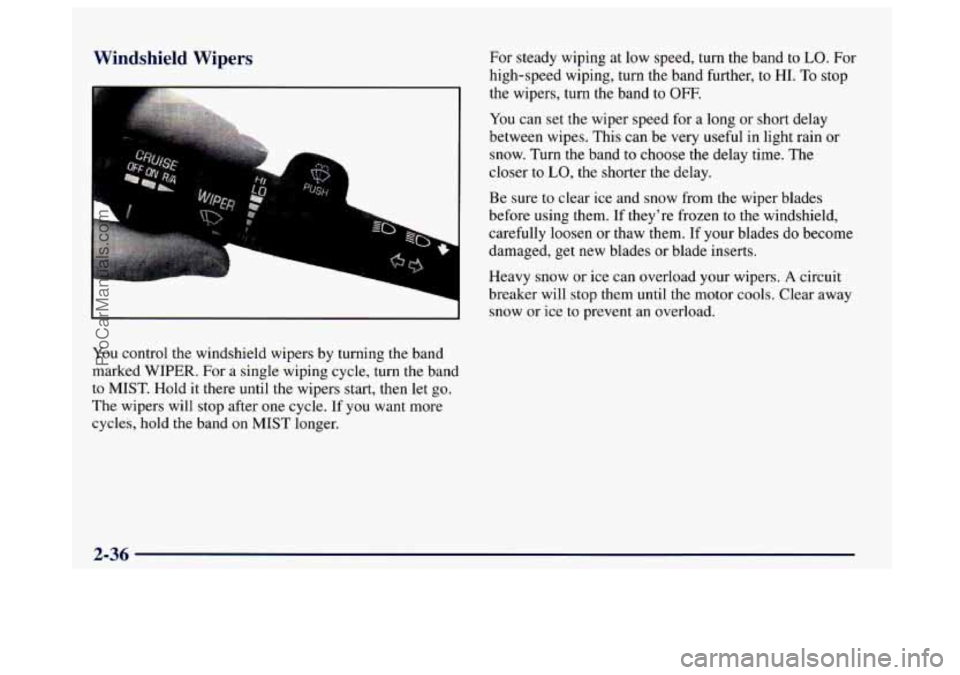
You control the windshield wipers by turning the band
marked WIPER. For a single wiping cycle, turn the band
to MIST. Hold it there until the wipers start, then let go.
The wipers will stop after one cycle. If you want more
cycles,
hold the band on MIST longer.
For steady wiping at low speed, turn the band to LO. For
high-speed wiping, turn the band further,
to HI. To stop
the wipers, turn the band to OFF.
You can set the wiper speed for a long or short delay
between wipes. This
can be very useful in light rain or
snow. Turn the band to choose the delay time. The
closer
to LO, the shorter the delay.
Be sure to clear ice and snow from the wiper blades
before using them. If they're frozen
to the windshield,
carefully loosen or thaw them. If your blades do become
damaged, get new blades or blade inserts.
Heavy snow or ice can overload your wipers.
A circuit
breaker will stop them until the motor cools. Clear away
snow or ice to prevent an overload.
2-36
ProCarManuals.com
Page 125 of 406
Storage Compartments
Glove Box
Use the door key to lock and unlock the glove box. To
open, lift the latch.
Storage Armrest (If Equipped)
To use the storage area, fold down the armrest located in
the center front seat. Press the latch on the front edge
and pull
up. Dual oversized cupholders will fold out
from within the storage armrest.
You may also have an armrest located within the center
back seat of your vehicle. It may have a storage area and
cupholders.
To open, pull up on the lever at the end of
the armrest and
lift. Two cupholders will then be
accessible and you will have access to
the storage
compartment area.
Convenience Net (If Equipped)
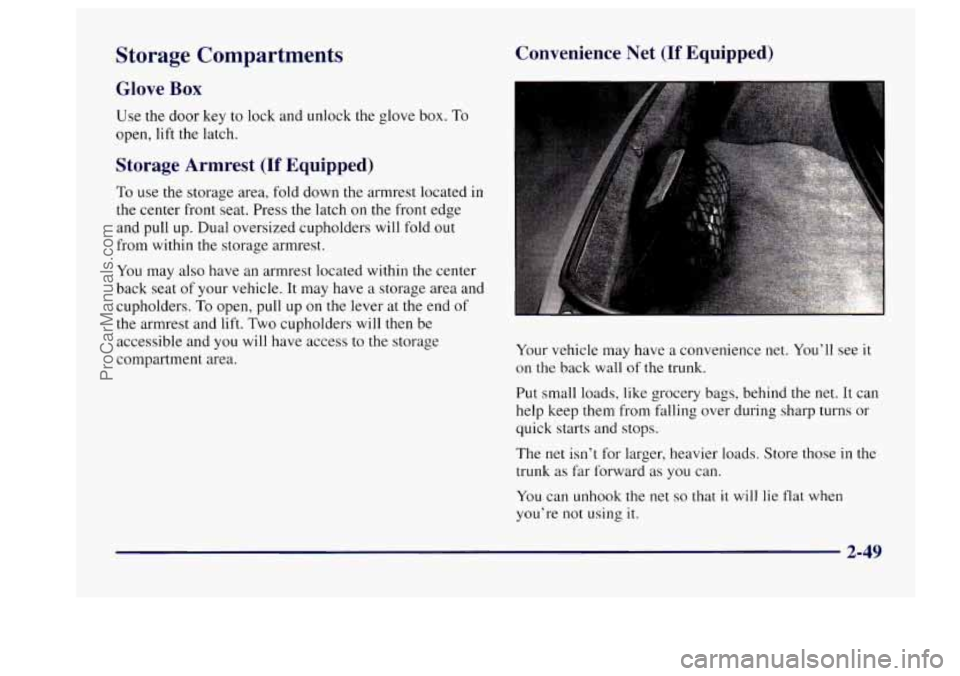
Your vehicle may have a convenience net. You’ll see it
on the back wall of the trunk.
Put small loads, like grocery bags, behind
the net. It can
help keep them from falling over during sharp turns or
quick starts and stops.
The
net isn’t for larger, heavier loads. Store those in the
trunk
as far forward as you can.
You can unhook the net so that it will lie flat when
you’re not using it.
2-49
ProCarManuals.com
Page 134 of 406
Your brake system may not be working properly
if the brake system warning light is on. Driving
with the brake system warning light on can lead
to an accident.
If the light is still on or if the
anti-lock brake system warning light is flashing
after you’ve pulled
off the road and stopped
carefully, have the vehicle towed for service.
When the ignition is on, the brake system warning light
will also come on when you set your parking brake. The
light will stay
on if your parking brake doesn’t release
fully. If it stays on after your parking brake is
fully
released, it means you have a brake problem.
Anti-Lock Brake System Warning Light
ANTI -
LOCK
With the anti-lock brake
system, this light will come
on when
you start your
engine and it will stay
on
for three seconds.
That’s normal.
If the light flashes when you’re driving, you don’t have
anti-lock brakes and there could be
a problem with your
regular brakes. Pull off the road and stop carefully.
You
may notice that the pedal is harder to push. Or, the pedal
may
go closer to the floor. It may take longer to stop.
Have the vehicle towed for service. (See “Towing Your
Vehicle”
in the Index.)
2-58
ProCarManuals.com
Page 135 of 406
ON:
Your regular brake system may not be working
properly if the anti-lock brake system warning
light is flashing. Driving with the anti-lock brake system warning light flashing can lead
to an
accident. After you’ve pulled off the road and
stopped carefully, have the vehicle towed
for service.
If the anti-lock brake system warning light stays on
longer than normal after you’ve started your engine, turn
the ignition
off. Or, if the light comes on and stays on
when you’re driving, stop as soon as possible and turn
the ignition
off. Then start the engine again to reset the
system. If
the light still stays on, or comes on again
while you’re driving, your Buick needs service, If the
light is
on but not flashing and the regular brake system
warning light isn’t on, you still have brakes, but you
don’t have anti-lock brakes.
The anti-lock brake system warning light should come
on briefly when
you turn the ignition key to RUN. If the
light doesn’t come
on then, have it fixed so it will be
ready to warn you
if there is a problem.
4nti-Lock Brake System Active Light
1
When your anti-lock system
is adjusting brake pressure
to help avoid a braking
skid,
the anti-lock brake system
Slippery road conditions may exist if this light comes
on,
so adjust your driving accordingly. The light will
stay
on for a few seconds after the system stops
adjusting brake pressure.
The anti-lock brake system active light also comes
on
briefly when you turn the ignition key to RUN. If the
light doesn’t come on then, have it fixed
so it will be
there to tell you when the system is active.
2-59
ProCarManuals.com