1997 BUICK CENTURY steering wheel
[x] Cancel search: steering wheelPage 236 of 406
r I A CAUTION:
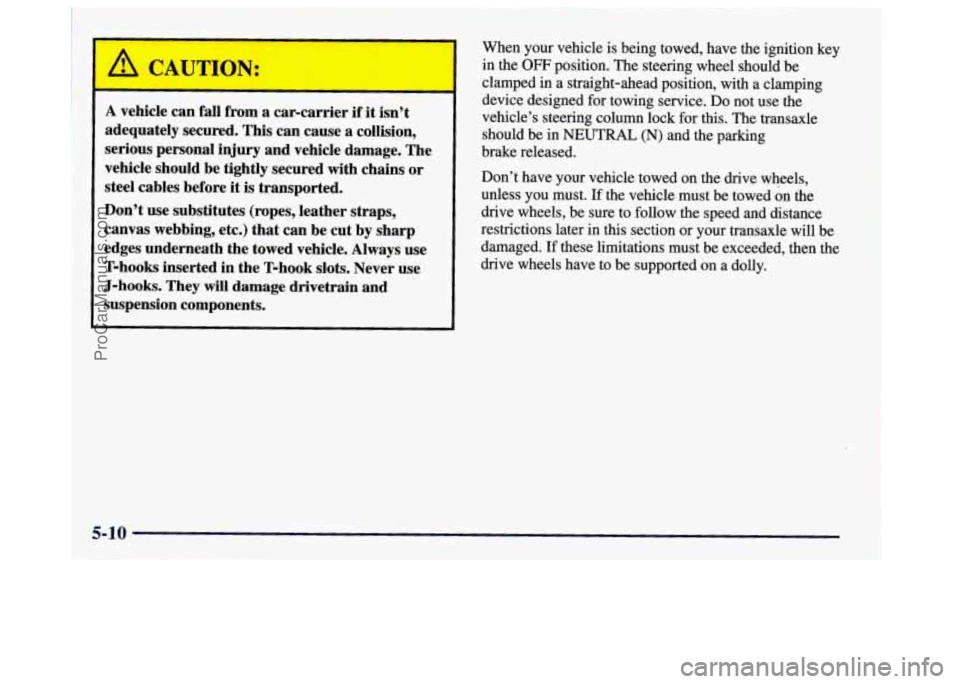
A vehicle can fall from a car-carrier if it isn’t
adequately secured. This can cause a collision,
serious personal injury and vehicle damage. The
vehicle should be tightly secured with chains or
steel cables before
it is transported.
Don’t use substitutes (ropes, leather straps,
canvas webbing, etc.) that can be cut by sharp
edges underneath the towed vehicle. Always use
T-hooks inserted in the T-hook slots. Never use
J-hooks.
They will damage drivetrain and
suspension components.
When your vehicle is being towed, have the ignition key
in the
OFF position. The steering wheel should be
clamped in a straight-ahead position, with a clamping
device designed for towing service. Do not use the
vehicle’s steering column lock for
this. The transaxle
should be in
NEUTRAL (N) and the parking
brake released.
Don’t have your vehicle towed on the drive wheels,
unless you must.
If the vehicle must be towed on the
drive wheels, be sure to follow the speed and distance
restrictions later in this section or your transaxle will be
damaged. If these limitations must be exceeded, then the
drive wheels have
to be supported on a dolly.
5-10
ProCarManuals.com
Page 251 of 406
If a Tire Goes Flat
It’s unusual for a tire to “blow out” while you’re driving,
especially if
you maintain your tires properly. If air goes
out of a tire, it’s much more likely
to leak out slowly.
But
if you should ever have a “blowout,” here are a few
tips about what to expect and what to do:
If a front tire fails, the flat tire will create a drag that
pulls the vehicle toward that side. Take your foot off the
accelerator pedal and grip the steering wheel firmly.
Steer
to maintain lane position, and then gently brake to
a stop well out of the traffic lane.
A rear blowout, particularly on a curve, acts much like a
skid and may require the same correction you’d use in a
skid. In any rear blowout, remove your foot from the
accelerator pedal. Get the vehicle under control by
steering the way you want the vehicle to
go. It may be
very bumpy and noisy, but you can still steer. Gently
brake to a stop
-- well off the road if possible.
If a tire goes flat, the next part shows how
to use your
jacking equipment to change a flat tire safely.
Changing a Flat Tire
If a tire goes flat, avoid further tire and wheel damage
by driving slowly
to a level place. Turn on your hazard
warning flashers.
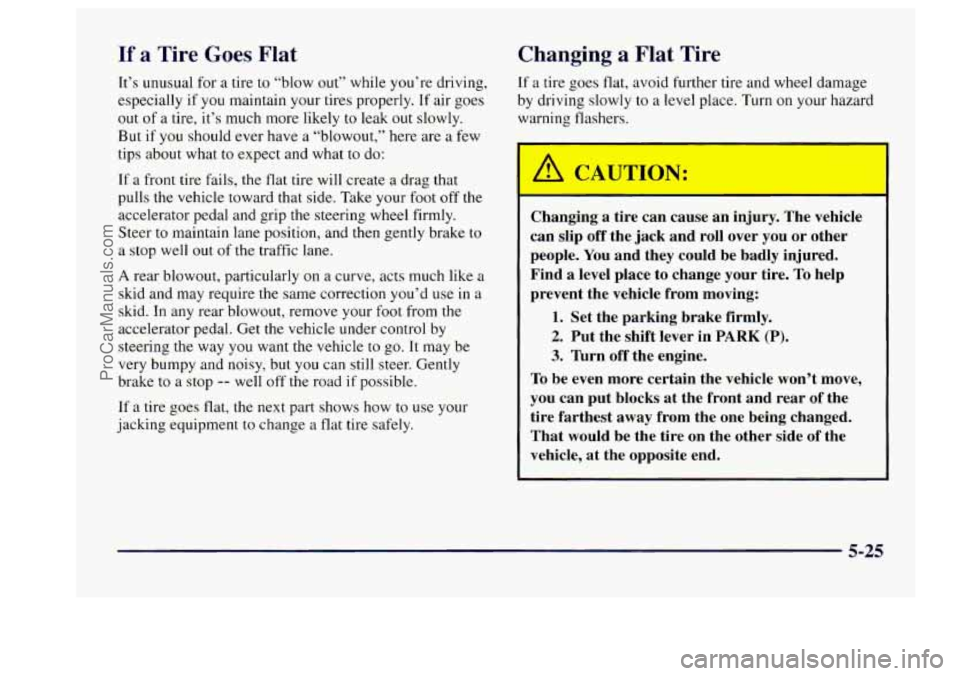
A CAC ,,.IN:
Changing a tire can cause an injury. The vehicle
can slip off the jack and
roll over you or other
people. You and they could be badly injured.
Find a level place to change your tire.
To help
prevent the vehicle from moving:
1. Set the parking brake firmly.
2. Put the shift lever in PARK (P).
3. Turn off the engine.
To be even more certain the vehicle won’t move,
you can put blocks at the front and rear of the
tire farthest away from the one being changed.
That would be the tire on the other side of the
vehicle, at the opposite end.
5-25
ProCarManuals.com
Page 264 of 406
If You’re Stuck: In Sand, Mud,
Ice or Snow
What you don’t want to do when your vehicle is stuck is
to spin your wheels too fast. The method known as
“roclung” can help you get out when you’re stuck, but
you must use caution.
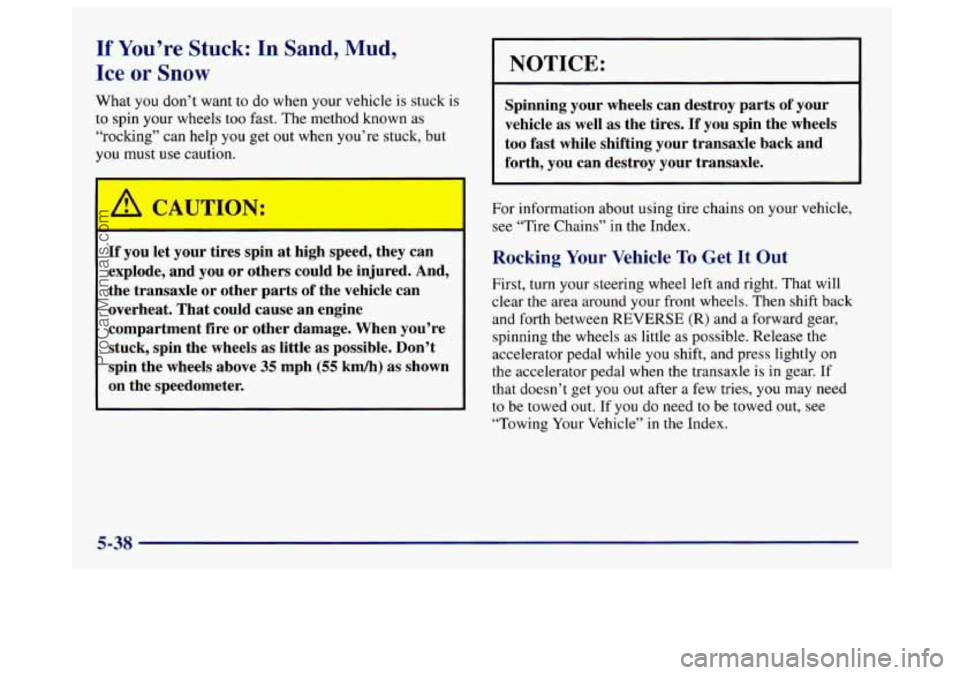
If you let your tires spin at high speed, they can
explode, and you or others could be injured. And,
the transaxle or other parts of the vehicle can
overheat. That could cause an engine
compartment fire or other damage. When you’re
stuck, spin the wheels
as little as possible. Don’t
spin the wheels above
35 mph (55 kmh) as shown
on the speedometer.
NOTICE:
Spinning your wheels can destroy parts of your
vehicle as well as the tires.
If you spin the wheels
too fast while shifting your transaxle back and
forth, you can destroy your transaxle.
For information about using tire chains on your vehicle,
see “Tire Chains” in the Index.
Rocking Your Vehicle To Get It Out
First, turn your steering wheel left and right. That will
clear the area around your front wheels. Then shift back
and forth between REVERSE (R) and a forward gear,
spinning the wheels as little as possible. Release the
accelerator pedal while you shift, and press lightly on
the accelerator pedal when the transaxle
is in gear. If
that doesn’t get you out after a few tries,
you may need
to be towed out. If you do need
to be towed out, see
“Towing Your Vehicle” in
the Index.
5-38
ProCarManuals.com
Page 267 of 406

Section 6 Service and Appearance Care
Here you will find information about the care of your Buick. This section begins with service and fuel information,
and then
it shows how to check important fluid and lubricant levels. There is also technical information about your
vehicle, and a part devoted
to its appearance care.
6-2
6-3
6-5
6-
5
6-7
6- 10
6-15
6-17
6-20
6-24
6-25
6-26
6-29
6-30
6-37 6-45
6-45
6-48
6-49 Service
Fuel
Fuels in Foreign Countries
Filling Your Tank
Checking Things Under the Hood
Engine Oil
Air Cleaner
Automatic Transaxle Fluid
Engine Coolant
Power Steering Fluid
Windshield Washer Fluid
Brakes
Battery
Bulb Replacement
Tires
Appearance Care
Cleaning the Inside of Your Buick
Cleaning the Built-in Child Restraint
Care
of Safety Belts and Built-in Child
Restraint Harness 6-49
6-49
6-50
6-50
6-5 1
6-52
6-52 6-52
6-5
3
6-53
6-54
6-55
6-55
6-56 6-62
6-62
6-63
6-63
6-63 Cleaning
Glass Surfaces
Cleaning the Outside
of the Windshield and
Wiper Blades
Weatherstrips
Cleaning the Outside of Your Buick
Cleaning Aluminum Wheels
Cleaning Tires
Sheet Metal Damage
Finish Damage
Underbody Maintenance
Chemical Paint Spotting
Appearance Care Materials Chart
Vehicle Identification Number
(VIN)
Service Parts Identification Label
Electrical System Replacement Bulbs
Capacities and Specifications
Vehicle Dimensions
Normal Maintenance Replacement Parts
Air Conditioning Refrigerants
6-1
ProCarManuals.com
Page 325 of 406
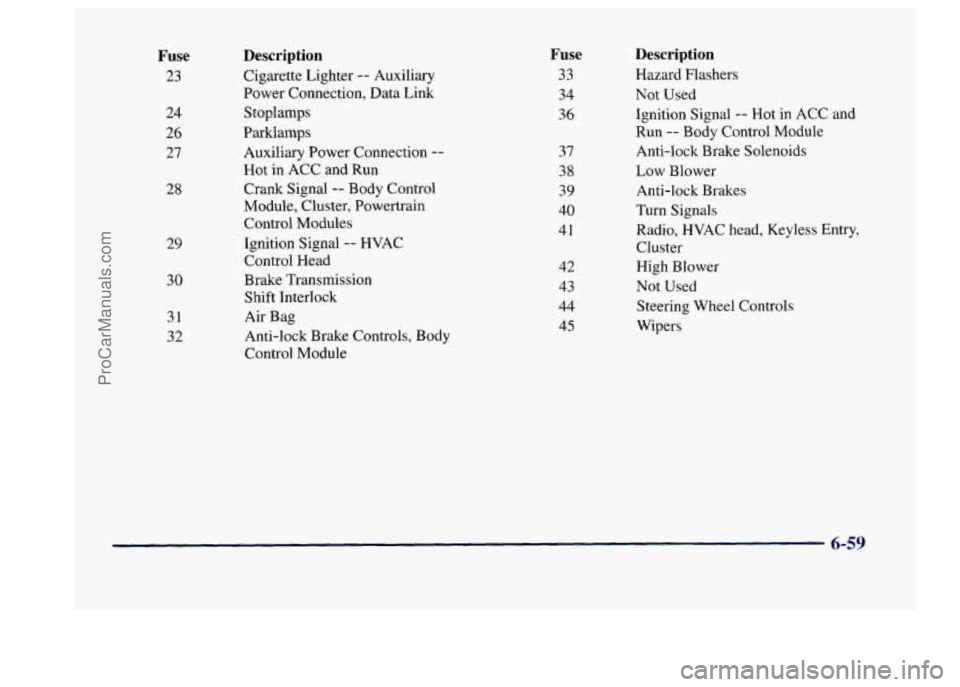
Fuse
23 24
26 27
28
29
30
31
32
Description
Cigarette Lighter -- Auxiliary
Power Connection, Data Link
Stoplamps
Parklamps Auxiliary Power Connection
--
Hot in ACC and Run
Crank Signal
-- Body Control
Module, Cluster, Powertrain
Control
Modules
Ignition Signal -- HVAC
Control Head
Brake Transmission
Shift Interlock
Air Bag
Anti-lock Brake Controls, Body
Control Module
Fuse
33
34
36
37
38
39
40
41
42
43
44
45
Description
Hazard Flashers
Not Used
Ignition Signal
-- Hot in ACC and
Run
-- Body Control Module
Anti-lock Brake Solenoids
Low Blower
Anti-lock Brakes
Turn Signals Radio,
HVAC head, Keyless Entry,
Cluster
High Blower
Not Used
Steering Wheel Controls
Wipers
6-59
ProCarManuals.com
Page 326 of 406
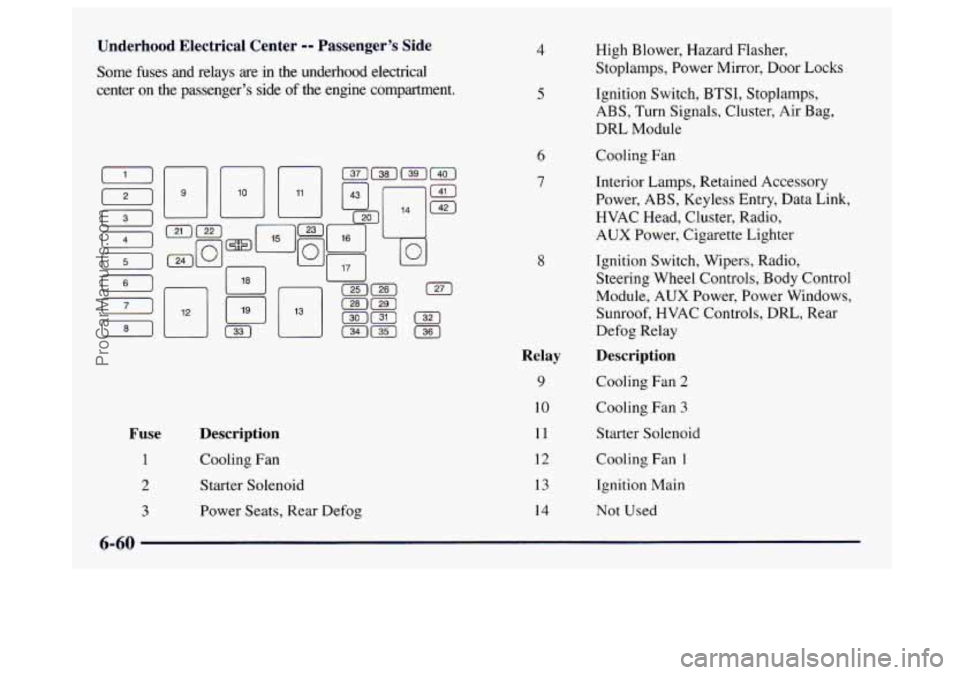
Underhood Electrical Center -- Passenger's Side
Some fuses and relays are in the underhood electrical
center on the passenger's side
of the engine compartment.
D
121
(31
(41
(51 F I I I I
m
[61
18j
(71 [TI
Fuse
1
2
3
Description
Cooling Fan
Starter Solenoid
Power Seats, Rear Defog
4
5
6
7
8
Relay
9
10
11
12
13
14
High Blower, Hazard Flasher,
Stoplamps, Power Mirror, Door Locks
Ignition Switch, BTSI, Stoplamps,
ABS, Turn Signals, Cluster, Air Bag,
DRL Module
Cooling Fan
Interior Lamps, Retained Accessory
Power, ABS, Keyless Entry, Data Link,
HVAC Head, Cluster, Radio,
AUX Power, Cigarette Lighter
Ignition Switch, Wipers, Radio,
Steering Wheel Controls, Body Control
Module, AUX Power, Power Windows,
Sunroof, HVAC Controls, DRL, Rear
Defog Relay
Description
Cooling Fan 2
Cooling Fan 3
Starter Solenoid
Cooling Fan
1
Ignition Main
Not Used
ProCarManuals.com
Page 371 of 406
Part C: Periodic Maintenance
Inspections
Listed below are inspections and services which should be
performed at least twice a year (for instance, each spring
and fall). You should let your
GM dealer’s service
department or other qualified service center do these jobs.
Make sure any necessary repairs are completed at once.
Proper procedures
to perform these services may be
found in a
GM service manual. See “Service and Owner
Publications” in the Index.
Steering, Suspension and Front Drive Axle
Boot and Seal Inspection
Inspect the front and rear suspension and steering
system for damaged, loose or missing parts, signs
of
wear or lack of lubrication. Inspect the power steering
lines and hoses for proper hook-up, binding, leaks,
cracks, chafing, etc. Clean and then inspect the drive
axle boot seals for damage, tears or leakage. Replace
seals if necessary.
Exhaust System Inspection
Inspect the complete exhaust system. Inspect the body
near the exhaust system.
Look for broken, damaged,
missing or out-of-position parts
as well as open seams, holes,
loose connections or other conditions which could
cause
a heat build-up in the floor pan or could let
exhaust fumes into the vehicle. See “Engine Exhaust’’
in the Index.
Radiator and Heater Hose Inspection
Inspect the hoses and have them replaced if they are
cracked, swollen or deteriorated. Inspect all pipes,
fittings and clamps; replace
as needed.
Throttle Linkage Inspection
Inspect the throttle linkage for interference or binding,
and for damaged or missing parts. Replace parts
as
needed. Replace any cables that have high effort or
excessive wear. Do
not lubricate accelerator and cruise
control cables.
Brake System Inspection
Inspect the complete system. Inspect brake lines and
hoses for proper hook-up, binding, leaks, cracks,
chafing, etc. Inspect disc brake pads for wear and rotors
for surface condition. Also inspect drum brake linings
for wear and cracks. Inspect other brake parts, including
drums, wheel cylinders, calipers, parking brake, etc.
Check parking brake adjustment. You may need to have
your brakes inspected more often
if your driving habits
or conditions result in frequent braking.
7-41
ProCarManuals.com
Page 393 of 406

Section 9 Index
Adding Equipment to the Outside of Your Vehicle ..... 6-3
AirBag
....................................... 1-19
How Does
it Restrain .......................... 1-23
How
it Works ................................ 1-21
Location
.................................... 1-21
Readiness Light
......................... 1.20. 2.56
Servicing
................................... 1-24
What Makes
it Inflate .......................... 1-22
What Will You See After
it Inflates ............... 1-23
When Should
it Inflate ......................... 1-22
Aircleaner
.................................... 6-1s
Air Conditioning
........................ 3-3,3-6, 3-9
Air Conditioning Refrigerants ..................... 6-63
Alarm, Instant
................................. 2- 12
Alignment and Balance, Tire
...................... 6-43
Aluminum Wheels, Cleaning ...................... 6-5 1
AM-FM Stereo ................................ 3- 13
AM-FM Stereo
with Cassette Tape Player ........... 3- 15
AM-FM Stereo with Cassette Tape Player and
Automatic Tone Control
........................ 3- 18
AM-FM Stereo
with Compact Disc Player and
Automatic Tone Control
........................ 3-22
AM-FM Stereo
with Cassette Tape and Compact
Disc Player with Automatic Tone Control
.......... 3-26
Antenna Backglass
.................................... 3-37
FixedMast
.................................. 3-36 Antifreeze
..................................... 6-20
Anti-Lock Brake System Active Light
................. 2.59. 4.9
Brake System Warning Light
................ 2.58. 4.7
Brakes
...................................... 4-7
Using ....................................... 4-9
Anti.Theft. Radio .............................. 3-31
Appearance Care
............................... 6-45
Appearance Care Materials ....................... 6-54
Arbitration Program
.............................. 8-7
Armrest. Storage
............................... 2-49
Audio Controls. Steering Wheel Touch Control
....... 3-33
Audio Equipment. Adding
........................ 3-35
Audio Systems
................................. 3-12
Audio Systems. Tips
............................ 3-34
Auto-Down Window
............................ 2-32
Automatic Headlamp Control
............................ 2-42
Overdrive
(0) .......................... 2-24.2-25
Power Door Locks
............................. 2-7
Transaxle Check
.............................. 7-38
Transaxle Fluid
............................... 6-17
Transaxle Operation
........................... 2-22
Transaxle Park Mechanism Check ................ 7-40
Ashtrays
...................................... 2-50
Auxiliary Power Connection
...................... 2-51
9-1
ProCarManuals.com