1997 BMW 528i drive
[x] Cancel search: drivePage 3 of 1002

Downloaded from www.Manualslib.com manuals search engine
YOU are now in Volume I
I
Foreword ................... .. ........................................................................\
.......... v
Index
........................ .. ................................................................ rear of manual
General, 001 General Warnings and Cautions 002 Vehicle Identification and VIN Decoder
Maintenance OiO 020 Maintenance
Engine
100 Engine-General 110 Engine Removal and Installation
113 Cylinder Head Removal and
Installation
116 Cyiinder Head and Valvetrain 117 Camshaft Timing Chain
119 Lubrication System
200 Transmission-General
2 Transmission 210 clutch 230 ManualTransmission
I20 Ignition System
121 Battery, Starter, Alternator
130 Fuel Injection
160 Fuel Tank and Fuel Pump 170 Radiator and Cooling System
180 Exhaust System
240 Automatic Transmission
250 Gearshift Linkage 260 Driveshaft
Suspension, 300 Suspension, Steering and 330 Rear Suspension
Brakes-General 331 Final Drive
Steering and No Front Suspension 340 Brakes
320 Steering and Wheel Alignment
400 Body-General
410 Fenders, Engine Hood 411 Doors
412 Trunk Lid, Tailgate
510 Exterior Trim, Bumpers 512 Door Windows
Equipment 513 Interior Trim
7
Equipment and 720 seat Belts
Accessories 721 Airbag System (SRS)
OBD On-Board Diagnostics
. ............ ..
515 Central Lociting and
Anti-Theft
520 Seats 540 Sunroof
.................................................................... Foreword .............................. .. v
Index ................... .. ................................................................ rear of manual
Electrical
6 system
600 Electrical System-General 620 Instruments
610 Electrical Comoonent Locations 630 Liohts
611 wipers and washers 612 Switches eati in^ and Air Conditioning
Radio
. ........... ........ .........................
Electrical Wiring Diagrams
Page 5 of 1002

Downloaded from www.Manualslib.com manuals search engine
Foreword
For the BMW owner with basic mechanical skills and for independent auto service professionals.
this manual includes many of the specifications and procedures that were available to an
authorized BMW dealer service deoartment as this manual went to
Dress. The BMW owner with , no intention of working on his or her car will find that owning and referring to this manual makes it
possible to be better informed and to more
Itnowledgeably discuss repairs with a professional
automotive technician.
If you are a BMW owner intending to do maintenance and repair work, make sure you have
screwdrivers, a set of metric wrenches and sockets and metric Allen and
Torx wrenches, since
these basic hand tools are needed for most of the work described in
this manual. Many procedures
also require a torque wrench to ensure that fasteners are tightened properly and in accordance
with specifications. Additional information on basic tools and other tips are in
010 General. In
some cases, the text refers to special tools that are recommended or required to accomplish
adjustments or repairs. These tools are usually identified by their
BMW special tool number and
illustrated.
Disclaimer
We have endeavored to ensure the accuracy of the information in this manual. When the vast
array of data presented in the manual is
talten into account, however, no claim to infallibility can
be made. We therefore cannot be responsible for the result of any errors that may have crept into
the text. Please also read the Important Safety Notice on the copyright page at the beginning of
this book.
Prior to starting a repair procedure, read the procedure,
001 General Warnings and Cautions
and the warnigns and cautions that accompany the procedure. Reading a procedure before
beginning
work will help you determine in advance the need for specific skills, identify hazards,
prepare for appropriate capture and handling of hazardous materials, and the need for particular
tools and replacement parts such as gasltets.
Bentley Publishers encourages comments from the readers of this manual with regard to errors,
and/or suggestions for improvement of our product. These communications have been and will be
carefully considered in the preparation of this and other manuals. If you identify inconsistencies in
the manual, you may have found an error. Please contact the publisher and we will endeavor to
post applicable corrections on our
website. Posted corrections (errata) should be reviewed before
beginning
worlc. Please see the following web address:
BMW offers extensive warranties, especially on components of the fuel delivery and emission
control systems. Therefore, before deciding to repair a BMW that may be covered wholly or in part
by any warranties issued by
BMW of North America, LLC, consult your authorized BMW dealer.
You may find that the dealer can
make the repair either free or at minimum cost. Regardless of its
age, or whether it is under warranty, your BMW
Is both an easy car to service and an easy car to
get serviced. So
if at any time a repair is needed that you feel is too difficult to do yourself, a trained
BMW technician is ready to do the job for you.
Bentley Publishers
Page 9 of 1002
Downloaded from www.Manualslib.com manuals search engine
002 Vehicie identification and
VlN Decoder
Vehicle identification Number (VIN), decoding
Some of the information in this manual applies only to cars of a parlicuiar model year or range
of vears. For
examole. 1999 refers to the 1999 model vear but does not necessarilv malch the
caiendsr year in which the car was manufactured or sold. To be sure of the model year of a
particular car,
checic the Vehicle ldentification Number (VIN) on the car.
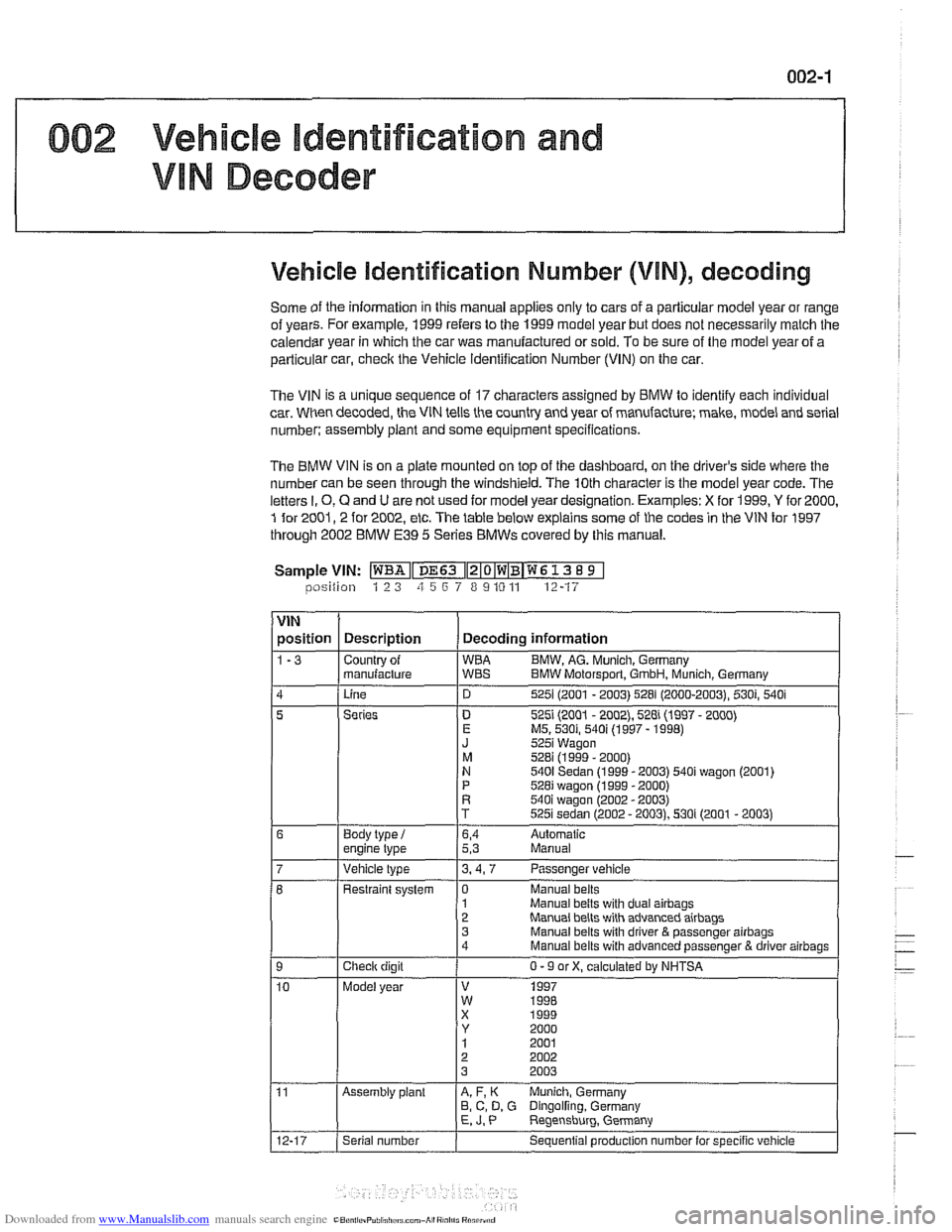
The VIN is a unique sequence of 17 characters assigned by BMW lo identify each individual
car. When decoded, the VIN tells the country and year of manufacture; make, model and serial
number: assembly
plant and some equipment specifications.
The BMW VIN is on a plate mounted on top of the dashboard, on the driver's side where the
number can be seen through the windshield, The 10th character is the model year code. The
letters
I. 0, Q and U are not used for model year designation. Examples: X for 1999, Y for 2000,
1 for 2001,2 for 2002, etc. The table below explains some of the codes in the VIN for 1997
through 2002 BMW
E39 5 Series BMWs covered by this manual.
Sample
VIN: ~~Iz~o~w~B~w~ 13 8 9 1 lposition 1 2 3 zi 5 6 7 8 9 10 11 12-17
VIN
position Description Decoding information
1-3 Countrv of WBA B
I J 1 znan~+q ;BT BMW Molorsporl. Gmon, ~;nch Gerrn;!n,
Linc 525 (2UU1 - 2003) 528 (2000-2003. 530; 540 i
5
1
Manual belts with dual airbags Manual belts with advanced airbaos
Series
Body
type
i engine lype . ..
D 5251 (2001 - 2002), 528i (1997 - 2000) E MS. 530i, 540i (1997 - 1998) J 5251 Wagon
M 528i (1999 - 2000) N 5401 Sedan (1999 - 2003) 540i wagon (2001)
P 528i wagon (1999 - 2000) R 540i waaon 12002 - 20031
6,4 Aulomatic 5,3 Manual
Vehicle type 3.4.7 Passenger vehicle
Checlr digit
Model year Restraint
system
1 0 Manual belts
3 Manual belts wilh driver
& passenger airbags 4
Manual belts with advanced passenger B driver airbags
0 - 9 or X, calculated by NHTSA
V 1997 W 1RRR
Assembly plant A, F, K Munich, Germany
B, C, D, G Dingolfing. Germany E, J. P Reqensburq. Germany .
Serial number
Sequential produclion number lor specific vehicle
Page 19 of 1002

Downloaded from www.Manualslib.com manuals search engine
General
Table a. General bolt tightening torques in Nm
(max. permissible)
Bolt Class (according to DIN
267)
Gaskets and seals
Gasket aredesigned to crush and become thinner as the mat-
ing parts are bolted together. Once agasket has been used, it
is no longer capable
;f malting as good a seal as when new,
and is much more likely to leak.
Forthis reason, gaskets
should not be reused.
Some gaskets and seals are
d~rectional. Make sure thatthese
are
~nstalled correctly. In places where a shaft must pass
through a housing,
flex~ble lip seals are used to keep the lubri-
cating
011 or grease from leaking out past the rotatlng shaft.
Seals should never be reused once they have been removed.
When
rernovlng a seal, be careful not to damage the metal
surfaces.
The ltey to seal installation is to get the seal in straight without
damaging it. Use a seal driver that is the same diameter as
the seal housing to gently and evenly install into place.
If a
proper size seal driver is not available, a socket of the right
size will do.
Some seals are directional and special installation instruc-
tions apply. Make sure a seal is installed with the lip facing the
correct way. Note the installation direction of the old seal be-
fore removing it.
Page 22 of 1002

Downloaded from www.Manualslib.com manuals search engine
01 0-1 2
1 General
Information you need to know
Model
When ordering parts it is important that you know the correct
model designation for your car. Models covered in this E39
manual are the
525i,5281,530i, 540i in Sedan and Station
Wagon body styles.
Model year
This is not necessarily the same as date of manufacture or
date of sale.
A 1999 model may have been manufactured in
late 1998, and perhaps not sold until early 2000. It is still a
1999 model. Model years covered by this manual are 1997 to
2002.
Date of manufacture
This information is necessary when ordering replacement
parts or determining if any of the warranty recalls are applica-
ble to your car. The label on the driver's door below the door
latch will specify the month and year that the car was built.
Vehicle
Identification Number (VIN)
This is a combination of letters and numbers that identify the
particular car. The VIN appears on the state registration doc-
ument, and on the car itself. One location is on the right front
strut tower in the engine compartment (arrow), another in the
lower left corner of the windshield.
Engine code
5 Series car covered in this manual are powered by
6 and 8 - cylinderengines. For information on engine codes and en- -. -
gine applications, see 100 Engine-General. -
Transmission code
The transmission type with its identifying code may be
impor- :
tant when buying clutch parts, seals, gaskets, and other .- transmission-related parts. For information on transmission
codes and applications, see 200 Transmission-General.
Page 24 of 1002
Downloaded from www.Manualslib.com manuals search engine
01 0-1 4
General
Specialty tool suppliers
Peake Research, Automotive Products Division
P.O. Box 28776
San Jose, CA 95159
408-369-0406
[email protected]
http://www.peakeresearch.com
Basic tool requirements
The basic hand tools described below can be used to accom-
plish most of the simple maintenance and repair tasks.
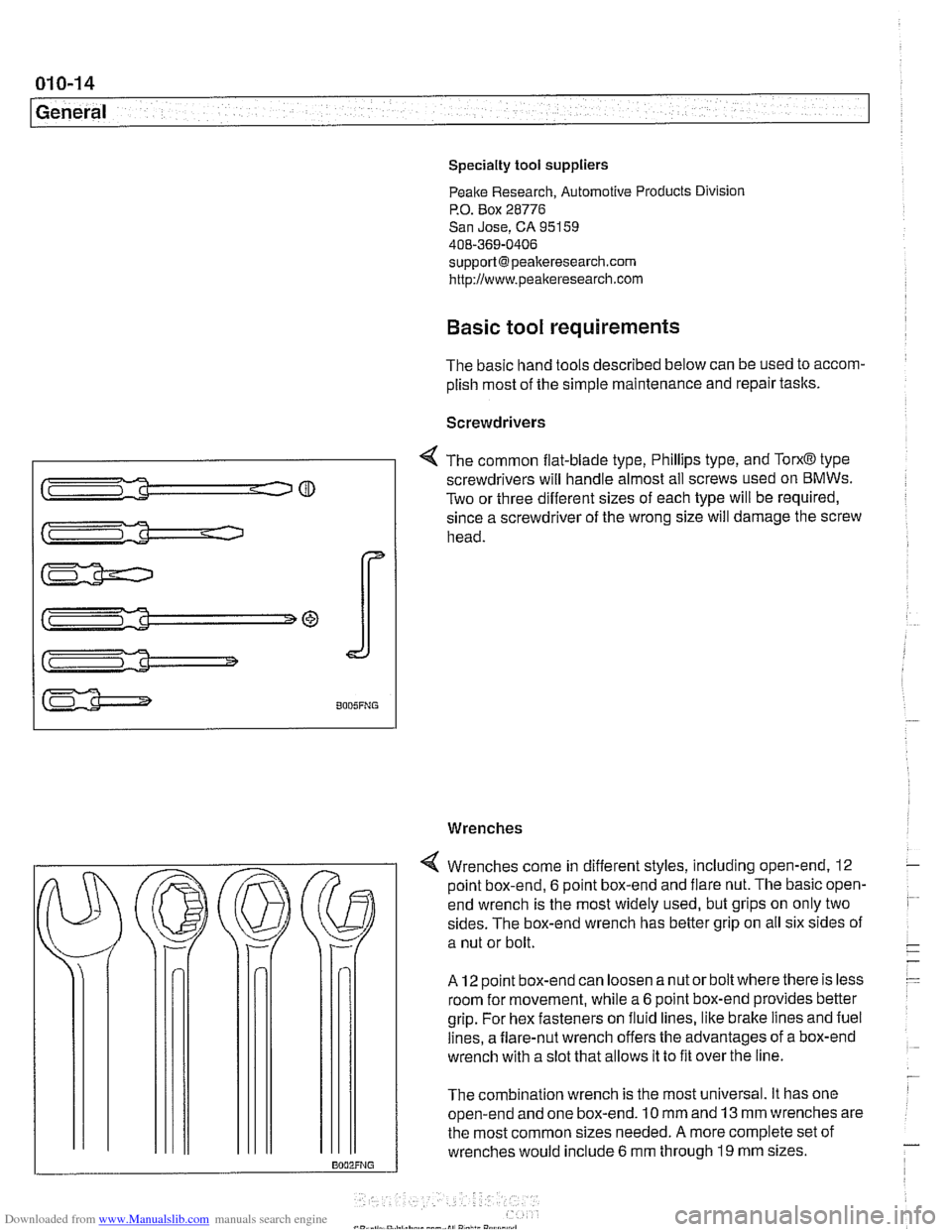
Screwdrivers
4 The common flat-blade type, Phillips type, and TorxO type
screwdrivers will handle almost all screws used on
BMWs.
Two or three different sizes of each type will be required,
since a screwdriver of the wrong size will damage the screw
head.
Wrenches
4 Wrenches come in different styles, including open-end. 12
point box-end,
6 point box-end and flare nut. The basic open-
end wrench is the most widely used, but grips on only two
sides. The box-end wrench has better grip on all six sides of
a nut or bolt.
A 12 point box-end can loosen a nut or bolt where there is less
room for movement, while
a 6 point box-end provides better
grip. For hex fasteners on fluid lines, like brake lines and fuel
lines, a flare-nut wrench offers the advantages of a box-end
wrench with a slot that allows it to fit over the line.
The combination wrench is the most universal. It has one
open-end and one box-end. 10 mm and 13 mm wrenches are
the most common sizes needed.
A more complete set of
wrenches would include
6 mm through 19 mm sizes.
Page 25 of 1002
Downloaded from www.Manualslib.com manuals search engine
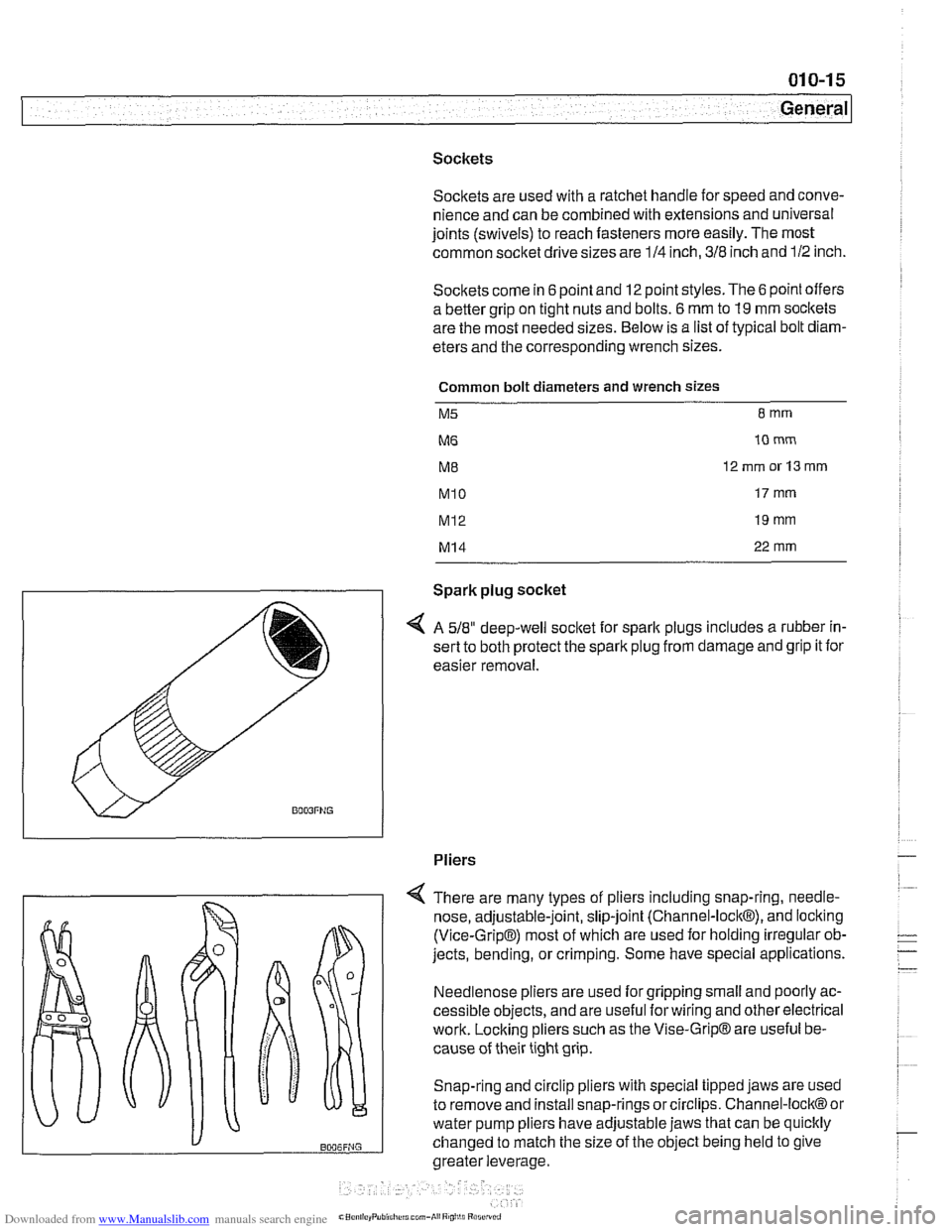
Sockets Socltets are used with a ratchet handle for speed and conve-
nience and can be combined with extensions and universal
joints (swivels) to reach fasteners more easily. The most
common socket drive sizes are
114 inch, 318 inch and 112 inch.
Sockets come in
6 point and 12 point styles. The 6 point offers
a better grip on tight nuts and bolts.
6 mm to 19 mm socltets
are the most needed sizes. Below is a list of typical bolt
diarn-
eters and the corresponding wrench sizes.
Common bolt diameters and wrench sizes
M5 8 rnrn
M6
10 rnm
M8 12rnrnor13rnrn
MI 0 17 rnrn
MI2 19 rnrn
M14 22 mm
Spark plug socket
4 A 518" deep-well socket for sparlt plugs includes a rubber in-
sert to both protect the spark plug from damage and grip it for
easier removal.
Pliers
There are many types of pliers including snap-ring,
needle-
nose, adjustable-joint, slip-joint (Channel-lock@), and locking
(Vice-Grip@) most of which are used for holding irregular ob-
jects, bending, or crimping. Some have special applications.
Needlenose pliers are used for gripping small and poorly ac-
cessible objects, and are useful forwiring and other electrical
work. Locking pliers such as the Vise-Grip@ are useful be-
cause of their tight grip.
Snap-ring and circlip pliers with special tipped jaws are used
to remove and install snap-rings or circlips. Channel-lock@ or
water pump pliers have adjustable jaws that can be quicltly
changed to match the size of the object being held to give
greater leverage,
Page 28 of 1002

Downloaded from www.Manualslib.com manuals search engine
-
General
BMW special tools
Many repairs covered in this manual call for the use of BMW
special tools. Many of the BMW special tools mentioned in
this manual are simply the best thing to use to do the job cor-
rectly. In these cases, the tool is identified with a
BMW parl
number. See your authorized BMW dealer parts department
for information on how to order special tools.
There are some jobs for which expensive special tools are es-
sential, and not a cost-effective purchase for a one time repair
by the do-it-yourself owner. This manual includes such re-
pairs for the benefit of those with the necessary experience
and access to tools. For the do-it-yourselfer, the need for spe-
cial tools is noted in the text, and whether or not BMW dealer
service is recommended.
Changing a tire
- Stop car on as flat a surface as possible, in a place where you
can be easily seen by other drivers. Avoid stopping just over
the crest of a hill.
WARNING -
If a tire goes flat while driving, pull well off the road. Changing
a tire on a busy slreet or liigliway is very dangerous. If
nec-
essag drive a short distance on the flat tire to get to a safe
place. It is much better to ruin a tire or rim than to
risk being
hit.
-
- Turn on emergency flashers, and set out flares or emergency
markers well behind car.
Choclc wheel (wheel chock located
in trunk) diagonally opposite to the one being changed. Pas-
sengers should get out of car and stand well away from road.
- Take jaclc and tools from tool area beneath trunk mat. Re-
move spare tire from tire storage tray.
- Loosen wheel bolts while car is on ground, but leave them a
little snug.
< Place jack in lifting point nearest wheel being changed. Use
a board to provide a firm footing for jack if ground is soft.
Raise car only far enough so that the wheel is fully off ground
and then remove wheel nuts and wheel.
- Install spare wheel. Install wheel nuts and tighten them hand
tight using lug nut wrench.