1997 BMW 328i fender
[x] Cancel search: fenderPage 3 of 759
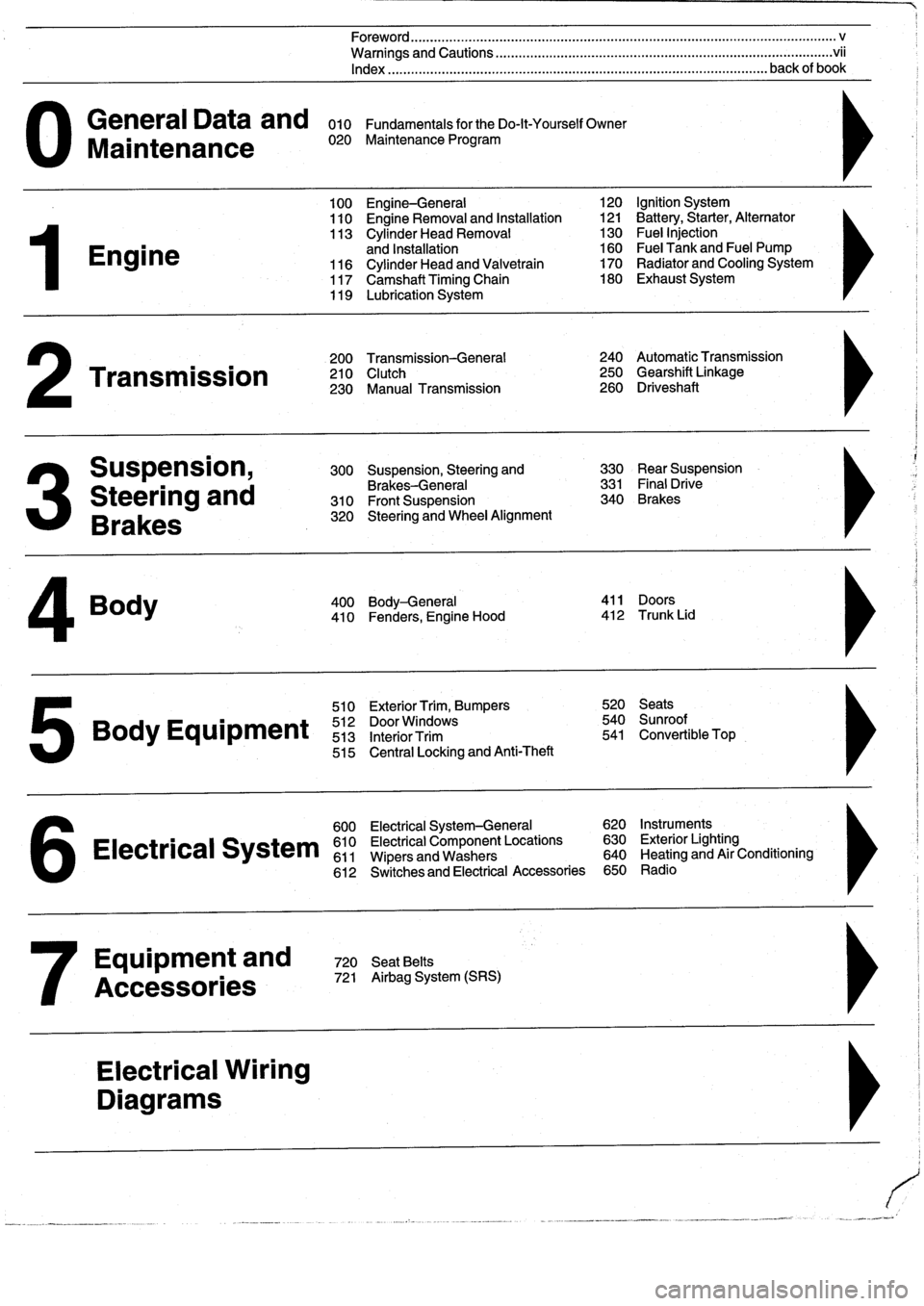
General
Data
and
010
FundamentalsfortheDo-lt-YourselfOwner
Maintenance
020
Maintenance
Program
Engine
Transmission
Suspension,
Steering
and
Brakes
4
Body
100
Engine-General
110
Engine
Removal
and
Installation
113
Cylinder
Head
Removal
and
Installation
116
Cylinder
Head
and
Valvetrain
117
Camshaft
Timing
Chain
119
Lubrication
System
200
Transmission-General
210
Clutch
230
Manual
Transmission
510
Exterior
Trim,
Bumpers
520
Seats
Bo
y
Equipment
512
DoorWTdws
540
nr
t
513
InteriorTrim
541
Convertible
Top
515
Central
Locking
and
Anti-Theft
600
Electrical
System-General
620
Instruments
Electrical
S
stem
610
Electrical
Component
Locations
630
Exterior
Lighting
611
Wipers
and
Washers
640
Heating
and
Air
Conditioning
6
612
Switches
and
Electrical
Accessories
650
Radio
Equipment
and
720
SeatBelts
Accessories
721
Airbag
System
(SRS)
Electrical
Wiring
Diagrams
Foreword
.
...
.
.
.
..................
.
.
.
.....
.
............
.
...
.
.
.
.
.
................
.
.
.
.....
.
......
.
................
.
.
.
.....
v
Warnings
and
Cautions
.....
.
...
.
.
.
.
.
..........
.
...
.
.
.
.
.
......
.
.........
.
.
.
...
.
.
.
......
.
.
.
.
.
............
.
.
.
.
.
.
.vii
Index
..............
.
.
.
.....
.
............
.
...
.
.
.
.
.
........
.
...
.
.
.
.
.
.......
.
......
.
...
.
.
.
.
.
.
.
........
.
.
.
..
back
of
book
300
Suspension,
Steering
and
330
RearSuspension
Brakes-General
331
Final
Drive
310
Front
Suspension
340
Brakes
320
Steering
and
Wheel
Alignment
400
Body-General
411
Doors
410
Fenders,
Engine
Hood
412
Trunk
Lid
120
Ignition
System
121
Battery,Starter,
Alternator
130
Fue¡
Injection
160
Fuel
Tank
and
Fuel
Pump
170
Radiator
and
Cooling
System180
Exhaust
System
240
Automatic
Transmission
250
Gearshift
Linkage
260
Driveshaft
Page 12 of 759

010-
4
FUNDAMENTALS
FOR
THE
DO-ITYOURSELF
OWNER
Fig
.
3
.
BMW
supplied
jack
correctly
positioned
in
front
jacking
point
.
Most
of
the
repairs
and
maintenance
tasks
described
in
this
manual
can
be
successfully
completedby
anyone
with
basic
tools
and
abilities
.
To
prevent
getting
in
too
deep,
know
what
WARNING-
the
wholejob
requires
before
starting
.
Read
the
procedure
thor-
"
Do
not
rely
on
thetransmission
or
the
emergen-
oughly,
from
beginning
to
end,
in
order
to
know
just
what
to
ex
cybrake
to
keep
thecar
from
rolling
.
They
are
pect
and
what
parts
will
have
to
be
replaced
.
nota
substitute
for
positively
blocking
the
oppo-
site
wheel
.
"
Never
work
undera
car
that
is
supported
only
by
ajack
Use
jack
stands
that
are
properly
de-
signed
to
support
the
car
.
See
Tools
.
Working
under
car
safely
1
.
Disconnect
negative
(-)
cable
from
battery
so
that
no
one
else
can
start
thecar
.
Let
others
know
what
you
will
be
doing
.
CAUTION-
Prior
to
disconnecting
the
battery
read
the
battery
disconnection
cautions
given
at
the
front
of
this
manual
on
page
vüi
.
2
.
Raisecar
slowly
as
described
above
.
3
.
Use
at
least
two
jack
stands
to
support
thecar
.
A
jack
is
atemporary
lifting
device
and
should
not
be
used
alone
to
support
the
car
while
you
are
under
it
.
Use
jack
stands
designed
for
the
purpose
of
supporting
a
car
.
For
more
information
on
jack
stands,
see
Toolsbelow
.
WARNING
-
Do
notusewood,
concrete
blocks,
orbricks
to
sup-
port
acar
.
Woodmay
split
.
Blocks
or
bricks,
while
strong,
are
not
designed
for
that
kind
of
load,
and
may
brakkor
collapse
.
ADVICE
FOR
THE
BEGINNER
4
.
Place
jack
stands
on
firm,
solid
surface
.
If
necessary,
use
a
flat
board
or
similar
solid
object
to
provide
a
firm
footing
.
5
.
Lower
car
slowly
until
its
weight
is
fully
supportedby
jack
stands
.
Watch
to
make
sure
that
the
jack
stands
do
not
tip
orlean
as
thecar
settles
on
them
.
6
.
Observe
all
jacking
precautions
again
when
raising
car
to
remove
jack
stands
.
ADVICE
FORTHE
BEGINNER
The
tips
in
the
paragraphs
that
follow
are
general
advice
to
help
any
do-it-yourself
BMW
owner
perform
repairs
and
main-
tenance
tasks
more
easily
and
more
professionally
.
Planning
Ahead
Cleanliness
Keeping
things
organized,
neat,
and
clean
is
essential
to
do-
ing
a
good
job
.
When
working
under
the
hood,
fender
covers
will
protect
the
finish
from
scratches
and
other
damage
.
Make
sure
the
car
is
relatively
clean
so
thatdi
rt
under
the
cover
does
not
scratch
the
finish
.
Any
repair
job
will
be
less
troublesome
if
the
parts
are
clean
.
For
cleaning
old
parts,
there
are
many
solvents
and
parts
cleaners
commercially
available
.
For
cleaning
parts
priorto
assembly,
commercially
available
aerosol
cans
of
parts
cleaner
or
brake
cleaner
are
handy
to
use,
and
the
cleaner
will
evaporate
completely
.
WARNING
-
Virtually
all
solvents
used
for
cleaning
parts
are
highly
flammable,
especially
in
aerosol
form
.
Use
wíth
extreme
care
.
Do
not
smoke
.
Do
not
use
these
products
near
any
source
of
heat,
sparksor
flame
.
Let
any
solvent
orcleaning
product
dry
completely
.
Low-
pressure,
dry
compressed
air
is
helpful
if
available
.
Also,
use
only
lint-free
rags
for
cleaning
and
drying
.
Page 15 of 759

Non-returnable
Parts
FUNDAMENTALS
FOR
THEDO-ITYOURSELF
OWNER
010-
7
Many
independent
repair
shops
make
a
point
of
using
genu-
Original
body
paneis
and
other
large
components
are
identi-
ine
BMW
parts,
even
though
they
may
at
times
be
more
expen-
fied
by
a
label
bearing
the
VINand
two
BMW
roundellogos
.
Re-
sive
.
Theyknow
the
value
of
doing
thejob
right
with
the
right
placement
parts
have
a
similar
label,
bearing
one
BMW
roundel
parts
.
Parts
from
other
sources
can
beas
good,
particularly
if
logo
and
the
letters
DOT-R
.
See
Fig
.
6
.
Parts
or
assemblies
manufactured
by
one
of
BMWs
original
equipment
suppliers,
bearing
the
label
arethe
engine,
transmission,
front
and
rear
but
it
is
often
difficult
to
know
.
bumpers,
front
fenders,
rear
quarter
paneis,
hood,
trunk
lid
and
doors
.
These
labels
shouldnot
be
removed
as
they
will
tear
BMW
is
constantly
updating
and
improving
their
cars,
often
apart
.
making
improvements
during
a
given
model
year
.
BMW
may
recommend
a
newer,
improved
part
as
a
replacement,
and
your
authorized
dealer's
parts
department
will
know
about
it
and
provide
it
.
The
BMW
parts
organization
is
best
equipped
to
deal
with
any
BMW
parts
needs
.
Some
parts
cannot
be
returned
for
credit,
even
if
they
arethe
wrong
parts
forthe
car
.
The
best
example
is
electrical
parts,
which
are
almost
universally
considered
non-returnable
be-
,
..
cause
they
are
so
easily
damaged
internally
.
Buy
electrícal
parts
carefully,
and
beas
sure
as
possible
that
P-
DOT~
R
a
replacement
is
needed,
especially
for
expensive
parts
such
as
electronic
control
units
.
It
may
bewise
to
let
an
authorized
B328FUN
BMW
dealeror
other
qualified
shop
confirm
your
diagnosisbe-
fore
replacing
an
expensive
part
that
cannot
be
retuned
.
Fig
.
6
.
Labels
used
to
identiy
parts
.
Original
equipment
labelwith
VIN
number
and
roundel
logos
(top)
and
replacement
part
la-
bel
with
one
roundel
logos
Information
You
Need
to
Know
Engine
.
3-Seriescars
covered
in
this
manualare
powered
Model
.
When
ordering
parts
it
is
important
that
you
know
the
by
either
a
4-or
6-cylinder
engine
.
For
information
-
on
engine
correct
model
designation
for
your
car
.
Models
covered
in
this
codes
and
engine
applications,
see100
Engine-General
.
manual
are
E36
3
Series
in
both
4-
and
6-cylinderconfigura-
tions
.
Transmission
.
The
transmissiontype
with
its
identifying
code
may
be
important
when
buying
clutch
parts,
seals,
gas
Moda¡
Year
.
This
is
not
necessarily
the
same
as
date
of
kets,
and
othertransmission-relatedparts
.
For
information
on
manufacture
or
date
of
sale
.
A
1997
model
may
havebeen
transmission
codes
and
applications,
see200
Transmission
manufactured
in
late
1996,
and
perhaps
not
sold
until
early
General
.
1997
.
It
is
still
a1997
model
.
Model
years
covered
by
this
man-
ual
are
1992
to
1998
.
SERVICE
Date
of
Manufacture
.
This
information
is
helpful
when
or-
dering
replacement
parts
or
determining
if
any
of
the
warranty
BMW
dealers
are
uniquely
qualified
to
provide
service
for
recalls
are
applicable
to
your
car
.
The
label
on
the
driver's
door
BMW
cars
.
Their
authorized
relationship
with
the
large
BMW
below
the
door
latch
will
specify
the
month
and
year
that
the
car
serviceorganization
means
that
they
are
constantly
receiving
was
built
.
new
tools
and
equipment,
together
with
the
latest
and
most
ac-
curate
repair
information
.
Vehicle
Identification
Number
(VIN)
.
This
is
a
combination
of
letters
and
numbers
that
identify
the
particular
car
.
TheVIN
appears
on
the
state
registration
document,
and
on
thecar
it-
self
.
One
location
isin
the
rear
of
the
engine
compartment,
en-
other
in
the
lower
left
comer
of
the
windshield
.
The
National
Highway
Traffic
Safety
Administration
(NHT-
SA)
requires
passenger
cars
with
a
high
theftrateto
have
the
VINmarked
on
specific
parts
of
thecar
when
manufactured
.
On
BMW
cars,
these
parts
are
identified
byan
adhesive
label
.
)WBADK00000000
0
000
0
The
BMW
dealers
service
technicians
are
highlytrained
and
very
capable
.
Unfke
most
independent
repair
shops,
autho-
rized
BMW
dealers
are
intensely
committed
tosupporting
the
BMW
product
.
They
share
the
owners
interest
in
BMW
value,
performance,
and
reliability
.
On
the
other
hand,
there
are
many
independent
shops
that
specialize
in
BMW
service
and
are
ca-
pable
of
doing
high
quality
repair
work
.
Checking
with
other
BMW
owners
for
recommendations
on
service
facilitiesis
a
good
way
to
leam
of
reputable
BMW
shops
in
yourarea
.
SERVICE
Page 59 of 759

110
Engine
Removal
and
Installation
GENERAL
.
.
.
.
.......
.
.
.
..........
.
...
110-1
Engine,
removing
and
installing
(4-cylinder
engines)
.
..
.....
..
...........
110-1
ENGINE
REMOVAL
AND
INSTALLATION
110-1
Engine,
removing
and
installing
(6-cylinder
engines)
..
...
...
..
.....
..
....
110-4
GENERAL
Some
special
tools
are
required
for
removal
and
installation
of
the
engine
.
Be
sure
to
have
the
necessary
equipment
on
hand
before
starting
thejob
.
CAUTION-
"
Engine
removal
requires
disconnecting
the
bat-
tery
.
This
may
erase
any
system
fault
code(s)
that
havebeen
stored
in
control
unit
memories
.
Check
forfault
codes
prior
to
disconnecting
the
battery
cables
.
"
If
the
Check
Engine
lightis
illuminated
with
the
engine
running,
see
100
Engine-General
for
On-Board
Diagnostics
(08D)
fault
code
infor-
mation
.
"
If
any
other
system
faults
have
been
detected,
as
indicated
by
an
illuminated
ANTI
LOCK,
SRS
or
AST
warning
light,
see
the
appropriate
repair
group
inthis
manual
or
an
authorized
BMW
dealer
for
more
information
on
fault
codes
.
ENGINE
REMOVALAND
INSTALLATION
Engine,
removing
and
installing
(4-cylinder
engines)
Cover
al¡
painted
surfaces
before
beginning
theremoval
procedure
.
Asan
aid
to
installation,
label
al¡
components,
wires,
and
hoses
before
removing
them
.
Do
not
reuse
gas-
kets,
O-rings
or
seals
during
reassembly
.
WARNING
-
Due
to
risk
of
personal
injury,
be
sure
the
engine
is
cold
before
beginning
the
removalprocedure
.
1.
Disconnect
negative
(-)
cable
from
battery
in
luggage
compartment
.
0011969
CAUTION-
Prior
to
disconnecting
the
battery,
read
the
battery
disconnection
cautions
given
at
the
front
of
this
manual
on
page
viii
.
ENGINE
REMOVAL
AND
INSTALLATION
110-1
2
.
Remove
transmission
from
car
.
See230
Manual
Transmission
or
240
Automatic
Transmission
.
3
.
Remove
enginehood
or
place
hood
in
service
positíon
.
See
410
Fenders,
Engine
Hood
.
NOTE-
tt
is
notnecessary
to
remove
the
engine
hood,
but
it
is
helpful
and
will
make
engine
removal
and
installation
easier
.
4
.
Remove
splash
guard
under
engine,
if
applicable
.
5
.
Unbolt
ignition
coil
assembly
from
bracket
on
strut
tow-er
.
Disconnect
wiring
to
ignition
cofs,
then
place
coil
assembly
on
engine
.
6
.
Disconnect
al¡
cables
and
harness
connectors
at
throt-
tle
housing
.
7
.
Unbolt
andremove
complete
air
cleaner
housing
with
mass
air
flow
sensor,
disconnecting
and
labeling
con-
nectors,
ducting
and
hoses
asnecessary
.
See
Fig
.
1
.
Fig
.
1
.
Intake
air
duct
hose
clamp
(A),
mass
air
flow
sensor
connec-
tor
(B),
and
air
cleanerto
air
flow
sensor
clips
(C)
on
M44
en-
gine
.
ENGINE
REMOVAL
AND
INSTALLATION
Page 62 of 759

110-
4
ENGINE
REMOVAL
AND
INSTALLATION
Engine,
removing
and
installing
(6-cylinder
engines)
Engineremoval
procedures
for
the
various
6-cylinder
en-
gines
arecovered
in
this
section
.
Most
steps
in
theproce-
dures
are
similar
or
the
same
for
al¡
engines
.
Specific
differences
that
apply
are
noted
at
the
beginning
of
each
step
.
Be
sure
to
cover
all
painted
surfaces
before
beginning
the
removal
procedure
.
As
an
aid
to
installation,
label
all
compo-
nents,wires,
and
hoses
before
removing
them
.
Do
not
reuse
gaskets,
O-rings
or
seals
during
reassembly
.
WARNING
-
Due
to
risk
of
personal
injury,
be
sure
the
engine
is
cold
before
beginning
the
removalprocedure
.
1
.
Disconnect
negative
(-)
battery
cable
in
luggage
com-
partment
.
CAUTION-
Prior
to
disconnecting
the
battery,
read
the
battery
disconnection
cautions
given
at
the
front
of
this
manual
onpage
vi¡¡
.
2
.
Remove
engine
hood
or
place
hood
in
service
position
.
See410
Fenders,
Engine
Hood
.
NOTE-
1t
is
not
necessary
to
remove
the
engine
hood,
but
it
is
helpful
and
will
make
engine
removal
and
installation
easier
.
3
.
Remove
splash
guardunder
engine,
if
applicable
.
4
.
Remove
transmission
from
car
.
See
230
Manual
Transmission
or
240Automatic
Transmission
.
5
.
Remove
vacuum
hosefrom
brake
booster
on
bulkhead
.
Cover
hole
in
booster
and
plug
hose
end
.
6
.
Remove
intake
air
plenum
panel
in
rear
of
engine
com-
partment
.
See
640
Heating
and
AirConditioning
.
7
.
Remove
ground
strap
from
timing
case
cover,
if
appli-
cable
.
8
.
Remove
top
enginecovers
and
disconnect
ignition
coil
harness
connectors
.
Working
at
fuel
injectors,
pry
open
small
wire
clipsat
each
injector
.
Remove
main
harness
hold-down
nuts
and
lift
completeharness
away
.
See
Fig
.
7
.
ENGINE
REMOVAL
AND
INSTALLATION
Fig
.
7
.
Remove
mainharnessfrom
top
engine
and
place
at
base
of
windshield
.
0012703
Fig
.
8
.
Mass
air
flow
sensor
connector
air
duct
hose
clamp,
and
air
cleaner
housing
mounting
bolts
(arrows)
.
9
.
Unbolt
andremove
complete
air
cleaner
housing
with
10
.
On
cars
with
automatic
transmission,
remove
front
and
mass
air
flow
sensor,
disconnecting
and
labeling
con-
rearbrackets
holding
transmission
cooler
linesto
side
nectors,
ducting
and
hoses
asnecessary
.
See
Fig
.
8
.
of
engine
.
Page 188 of 759
160-
4
FUEL
TANK
AND
FUEL
PUMP
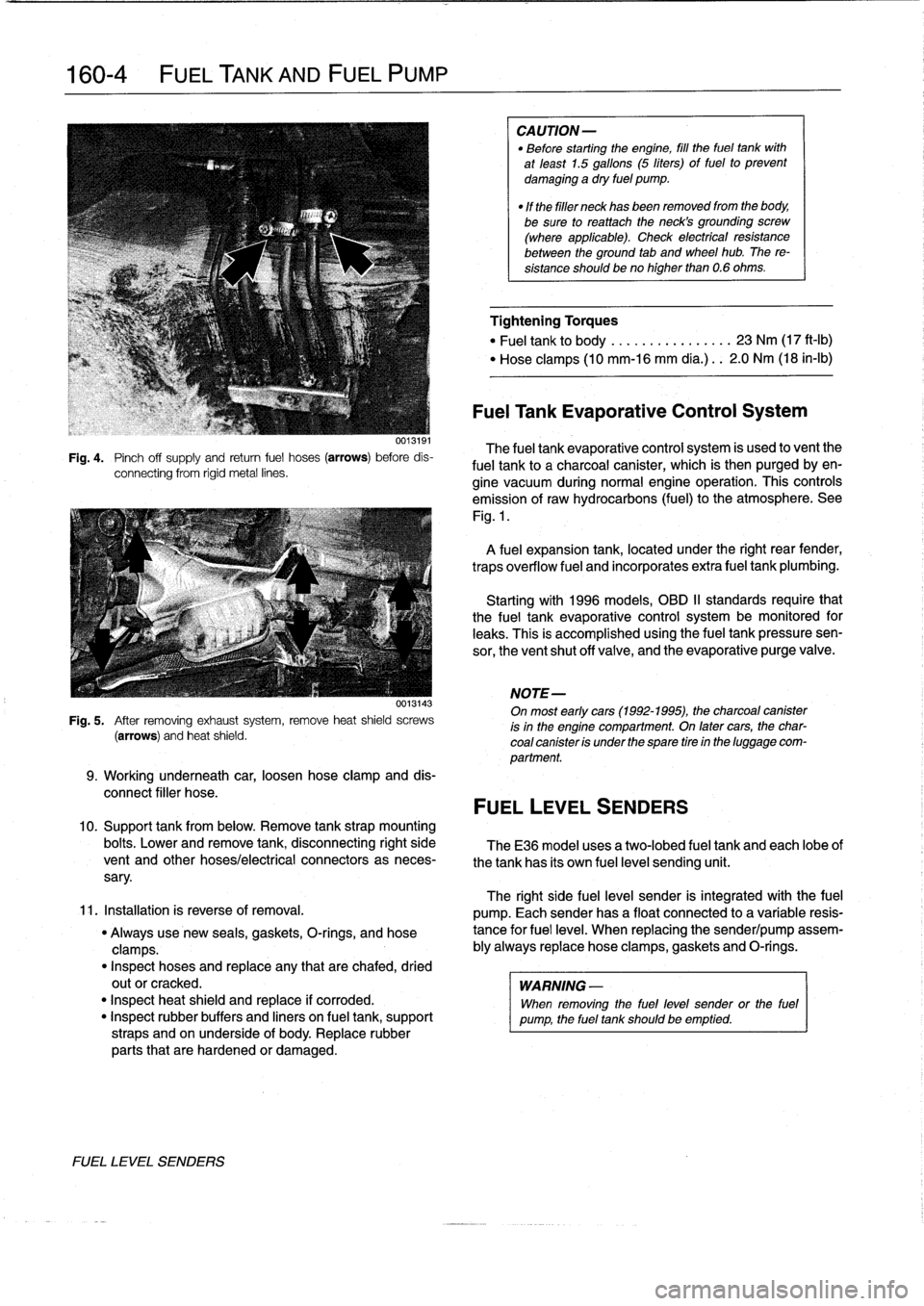
Fig
.
4
.
Pinch
off
supply
and
retum
fuel
hoses
(arrows)
before
dis-
connecting
from
rigid
metal
lines
.
0013143
Fig
.
5
.
After
removing
exhaustsystem,
remove
heat
shield
screws
(arrows)
and
heat
shield
.
9
.
Working
underneath
car,
loosen
hose
clamp
and
dis-
connect
filler
hose
.
10
.
Support
tank
from
below
.
Remove
tank
strap
mounting
bolts
.
Lower
and
remove
tank,
disconnecting
right
side
TheE36
model
uses
a
two-lobed
fuel
tank
and
each
lobeof
vent
and
other
hoses/electrical
connectors
as
neces-
the
tank
has
its
own
fuel
level
sending
unit
.
sary
.
11
.
Installation
is
reverse
of
removal
.
"
Always
use
new
seals,
gaskets,
O-rings,
and
hose
clamps
.
"
Inspect
hoses
and
replace
any
that
are
chafed,
dried
outor
cracked
.
"
Inspect
heat
shield
and
replace
if
corroded
.
"
Inspect
rubber
buffers
and
liners
on
fuel
tank,
support
straps
and
on
underside
of
body
.
Replace
rubber
parts
that
are
hardened
or
damaged
.
FUEL
LEVEL
SENDERS
CAUTION-
"
Before
starting
the
engine,
fill
the
fuel
tank
with
at
least
1.5
gallons
(5
liters)
of
fuel
to
prevent
damaging
a
dry
fuel
pump
.
"
If
the
filler
neck
has
been
removed
from
the
body,
be
sure
toreattach
theneck's
grounding
screw
(where
applicable)
.
Check
electrical
resistance
between
the
ground
tab
and
wheel
hub
.
The
re-
sistance
shouldbeno
higher
than
0
.6
ohms
.
Tightening
Torques
"
Fuel
tank
to
body
.............
...
23
Nm
(17
ft-Ib)
"
Hose
clamps
(10
mm-16
mm
día
.)
..
2
.0
Nm
(18
in-lb)
Fuel
Tank
Evaporative
Control
System
The
fuel
tank
evaporative
control
system
is
used
to
vent
the
fuel
tank
to
a
charcoal
canister,
which
is
then
purgedby
en-
gine
vacuum
during
normal
engine
operatíon
.
This
controls
emission
of
raw
hydrocarbons
(fuel)
to
the
atmosphere
.
See
Fig
.
1
.
A
fuel
expansion
tank,
located
under
the
right
rear
fender,
traps
overflow
fuel
and
incorporates
extra
fuel
tank
plumbing
.
Startingwith
1996
models,
OBD
II
standards
require
that
the
fuel
tank
evaporative
control
system
be
monitored
for
leaks
.
This
is
accomplished
usingthe
fuel
tankpressuresen-
sor,
the
ventshut
off
valve,
and
the
evaporative
purge
valve
.
NOTE-
On
most
early
cars(1992-1995),
the
charcoal
canister
is
in
the
engine
compartment
.
On
latercars,
the
char-
coal
canister
is
under
the
spare
tire
in
the
luggage
com-
partment
.
FUEL
LEVEL
SENDERS
The
right
side
fuel
leve¡
sender
is
integrated
with
the
fuel
pump
.
Each
senderhas
a
float
connected
to
a
variable
resis-
tance
for
fuel
leve¡
.
When
replacing
the
sender/pump
assem-
bly
always
replace
hose
clamps,gaskets
and
O-rings
.
WARNING
-
When
removing
the
fuel
level
sender
or
the
fuel
pump,
the
fuel
tank
should
be
emptied
.
Page 304 of 759

400-2
BODY-GENERAL
4-door
Sedan
Coupe
-
saas3
.7""
351
/
37
.3
O
I
x
`-193
267
o
oa
'3281
model
"M3
model
Convertible
BODYASSEMBLY
55
ass
.e
iss
""
-
66
.9
-
Fig
.
2
.
E36
body
dimensíons
.
BODY
ASSEMBLY
29
.4
29
4
The
BMW
3
Series
chassis
is
a
unibodydesign
constructed
ofhigh
strength
steel
.
Attaching
parts,
suchas
the
front
fend-
ers,
rear
quarter
panels,
doors,
trunk
lid
and
hood
are
also
constructed
of
steel
.
706
.31108
.7"
I
38
.5
174
.5
174
.5
O
oo
196
.3/106
.7'
"
35_5
1.
.
55
.9,566
".
106
.3/196
.7""
i.
358
-1745-
55
9/56
3'/56
6"
-
J
0013099
Windows
bonded
flush
to
the
body
and
the
guided
flow
of
cooling
air
into
the
engine
compartment
provide
a
good
coeffi-
cient
of
drag(CD)
.
TheE36
cars
have
a
CD
of
approximately
0
.30for
the
sedan
and
coupe
models,
and
0
.35
for
the
con-
vertible
models
:
The
exterior
panels
are
corrosion-resistant
zinc
coated
steel
.
The
front
fenders
are
bolted
on
and
easily
replaceabie
.
The
body
styles
of
E36
cars
coveredby
this
manual
arethe
See410
Fenders,
Engine
Hood
.
4-door
sedan,
2-door
coupe
and
convertible
.
Body
dimen-
sions
vary
slightly
betweenmodels
.
See
Fig
.
2
.
The
front
and
rear
bumpers
use
an
aluminum
framework
with
an
overlaid
high-impact,
deformable
plastic
cover
.
This
Exterior
and
Aerodynamics
bumper
system
keeps
damage
to
a
minimum
in
head-on
colli-
sions
of
up
to
10
m
.p
.h
.
(15
km/h)
.
See
510
Exterior
Trim,
TheE36
can
be
immediatelyrecognized
asa
typical
BMW
.
Bumpers
.
With
its
traditionalstyling
features,
suchas
the
BMW
kidney
grille,
circular
headlights
behind
a
glass
cover
(for
reasons
of
streamliníng),
and
the
"kick"
in
the
rearmost
roof
pillar
(C-pil-
lar)
.
Page 309 of 759

GENERAL
This
repair
group
covers
replacement
of
the
front
fenders
and
removal
and
installation
of
the
engine
hood
.
NOTE-
The
body
is
painted
at
the
factoryafter
assembly
.
Re-
alignment
of
body
panels
may
expose
unpainted
metal
.
Paint
all
exposed
metal
once
the
work
fs
complete
.
FRONT
FENDERS
Front
fender,
removing
and
installing
1
.
Raise
hood
.
Raise
and
safely
support
front
of
vehicle
.
WARNING
-
"
When
raising
thecar
using
a
floor
jack
or
a
hy-
draulic
lift,
carefully
position
the
jack
pad
to
pre-
vent
damaging
thecar
body
.
A
suitable
liner
(wood,
rubber,
etc
.)
should
be
placed
between
the
jack
and
the
car
to
prevent
body
damage
.
"
Watch
the
jack
closely
.
Make
sure
it
stays
stable
and
does
not
shift
or
tilt
.
As
the
car
is
raised,
the
car
may
roll
slightly
and
the
jack
may
shift
.
2
.
Remove
front
wheel
.
Remove
inner
plastic
liner
from
wheel
well
.
3
.
Remove
front
bumper
.
See510
Exterior
Trim,
Bumpers
.
4
.
Working
atfront
corner
of
fender,
remove
front
grille
panel
bolts
(2
bolts
at
left
and
right)
.
See
Fig
.
1
.
FENDERS,
ENGINE
HOOD
410-1
410
Fenders,
Engine
Hood
GENERAL
...............
.
.
.
.
.
.
.
.
.
.
.
..
410-1
ENGINE
HOOD
.
.
.
.
.
.
.
.
.
.
.
.
.
.
.
.
.
.
.
...
.
.410-3
Hood,
raising
to
service
position
.
.
.
.
.
.
.
.
...
410-3
FRONTFENDERS
........
.
.
.
.
.
.
.
.
.
.
.
.
.410-1
Hood,
removin
and
installin
410-3
Front
Pender,
removing
and
installing
.
.
.
....
410-1
Hood,
aligning
...
.
.
.
.
.
.
.
.....
.
.
.
.
.
.
.
...
410-4
Hood
release
cable
and
latches,
adjusting
...
410-4
001
.145
Fig
.
1
.
Front
grille
panel
to
front
fender
retaining
bolts
(arrows)
.
Front
bumpershown
removed
.
5
.
Remove
front
turn
signalliens
assembly
from
applica-
ble
front
corner
.
Carefully
pryout
side
directional
from
fender
(later
cars
only)
.
See
630
Exterior
Lighting
.
6
.
Remove
fender
attaching
bolts
atfront
underside
of
fender
.
See
Fig
.
2
.
7
.
Remove
bolts
along
top
edge
of
fender
:
See
Fig
.
3
.
8
.
Open
front
door
and
remove
fender
mounting
bolts
in
door
jamb
.
See
Fig
.
4
.
9
.
Carefully
remove
fender
from
body
.
FRONTFENDERS