1996 TOYOTA TACOMA wiring
[x] Cancel search: wiringPage 33 of 196
31
CAUTION!
The SRS airbag system is designed
only as a supplement to the primary protection of the seat belt system of
the driver. The driver is particularlysusceptible to injury if he/she does
not wear his/her seat belt; when
sudden braking or a collision oc-
curs, he/she may be thrown for-
ward. To obtain further protection in
an accident, the driver and all pas-
sengers in the vehicle should al-ways wear their seat belts when
driving. For instructions and pre-
cautions concerning the seat belt
systems, see Seat beltsº in this
chapter.
CAUTION!
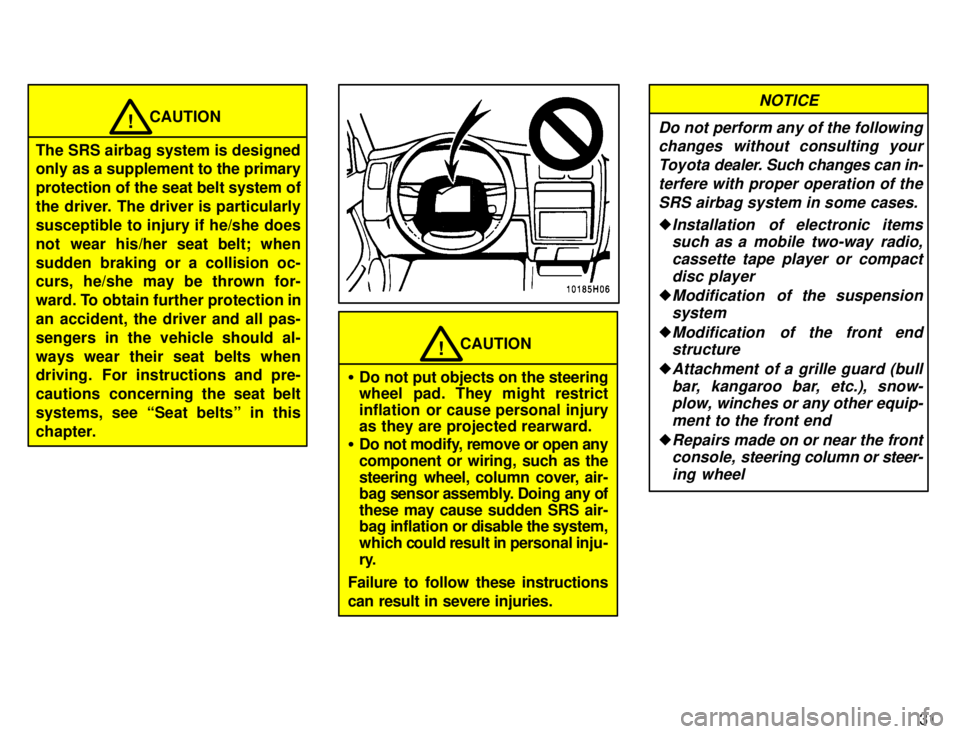
Do not put objects on the steering
wheel pad. They might restrict
inflation or cause personal injury as they are projected rearward.
Do not modify, remove or open any
component or wiring, such as the
steering wheel, column cover, air-
bag sensor assembly. Doing any of
these may cause sudden SRS air-
bag inflation or disable the system,
which could result in personal inju-
ry.
Failure to follow these instructions
can result in severe injuries.
NOTICE
Do not perform any of the following changes without consulting your
Toyota dealer. Such changes can in-
terfere with proper operation of the SRS airbag system in some cases.
Installation of electronic itemssuch as a mobile two-way radio,
cassette tape player or compactdisc player
Modification of the suspension system
Modification of the front endstructure
Attachment of a grille guard (bull
bar, kangaroo bar, etc.), snow-plow, winches or any other equip-
ment to the front end
Repairs made on or near the frontconsole, steering column or steer-
ing wheel
Page 55 of 196

51
(d) Low Oil Pressure Warning Light
This light warns that the engine oil pres-
sure is too low.
If it flickers or stays on while you are driving,
pull off the road to a safe place and stop the
engine immediately. Call a Toyota dealer or
qualified repair shop for assistance.
The light may occasionally flicker when
the engine is idling or it may come on brief-
ly after a hard stop. There is no cause for concern if it then goes out when the en-
gine is accelerated slightly.
The light may come on when the oil level
is extremely low. It is not designed to indi- cate low oil level, and the oil level must bechecked using the level dipstick.
NOTICE
Do not drive the vehicle with the warning light onÐeven for one
block. It may ruin the engine.
(e) Low Fuel Level Warning Light
This light comes on when the fuel level in
the tank becomes nearly empty. Fill up the
tank as soon as possible. (f) Malfunction Indicator Lamp
This lamp comes on in the following cases.
a. The fuel tank is completely empty. (See Fuel gaugeº in Chapter 1-5 for instruc- tions.)
b. The fuel tank cap is not tightened se-
curely. (See Fuel tank capº in Chapter
1-2 for instructions.)
c. There is a problem somewhere in your
engine or automatic transmission electri- cal system.
If it comes on while you are driving in case
c, have your vehicle checked/repaired by
your Toyota dealer as soon as possible.
(g) ABSº Warning Light
This light warns that there is a problem
somewhere in your anti-lock brake sys-tem.
If the light comes on while you are driving,
have your vehicle checked by your T
oyota
dealer as soon as possible.
The light will come on when the ignition key is turned to the ONº position. After
about 3 seconds, the light will go off. When the ABSº warning light is on (and
the brake system warning light is off), thebrake system operates conventionally but
without anti-lock function. Vehicles with rear differential lock systemÐ
The anti-lock brake system does not op-
erate when the rear differential is locked.
It is normal operation for the ABSº warn-
ing light to be on at this time.
(h) SRS Airbag Warning Light
This light will come on when the igni-
tion
key is turned to the ACCº or ONº
position. After about 6 seconds, the
light will go off. This means the airbag
system is operating properly.
The warning light system monitors the air-
bag sensor assembly, inflator, warning light, interconnecting wiring and powersources.
If either of the following conditions occurs, this indicates a malfunction somewhere inthe parts monitored by the warning light
system. Contact your Toyota dealer as
soon as possible to service the vehicle. The light does not come on when the
ignition key is turned to the ACCº or
ONº position or remains on.
The light comes on while driving.
(i) Light Reminder Buzzer
This buzzer will sound if the driver's door is opened while the ignition switch is turned to the LOCKº position with the
headlight switch on. Removing the key will
not stop the buzzer as long as the head-light switch is on.
Page 114 of 196

11 0Before starting the engine, be sure to follow
the instructions in (a) Before crankingº. Normal starting procedure
The multiport fuel injection system/se-
quential multiport fuel injection system in
your engine automatically controls the
proper air-fuel mixture for starting. You can start a cold or hot engine as follows:
1. With your foot off the accelerator ped- al, crank the engine by turning the key to
STARTº. Release it when the engine starts.
2. After
the engine runs for about 10 sec-
onds, you are ready to drive.
If the weather is below freezing, let the en-
gine warm up for a few minutes before driving.
If the engine stalls...
Simply restart it, using the correct proce- dure given in normal starting. If the engine will not startÐ
See If your vehicle will not startº in Part 4.
Do not crank for more than 15 sec-onds at a time. This may overheat
the starter and wiring systems.
Do not race a cold engine.
NOTICE
If the engine becomes difficult tostart or stalls frequently, have the
engine checked immediately. Always slow down in gusty crosswinds.
This will allow you much better control.
Drive slowly onto curbs and, if pos-
sible, at a right angle. Avoid drivingonto high, sharp-edged objects and
other road hazards. Failure to do so
can lead to severe tire damage result-
ing in tire bursts.
When parking on a hill, turn the front
wheels until they touch the curb so that
the vehicle will not roll. Apply the parking
brake, and place the transmission in Pº
(automatic) or in first or reverse (manu-
al). If necessary, block the wheels.
Washing your vehicle or driving through
deep water may get the brakes wet. To
see whether they are wet, check that
there is no traffic near you, and then
press the pedal lightly. If you do not feel
a normal braking force, the brakes are
probably wet. To dry them, drive the ve-
hicle cautiously while lightly pressing the
brake pedal with the parking brake
pulled. If they still do not work safely, pull
to the side of the road and call a Toyota
dealer for assistance.
Four- wheel drive modelsÐToyota rec-
ommends not using four- wheel drive on
dry hard- surfaced roads, because four-
wheel driving will cause unnecessary
noise and wear, and poor fuel economy.
(b) Starting the engine
Tips for driving in variousconditions
Page 119 of 196
11 5
HITCHES
Use only a weight carrying hitch de-
signed for the total trailer weight. Toyo-
ta does not recommend using a weight
distribution (load equalizing) hitch.
The hitch must be bolted securely to
the vehicle frame and installed accord-
ing to the hitch manufacturer's instruc- tions.
If using a fifth wheel hitch, the center
of the king pin must be forward of the
axis of the vehicle's rear wheels, and
installed according to the manufactur-
er's instructions.
The hitch ball and king pin should havea light coat of grease.
Toyota recommends that the trailer
hitch, except fifth wheel hitch, be re- moved when not towing to prevent in-jury and/or damage by the hitch in
event of a rear end collision. After re-moving the hitch, the installation area
should be sealed to prevent entry of exhaust fumes and mud.
Do not use an axle-mounting hitch
as it may cause damage to the axle
housing, wheel bearings, wheelsand/or tires.
NOTICE
BRAKES AND SAFETY CHAINS Toyota recommends trailers with brakes
that conform to any applicable federal
and state/provincial regulations.
A safety chain must always be used
between the towing vehicle and the
trailer. Leave sufficient slack in the
chain for turns. The chain should cross
under the trailer tongue to prevent the tongue from dropping to the ground in
case it becomes damaged or sepa-
rated. For correct safety chain proce-
dures, follow the hitch or trailer
manufacturer 's recommendations.
CAUTION
If the total trailer weight exceeds
453 kg (1000 lb.), trailer brakes are required.
Never tap into your vehicle's hy- draulic system as it would lower
its braking effectiveness.
Never tow a trailer without using a
safety chain securely attached to
both the trailer and the vehicle. If
damage occurs to the coupling
unit or hitch ball, there is danger of
the trailer wandering over into
another lane.!
TIRES Ensure that your vehicle's tires are
properly inflated.
The trailer tires should be inflated to
the pressure recommended by the
trailer manufacturer in respect to the
total trailer weight.
TRAILER LIGHTS Trailer lights must comply with federal,
state/provincial and local regulations. See your local recreational vehicle
dealer or rental agency for the correct type of wiring and relays for your trail-
er. Check for correct operation of the
turn signals and stop lights each time
you hitch up. Direct splicing may dam-
age your vehicle's electrical system
and cause a malfunction of your lights.
BREAK-IN SCHEDULE Toyota recommends that you do not
tow a trailer with a new vehicle or a ve-
hicle with any new power train compo-
nent (engine, transmission, differen- tial, wheel bearing, etc.) for the first
800 km (500 miles) of driving.
Page 124 of 196
120If the engine will not start, your engine
may be flooded because of repeated cranking.
If this happens, turn the key to STARTº with the accelerator pedal held down.
Keep
the key and accelerator pedal so for
15 seconds and release them. Then try
starting the engine with your foot off the accelerator pedal.
If the engine does not start after 15 sec-
onds of cranking, release the key, wait a few minutes and try again.
If the engine still will not start, it needs ad-
justment or repair. Call a Toyota dealer or
qualified repair shop for assistance.
NOTICE
Do not crank for more than 15 seconds at a time. This may
overheat the starter and wiring systems.
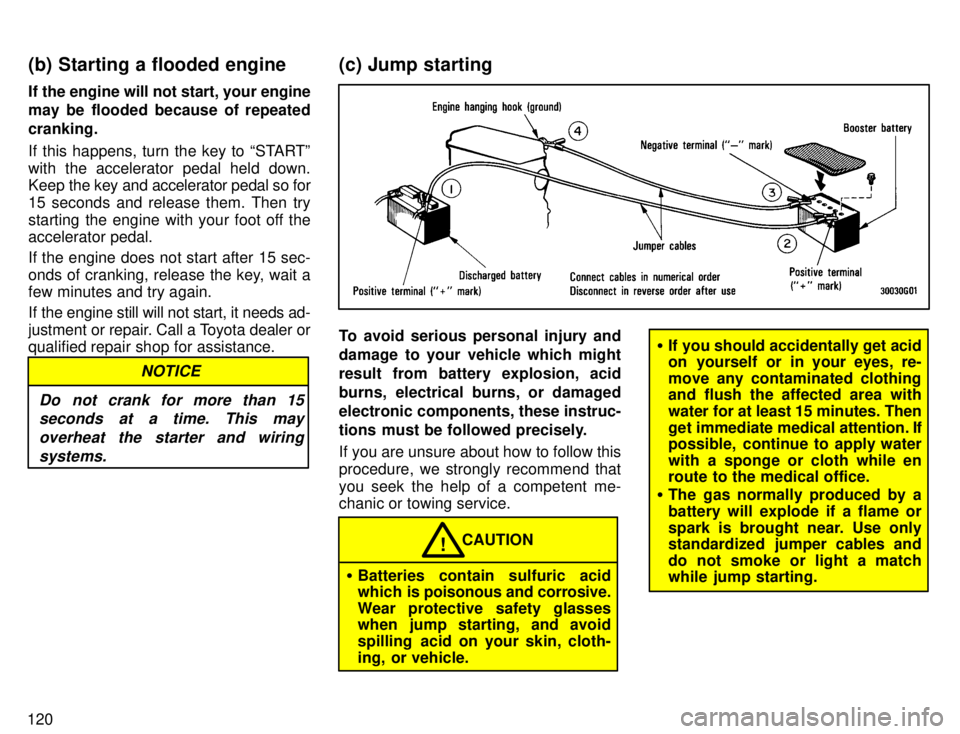
To avoid serious personal injury and
damage to your vehicle which might
result from battery explosion, acid
burns, electrical burns, or damaged
electronic components, these instruc-
tions must be followed precisely.
If you are unsure about how to follow this procedure, we strongly recommend thatyou seek the help of a competent me-
chanic or towing service.
Batteries contain sulfuric acid
which is poisonous and corrosive.
Wear protective safety glasses
when jump starting, and avoid
spilling acid on your skin, cloth-
ing, or vehicle. CAUTION
!
If you should accidentally get acid
on yourself or in your eyes, re- move any contaminated clothing
and flush the affected area with
water for at least 15 minutes. Then
get immediate medical attention. If
possible, continue to apply water
with a sponge or cloth while en
route to the medical office.
The gas normally produced by a battery will explode if a flame or
spark is brought near. Use only
standardized jumper cables and
do not smoke or light a match
while jump starting.
(b) Starting a flooded engine (c) Jump starting