1996 TOYOTA TACOMA inflation pressure
[x] Cancel search: inflation pressurePage 122 of 196
11 8Getting
more kilometers/mileage from a li-
ter/gallon of fuel is easyÐjust take it easy.
It will help make your vehicle last longer,
too. Here are some specific tips on how to
save money on both fuel and repairs: Keep your tires inflated at the cor- rect pressure. Underinflation causes
tire wear and wastes fuel. See Chapter
7-2 for instructions.
Do not carry unneeded weight in
your vehicle. Excess weight puts a
heavier load on the engine, causinggreater fuel consumption.
Avoid lengthy warm-up idling.
Once the engine is running smoothly,
begin drivingÐbut gently. Remember,
however, that on cold winter days this
may take a little longer.
Accelerate slowly and smoothly.
Avoid jackrabbit starts. Get into high
gear as quickly as possible.
Avoid long engine idling. If you have
a long wait and you are not in traffic, it
is better to turn off the engine and start
again later.
Avoid engine lug or overrevving.
Use a gear position suitable for the
road on which you are travelling.
Avoid continuous speeding up and
slowing down. Stop-and-go driving
wastes fuel.
Avoid unnecessary stopping and braking. Maintain a steady pace. Try
to time the traffic signals so you only
need to stop as little as possible or take
advantage of through streets to avoid
traffic lights. Keep a proper distance
from other vehicles to avoid suddenbraking. This will also reduce wear onyour brakes.
Avoid heavy traffic or traffic jams
whenever possible.
Do not rest your foot on the clutch
or brake pedal. This causes needless
wear, overheating and poor fuel econ-
omy.
Maintain a moderate speed on highways. The faster you drive, the
greater the fuel consumption. By re-
ducing your speed, you will cut down
on fuel consumption.
Keep the front wheels in properalignment. Avoid hitting the curb and
slow down on rough roads. Improper
alignment not only causes faster tire
wear but also puts an extra load on the
engine, which, in turn, wastes fuel.
Keep the bottom of your vehicle
free from mud, etc. This not only
lessens weight but also helps prevent corrosion.
Keep your vehicle tuned-up and in
top shape. A dirty air cleaner, improp-
er valve clearance, dirty plugs, dirty oil
and grease, brakes not adjusted, etc.
all lower engine performance and con-
tribute to poor fuel economy. For lon-
ger life of all parts and lower operating
costs, keep all maintenance work on
schedule, and if you often drive under severe conditions, see that your ve-
hicle receives more frequent mainte-nance. (For scheduled maintenance
information, please refer to the sepa-
rate Owner's Manual Supplement/
Maintenance Scheduleº).
CAUTION
Never turn off the engine to coast
down hills. Your power steering and
brake booster will not function with-
out the engine running. Also, the
emission control system operates
properly only when the engine is
running.!
How to save fuel and make your
vehicle last longer, too
Page 134 of 196
130
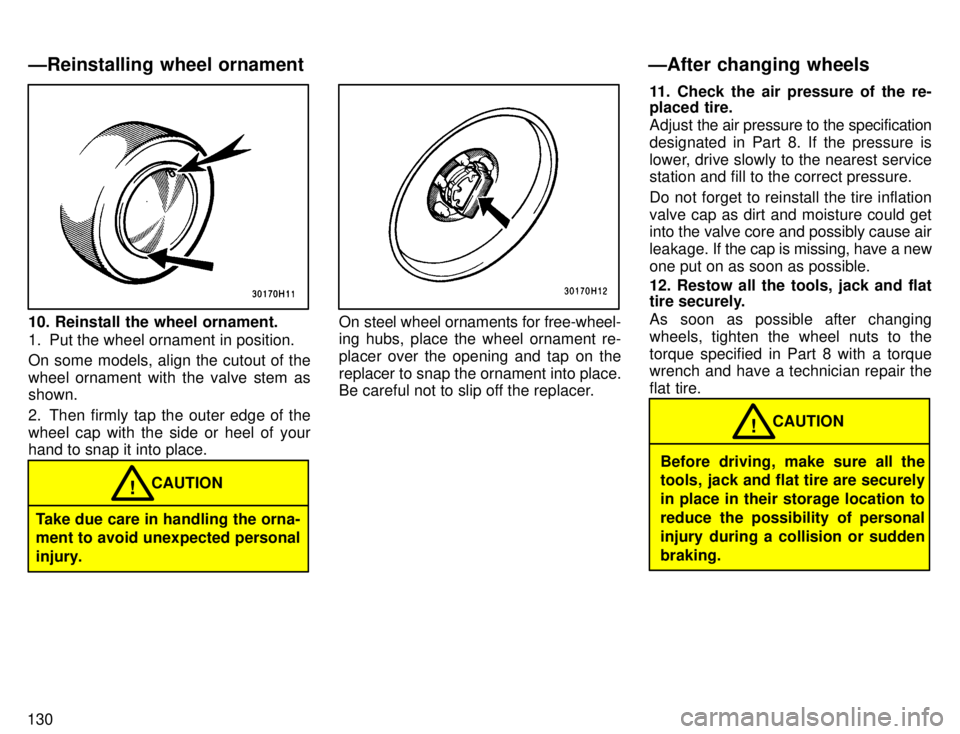
10. Reinstall the wheel ornament.
1. Put the wheel ornament in position.
On some models, align the cutout of the
wheel ornament with the valve stem as shown.
2. Then firmly tap the outer edge of the
wheel cap with the side or heel of your
hand to snap it into place.
Take due care in handling the orna- ment to avoid unexpected personal
injury.CAUTION
!
On steel wheel ornaments for free-wheel-
ing hubs, place the wheel ornament re-
placer over the opening and tap on the
replacer to snap the ornament into place.
Be careful not to slip off the replacer. 11. Check the air pressure of the re-
placed tire.
Adjust
the air pressure to the specification
designated in Part 8. If the pressure is
lower, drive slowly to the nearest service station and fill to the correct pressure.
Do not forget to reinstall the tire inflation valve cap as dirt and moisture could get into the valve core and possibly cause air
leakage. If the cap is missing, have a new
one put on as soon as possible. 12. Restow all the tools, jack and flat
tire securely.
As soon as possible after changing
wheels, tighten the wheel nuts to thetorque specified in Part 8 with a torque
wrench and have a technician repair the
flat tire.
Before driving, make sure all the
tools, jack and flat tire are securely in place in their storage location to
reduce the possibility of personal
injury during a collision or suddenbraking. CAUTION
!
ÐReinstalling wheel ornament
ÐAfter changing wheels
Page 163 of 196
159
c. Reinstall the filler cap.
d. Remove the filler cap again and look at the fluid level. If the fluid is cold, the level
should be in
the COLDº range on the dip-
stick. Similarly, if it is hot, the fluid level
should be in the HOTº range. If the level
is at the low side of either range, add auto-
matic transmission fluid DEXRON -II or
-III to bring the level within range.
e. After replacing the filler cap, visually check the steering box case, vane pump
and hose connections for leaks or dam-age.
CAUTION
The reservoir tank may be hot so be
careful not to burn yourself.!
Avoid overfilling, or the power steering could be damaged.
NOTICE
Keep your tire pressures at the proper level.
The recommended cold tire pressures,
tire size and the cargo weight rating are
given in Part 8.
You should check the tire pressures every
two weeks, or at least once a month. And
do not forget the spare!
Incorrect tire pressure can reduce tire
life and make your vehicle less safe to drive.
Low tire pressure results in excessive
wear, poor handling, reduced fuel econo-
my, and the possibility of blowouts from overheated tires. Also, low tire pressure
can cause poor sealing of the tire bead. If
the tire pressure is excessively low, there
is the possibility of wheel deformation and/or tire separation.
High tire pressure produces a harsh ride,
handling problems, excessive wear at the center of the tire tread, and a greater pos-
sibility of tire damage from road hazards.
If a tire frequently needs refilling, have it
checked by your Toyota dealer. The following instructions for check-
ing tire pressure should be observed:
The pressure should be checked
only when the tires are cold. If your
vehicle has been parked for at least 3hours and has not been driven formore than 1.5 km or 1 mile since, you
will get an accurate cold tire pressure reading.
Always use a tire pressure gauge.
The appearance of a tire can be mis-
leading. Besides, tire pressures that
are even just a few pounds off can de-
grade handling and ride.
Do not bleed or reduce tire pres-sure after driving. It is normal for the
tire pressure to be higher after driving.
Never exceed the cargo weight rat-ing. The luggage weight should be
distributed evenly.
Be sure to reinstall the tire inflation
valve caps. Without the valve caps,
dirt or moisture could get into the valve
core and cause air leakage. If the capshave been lost, have new ones put onas soon as possible.
Checking tire pressure