31
CAUTION!
The SRS airbag system is designed
only as a supplement to the primary protection of the seat belt system of
the driver. The driver is particularlysusceptible to injury if he/she does
not wear his/her seat belt; when
sudden braking or a collision oc-
curs, he/she may be thrown for-
ward. To obtain further protection in
an accident, the driver and all pas-
sengers in the vehicle should al-ways wear their seat belts when
driving. For instructions and pre-
cautions concerning the seat belt
systems, see Seat beltsº in this
chapter.
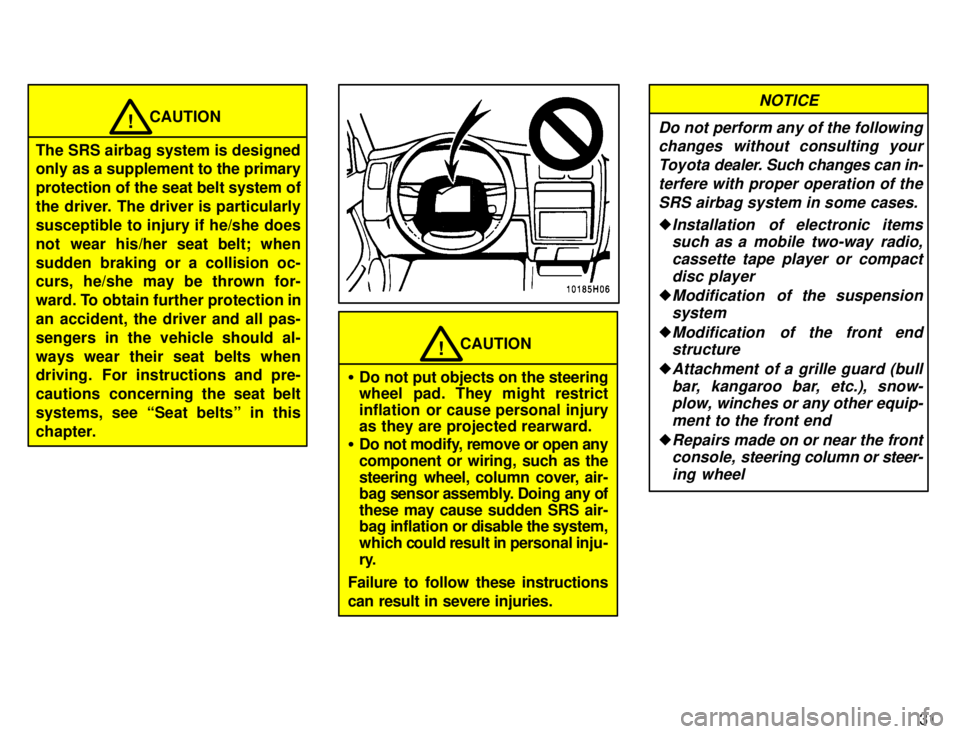
CAUTION!
Do not put objects on the steering
wheel pad. They might restrict
inflation or cause personal injury as they are projected rearward.
Do not modify, remove or open any
component or wiring, such as the
steering wheel, column cover, air-
bag sensor assembly. Doing any of
these may cause sudden SRS air-
bag inflation or disable the system,
which could result in personal inju-
ry.
Failure to follow these instructions
can result in severe injuries.
NOTICE
Do not perform any of the following changes without consulting your
Toyota dealer. Such changes can in-
terfere with proper operation of the SRS airbag system in some cases.
Installation of electronic itemssuch as a mobile two-way radio,
cassette tape player or compactdisc player
Modification of the suspension system
Modification of the front endstructure
Attachment of a grille guard (bull
bar, kangaroo bar, etc.), snow-plow, winches or any other equip-
ment to the front end
Repairs made on or near the frontconsole, steering column or steer-
ing wheel
144IN THE ENGINE COMPARTMENT Items listed below should be checked
from time to time, e.g. each time whenrefueling.
Washer fluid
Make sure there is sufficient fluid in the
tank. See Chapter 7-3 for additional
infor-
mation.
Engine coolant level
Make sure the coolant level is between the
FULLº and LOWº lines on the see-
through reservoir. See Chapter 7- 2 for
additional information. Battery electrolyte level Make sure the electrolyte level of all bat-
tery cells is between upper and lower level
lines on the case. Add only distilled water
when replenishing. See Chapter 7-3 for
additional information. Brake fluid level
Make sure the brake fluid level is correct.
See Chapter 7- 2 for additional information.
Engine oil level
Check the l evel on the dipstick with the en-
gine turned off and the vehicle parked on
a level spot. See Chapter 7-2 for addition-
al information. Power steering fluid level Check the level on the dipstick. The level
should be in the HOTº or COLDº range
depending on the fluid temperature. See Chapter 7-2 for additional information. Exhaust system
If you notice any change in the sound of
the exhaust or smell exhaust fumes, have the cause located and corrected immedi-
ately. (See engine exhaust cautions in
Part 2.)
Be on the alert for changes in perfor-
mance, sounds, and visual tip-offs
that in-
dicate service is needed. Some important
clues are as follows: Engine missing, stumbling, or pinging
Appreciable loss of power
Strange engine noises
A leak under the vehicle (however, wa-
ter dripping from the air conditioning
after use is normal.)
Change in exhaust sound (This may
indicate a dangerous carbon monox-
ide leak. Drive with the windows open
and have the exhaust system checked
immediately.)
Flat-looking tire; excessive tire squeal
when cornering; uneven tire wear
Vehicle pulls to one side when driving straight on a level road
Strange noises related to suspensionmovement
Loss of brake effectiveness; spongy
feeling brake or clutch pedal; pedal al-
most touches floor; vehicle pulls to one
side when braking
Engine coolant temperature continual-
ly higher than normal
Does your vehicle need repairing?