128
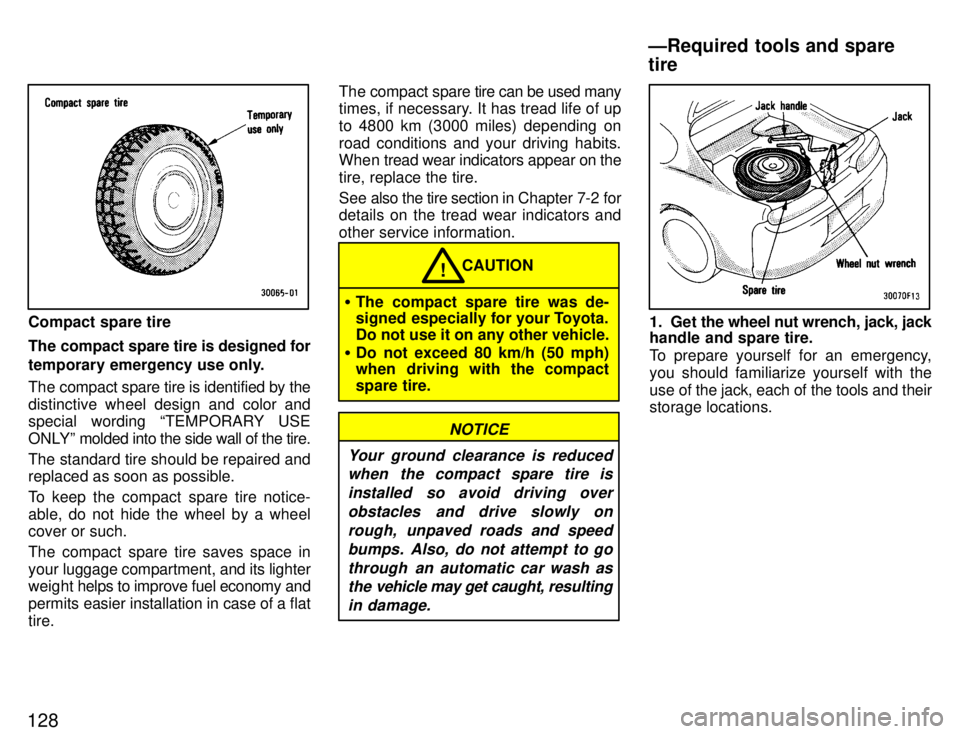
Compact spare tire
The compact spare tire is designed for
temporary emergency use only.
The compact spare tire is identified by the
distinctive wheel design and color and
special wording TEMPORARY USE
ONLYº molded into the side wall of the tire.
The standard tire should be repaired and replaced as soon as possible.
To keep the compact spare tire notice-
able, do not hide the wheel by a wheel cover or such.
The compact spare tire saves space in your luggage compartment, and its lighter
weight helps to i mprove fuel economy and
permits easier installation in case of a flattire. The compact spare
tire can be used many
times, if necessary. It has tread life of up
to 4800 km (3000 miles) depending on
road conditions and your driving habits.
When tread wear indicators appear on the
tire, replace the tire.
See also the tire section in Chapter 7-2 for
details on the tread wear indicators and other service information.
The compact spare tire was de-
signed especially for your Toyota. Do not use it on any other vehicle.
Do not exceed 80 km/h (50 mph)
when driving with the compact spare tire. CAUTION
!
NOTICE
Your ground clearance is reduced when the compact spare tire is
installed so avoid driving overobstacles and drive slowly on rough, unpaved roads and speedbumps. Also, do not attempt to go through an automatic car wash asthe vehicle may get caught, resulting
in damage.
1. Get the wheel nut wrench, jack, jack
handle and spare tire.
To prepare yourself for an emergency, you should familiarize yourself with the
use of the jack, each of the tools and their storage locations.
ÐRequired tools and spare tire
145
Service reminder indicators and
warn-
ing buzzers Check that all service reminder indicators
and warning buzzers function properly. Steering wheel
Be alert for changes in steering condition, such as hard steering or strange noise. Seats Check that all front seat controls such as
seat adjusters, seatback recliner, etc. op- erate smoothly and that all latches lock
securely in any position. For folding-down
rear seatback, check that the latches lock
securely. Make sure the front headrestsare firmly secured. Seat belts
Check that the seat belt system such as
buckles, retractors and anchors operate
properly and smoothly. Make sure the belt
webbing is not cut, frayed, worn or dam- aged. Accelerator pedal Check the pedal for smooth operation and
uneven pedal effort or catching. Clutch pedal Check the pedal for smooth operation. Brake pedal Check
the pedal for smooth operation and
that the pedal has the proper clearance. Check the brake booster function. Brakes
At a safe place, check that the brakes do not pull to one side when applied. Parking brake Check that the lever has the proper travel and that, on a safe incline, your vehicle is
held securely with only the parking brake applied.
Automatic transmission Parkº mech-
anismCheck the lock release button of the selec-
tor lever for proper and smooth operation.
On a safe incline, check that your vehicle is held securely with the selector lever inPº position and all brakes released.
IN THE ENGINE COMPARTMENT Items listed below should be checked
from time to time , e.g. each time when
refueling.
Washer fluid
Make sure there is sufficient fluid in the
tank. See Chapter 7-3 for additional infor-
mation.
Engine coolant level Make sure the coolant level is between
the FULLº and LOWº lines on the see-
through reservoir when the engine is cold.
See Chapter 7-2 for additional informa-tion. Battery electrolyte level Make sure the electrolyte level of all bat-
tery cells is correct. Add only distilled wa-
ter when replenishing. See Chapter 7-3
for additional information. Brake fluid level
Make sure the brake fluid level is correct. See Chapter 7-2 for additional informa- tion.
Engine oil level
Check the l
evel on the dipstick with the en-
gine turned off and the vehicle parked on
a level spot. See Chapter 7-2 for addition-
al information. Power steering fluid level Check the level on the dipstick. The level
should be in the HOTº or COLDº range
depending on the fluid temperature. See Chapter 7-2 for additional information. Exhaust system
If you notice any change in the sound of
the exhaust or smell exhaust fumes, have the cause located and corrected immedi-
ately. (See engine exhaust cautions in
Part 2.)
183
9. STOP 15 A: Stop lights, cruise control
system cancel device
10. CIG 15 A: Cigarette lighter, air condi-
tioning system, SRS airbag system, theft
deterrent system, shift lock control sys-tem
11. RAD NO.2 7.5 A: Radio, cassette
tape player, power antenna
12. TAIL 10 A: Tail lights, parking lights,
front side marker lights, rear side marker lights, licence plate lights
13. ECU-IG 10 A: Cruise control system,
anti-lock brake system, power steering,
power antenna, theft deterrent system,
shift lock control system, traction control system14. GAUGE 10 A: Gauges and meters,
service reminder indicators and warning
buzzers (except discharge and open door
warning lights), rear window defogger,
charging system, cruise control system,
electronically controlled automatic trans-mission system, traction control system
15. ECU-B 10 A: Air conditioning sys-
tem, cruise control system, anti-lock brake system, SRS airbag system, trac-tion control system
16. EFI NO.2 30 A: Multiport fuel injection
system/sequential multiport fuel injection
system17. EFI NO.1 30 A: Multiport fuel injection
system/sequential multiport fuel injection
system
18. AM2 30 A: Starter system
19. FOG 15 A: Front fog lights
20. HAZ-HORN 15 A: Emergency flash-
ers, horns
21. TRAC 7.5 A: Traction control system
22. ALT-S 7.5 A: Charging system
23. DOME 7.5 A: Interior lights, personal
lights, door courtesy lights, luggage
compartment light, ignition switch light,
open door warning light, theft deterrent
system, daytime running light system