1996 TOYOTA SUPRA light
[x] Cancel search: lightPage 21 of 188
20
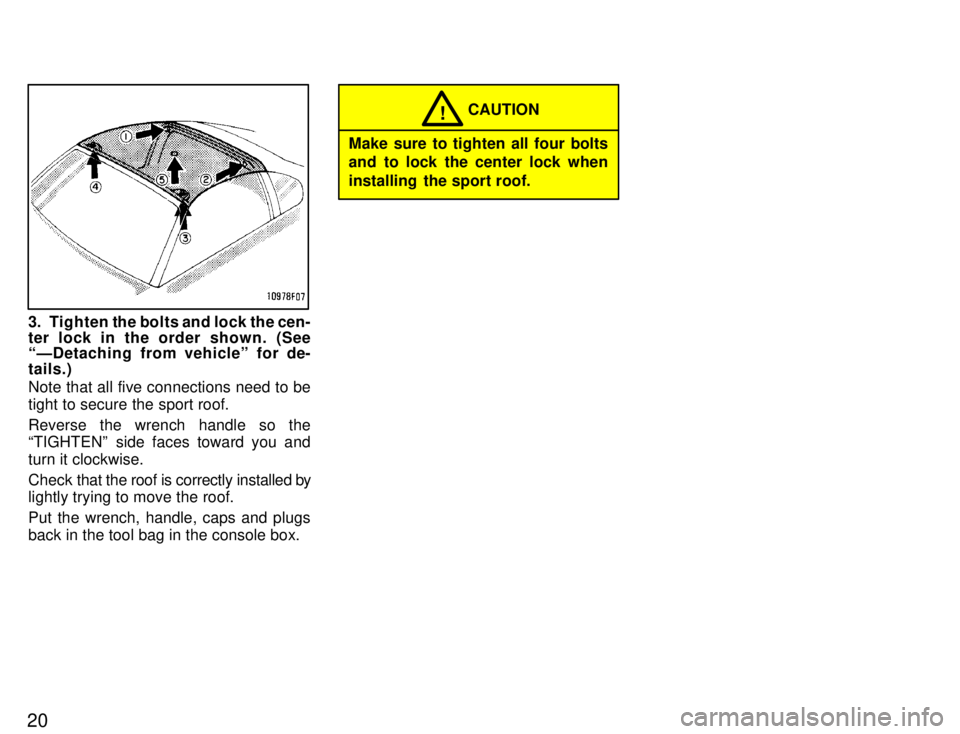
3. Tighten the bolts and lock the cen-
ter lock in the order shown. (See
ÐDetaching from vehicleº for de-
tails.) Note that all five connections need to be
tight to secure the sport roof. Reverse the wrench handle so the
TIGHTENº side faces toward you and
turn it clockwise.
Check that the roof is correctly installed by
lightly trying to move the roof.
Put the wrench, handle, caps and plugs back in the tool bag in the console box.
Make sure to tighten all four bolts
and to lock the center lock when
installing the sport roof.
CAUTION!
Page 23 of 188
22
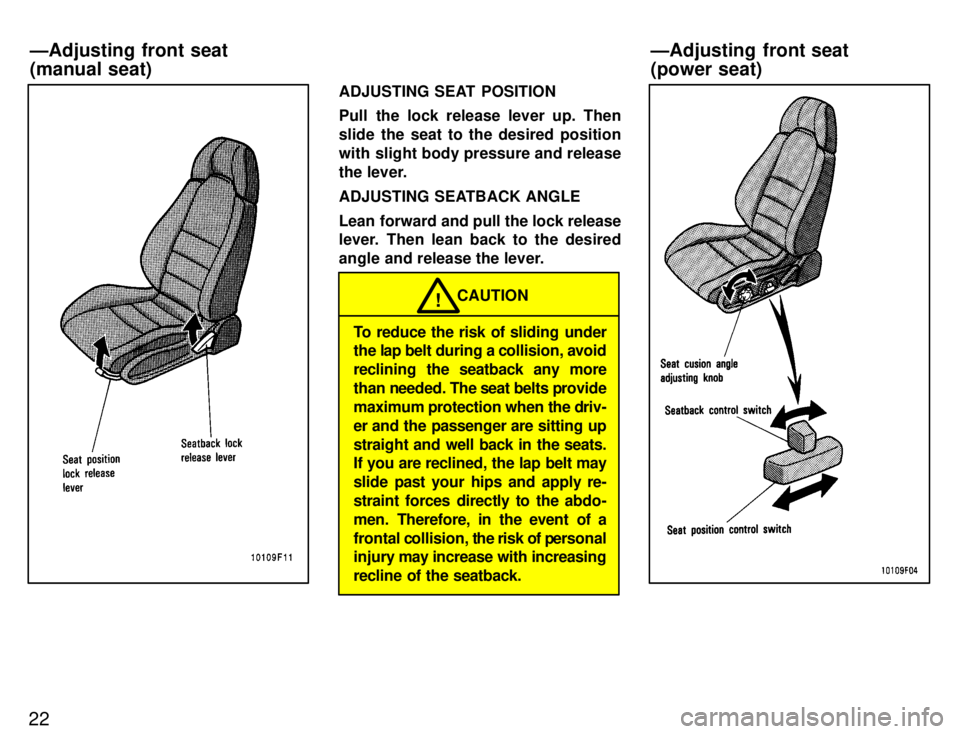
ADJUSTING SEAT POSITION
Pull the lock release lever up. Then
slide the seat to the desired position
with slight body pressure and release
the lever.
ADJUSTING SEATBACK ANGLE
Lean forward and pull the lock release
lever. Then lean back to the desired
angle and release the lever.
CAUTION!
To reduce the risk of sliding under
the lap belt during a collision, avoid
reclining the seatback any more
than needed. The seat belts provide
maximum protection when the driv-
er and the passenger are sitting up
straight and well back in the seats.
If you are reclined, the lap belt may
slide past your hips and apply re-
straint forces directly to the abdo-
men. Therefore, in the event of a
frontal collision, the risk of personal
injury may increase with increasing
recline of the seatback.
ÐAdjusting front seat (power seat)
ÐAdjusting front seat(manual seat)
Page 24 of 188
23
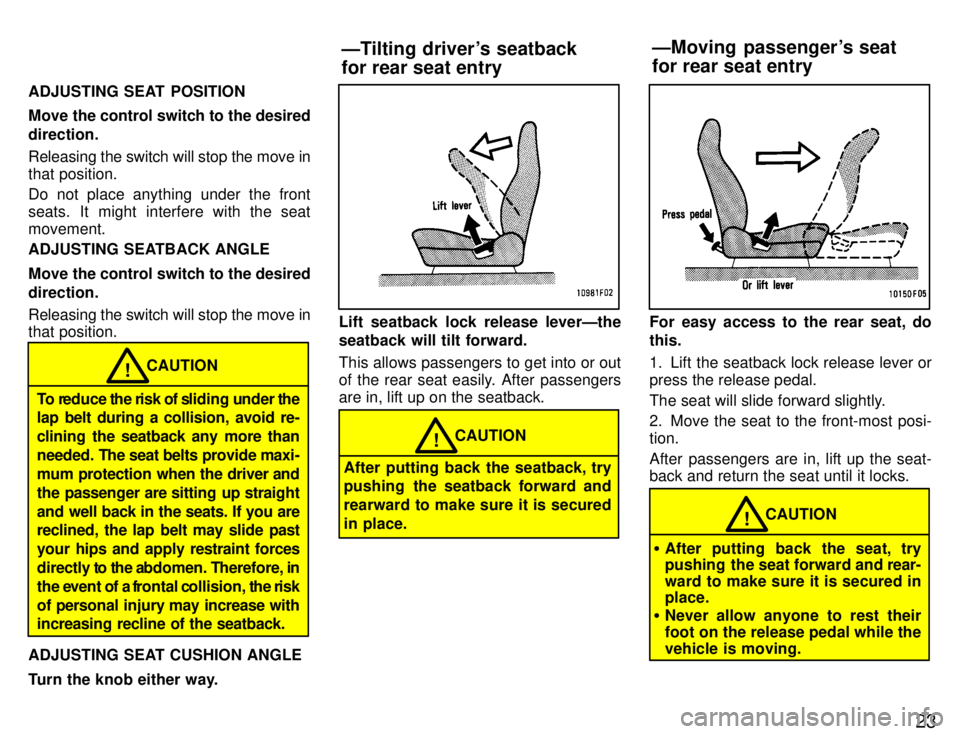
ADJUSTING SEAT POSITION
Move the control switch to the desired direction. Releasing the switch will stop the move in
that position.
Do not place anything under the front
seats. It might interfere with the seatmovement.
ADJUSTING SEATBACK ANGLE
Move the control switch to the desired direction. Releasing the switch will stop the move in
that position.
CAUTION!
To reduce the risk of sliding under the
lap belt during a collision, avoid re-
clining the seatback any more than
needed. The seat belts provide maxi-
mum protection when the driver and
the passenger are sitting up straight
and well back in the seats. If you are
reclined, the lap belt may slide past
your hips and apply restraint forces
directly to the abdomen. Therefore, in
the event of a frontal collision, the risk
of personal injury may increase with
increasing recline of the seatback.
ADJUSTING SEAT CUSHION ANGLE
Turn the knob either way.
Lift seatback lock release leverÐthe
seatback will tilt forward. This allows passengers to get into or out
of the rear seat easily. After passengersare in, lift up on the seatback.
CAUTION!
After putting back the seatback, try
pushing the seatback forward and rearward to make sure it is secured
in place.
For easy access to the rear seat, do this.
1. Lift the seatback lock release lever or press the release pedal.
The seat will slide forward slightly.
2. Move the seat to the front-most posi- tion.
After passengers are in, lift up the seat- back and return the seat until it locks.
CAUTION!
After putting back the seat, try
pushing the seat forward and rear-
ward to make sure it is secured inplace.
Never allow anyone to rest their
foot on the release pedal while the
vehicle is moving.
ÐMoving passenger's seat for rear seat entry
ÐTilting driver's seatbackfor rear seat entry
Page 25 of 188

24
FOLDING DOWN REAR SEAT
Unlock the seatback, and fold it down.
This will enlarge the luggage compart-
ment as far as the front seatbacks. See
Luggage stowage precautionsº in Part 2 for precautions to observe in loading lug- gage.SETTING UP REAR SEAT Unlock the seatback, and set it up.
CAUTION!
When returning the seatback to the
upright position: Make sure the seat belts are not
twisted or caught in the seatback
and are arranged in their proper
position for ready use.
Make sure the seatback is securely
locked by pushing forward and
rearward on the top of the seat- back.
To turn on the seat heater, push the Lº
switch for the driver's seat, and Rº
switch for the passenger's seat. The key must be in the ONº position. Once the seat is warmed up, the heat of
the seat heater is reduced automatically.
The indicator light above the switch illumi-nates when the seat heater is operating.
NOTICE
To prevent the battery from being discharged, turn the switch on
when the engine is running.
Fold-down rear seat Seat heaters
Page 26 of 188
25
Toyota strongly urges that the driver and passengers in the vehicle be properly re- strained at all times with the seat belts
provided. Failure to do so could increase
the chance of injury and/or the severity of
injury in accidents.
Baby or
small child. Use a child restraint
system which fits your vehicle. See Child
restraintº for details.Child. If a child is too large for a child re-
straint system, the child should sit in the rear seat and must be restrained using the
vehicle's seat belt. According to accident
statistics, the child is safer when properly
restrained in the rear seat than in the front
seat. Do not allow the child to stand up or
kneel on either rear or front seats. If the
shoulder belt falls across the child's neck
or face, have the child sit slightly closer to the center of the vehicle so that the belt
lays across the shoulder.
Pregnant woman. Toyota recommends
the use of a seat belt. Ask your doctor for
specific recommendations. The lap belt
should be worn securely and as low as
possible over the hips and not on the waist.
Injured person. Toyota recommends the
use of a seat belt. Depending on the injury,
however, first check with your doctor.
CAUTION!
Persons should ride in their seats
properly wearing their seat belts
whenever the vehicle is moving.
Otherwise, they are much more likely
to suffer serious bodily injury in the
event of s udden braking or a collision.
When using the seat belts, observe the following: Use the belt for only one person at
a time. Do not use a single belt for
two or more peopleÐeven children.
Avoid reclining the seatbacks too
much. The seat belts provide max-
imum protection when the seat- backs are in the upright position.
(See the seat adjustment instruc- tions.)
Be careful not to damage the belt
webbing or hardware. Take care
that they do not get caught or
pinched in the seat or doors.
Inspect the belt system periodical-
ly. Check for cuts, fraying, and
loose parts. Damaged parts
should be replaced. Do not disas-
semble or modify the system. Keep the belts clean and dry. If they
need cleaning, use a mild soap
solution or lukewarm water. Never
use bleach, dye, or abrasive clean-
ersÐthey may severely weaken the
belts.
Replace the belt assembly (includ-
ing bolts) if it has been used in a se-
vere impact. The entire assembly
should be replaced even if damage
is not obvious.
Seat beltsÐ ÐSeat belt precautions
Page 27 of 188
26
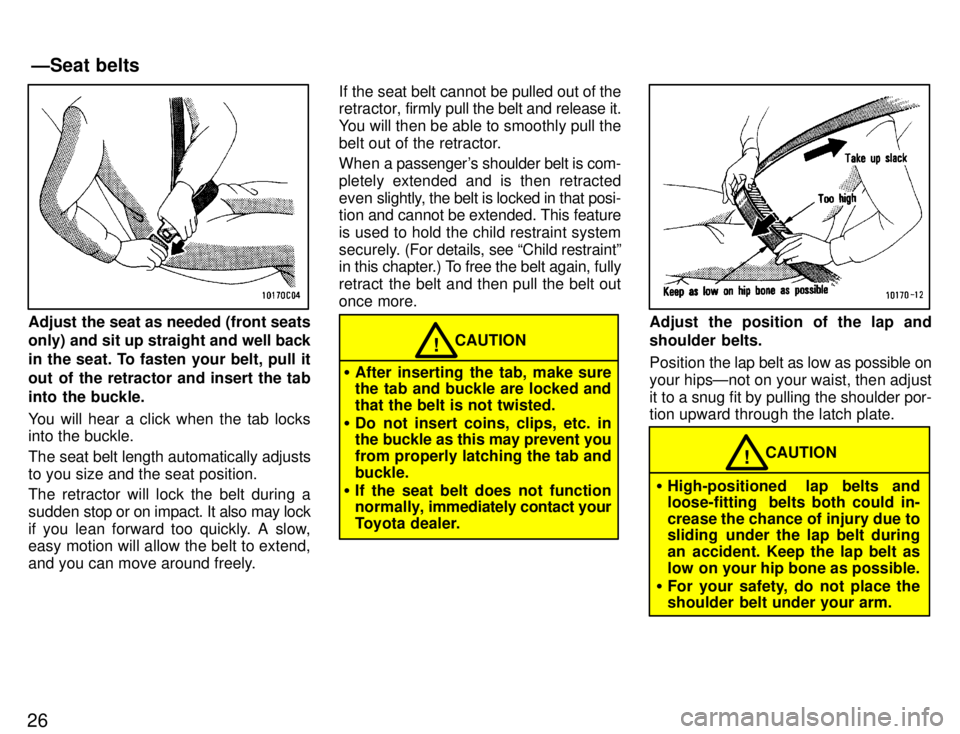
Adjust the seat as needed (front seats only) and sit up straight and well back
in the seat. To fasten your belt, pull it
out of the retractor and insert the tab
into the buckle.
You will hear a click when the tab locks into the buckle.
The seat belt length automatically adjusts
to you size and the seat position.
The retractor will lock the belt during a
sudden stop or on impact. It also may lock
if you lean forward too quickly. A slow, easy motion will allow the belt to extend,
and you can move around freely. If the seat belt cannot be pulled out of the
retractor,
firmly pull the belt and release it.
You will then be able to smoothly pull the
belt out of the retractor.
When a passenger's shoulder belt is com-
pletely extended and is then retracted
even slightly, the belt is locked in that posi-
tion and cannot be extended. This feature
is used to hold the child restraint system
securely. (For details, see Child restraintº
in this chapter.) To free the belt again, fully
retract the belt and then pull the belt out
once more.
CAUTION!
After inserting the tab, make sure
the tab and buckle are locked and that the belt is not twisted.
Do not insert coins, clips, etc. in
the buckle as this may prevent you
from properly latching the tab andbuckle.
If the seat belt does not function
normally, i mmediately contact your
Toyota dealer.
Adjust the position of the lap and
shoulder belts. Position the lap belt as low as possible on
your hipsÐnot on your waist, then adjust
it to a snug fit by pulling the shoulder por- tion upward through the latch plate.
CAUTION!
High-positioned lap belts and
loose-fitting belts both could in-
crease the chance of injury due to
sliding under the lap belt during
an accident. Keep the lap belt as
low on your hip bone as possible.
For your safety, do not place the
shoulder belt under your arm.
ÐSeat belts
Page 30 of 188

29
This indicator comes on when the
ignition key is turned to the ACCº or
ONº position. It goes off after about 6
seconds. This means the SRS airbags
are operating properly.
The SRS airbag warning light system
monitors the front airbag sensors, center
airbag sensor assembly, inflators, warn-
ing light, interconnecting wiring and power sources.The SRS airbag system is designed to
activate in response to a severe frontal
impact within the shaded area be-
tween the arrows in the illustration.
The SRS airbags will deploy if the severity
of the impact is above the designed
threshold level, comparable to an approxi-
mate 20 km/h (14 mph) collision when im-
pacting straight into a fixed barrier that
does not move or deform.
If the severity of the impact is below the
above threshold level, the SRS airbags
may not deploy. However, this threshold velocity will be
considerably higher if the vehicle strikes
an object, such as a parked vehicle or sign
pole, which can move or deform on im-
pact, or if it is
involved in an underride col-
lision (a collision in which the nose of the
vehicle underridesº, or goes under, the
bed of a truck). It is possible with collision severity at the marginal level of airbag sensor detection
and activation that only one of your ve-
hicle's two airbags will deploy.
For your safety, be sure to always wear your seat belts.
Page 34 of 188

33
Do not perform any of the followingchanges without consulting your
Toyota dealer. Such changes can interfere with proper operation ofthe SRS airbag system in some cases.
Installation of electronic itemssuch as a mobile two-way radio,
cassette tape player or compactdisc player
Modification of the suspension
system
Modification of the front end struc-
ture
Attachment of a grille guard (bull bar, kangaroo bar, etc.), snow-
plow, winches or any other equip-
ment to the front end
Repairs made on or near the frontfenders, rear console, steeringcolumn, steering wheel or dash-board near the front passenger
airbag
NOTICE
This SRS airbag system has a service re-
minder indicator to inform the driver of op-
erating problems. If either of the following
conditions occurs, this indicates a mal-
function of the airbags. Contact your To-
yota dealer as soon as possible to service
the vehicle. The light does not come on when the
ignition key is turned to the ACCº or
ONº position, or remains on.
The light comes on while driving.In the following cases, contact your Toyo-
ta dealer as soon as possible: The SRS airbags have been inflated.
The front part of the vehicle (shaded in the illustration) was involved in an ac-
cident not of the extent to cause the
SRS airbags to inflate.
The pad section of the steering wheel or
front passenger airbag cover (shaded in
the illustration) is scratched, cracked, or
otherwise damaged.