Page 133 of 188

131
6. After making sure that no one is in
the vehicle, raise it high enough so
that the spare tire can be installed.
Remember you will need more ground
clearance when putting on the spare tirethan when removing the flat tire.
To raise the vehicle, insert the jack handle
into the jack (it is a loose fit) and turn it
clockwise. As the jack touches the vehicle
and begins to lift, double-check that it is
properly positioned.
Never get under the vehicle when it is supported by the jack alone. CAUTION
!
7. Remove the wheel nuts and change tires.
Lift the flat tire straight off and put it aside.
Roll the spare wheel into position and
align the holes in the
wheel with the bolts.
Then lift up the wheel and get at least thetop bolt started through its hole. Wigglethe tire and press it back over the other bolts.Before putting on wheels, remove any
corrosion on the mounting surfaces with a
wire brush or such. Installation of wheels
without good metal-to-metal contact at
the mounting surface can cause wheel
nuts to loosen and eventually cause a
wheel to come off while driving. Therefore
after the first 1600 km (1000 miles), check
to see that the wheel nuts are tight.
ÐRaising your vehicle ÐChanging wheels
Page 134 of 188
132
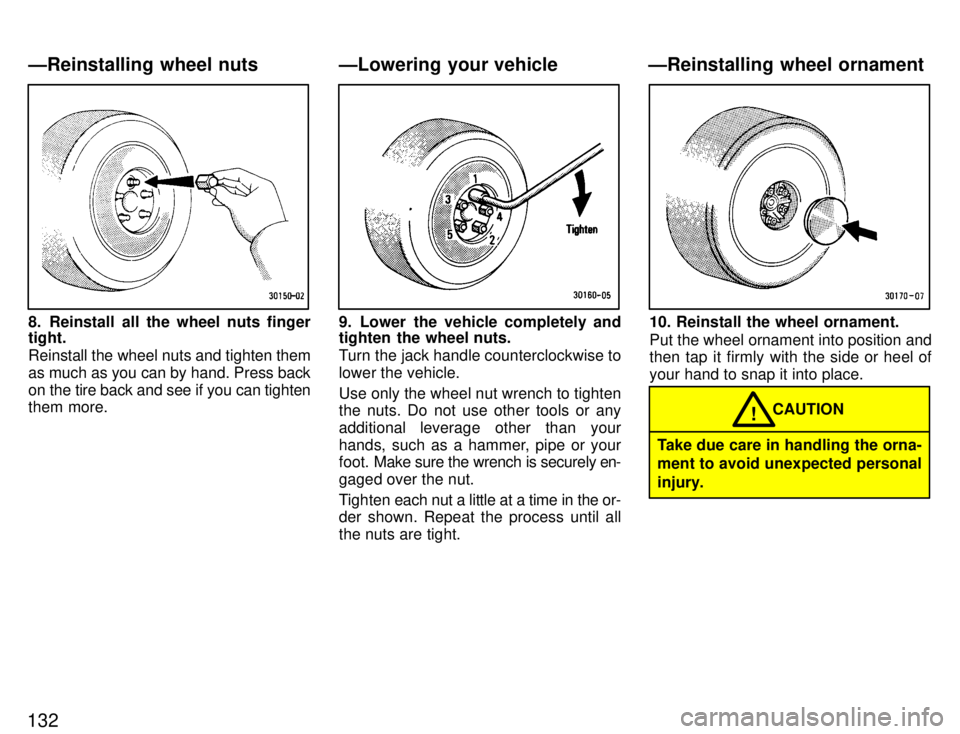
8. Reinstall all the wheel nuts finger tight.
Reinstall the wheel nuts and tighten them
as much as you can by hand. Press back
on the tire back and see if you can tighten
them more.9. Lower the vehicle completely and
tighten the wheel nuts.
Turn the jack handle counterclockwise to lower the vehicle. Use only the wheel nut wrench to tighten the nuts. Do not use other tools or any
additional leverage other than your
hands, such as a hammer, pipe or your
foot. M ake sure the wrench is securely en-
gaged over the nut.
Tighten each nut a little at a time in the or-
der shown. Repeat the process until all the nuts are tight.10. Reinstall the wheel ornament.
Put the wheel ornament into position and
then tap it firmly with the side or heel of your hand to snap it into place.
Take due care in handling the orna- ment to avoid unexpected personal
injury. CAUTION
!
ÐLowering your vehicle ÐReinstalling wheel ornament
ÐReinstalling wheel nuts
Page 159 of 188
157
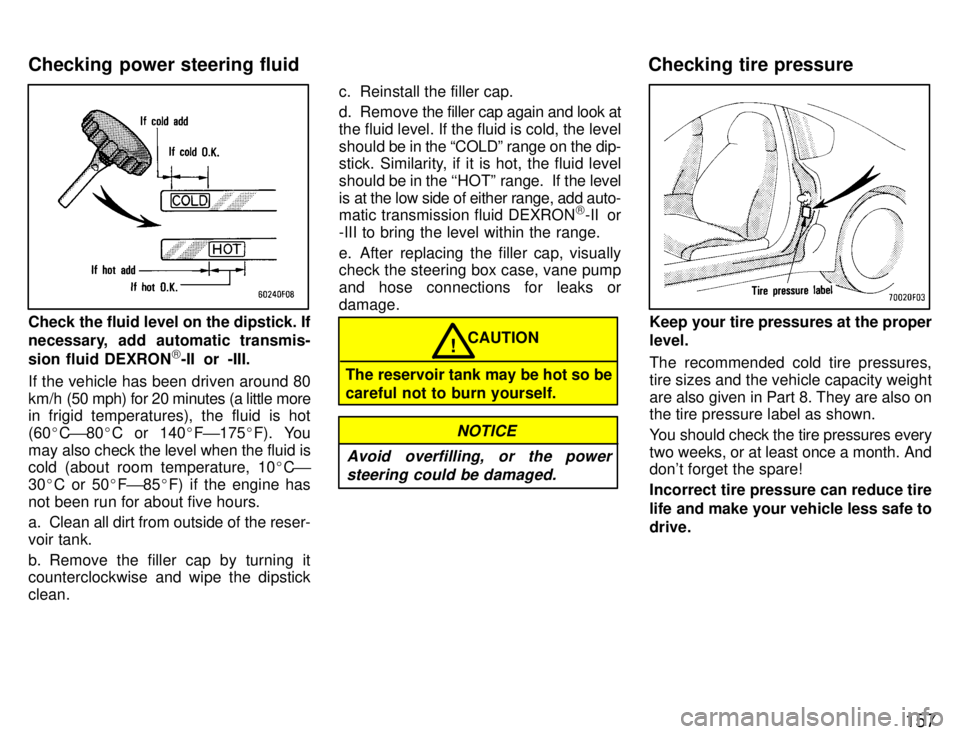
Check the fluid level on the dipstick. If
necessary, add automatic transmis-
sion fluid DEXRON)
-II or -III.
If the vehicle has been driven around 80
km/h (50 mph) for 20 minutes (a little more
in frigid temperatures), the fluid is hot(60 C ' 80 C or 140 F ' 175 F). You
may also check the level when the fluid is
cold (about room temperature, 10 C '
30 C or 50 F ' 85 F) if the engine has
not been run for about five hours.
a. Clean all dirt from outside of the reser- voir tank.
b. Remove the filler cap by turning it
counterclockwise and wipe the dipstick clean. c. Reinstall the filler cap.
d. Remove the filler cap again and look at the fluid level. If the fluid is cold, the level
should be in
the COLDº range on the dip-
stick. Similarity, if it is hot, the fluid level
should be in the ``HOTº range. If the level
is at the low side of either range, add auto-
matic transmission fluid DEXRON )
-II or
-III to bring the level within the range.
e. After replacing the filler cap, visually check the steering box case, vane pump
and hose connections for leaks ordamage.
CAUTION
The reservoir tank may be hot so be
careful not to burn yourself.!
Avoid overfilling, or the power steering could be damaged.
NOTICE
Keep your tire pressures at the proper level.
The recommended cold tire pressures, tire sizes and the vehicle capacity weightare also given in Part 8. They are also on the tire pressure label as shown.
You should check the tire pressures every
two weeks, or at least once a month. And
don't forget the spare!
Incorrect tire pressure can reduce tire
life and make your vehicle less safe to drive.
Checking power steering fluid
Checking tire pressure
Page 173 of 188
171
3. Turn the bulb clockwise and re- move it. Install a new bulb, turn it
counterclockwise, then plug in the
connector.
To install a bulb, align the tab of the bulb
socket with the cutouts of the mountinghole.
RIGHT SIDE HEADLIGHT: Install the air
cleaner cover securely.
Aiming is not necessary after replacing
the bulb. When aiming adjustment is nec-
essary, contact your Toyota dealer.1. Open the hood.
RIGHT SIDE HEADLIGHT: Release the
clips of the air cleaner and remove the
air cleaner cover.2. Unplug the connector while de-
pressing the lock release. If the connector is tight, wiggle it.
ÐHeadlights (high beam)
Page 174 of 188
172
3. Turn the bulb counterclockwise
and remove it. Install a new bulb, turn
it clockwise, then plug in the connec-
tor.
To install a bulb, align the tab of the bulb
socket with the cutouts of the mountinghole.
RIGHT SIDE HEADLIGHT: Install the air
cleaner cover securely.
Aiming is not necessary after replacing
the bulb. When aiming adjustment is nec-
essary, contact your Toyota dealer.1. Open the hood.
RIGHT SIDE HEADLIGHT: Release the
clips of the air cleaner and remove the
air cleaner cover.2. Turn the cover counterclockwise
and remove it.
ÐFront fog lights
Page 175 of 188
173
3. Disconnect the cords.4. Release the bulb retaining spring
and remove the bulb. Install a new
bulb and the bulb retaining spring.
To install the bulb, align the cutouts of the
bulb with the protrusions of the mountinghole.5. Connect the cords and install the cover by turning it clockwise.
RIGHT SIDE HEADLIGHT: Install the air
cleaner cover securely.