Page 141 of 195
136
If towing is necessary, we recommend
you have it done by your Toyota dealer
or a commercial tow truck service.
Proper equipment will help ensure that
your vehicle is not damaged while being
towed. Commercial operators are gener-
ally aware of the state/provincial and local
laws pertaining to towing.
Your vehicle can be damaged if it is towed
incorrectly. Although most operators know
the correct procedure, it is possible to
make a mistake. To avoid damage to your
vehicle, make sure the following few pre-
cautions are observed. If necessary, show
this page to the tow truck driver.
TOWING PRECAUTIONS:
Use a safety chain system for all towing,
and abide by the state/provincial and local
laws. The wheels and axle on the ground
must be in good condition. If they are
damaged, use a towing dolly.
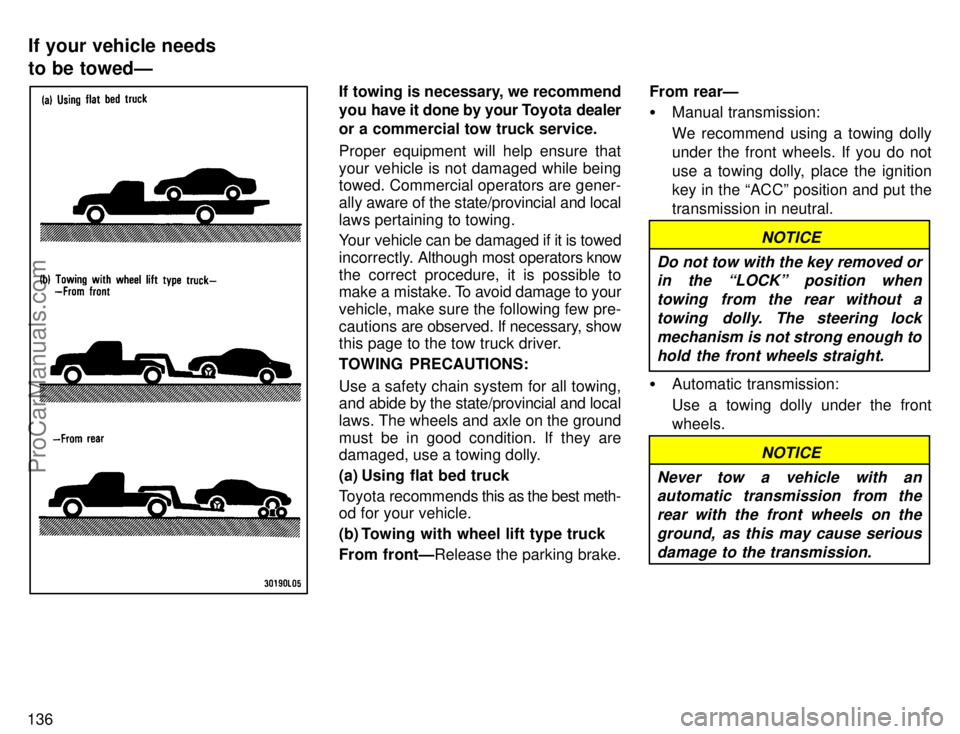
(a) Using flat bed truck
Toyota recommends this as the best meth-
od for your vehicle.
(b) Towing with wheel lift type truck
From frontÐRelease the parking brake.From rearÐ
�Manual transmission:
We recommend using a towing dolly
under the front wheels. If you do not
use a towing dolly, place the ignition
key in the ACCº position and put the
transmission in neutral.
NOTICE
Do not tow with the key removed or
in the LOCKº position when
towing from the rear without a
towing dolly. The steering lock
mechanism is not strong enough to
hold the front wheels straight.
�Automatic transmission:
Use a towing dolly under the front
wheels.
NOTICE
Never tow a vehicle with an
automatic transmission from the
rear with the front wheels on the
ground, as this may cause serious
damage to the transmission.
If your vehicle needs
to be towedÐ
ProCarManuals.com
Page 143 of 195

138
If you cannot shift the selector lever
out of Pº position to other positions
even though the brake pedal is de-
pressed, use the shift lock override
button as follows:
1. Turn the ignition key to LOCKº
position. Make sure the parking brake
is on.
2. Pry up the cover with a flat-bladed
screwdriver or equivalent.3. Insert the screwdriver or equivalent
into the hole to push down the shift
lock override button. You can shift out
of Pº position only while pushing the
button.
4. Shift into Nº position.
5. Insert the cover.
6. Start the engine. For your safety,
keep the brake pedal depressed.
Be sure to have the system checked by
your Toyota dealer as soon as possible.Many Toyota dealers can make a new
key if you can give them the key num-
ber.
See the suggestion given in Keysº in
Chapter 1-2.
If your keys are locked in the vehicle and
you cannot get a duplicate, many Toyota
dealers can still open the door for you, us-
ing their special tools. If you must break a
window to get in, we suggest breaking the
smallest side window because it is the
least expensive to replace. Be extremely
cautious to avoid cuts from the glass.
If you cannot shift automatic
transmission selector lever If you lose your keys
ProCarManuals.com
Page 156 of 195

151 If you perform maintenance by your-
self, be sure to follow the correct pro-
cedure given in this part.
You should be aware that improper or in-
complete servicing may result in operat-
ing problems.
Performing do-it-yourself maintenance
during the warranty period may affect
your warranty coverage. Read the sepa-
rate Toyota Warranty statement for details
and suggestions.
This part gives instructions only for those
items that are relatively easy for an owner
to perform. As explained in Part 6, there
are still a number of items that must be
done by a qualified technician with special
tools.
For information on tools and parts for do-
it-yourself maintenance, see Parts and
toolsº.
Utmost care should be taken when work-
ing on your vehicle to prevent accidental
injury. Here are a few precautions that you
should be especially careful to observe:
�When the engine is running, keep
hands, clothing, and tools away
from the moving fan and engine
drive belts. (Removing rings,
watches, and ties is advisable.)CAUTION
!
�Right after driving, the engine
compartmentÐthe engine, radia-
tor, exhaust manifold, power
steering fluid reservoir and spark
plug boots, etc.Ðwill be hot. So
be careful not to touch them. Oil,
fluids and spark plugs may also be
hot.
�If the engine is hot, do not remove
the radiator cap or loosen the drain
plugs to prevent burning yourself.
�Do not smoke, cause sparks or al-
low open flames around fuel or the
battery. Their fumes are flamable.
�Be extremely cautious when work-
ing on the battery. It contains poi-
sonous and corrosive sulfuric
acid.
�Do not get under your vehicle with
just the body jack supporting it. Al-
ways use automotive jack stands
or other solid supports.
�Be sure that the ignition is off if you
work near the electric cooling fans
or radiator grille. With the ignition
on, the electric cooling fan may au-
tomatically start to run if the air
conditioning is on.�Use eye protection whenever you
work on or under your vehicle
where you may be exposed to fly-
ing or falling material, fluid spray,
etc.
�Used engine oil contains poten-
tially harmful contaminants which
may cause skin disorders such as
inflammation or skin cancer, so
care should be taken to avoid pro-
longed and repeated contact with
it. To remove used engine oil from
your skin, wash thoroughly with
soap and water.
�Do not leave used oil within the
reach of children.
�Dispose of used oil and filter only
in a safe and acceptable manner.
Do not dispose of used oil and filter
in household trash, in sewers or
onto the ground. Call your dealer
or a service station for information
concerning recycling or disposal.
Do-it-yourself service
precautions
ProCarManuals.com
Page 174 of 195

169
If the headlights or other electrical
components do not work, check the
fuses. If any of the fuses are blown,
they must be replaced.
See Fuse locationsº in Chapter 7-1 for
locations of the fuses.
Turn the ignition switch and inopera-
tive component off. Pull a suspected
fuse straight out and check it.
Determine which fuse may be causing the
problem. The lid of the fuse box shows the
name of the circuit for each fuse. See Part
8 of this manual for the functions con-
trolled by each circuit.
Type A fuses can be pulled out by the pull-
out tool.If you are not sure whether the fuse has
blown, try replacing the suspected fuse
with one that you know is good.
If the fuse has blown, push a new fuse
into the clip.
Only install a fuse with the amperage rat-
ing designated on the fuse box lid.
If you do not have a spare fuse, in an
emergency you can pull out the CIG &
RADIOº, DOMEº or A/Cº fuse, which
may be dispensable for normal driving,
and use it if its amperage rating is the
same.
If you cannot use one of the same amper-
age, use one that is lower, but as close as
possible to the rating. If the amperage is
lower than that specified, the fuse might
blow out again but this does not indicate
anything wrong. Be sure to get the correct
fuse as soon as possible and return the
substitute to its original clip.
It is a good idea to purchase a set of spare
fuses and keep them in your vehicle for
emergencies.
If the new fuse immediately blows out,
there is a problem with the electrical sys-
tem. Have your Toyota dealer correct it as
soon as possible.
Checking and replacing fuses
ProCarManuals.com
Page 175 of 195

170
Never use a fuse with a higher am-
perage rating, or any other object, in
place of a fuse. This may cause ex-
tensive damage and possibly a fire.CAUTION
!
If any washer does not work, the wash-
er tank may be empty. Add washer
fluid.
You may use plain water as washer fluid.
However, in cold areas where tempera-
tures range below freezing point, use
washer fluid containing antifreeze. This
product is available at your Toyota dealer
and most auto parts stores. Follow the
manufacturer 's directions for how much
to mix with water.
NOTICE
Do not use engine antifreeze or any
other substitute because it may
damage your vehicle's paint.
The following illustrations show how to
gain access to the bulbs. When replacing
a bulb, make sure the ignition switch and
light switch are off. Use bulbs with the
wattage ratings given in the table.
Halogen bulbs have pressurized
gas inside and require special han-
dling. They can burst or shatter if
scratched or dropped. Hold a bulb
only by its plastic or metal case. Do
not touch the glass part of a bulb
with bare hands.CAUTION
!
NOTICE
Only use a bulb of the listed type.
Light BulbsBulb
No.WType
Headlight
(inner bulb)900565A
Headlights
(outer bulb)900655B
Parking and front
side marker lights1943.8D
Front turn signal
lights115627C
Adding washer fluid Replacing light bulbsÐ
ProCarManuals.com