Page 35 of 195

31 When the airbags inflate, they produce a
fairly loud noise and release some smoke
along with the nitrogen gas. This is not
harmful and does not indicate a fire. Be
sure to wash off any residue as soon as
possible to prevent minor skin irritation.
Deployment of the airbags happen in a
fraction of a second, so the airbags must
inflate with considerable force. While the
system is designed to reduce serious inju-
ries, it may also cause minor burns or
abrasions and swellings.
Parts of the airbag module (steering
wheel hub, dashboard) may be hot for
several minutes, but the airbags them-
selves will not be hot. The airbags are de-
signed to inflate only once.
A crash severe enough to inflate the air-
bags may break the windshield as the ve-
hicle buckles. In vehicles with a passen-
ger airbag the windshield may also be
damaged by absorbing some of the force
of the inflating airbag.
CAUTION!
�The SRS airbag system is de-
signed only as a supplement to
the primary protection of the seat
belt systems of the driver and
front passenger. The front seat oc-
cupants are particularly suscepti-
ble to injury if they do not wear
their seat belts; when sudden
braking or a collision occurs, they
may be thrown forward. To obtain
further protection in an accident,
the driver and all passengers in
the vehicle should always wear
their seat belts when driving. For
instructions and precautions con-
cerning the seat belt system, see
Seat beltsº in this chapter.
�A baby or small child who is too
small to use a seat belt should be
properly secured in a rear seat us-
ing a child restraint system.
�Do not use a rear-facing child re-
straint system in the front seat be-
cause the force of the rapid inflation
of the passenger airbag may cause
severe injury to the child. Vehicles
with a passenger airbag display a
caution label on the passenger side
instrument panel as shown above
to remind you not to install a rear-
facing child restraint system on the
front seat.
ProCarManuals.com
Page 44 of 195

39
CAUTION!
Make sure the child is securely re-
strained with the built-in child re-
straint. Failure to follow the manufac-
turer 's instructions on the use of this
child restraint system can result in
your child striking the vehicle's inte-
rior during a sudden stop or crash.
Snugly adjust the belts provided with
the child restraint around your child.
When using the built-in child re-
straint, observe the following:
�Use the belts for only one child at
a time. Do not use the belts for two
or more children.
�Be careful not to damage the belt
webbing or hardware. Take care
that they do not get caught or
pinched in the seatback.
�Inspect the belt system periodical-
ly. Check for cuts, fraying, and
loose parts. Damaged parts should
be replaced. Do not disassemble or
modify the child restraint belt sys-
tem.
�Keep the belts clean and dry. If they
need cleaning, use a mild soap
solution or lukewarm water. Never
use bleach, dye, or abrasive clean-
ersÐthey may severely weaken the
belts.
�Replace the built-in child restraint
assembly if it has been used in a
severe impact. The entire assem-
bly should be replaced even if
damage is not obvious.
�Do not use another child restraint
system over the opened built-in
child restraint.
�Do not use the adult lap and shoul-
der belt with the built-in child re-
straint.
1. Separate the fastener tapes behind
the head restraint to separate the head
pad from the seatback. Lower the child
restraint cushion and fold back the
head pad under the child restraint
cushion.
CAUTION!
Do not use the built-in child restraint
with the head pad unfolded.
ProCarManuals.com
Page 48 of 195

43
8. To release the child from the seat
belts, compress the shoulder belt clip,
then press the buckle release button.
Move both belts off the child's shoulders.9. To store the built-in child restraint,
fasten the shoulder belt clip and return
the seat belt buckle using the fastener
tapes. Fold up the seat belt adjustment
strap in the seat. Then raise the seat
cushion and return the head pad by
engaging the fastener tapes while
pressing the child restraint cushion
and head pad firmly.A child restraint system for a small
child or baby must itself be restrained
on the seat with either the lap belt or
the lap portion of the lap/shoulder
belt.
The child restraint system should conform
to the size of the child and properly fit the
vehicle seat. For greater safety, the child
restraint system should be installed in the
rear seat. According to accident statistics,
children are safer when properly re-
strained in the rear seat than in the front
seat.
When installing a child restraint system,
follow the instructions provided by the
manufacturer of the system. General di-
rections are also provided under the fol-
lowing illustrations.
CAUTION!
After installing the child restraint
system, make sure it is secured in
place. If it is not restrained securely,
it may cause injury to the child in the
event of a sudden stop or accident.
When not using the child restraint system,
keep it secured with the seat belt or place
it somewhere other than in passenger
compartment. This will prevent it injuring
passengers in the event of a sudden stop
or accident.
-Child restraint system
ProCarManuals.com
Page 49 of 195

44Your vehicle has anchors for securing the
top strap of a child restraint system. The
anchor nuts are welded beneath the sheet
metal to permit installation of an anchor
bracket for a child restraint system.
To install an anchor bracket, use an 8 mm
x 30 mm x 1.25 mm coarse thread metric
bolt and 10 mm (0.4 in.) spacer. Note that
the bolts accompanying many child re-
straint systems are not metric. You can
damage the anchor nuts on your vehicle
if you force bolts with different thread into
the anchor nuts.
For instructions about how to install the
anchor bracket, see (C) TOP STRAP
ANCHORS AND LOCATIONSº.
If your child restraint system does not pro-
vide any of the necessary parts, you can
purchase the following items from your
Toyota dealer.
* CRS installation kit
(Part No. 04731-22012)
Ðcontains 1 bolt, 3 types of spacers
and 1 locking clip.
* Bolt (Part No. 91511-60830)
(A) INSTALLATION ON REAR SEAT
CENTER
When installing a rear-facing child re-
straint system, follow the same procedure
as when installing a forward-facing child
restraint system.
CAUTION!
Do not use a rear-facing child re-
straint system in the rear seat if it in-
terferes with the lock mechanism of
the front seats. This may cause se-
vere injury to the child and front
passenger in case of sudden brak-
ing or a collision.
ProCarManuals.com
Page 51 of 195
46
CAUTION!
Push and pull the child restraint
system in different directions to be
sure it is secure.
4. To remove the child restraint system,
press the buckle-release button and un-
hook the top strap.
ProCarManuals.com
Page 53 of 195
48
2. Fully extend the shoulder belt to put it
in the lock mode.3. Place the shoulder belt between the
vehicle seatback and the child restraint
system and allow it to retract. To hold the
child restraint system securely, let the
shoulder belt retract as far as it will go
while firmly pushing down the child re-
straint system.4. If your child restraint system requires
the use of a top strap, latch the hook onto
the anchor bracket and tighten the top
strap.
ProCarManuals.com
Page 54 of 195
49
CAUTION!
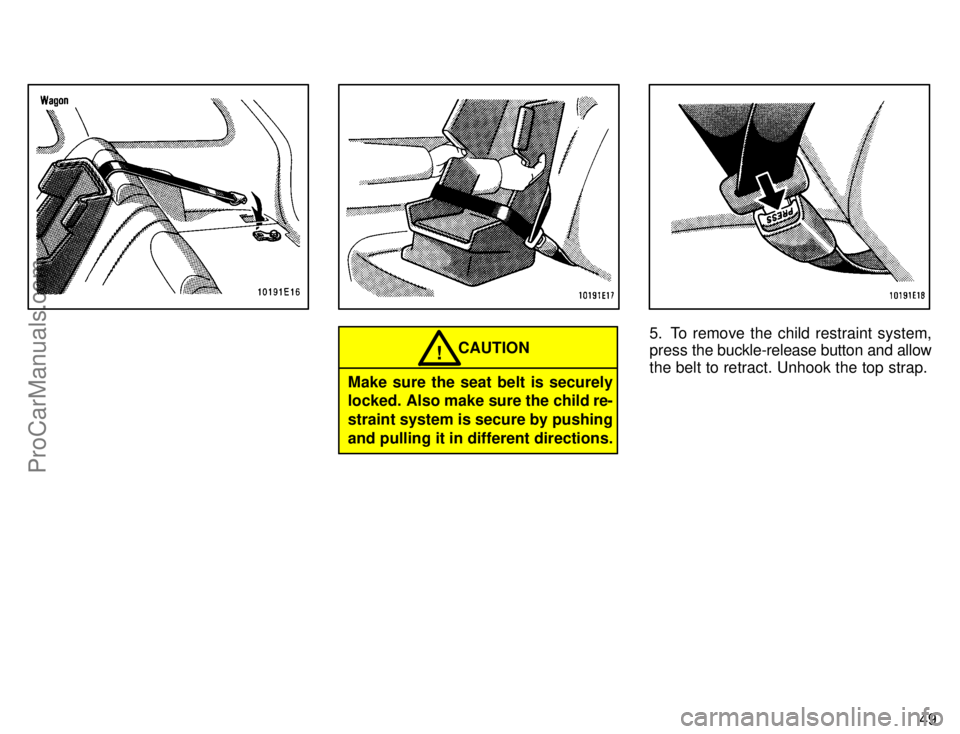
Make sure the seat belt is securely
locked. Also make sure the child re-
straint system is secure by pushing
and pulling it in different directions.
5. To remove the child restraint system,
press the buckle-release button and allow
the belt to retract. Unhook the top strap.
ProCarManuals.com
Page 58 of 195
53
2. Fully extend the shoulder belt to put in
the lock mode.3. Place the shoulder belt between the
vehicle seatback and the child restraint
system and allow it to retract. To hold the
child restraint system securely, let the
shoulder belt retract as far as it will go
while firmly pushing down the child re-
straint system.4. If your child restraint system requires
the use of a top strap, latch the hook onto
the tab of the rear center belt and tighten
the top strap.
ProCarManuals.com