Page 50 of 203
Part 1Headlights and turn signals43
OPERATION OF
INSTRUMENTS AND
CONTROLSÐ
Chapter 1-4
Lights, Wipers
and Defogger
�Headlights and turn signals
� Emergency flashers
� Instrument panel light control
� Front fog lights
� Interior lights
� Personal lights
� Ignition switch light
� Luggage compartment light
� Windshield wipers and washer
� Rear window wiper and washer
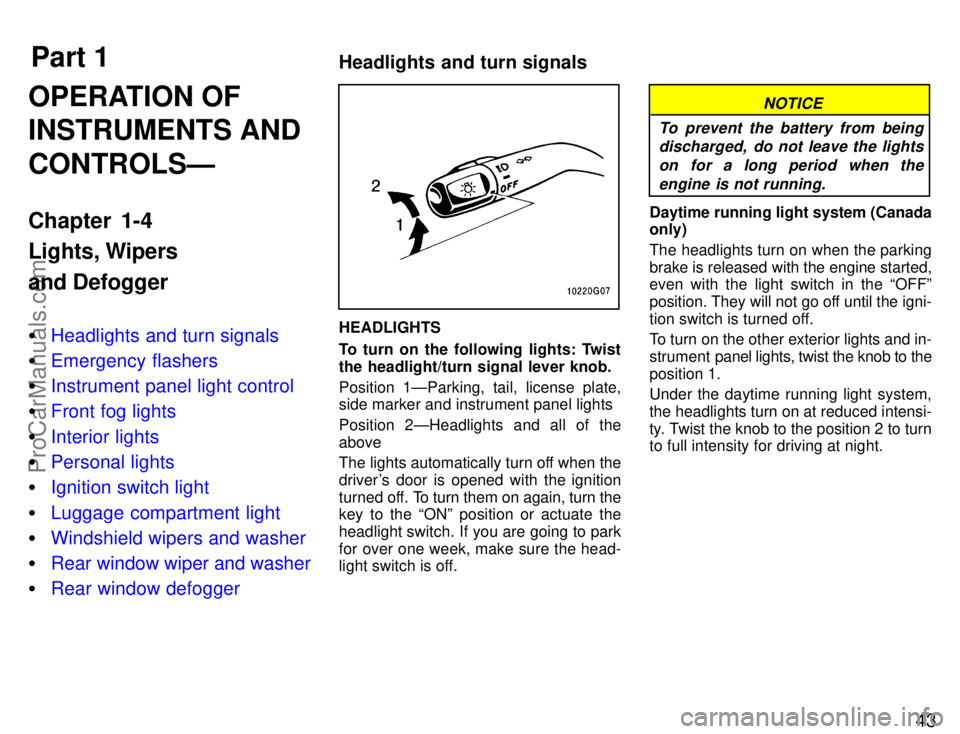
� Rear window defoggerHEADLIGHTS
To turn on the following lights: Twist
the headlight/turn signal lever knob.
Position 1ÐParking, tail, license plate,
side marker and instrument panel lights
Position 2ÐHeadlights and all of the
above
The lights automatically turn off when the
driver's door is opened with the ignition
turned off. To turn them on again, turn the
key to the ONº position or actuate the
headlight switch. If you are going to park
for over one week, make sure the head-
light switch is off.
NOTICE
To prevent the battery from being discharged, do not leave the lights
on for a long period when theengine is not running.
Daytime running light system (Canada
only)
The headlights turn on when the parking
brake is released with the engine started,
even with the light switch in the OFFº
position. They will not go off until the igni-
tion switch is turned off.
To turn on the other exterior lights and in-
strument panel lights, twist the knob to the
position 1.
Under the daytime running light system,
the headlights turn on at reduced intensi-
ty. Twist the knob to the position 2 to turn
to full intensity for driving at night.
ProCarManuals.com
Page 51 of 203

44
High-low beamsÐFor high beams, turn
the headlights on and push the lever away
from you (position 1). Pull the lever toward
you (position 2) for low beams.
The headlight high beam indicator light
(blue light) on the instrument panel will tell
you that the high beams are on.
Flashing the high beam headlights
(position 3)ÐPull the lever all the way
back. The high beam headlights turn off
when you release the lever.
You can flash the high beam headlights
with the knob turned to OFFº.TURN SIGNALS
To signal a turn, push the headlight/
turn signal lever up or down to posi-
tion 1.
The key must be in the ONº position.
The lever automatically returns after you
make a turn, but you may have to return
it by hand after you change lanes.
To signal a lane change, move the lever
up or down to the pressure point (position
2) and hold it.
If the turn signal indicator lights (green
lights) on the instrument panel flash faster
than normal, a front or rear turn signal bulb
is burned out.To turn on the emergency flashers,
push the switch.
All the turn signal lights will flash. To turn
them off, push the switch once again.
Turn on the emergency flashers to warn
other drivers if your vehicle must be
stopped where it might be a traf fic hazard.
Always pull as far off the road as possible.
The turn signal light switch will not work
when the emergency flashers are operat-
ing.
Emergency flashers
ProCarManuals.com
Page 52 of 203
45
NOTICE
To prevent the battery from being discharged, do not leave the switch
on longer than necessary when theengine is not running.
To adjust the brightness of the instru-
ment panel lights, turn the knob.To turn on the front fog lights, twist the
band of the headlight and turn signal
switch lever. They will come on when
the tail lights are turned on.
Instrument panel light control Front fog lights
ProCarManuals.com
Page 53 of 203

46
To turn on the interior light, push the
switch. To turn the light off, slightly
push the switch on the opposite side.
The interior light switch has the following
position:
ONºÐTurns the light all the time.
DOORºÐTurns the light on when either
side door or the back door is opened. The
light goes off when both side doors and
the back door are closed.The interior lights operate separately
with each outer switch.
To turn on the light, push the switch on
your side. To turn the light off, push the
switch once again.
The center switch has the following posi-
tions:
DOORºÐTurn both lights on when either
side door or the back door is opened. The
lights remain on for some time after both
side doors and the back door are closed.
OFFºÐThe lights are off unless you op-
erate either outside switch.To operate the personal light, move
the knob.
To turn on: Push the knob forward.
To turn off: Pull the knob backward.
The light comes on when either side door
is opened.
Interior lights (without moon
roof) Personal lights
Interior light (with moon roof)
ProCarManuals.com
Page 54 of 203
47
For easy access to the ignition switch,
the ignition switch light comes on
when either side door or the back door
is opened.
The light remains on for some time after
both side doors and the back door are
closed.To turn the luggage compartment light
on, open the back door and push the
switch. Closing the back door will turn
the light off.To turn on the windshield wipers,
move the lever.
The key must be in the ONº position.
There are three speed settings:
IntermittentÐWith the lever at the posi-
tion 1
SlowÐWith the lever at the position 2
FastÐWith the lever at the position 3
With interval adjuster: The INT TIMEº
band lets you adjust the wiping time inter-
val when the wiper lever is in the intermit-
tent position (position 1). Twist the band
upward to increase the time between
sweeps, and downward to decrease it.
Ignition switch light Windshield wipers and washer
Luggage compartment light
(liftback)
ProCarManuals.com
Page 56 of 203
49
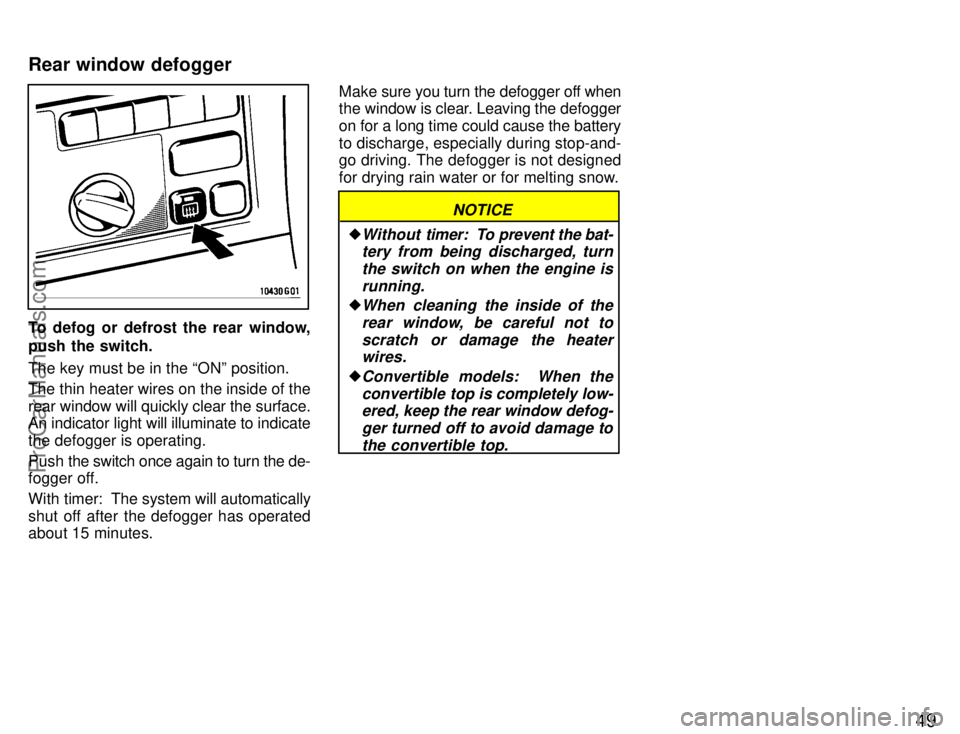
To defog or defrost the rear window,
push the switch.
The key must be in the ONº position.
The thin heater wires on the inside of the
rear window will quickly clear the surface.
An indicator light will illuminate to indicate
the defogger is operating.
Push the switch once again to turn the de-
fogger off.
With timer: The system will automatically
shut off after the defogger has operated
about 15 minutes. Make
sure you turn the defogger off when
the window is clear. Leaving the defogger
on for a long time could cause the battery
to discharge, especially during stop-and-
go driving. The defogger is not designed
for drying rain water or for melting snow.
NOTICE
�Without timer: To prevent the bat-
tery from being discharged, turn
the switch on when the engine isrunning.
�When cleaning the inside of therear window, be careful not toscratch or damage the heaterwires.
�Convertible models: When the
convertible top is completely low-ered, keep the rear window defog-
ger turned off to avoid damage tothe convertible top.
Rear window defogger
ProCarManuals.com
Page 58 of 203
Part 1Fuel gauge51
OPERATION OF
INSTRUMENTS AND
CONTROLSÐ
Chapter 1-5
Gauges, Meters
and Service reminder
indicators
�Fuel gauge
� Engine coolant temperature
gauge
� Tachometer
� Odometer and trip meter
� Service reminder indicators and
warning buzzers
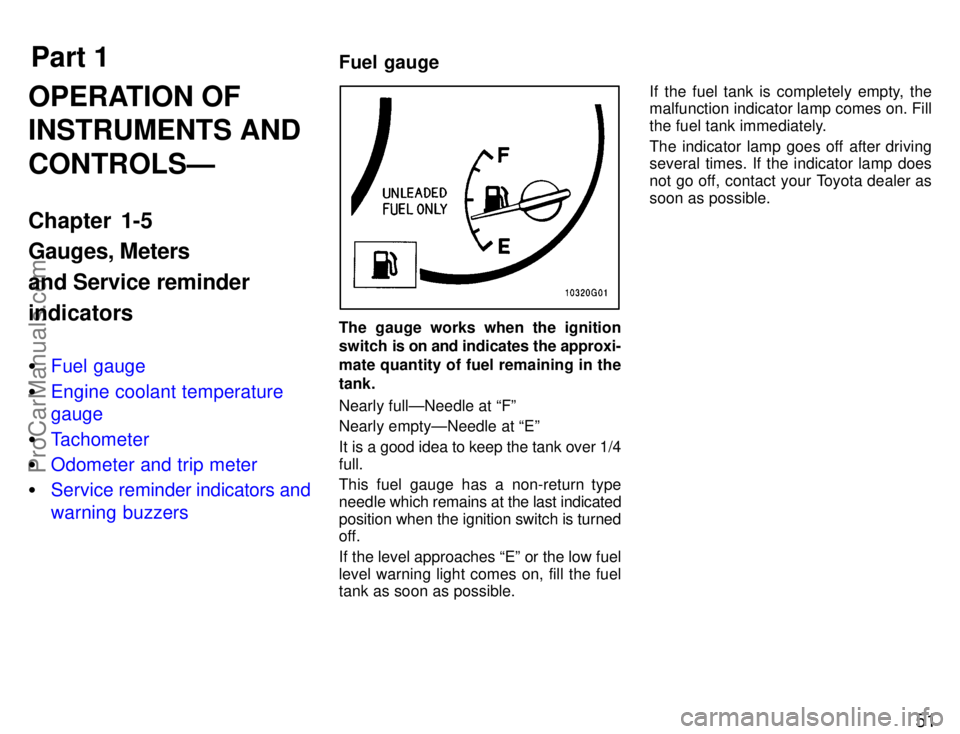
The gauge works when the ignition
switch is on and indicates the approxi-
mate quantity of fuel remaining in the
tank.
Nearly fullÐNeedle at Fº
Nearly emptyÐNeedle at Eº
It is a good idea to keep the tank over 1/4
full.
This fuel gauge has a non-return type
needle wh ich remains at the last indicated
position when the ignition switch is turned
off.
If the level approaches Eº or the low fuel
level warning light comes on, fill the fuel
tank as soon as possible. If the fuel tank is completely empty, the
malfunction indicator lamp comes on. Fill
the fuel tank immediately.
The indicator lamp goes off after driving
several times. If the indicator lamp does
not go off, contact your Toyota dealer as
soon as possible.
ProCarManuals.com
Page 61 of 203

54
(a) Brake System Warning Light
This light has the following functions:
Parking brake reminder
If this light is on, make sure the parking
brake is fully released. The light should go
off.
Low brake fluid level warning
If this light comes on and stays on while
you are driving, slowdown and pull off the
road. Then stop the vehicle carefully.
There maybe a problem somewhere in
the brake system. Check the fluid level of
the see-through reservoir.
To make sure the parking brake has not
caused the warning light to come on,
check to see that the parking brake is fully
released.
If the brake fluid level is low...
At a safe place, test your brakes by start-
ing and stopping.
�If you judge that the brakes still work
adequately, drive cautiously to your
nearest dealer or shop for repairs.
� If the brakes are not working, have the
vehicle towed in for repairs. (For tow-
ing information, see Part 4.)
It is dangerous to continue driving
normally when the brake fluid level
is low. CAUTION
!
If the brake fluid level is correct...
Have the warning system checked by
your Toyota dealer.
(b) Seat Belt Reminder Light and
Buzzer
Once the ignition key is turned to ONº or
STARTº, the reminder light and buzzer
come on if the driver's seat belt is not fas-
tened. Unless the driver fastens the belt,
the light stays on and the buzzer stops af-
ter about 4 to 8 seconds.
(c) Discharge Warning Light
This light warns that the battery is being
discharged.
If it comes on while you are driving, there
is a problem somewhere in the charging
system.
The engine ignition will continue to oper-
ate, however, until the battery is dis-
charged. Turn off the air conditioning,
blower, radio, e tc., and drive directly to the
nearest Toyota dealer or repair shop.
NOTICE
Do not continue driving if the engine drive belt is broken or loose.
(d) Low Oil Pressure Warning Light
This light warns that the engine oil pres-
sure is too low.
If it flickers or stays on while you are driv-
ing, pull off the road to a safe place and
stop the engine immediately. Call a Toyota
dealer or qualified repair shop for assis-
tance.
The light may occasionally flicker when
the engine is idling or it may come on brief-
ly after a hard stop. There is no cause for
concern if it then goes out when the en-
gine is accelerated slightly.
The light may come on when the oil level
is extremely low. It is not designed to indi-
cate low oil level, and the oil level must be
checked using the level dipstick.
NOTICE
Do not drive the vehicle with the warning light onÐeven for one
block. It may ruin the engine.
(e) Malfunction indicator lamp
This lamp comes on in the following
cases.
a. The fuel tank is completely empty.
(See Fuel gaugeº in Chapter 1-5 for in-
structions.)
ProCarManuals.com