1996 TOYOTA 4RUNNER parking brake
[x] Cancel search: parking brakePage 151 of 217
148When restarting out after parking on a slope:
1. With the transmission in Pº position
(automatic) or
the clutch pedal depressed
(manual), start the engine. (With an auto-
matic transmission, be sure to keep thebrake pedal depressed.)
2. Shift into gear.
3. Release the parking brake (also foot
brake on automatic transmission ve-
hicles) and slowly pull or back away from
the wheel blocks. Stop and apply yourbrakes.
4. Have someone retrieve the blocks.
CAUTION!
Do not exceed 72 km/h (45 mph) or
the posted towing speed limit,
whichever is lower. Because in-
stability (swaying) of a towing ve-
hicle-trailer combination usually
increases as the speed increases,
exceeding 72 km/h (45 mph) maycause loss of control.
Slow down and downshift before
descending steep or long downhill
grades. Do not make suddendownshifts.
Avoid holding the brake pedal
down too long or too frequently.
This could cause the brakes to
overheat and result in reduced
braking efficiency. Getting
more kilometers/mileage from a li-
ter/gallon of fuel is easyÐjust take it easy.
It will help make your vehicle last longer,
too. Here are some specific tips on how to
save money on both fuel and repairs: Keep your tires inflated at the cor- rect pressure. Underinflation causes
tire wear and wastes fuel. See Chapter
7-2 for instructions.
Do not carry unneeded weight in
your vehicle. Excess weight puts a
heavier load on the engine, causinggreater fuel consumption.
Avoid lengthy warm-up idling.
Once the engine is running smoothly,
begin drivingÐbut gently. Remember,
however, that on cold winter days this
may take a little longer.
Accelerate slowly and smoothly.
Avoid jackrabbit starts. Get into high
gear as quickly as possible.
Avoid long engine idling. If you have
a long wait and you are not in traffic, it
is better to turn off the engine and start
again later.
Avoid engine lug or overrevving.
Use a gear position suitable for the
road on which you are travelling.
How to save fuel and make
your vehicle last longer, too
Page 158 of 217
155
If your engine coolant temperature
gauge indicates overheating, if you
experience a loss of power, or if you
hear a
loud knocking or pinging noise,
the engine has probably overheated.
You should follow this procedure 0
1. Pull safely off the road, stop the vehicle
and turn on your emergency flashers. Put
the transmission in Pº (automatic) or neu-
tral ( manual) and apply the parking brake.
Turn off the air conditioning if it is beingused.
2. If coolant or steam is boiling out of the
radiator or reservoir, stop the engine. Wait
until the steam subsides before opening
the hood. If there is no coolant boiling over or steam, leave the engine running.
To help avoid personal injury, keep
the hood closed until there is no steam. Escaping steam or coolant is
a sign of very high pressure. CAUTION
! 3. Visually
check to see if the engine drive
belt (fan belt) is broken or loose. Look for
obvious coolant leaks from the radiator,
hoses, and under the vehicle. However, note that water draining from the air condi-
tioning is normal if it has been used.
When the engine is running, keep
hands and clothing away from the
moving fan and engine drive belts. CAUTION
!
4. If the engine drive belt is broken or the
coolant is leaking, stop the engine imme-
diately. Call a Toyota dealer for assis-tance.
5. If the engine drive belt is O.K. and there are no obvious leaks, you may help
the engine cool down more quickly by run- ning it at about 1500 rpm for a few minutes with the accelerator pedal lightly de-pressed.
6. Check the coolant reservoir. If it is dry,
add coolant to the reservoir while the en-gine is running. Fill it about half full.
Do not attempt to remove the radia-
tor cap when the engine and radia-
tor are hot. Serious injury could re-
sult from scalding hot fluid and
steam blown out under pressure. CAUTION
!
7. After the engine coolant temperature
has cooled to normal, again check the
coolant level in the reservoir. If necessary,
bring it up to half full again. Serious cool- ant loss indicates a leak in the system.
You should have it checked as soon as
possible at your Toyota dealer.
If your vehicle overheats
Page 159 of 217
1561. Reduce
your speed gradually, keeping
a straight line. Move cautiously off the
road to a safe place well away from the
traffic. Avoid stopping on the center divid-
er of a highway. Park on a level spot with firm ground.
2. Stop the engine and turn on your emer-
gency flashers.
3. Firmly set the parking brake and put the transmission in Pº (automatic) or re- verse (manual).
4. Have everyone get out of the vehicle
on the side away from traffic.
5. Read the following instructions thor-
oughly.
When jacking, be sure to observe
the following to reduce the possibil-
ity of personal injury: Follow jacking instructions.
Use the jack only for lifting your
vehicle during wheel changing.
Never get beneath the vehicle
when supported by the jack.
Do not start or run the engine
while your vehicle is supported by a jack. CAUTION
!
NOTICE
Do not continue driving with a deflated tire. Driving even a short
distance can damage a tire beyondrepair.
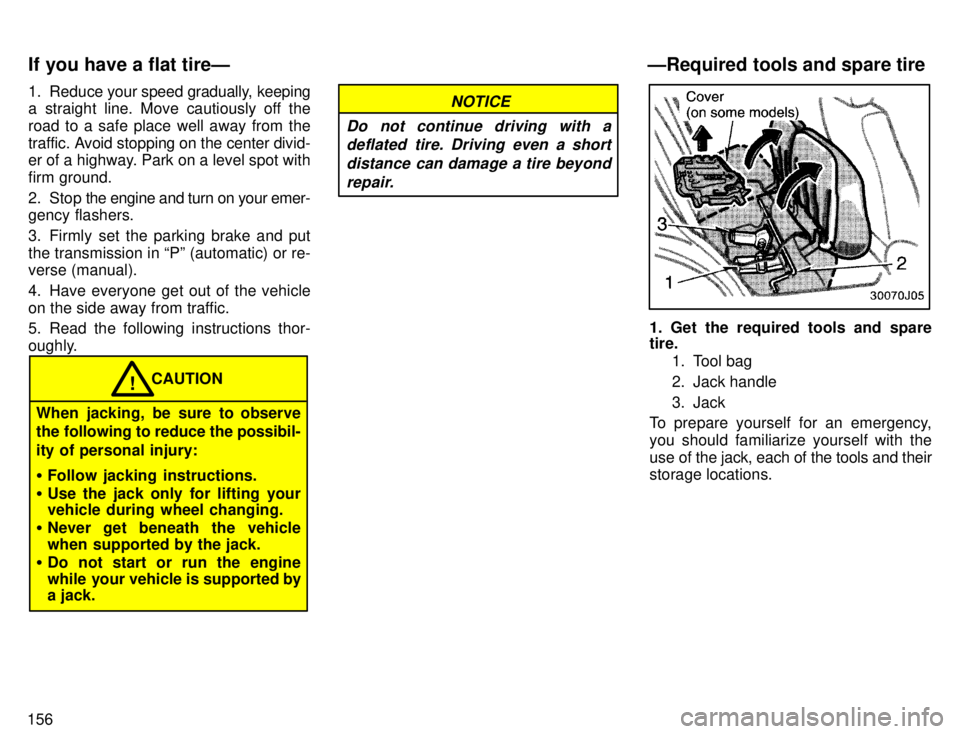
1. Get the required tools and spare tire. 1. Tool bag
2. Jack handle
3. Jack
To prepare yourself for an emergency, you should familiarize yourself with the
use of the jack, each of the tools and their storage locations.
If you have a flat tireÐ
ÐRequired tools and spare tire
Page 166 of 217
163
(b) Towing with wheel lift type truck From frontÐ
Manual transmission:
We recommend using a towing dolly un-
der the rear wheels. If you do not use a
towing dolly, release the parking brake
and put the transmission in neutral. Automatic transmission:
Use a towing dolly under the rear wheels.
NOTICE
Never tow a vehicle with an auto- matic transmission from the front
with the rear wheels on the ground,as this may cause serious damage to the transmission.
From rearÐ Place the ignition key in the
ACCº position.
NOTICE
Do not tow with the key removed or in the LOCKº position, as the steer-
ing lock mechanism is not strongenough to hold the front wheels straight while towing.
(c) Towing with sling type truck from front
Follow the instructions for towing from
front in (b) Towing with wheel lift type truckº.
Four±wheel drive modelsÐ
(a) Using flat bed truck
Toyota recommends this as the best method for your vehicle.
(b) Towing with wheel lift type truck From frontÐ Manual transmission:
We recommend using a towing dolly un-
der the rear wheels. If you do not use a
towing dolly, release the parking brake,
put the transmission in neutral and set the
transfer in H2º. Automatic transmission:
Use a towing dolly under the rear wheels.
NOTICE
Never tow a vehicle with an auto- matic transmission from the front
with the rear wheels on the ground,as this may cause serious damage to the transmission.
From rearÐ We recommend using a tow-
ing dolly under the front wheels. If you do
not use a towing dolly, place the ignitionkey in the ACCº position, put the trans-
mission in neutral and the transfer in H2º.
NOTICE
Do not tow with the key removed or in the LOCKº position when tow-
ing from the rear without a towingdolly. The steering lock mechanism is not strong enough to hold thefront wheels straight.
(c) Towing with sling type truck from front
Follow the instructions for towing from
front in (b) Towing with wheel lift typetruckº.
Page 167 of 217
164
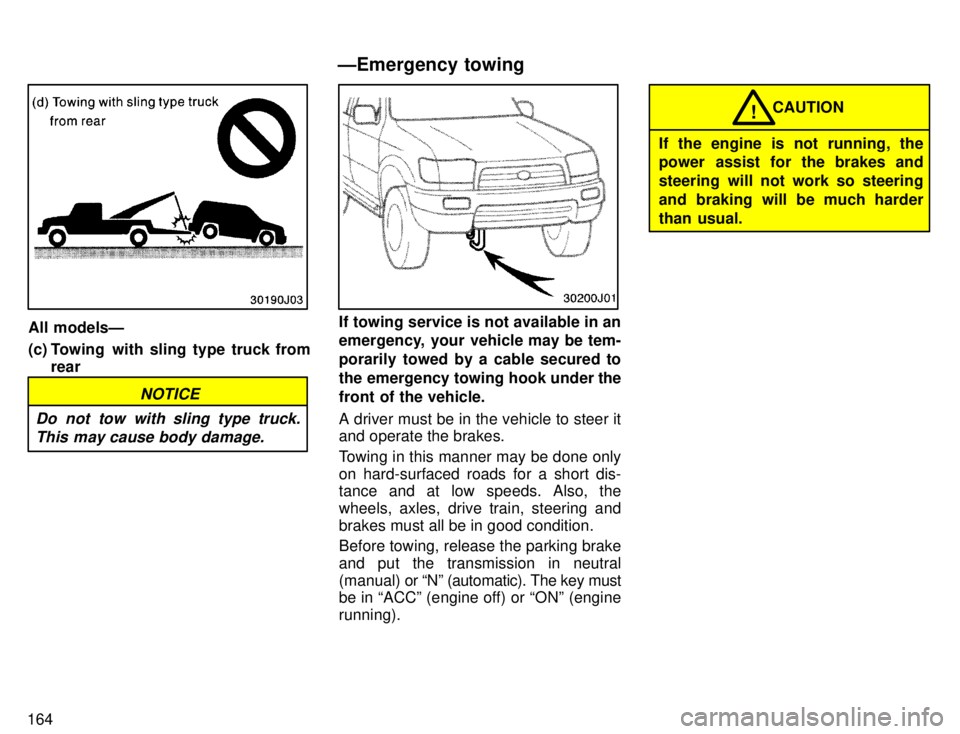
All modelsÐ
(c) Towing with sling type truck fromrear
NOTICE
Do not tow with sling type truck. This may cause body damage.
If towing service is not available in an
emergency, your vehicle may be tem-
porarily towed by a cable secured to
the emergency towing hook under the
front of the vehicle. A driver must be in the vehicle to steer it and operate the brakes.
Towing in this manner may be done only
on hard-surfaced roads for a short dis-
tance and at low speeds. Also, the
wheels, axles, drive train, steering andbrakes must all be in good condition. Before towing, release the parking brake
and put the transmission in neutral
(manual) or Nº (automatic). The key must
be in ACCº (engine off) or ONº (enginerunning).
CAUTION!
If the engine is not running, the
power assist for the brakes and
steering will not work so steering
and braking will be much harder
than usual.
ÐEmergency towing
Page 168 of 217

165
Before emergency towing, check that the hook installation bolts are not loose.
Fasten the towing rope or cable se-curely to the hook.
Do not jerk the hook.
To avoid damaging the hook, do not
pull from the side or at a vertical angle.
Always pull straight ahead.
If you cannot shift the selector lever
out of Pº position to other positions
even though the brake pedal is de-pressed, use the shift lock override
button as follows:
1. Turn the ignition key to LOCKº
position. Make sure the parking brakeis set.
2. Pry up the cover with a flat-bladed screwdriver or equivalent.3. Insert the screwdriver or equivalent
into the hole to push down the shift
lock override button. You can shift out of Pº position only while pushing thebutton.
4. Shift into Nº position.
5. Insert the cover.
6. Start the engine. For your safety, keep the brake pedal depressed.
Be sure to have the system checked by
your Toyota dealer as soon as possible.
ÐEmergency towing hook precautions
If you cannot shift automatic transmission selector lever (two-wheel drive models)
Page 169 of 217

166
If you cannot shift the selector lever
out of Pº position to other positions
even though the brake pedal is de-pressed, use the shift lock override
button as follows:
1. Turn the ignition key to LOCKº
position. Make sure the parking brakeis set.
2. Pry up the cover with a flat-bladed screwdriver or equivalent.3. Insert your finger into the hole to
move the shift lock override lever
backward. You can shift out of Pº
position only while holding back the
lever.
4. Shift into Nº position.
5. Insert the cover.
6. Start the engine. For your safety, keep the brake pedal depressed.
Be sure to have the system checked by
your Toyota dealer as soon as possible.Many Toyota dealers can make a new
key if you can give them the key num-
ber. See the suggestion given in Keysº in Chapter 1-2.
If your keys are locked in the vehicle and
you cannot get a duplicate, many Toyota
dealers
can still open the door for you, us-
ing their special tools. If you must break a
window to get in, we suggest breaking the
smallest side window because it is the least expensive to replace. Be extremely cautious to avoid cuts from the glass.
If you cannot shift automatic
transmission selector lever
(four-wheel drive models)
If you lose your keys
Page 178 of 217

175
Tire surface and wheel nuts Check the tires carefully
for cuts, damage
or excessive wear. See Chapter 7-2 for
additional information. When checking the tires, make sure no nuts are missing,
and check the nuts for looseness. T ighten
them if necessary.
Tire rotation
Rotate the tires every 12000 km (7500
miles). See Chapter 7-2 for additional in-formation.
Fluid leaks Check underneath for leaking fuel, oil, wa-
ter or other fluid after the vehicle has been
parked for a while. If you smell fuel fumes
or notice any leak, have the cause found
and corrected immediately. Doors and engine hood
Check that all doors including back door
operate smoothly and all latches lock se-
curely. M ake sure the engine hood secon-
dary latch secures the hood from opening
when the primary latch is released. INSIDE THE VEHICLE Items listed below should be checked
regularly, e.g. while performing peri-
odic services, cleaning the vehicle,etc. Lights Make sure the headlights, stop lights, tail lights, turn signal lights, and other lights are all working. Check headlight aim. Service reminder indicators and
warn-
ing buzzers Check that all service reminder indicators
and warning buzzers function properly. Steering wheel
Check that it has the specified freeplay.
Be alert for changes in steering condition,such as hard steering or strange noise. Seats Check that all seat controls such as seat
adjusters, seatback recliner, etc. operate
smoothly and that all latches lock securely
in any position. Check that the head re-
straints move up and down smoothly and
that the locks hold securely in any latched
position. For folding-down rear seat-
backs, swing-up rear seat cushions and
detachable temporary third seat, check
that the latches lock securely. Seat belts
Check that the seat belt system such as
buckles, retractors and anchors operate
properly
and smoothly. Make sure the belt
webbing is not cut, frayed, worn or dam-aged. Accelerator pedal Check the pedal for smooth operation and
uneven pedal effort or catching. Clutch pedal Check the pedal for smooth operation. Brake pedal Check the pedal for smooth operation and
that the pedal has the proper clearance. Check the brake booster function. Brakes
At a safe place, check that the brakes do not pull to one side when applied. Parking brake Check that the lever has the proper travel and that, on a safe incline, your vehicle is
held securely with only the parking brake applied.