11 6
Air Intake selector Move the lever to select the air source.
1. RecirculateÐRecirculates the air in-
side the vehicle.
2. Fresh ÐDraws outside air into the sys-
tem. A/Cº button
To turn on the air conditioning, press the
A/Cº button. The A/Cº button indicator
will come on. To turn the air conditioning
off, press the button again.
If the A/Cº button indicator flashes, there
is a problem in the air conditioning system
and the air conditioning automatically
shuts off. If this happens, take your ve-
hicle to a Toyota dealer for service.
135
ABSº warning light
This light comes on when the ignition key is turned to the ONº position. After about
3 seconds, the light will go off.
When the light is on with the rear dif
feren-
tial locked, it indicates the anti-lock brake
system will not operate.
If either of the following conditions occurs, this indicates a malfunction somewhere inthe parts monitored by the warning light
system. Contact your Toyota dealer as
soon as possible to service the vehicle. The light does not come on as de-
scribed above, or remains on.
The light comes on while driving with
the rear differential unlocked.
The light does not come on with the
rear differential locked.
The light comes on while driving.
Even if the anti-lock brake system should
fail, the brake system will still operate con-
ventionally. Have your vehicle checked by
your Toyota dealer as soon as possible.
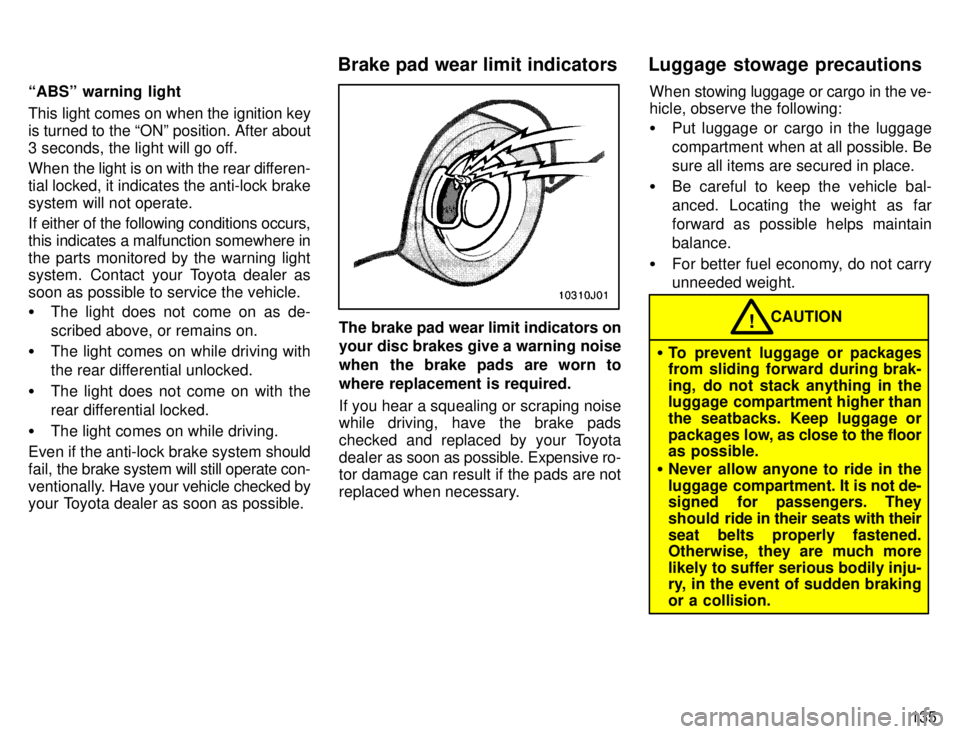
The brake pad wear limit indicators on your disc brakes give a warning noise
when the brake pads are worn to
where replacement is required.
If you hear a squealing or scraping noise
while driving, have the brake pads
checked and replaced by your Toyota
dealer as soon as possible. Expensive ro-
tor damage can result if the pads are not
replaced when necessary. When stowing luggage or cargo in the ve-
hicle, observe the following:
Put luggage or cargo in the luggage
compartment when at all possible. Besure all items are secured in place.
Be careful to keep the vehicle bal-anced. Locating the weight as far
forward as possible helps maintainbalance.
For better fuel economy, do not carry
unneeded weight.CAUTION!
To prevent luggage or packages
from sliding forward during brak-
ing, do not stack anything in the
luggage compartment higher than
the seatbacks. Keep luggage or
packages low, as close to the floor
as possible.
Never allow anyone to ride in the
luggage compartment. It is not de-
signed for passengers. They
should ride in their seats with their
seat belts properly fastened.
Otherwise, they are much more
likely to suffer serious bodily inju-
ry, in the event of sudden braking or a collision.
Brake pad wear limit indicators Luggage stowage precautions
175
Tire surface and wheel nuts Check the tires carefully
for cuts, damage
or excessive wear. See Chapter 7-2 for
additional information. When checking the tires, make sure no nuts are missing,
and check the nuts for looseness. T ighten
them if necessary.
Tire rotation
Rotate the tires every 12000 km (7500
miles). See Chapter 7-2 for additional in-formation.
Fluid leaks Check underneath for leaking fuel, oil, wa-
ter or other fluid after the vehicle has been
parked for a while. If you smell fuel fumes
or notice any leak, have the cause found
and corrected immediately. Doors and engine hood
Check that all doors including back door
operate smoothly and all latches lock se-
curely. M ake sure the engine hood secon-
dary latch secures the hood from opening
when the primary latch is released. INSIDE THE VEHICLE Items listed below should be checked
regularly, e.g. while performing peri-
odic services, cleaning the vehicle,etc. Lights Make sure the headlights, stop lights, tail lights, turn signal lights, and other lights are all working. Check headlight aim. Service reminder indicators and
warn-
ing buzzers Check that all service reminder indicators
and warning buzzers function properly. Steering wheel
Check that it has the specified freeplay.
Be alert for changes in steering condition,such as hard steering or strange noise. Seats Check that all seat controls such as seat
adjusters, seatback recliner, etc. operate
smoothly and that all latches lock securely
in any position. Check that the head re-
straints move up and down smoothly and
that the locks hold securely in any latched
position. For folding-down rear seat-
backs, swing-up rear seat cushions and
detachable temporary third seat, check
that the latches lock securely. Seat belts
Check that the seat belt system such as
buckles, retractors and anchors operate
properly
and smoothly. Make sure the belt
webbing is not cut, frayed, worn or dam-aged. Accelerator pedal Check the pedal for smooth operation and
uneven pedal effort or catching. Clutch pedal Check the pedal for smooth operation. Brake pedal Check the pedal for smooth operation and
that the pedal has the proper clearance. Check the brake booster function. Brakes
At a safe place, check that the brakes do not pull to one side when applied. Parking brake Check that the lever has the proper travel and that, on a safe incline, your vehicle is
held securely with only the parking brake applied.