Page 206 of 370
If No Steam Is Coming From Your Engine
If you get the overheat warning but see or hear no
steam, the problem may not be too serious. Sometimes
the engine can get a little too hot when you:
Climb a long hill on a hot day.
Stop after high-speed driving.
Idle for long periods in traffic.
Tow a trailer.
If you get the overheat warning with no sign of steam,
try this for a minute or
so:
1. Turn off your air conditioner.
2. Turn on your heater to full hot at the highest fan
3. If you’re in a traffic jam, shift to NEUTRAL (N);
speed and open the window as necessary.
otherwise, shift to the highest gear while
driving
-- DRIVE (D) or THIRD (3).
If you no longer have the overheat warning, you can
drive. Just to be safe, drive slower for about
10 minutes.
If the warning doesn’t come back on, you can
drive normally.
If the warning continues, pull over, stop, and park your
vehicle right away.
If there’s still no sign of stem, you can idle the engine
for two or three minutes while you’re parked, to see
if
the warning stops. But then, if you still have the
warning, turn oJffthe engine
and get everyone out of
the vehicle until it cools down.
You may decide not to lift
the hood but to get service
help right away.
5-13
ProCarManuals.com
Page 207 of 370
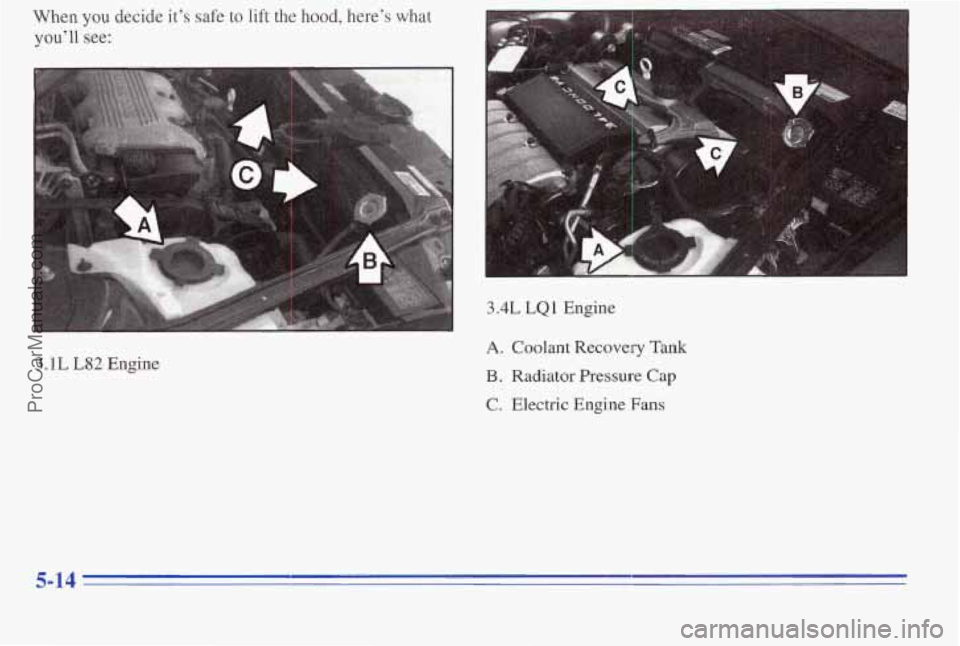
When you decide it’s safe to lift the hood, here’s what
you’ll see:
3.4L LQ1 Engine
3.1L L82 Engine
A. Coolant Recovery Tank
B. Radiator Pressure Cap
C. Electric Engine Fans
ProCarManuals.com
Page 208 of 370
An electric fan under the hood can start up even
when
the engine is not running and can injure
you. Keep hands, clothing and tools away from
any underhood electric fan.
If the coolant inside the coolant recovery tank is boiling,
don’t do anything else until
it cools down.
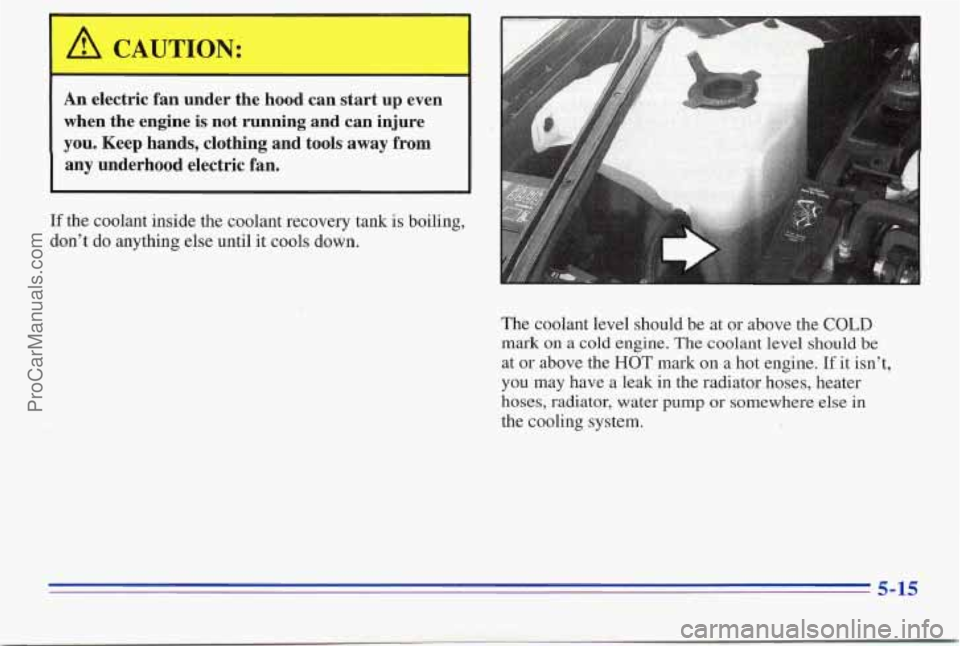
The coolant level should be
at or above the COLD
mark on a cold engine. The coolant level should be
at or above the HOT mark on a hot engine. If it isn’t,
you may have a leak
in the radiator hoses, heater
hoses, radiator, water pump or somewhere else in
the cooling system.
5-15
ProCarManuals.com
Page 209 of 370
A CAUTION:
I
Heater and radiator hoses, and other engine
parts,
can be very hot. Don’t touch them. If you
do, you can
be burned.
Don’t run the engine
if there is a leak. If you run
the engine,
it could lose all coolant. That could
cause
an engine fie, and you could be burned.
Get
any ‘leak fixed before you drive the, vehicle.
I NOTICE:
I
Engine damage from running your engine
without coolant isn’t covered by your warranty.
I
If there seems to be no leak, with the engine on, check to
see if the electric engine fan@) are running. If the engine
is overheating, both fan(s) should be running. If they
aren’t, your vehicle needs service.
How to Add Coolant to the Coolant
Recovery Tank
If you haven’t found a problem yet, but the coolant level
isn’t at the COLD mark, add a 50/50 mixture of ckm
water (preferably distilled) and DEX-COOL”
(orange-colored, silicate-free) antifreeze at the coolant
recovery
tank. (See “Engine Coolant” in the Index for
more information.)
Adding only plain water to your cooling system
can be
dangerous. Plain water, or some other
liquid Eke alcohol, can boil before the proper
coolant
mix will. Your vehicle’s coolant warning
system
is set for the proper coolant mix. With
plain water or the wrong mix, your engine could
get too hot but you wouldn’t get the overheat
warning.
Your engine ‘could catch fire and you or
others could be burned. Use a
50/50 mix Q€ clean
water and
DEX-COOL antifreeze.
5-16
,LC !
ProCarManuals.com
Page 210 of 370
NOTICE:
In cold weather, water can freeze and crack the
engine, radiator, heater core and other parts.
Use the recommended coolant and the proper
coolant
mix.
You can be burned if you spill coolant on hot
engine parts. Coolant contains ethylene glycol
and
it will burn if the engine parts are hot
enough. Don't spill coolant on a hot engine.
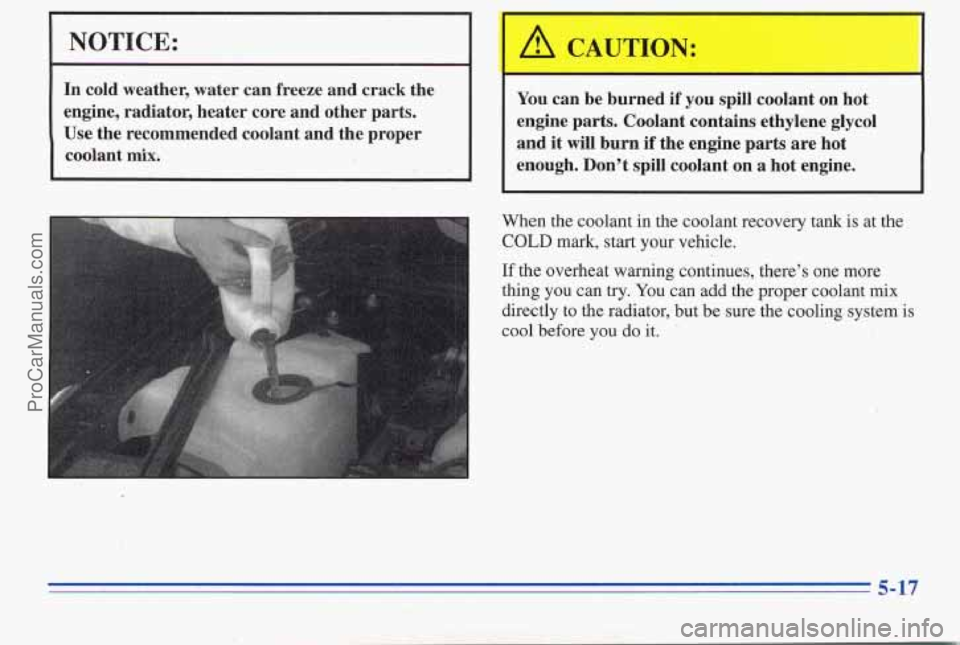
When the coolant in the coolant recovery tank is at the
COLD mark, start your vehicle.
If the overheat warning continues, there's one more
thing you can
try. You can add the proper coolant mix
directly to the radiator,. but be sure the cooling system is
cool before
you do it.
5-17
ProCarManuals.com
Page 212 of 370
How to Add Coolant to the Radiator
I NOTICE:
~~
Your engine has a specific radiator fill procedure.
Failure to follow this procedure could cause your
engine to overheat and be severely damaged.
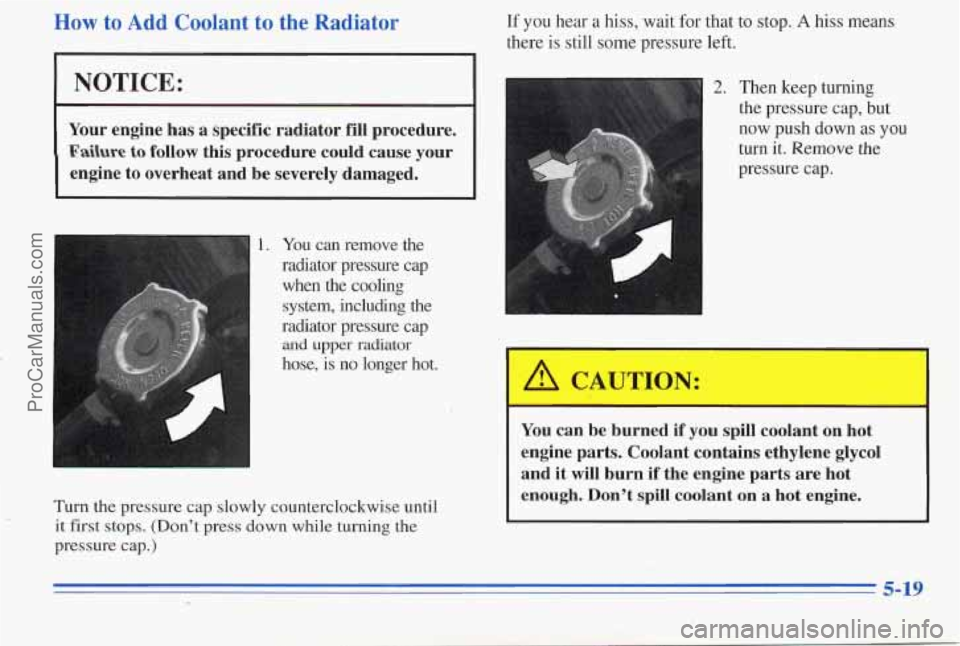
1. You can remove the
radiator pressure cap when the cooling system, including the
radiator pressure cap
and upper radiator
hose, is no longer hot.
If you hear a hiss, .wait for that to stop. A hiss means
there is still some pressure left.
Turn the pressure cap slowly counterclockwise until
it first stops. (Don't press down while turning the
pressure cap.)
I
Then keep turning
the pressure cap, but
now push down as
you
turn it. Remove the
pressure cap.
You can be burned if you spill coolant on hot
engine parts. Coolant contains ethylene glycol
and it will burn if the engine parts are hot
enough. Don't spill coolant
on a hot engine.
5-19
ProCarManuals.com
Page 213 of 370
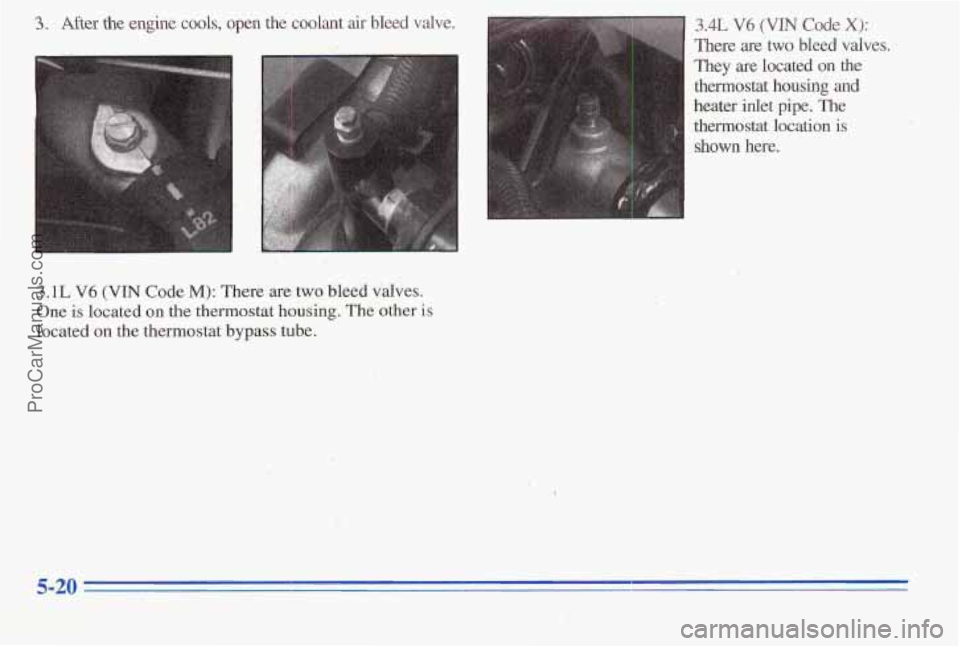
3. After the engine cools, open the coolant air bleed valve.
I 3.4L V6 (VIN Code X):
There are two bleed valves.
They
are located on the
thermostat
housing and
heater inlet pipe. The
.thermostat location is
shown here.
3.1L V6 (VIN Code M): There are two bleed valves.
One is located on the thermostat housing. The other is
located on the thermostat bypass tube.
i
5-20
ProCarManuals.com
Page 214 of 370
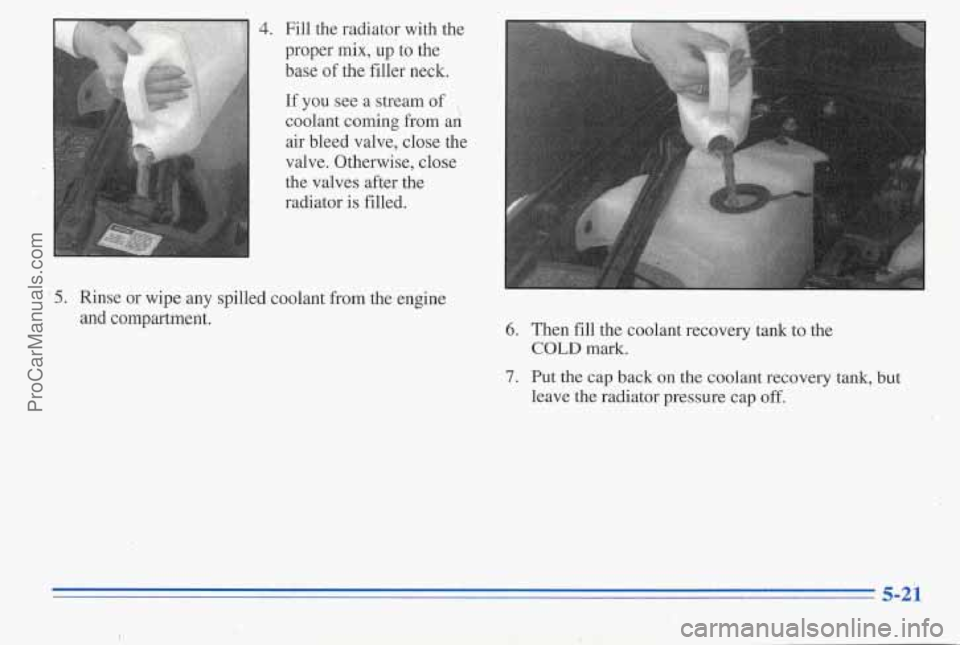
4. Fill the radiator with the
proper
mix, up to the
base of the filler neck.
If you see a stream
of ,
coolant co.ming from an
air bleed valve, close the
valve. Otherwise, close
the valves after the
radiator
is filled.
5. Rinse or wipe any spilled coolant from the engine
and compartmept.
6. Then fill the coolant recovery tank to the
7. Put the cap back on the coolant recovery tank, but
COLD mark.
leave the radiator pressure cap off.
ProCarManuals.com