1996 PONTIAC PONTIAC brake
[x] Cancel search: brakePage 119 of 370

Anti-Lock Brake System Active Light
(Option)
Men your anti-lock system
is adjusting brake pressure
to help avoid a braking skid,
the anti-lock brake system
active light will come on.
Engine Coolant Temperature Light
h E- -
c. TEMP
This light tells you that your
engine coolant,
has
overheated or your radiator
c-ooling €an
is not working.
.. . ..
' .. 5
.. . .
Slippery road conditions may exist if this light comes
on,
so adjust your driving accordingly. The light will
stay un for a few seconds after the system stops
adjusting brake pressure.
If you have been operatmg your vehicle under normal
driving conditions, you should pull off the road, stop
your vehicle and turn off the engine as soon as possible.
In "Problems on the Road," this manual shows what to
do. See "Engine Overheating" in the Index.
The anti-lock brake system active light also come,s on
briefly when you turn the ignition key to RUN. If the
'light doesn't come on then, have it fixed
so it will be
there to tell you when the system is active.
ProCarManuals.com
Page 156 of 370

Section 4 Your Driving and the Road
Here you’ll find information about driving on different
kinds of roads and in varying weather conditions. We’ve
also included many other useful tiprs on driving. The
best advice anyone can give about driving is:
Drive defensively.
Please start with a very important safety device
in your
Pontiac: Buckle
up. (See “Safety Belts” in the Index.)
Defensive driving really means “be ready for anything.”
On city streets, rural roads or freeways, it means
“always expect the unexpected.’’
Assume that pedestrians or other drivers are going to be
careless and
make mistakes. Anticipate what they might
do.
Be ready for their mistakes.
Rear-end collisions are about the most preventable of
accidents. Yet they are common. Allow enough
following distance. It’s the best defensive driving
maneuver, in both city and rural driving.
You never
know when the vehicle in front of you
is g,oing to brake
or turn suddenly.
4-1
ProCarManuals.com
Page 160 of 370

Control of a Vehicle
You have three systems that make your vehicle go where
you want it to go. They are the brakes, the steering and
the accelerator. All three systems have to do their work
at the places where the tires meet the road.
Sometimes, as when you’re driving on snow or ice, it’s
easy to ask more of those control systems than the tires
and road can provide. That means you can lose control
of your vehicle.
Braking
Braking action involves perception time and
reaction time.
First, you have to decide
to push on the brake pedal.
That’s perception time. Then you have to bring up your
foot and do
it. That’s reaction time.
Average reaction time is about
3/4 of a second. But
that’s only an average. It might be less with one driver
and
as long as two or three seconds or more with
another. Age, physical condition, alertness, coordination
and eyesight all play a part.
So do alcohol, drugs and
frustration. But even in
3/4 of a second, a vehicle
moving at
60 mph (100 km/h) travels 66 feet (20 m).
That could be a lot of distance in an emergency,
so
keeping enough space between your vehicle and others
is important.
And, of course, actual stopping &stances vary greatly
with the surface
of the road (whether it’s pavement or
gravel); the condition of the road (wet, dry, icy); tire
tread; and the condition
of your brakes.
4-5
ProCarManuals.com
Page 161 of 370
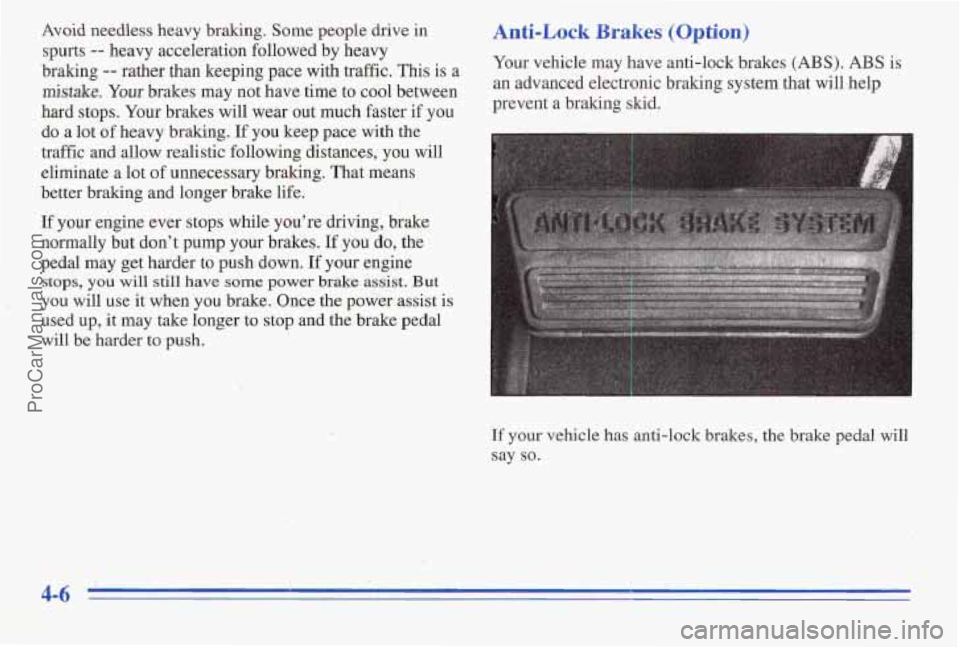
Avoid needless heavy braking. Some people drive in Anti-Lock Brakes (Option)
spurts -- heavy acceleration followedby heavy
braking
-- rather than keeping pace with traffic. This is a
mistake. Your brakes may not have time to cool between
hard
stops. Your brakes will wear out much faster if you
--
Your vehicle may have anti-lock brakes (ABS). ABS is
an advanced electronic
braking system that will help
prevent a braking
skid.
do a lot of heavy braking. If you keep pace with the
traffic and allow realistic following distances, you will
eliminate a lot
of unnecessary braking. That means
better braking and longer brake life.
If your engine ever stops while you're driving', brake
normally
but don't pump your brakes. If you do, the
pedal may get harder to push.down. If your engine
stops, you will still have some power brake assist. But
you will use it when you brake. Once the power assist is
used up, it may take longer to stop and the brake pedal
will
be harder to push.
If your vehicle has anti-lock brakes, the brake pedal will
say so.
I.. ._ . I ..
ProCarManuals.com
Page 162 of 370
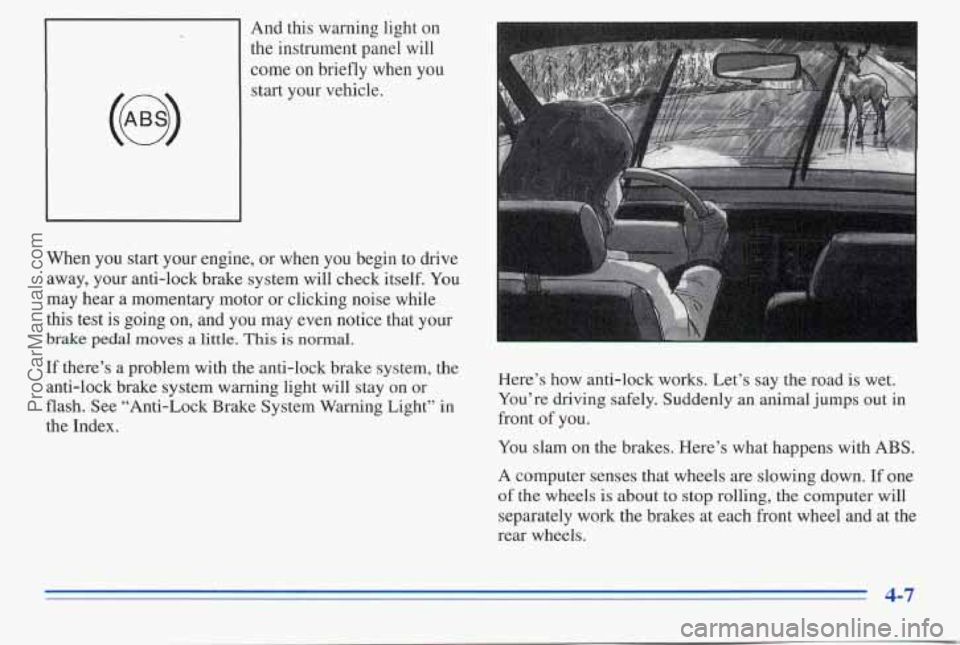
And this warning light on
the instrument panel will
come on briefly when you
start your vehicle.
When you start your engine, or when you begin to drive
away, your anti-lock brake system will check itself. ‘You
may hear a momentary motor or clicking noise while
this test
is going on, and you may even notice that your
brake pedal moves a little. This is normal.
If there’s a problem with the anti-lock brake system, the
anti-lock brake system warning light will stay on or
flash. See “Anti-Lock Brake System Warning Light” in
the Index. Here’s how anti-lock works. Let’s say
the road is wet.
You’re driving safely. Suddenly an animal jumps out in
front of you.
You slam on the brakes. Here’s what happens with
ABS.
A computer senses that wheels are slowing down. If one
of the wheels is about to stop rolling, the computer will
separately work the brakes at each front wheel and at the
rear wheels.
4-7
ProCarManuals.com
Page 163 of 370
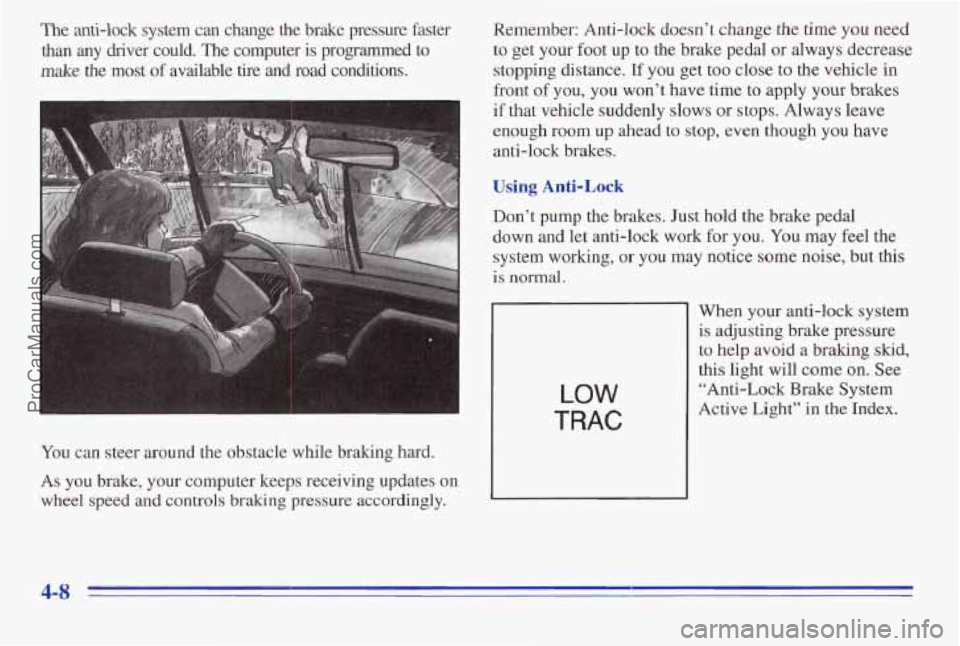
The anti-lock system can change the brake pressure faster
than any driver could. The computer is programmed to
make the most of available tire and road conditions.
You can steer around the obstacle while braking hard.
As you brake, your computer keeps receiving updates on
wheel speed and controls
braking pressure accordingly. Remember: Anti-lock doesn’t
change the time you
need
to get your foot up to the brake pedal or always decrease
stopping distance. If you get too close
to the vehicle in
front
of you, you won’t have time to apply your brakes
if that vehicle suddenly slows or stops. Always leave
enough room up ahead to
stop, even though you have
anti-lock brakes.
Using Anti-Lock
Don’t pump the brakes. Just hold the brake pedal
down and let anti-lock
work for you. You may feel the
system working,
or you may notice some noise, but this
is normal.
LOW
TRAC
When your anti-lock system
is adjusting brake pressure
to help avoid a braking
skid,
this light will come on. See
“Anti-Lock Brake System
Active
Light” in the Index.
4-8
ProCarManuals.com
Page 164 of 370
Braking in Emergencies
At some time, nearly every driver gets into a situation
that requires hard braking.
If you have anti-lock, you can steer and brake at the
same time. However,
if you don’t have anti-lock, your
first reaction
-- to hit the brake pedal hard and hold it
down
-- may be the wrong thing to do. Your wheels can
stop rolling. Once they do, the vehicle can’t respond to
your steering. Momentum will
carry it in whatever
direction it was headed when the wheels stopped rolling.
That could be off the road, into the very thing you were
trying to avoid, or into traffic.
If you don’t have anti-lock, use
a “squeeze” braking
technique.
This will give you maximum braking while
maintaining steering control. You do this by pushing on
the brake pedal with steadily increasing pressure.
In an emergency, you will probably want to squeeze the
brakes hard without locking the wheels. If you hear or
feel the wheels sliding, ease
off the brake pedal. This
will help you retain steering control. (If you
do have
anti-lock, it’s different: see “Anti-Lock Brakes” in
the Index.)
In many emergencies, steering can help you more than
even the very best braking.
Steering
Power Steering
If you lose power steering assist because the engine‘
stops or the system is not functioning, you can steer but
it will take much more effort.
Variable Assist Steering
This steering system provides lighter steering effort for
parking and when driving at low speeds. Steering effort
will increase at higher speeds for improved road feel.
Steering Tips
Driving on Curves
It’s important to take curves at a reasonable speed.
A lot of the “driver lost control” accidents mentioned on
the news happen on curves. Here’s why:
Experienced driver or beginner, each of us is subject to
the same laws
of physics when driving on curves. The
traction of the tires against the road surface makes it
possible for the vehicle to change its path when you turn
the front wheels. If there’s no traction, inertia will keep
the vehicle gqing in the same direction. If you’ve ever
. . ,,: ., .. %
A,. .c .. j: tried to steer a vehicle on wet ice, you’ll understand this.
ProCarManuals.com
Page 165 of 370

The traction you can get in a curve depends on the
condition of your tires and the road surface, the angle at
which
the curve is banked, and your speed. While you’re
in a curve, speed is the one factor you can control.
Suppose you’re steering through a sharp curve.
Then you suddenly apply the brakes. Both control
systems
-- steering and braking -- have to do ~eir
work where the tires meet
the road. Unless you have
four-wheel anti-lock brakes, adding
the hard braking
can demand too much of those places. You can
lose control.
The same thing can happen if you’re steering through a
sharp curve and you suddenly accelerate. Those two
control systems
-- steering and acceleration -- can
overwhelm
those places where the tires meet the road
and make you lose control.
What should you do
if this ever happens? Ease up on the
brake or accelerator pedal, steer the
vehicle the way you
want it to
go, and slow down.
Speed limit signs near curves warn that you should
adjust your
speed, Of course, the posted speeds are
based on good weather and road conditiolls. Under less
favorable conditions you’ll want to go slower.
If you need to reduce your speed as you approach a
curve, do it b’efore you enter the curve, while your front
wheels are straight ahead.
Try to adjust your speed so you can “drive” through the
curve. Maintain a reasonable, steady speed. Wait to
accelerate until you
are out of the curve, and then
accelerate gently into the straightaway.
Steering in Emergencies
There are times when steering can be more effective than
braking. For example, you come over
a hill and find a
truck stopped
in your lane, or a car suddenly pulls out
from nowhere, or a child darts out from between parked
cars and stops right in front of you. You can avoid these
problem
by braking -- if you can stop in time. But
sometimes you,can’t; there isn’t room. That’s the time for
evasive action
-- steering around the problem.
Your Pontiac can perform very well in emergencies like
these. First apply your brakes
-- but, unless you have
anti-lock, not enough
to lock your wheels. (See
“Braking in Emergencies” earlier in this section.) It
is
better t’o remove as much speed as you can from a
possible collision. Then steer around
the problem, to -the
left ‘or right depending on the space available.
I’ . , .I ,. ’ .~
.. . . ,.- , . . .. .
. .. :.
. . - I 1-.. -’ . ..
ProCarManuals.com