1996 OLDSMOBILE BRAVADA wheel
[x] Cancel search: wheelPage 149 of 340

Driving Downhill
When off-roading takes you downhill, you’ll want to
consider
a number of things:
How steep is the downhill? Will I be able to maintain
vehicle control?
What’s the surface like? Smooth? Rough? Slippery?
Hard-packed dirt? Gravel?
Are there hidden surface obstacles? Ruts?
Logs? Boulders?
What’s at the bottom of the hill? Is there a hidden
creek bank or even
a river bottom with large rocks?
If you decide you can go down a hill safely, then try to
keep your vehicle headed straight down, and use
a low
gear. This way, engine drag can help your brakes and
they won’t have to do all the work. Descend slowly,
keeping your vehicle under control at all times.
Heavy braking when going down a hill can cause
your brakes to overheat and fade. This could cause loss
of control and a serious accident. Apply the
brakes lightly when descending a hill and use a low gear to keep vehicle speed under control.
Are there
some things I should not do when
driving down a hill?
A: Yes! These are important because if you ignore them
you could lose control and have
a serious accident.
When driving downhill, avoid turns that take you
across the incline
of the hill. A hill that’s not too
steep to drive down may be too steep
to drive across.
You could roll over if you don‘t drive straight down.
Never go downhill with the transmission in
NEUTRAL
(N). This is called “free-wheeling.” Your
brakes will have to do all the work and could
overheat and fade.
4-21
ProCarManuals.com
Page 150 of 340

&: Am I likely to stall when going downhill?
A: It’s much more likely to happen going uphill. But if
0
0
0
0
it happens going downhill, here’s what to do.
Stop your vehicle by applying the regular brakes.
Apply the parking brake.
Shift to PARK
(P) and, while still braking, restart
the engine.
Shift back to a low gear, release the parking brake,
and drive straight down.
If
the engine won’t start, get out and get help.
Driving Across an Incline
Sooner or later, an off-road trail will probably go across
the incline of a hill.
If this happens, you have to decide
whether
to try to drive across the incline. Here are some
things
to consider:
0
0
0
A hill that can be driven straight up or down may be
too steep to drive across. When you
go straight up or
down a hill,
the length of the wheel base (the
distance
from the front wheels to the rear wheels)
reduces the likelihood the vehicle will tumble end
over end.
But when you drive across an incline, the
much more narrow track width (the distance between
the left and right wheels) may not prevent the vehicle
from tilting and rolling over. Also, driving across an
incline puts more weight on the downhill wheels.
This could cause a downhill slide or a rollover.
Surface conditions can be a problem when you drive
across a hill. Loose gravel, muddy spots, or even wet
grass can cause your tires to slip sideways, downhill.
If the vehicle slips sideways, it can hit something
that
will trip it (a rock, a rut, etc.) and roll over.
Hidden obstacles can make the steepness
of the
incline even worse. If you drive across a rock with
the uphill wheels, or
if the downhill wheels drop into
a rut or depression, your vehicle can tilt even more.
4-22 . . .~
ProCarManuals.com
Page 153 of 340

Driving in Mud, Sand, Snow or Ice
When you drive in mud, snow or sand, your wheels
won’t get good traction.
You can’t accelerate as
quickly, turning is more difficult, and you’ll need
longer braking distances.
It’s best
to use a low gear when you’re in mud -- the
deeper the mud, the lower the gear. In really deep mud,
the idea
is to keep your vehicle moving so you don’t
get stuck.
When you drive on sand, you’ll sense a change in wheel
traction. But
it will depend upon how loosely packed the
sand is. On loosely packed sand
(as on beaches or sand
dunes) your tires will tend to sink into the sand. This has
an effect on steering, accelerating and braking. You may
want to reduce
the air pressure in your tires slightly
when driving on sand. This
will improve traction. Hard packed snow and
ice offer the worst tire traction.
On these surfaces, it’s very easy to lose control. On wet
ice, for example, the traction is
so poor that you will
have difficulty accelerating. And if
you do get moving,
poor steering and difficult braking can cause
you to slide
out
of control.
1
A CAUl
Driving on frozen lakes, ponds or rivers can be
dangerous. Underwater springs, currents under
the ice, or sudden thaws can weaken the ice. Your
vehicle could fall through the ice and you and
your passengers could drown. Drive your vehicle
on safe surfaces only.
4-25
ProCarManuals.com
Page 154 of 340

Driving in Water
Light rain causes no special off-road driving problems.
But heavy rain can mean flash flooding, and flood
waters demand extreme caution.
Find out how deep the water is before
you drive through
it. If it’s deep enough to cover your wheel hubs, axles or
exhaust pipe, don’t try it
-- you probably won’t get
through.
Also, water that deep can damage your axle
and other vehicle parts.
If the water isn’t too deep, then drive through it
slowly. At fast speeds, water splashes
on your ignition
system and your vehicle can stall. Stalling can also
occur if you get your tailpipe under water. And,
as long
as your tailpipe is under water, you’ll never be able to
start your engine. When you go through water,
remember that when your brakes get wet,
it may take
you longer to stop. Driving through rushing water can be dangerous.
Deep water can sweep your vehicle downstream
and you and your passengers could drown.
If it’s
only inches deep, it can still wash away the
ground from under your tires, and you could lose
traction and roll the vehicle over. Don’t drive
through rushing water.
See “Driving Through Water” in the Index for more
information on driving through water.
ProCarManuals.com
Page 155 of 340
After Off-Road Driving
Remove any brush or debris that has collected on the
underbody, chassis or under the hood. These
accumulations can be a fire hazard.
Driving at Night
After operation in mud or sand, have the brake linings
cleaned and checked. These substances can cause
glazing and uneven braking. Check the body structure,
steering, suspension, wheels, tires and exhaust system
for damage. Also, check the fuel lines and cooling
system for any leakage.
Your vehicle will require more frequent service due to
off-road use. Refer to the Maintenance Schedule for
additional information.
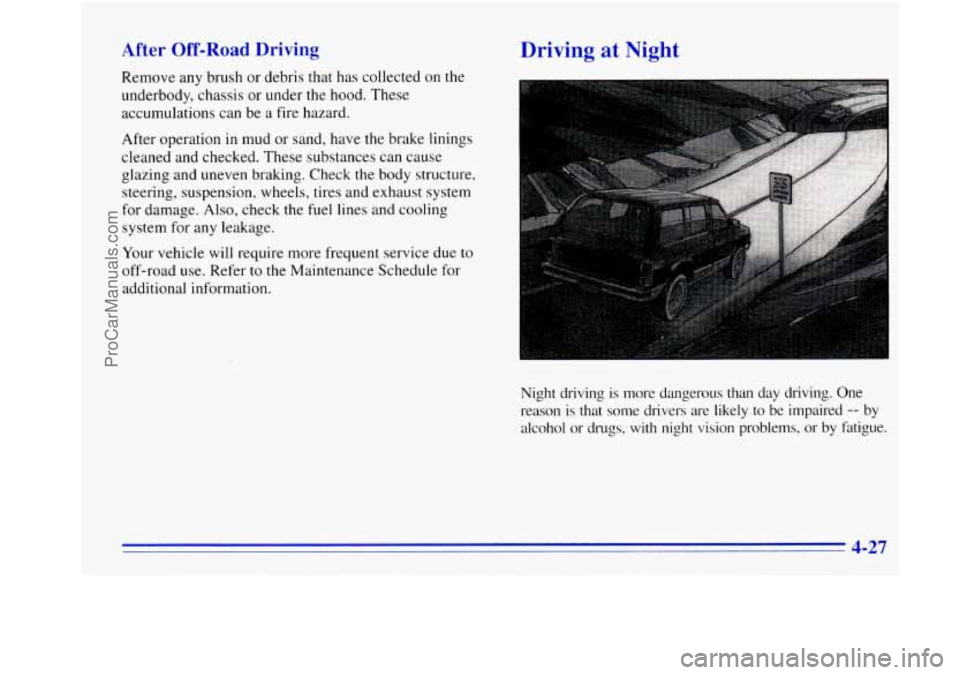
Night driving is more dangerous than day driving. One reason is that some drivers are
likely to be impaired -- by
alcohol or drugs, with night vision problems, or by fdtigue.
ProCarManuals.com
Page 163 of 340

Highway Hypnosis
Is there actually such a condition as “highway hypnosis”?
Or is it just plain falling asleep at the wheel? Call it
highway hypnosis, lack
of awareness, or whatever.
There is something about an easy stretch
of road with
the same scenery, along with the hum
of the tires on the
road,
the drone of the engine, and the rush of the wind
against the vehicle that can make you sleepy. Don’t
let it
happen to you! If it does, your vehicle can leave the
road in less than a second, and you could crash and
be injured.
What can
you do about highway hypnosis? First, be
aware that
it can happen.
Then here are some tips:
e
e
e Make sure your vehicle is well ventilated, with a
comfortably cool interior.
Keep your eyes moving. Scan the road ahead
and
to the sides. Check your mirrors and your
instruments frequently.
If you get sleepy, pull off the road
into a rest, service
or parking area and take a nap, get some exercise, or
both. For safety, treat drowsiness
on the highway as
an emergency.
Hill and Mountain Roads
Driving on steep hills or mountains is different from
driving
in flat or rolling terrain.
ProCarManuals.com
Page 166 of 340

What’s the worst time for this? “Wet ice.’’ Very cold
snow or ice can be slick and hard
to drive on. But wet
ice can be even more trouble because it may offer the
least traction of all.. You can get wet ice when it’s about
freezing
(32°F; OOC) and freezing rain begins to fall.
Try to avoid driving on wet ice until salt and sand crews
can get there. Whatever
the condition -- smooth ice, packed, blowing
or loose snow -- drive
with caution.
Accelerate gently. Try
not to break the fragile traction.
If you accelerate too fast, the drive wheels will spin and
polish
the surface under the tires even more.
Your anti-lock brakes improve your vehicle’s stability
when
you make a hard stop on a slippery road. Even
though you have an anti-lock braking system, you’ll
want to begin stopping sooner than you would on dry
pavement. See “Anti-Lock” in the Index.
Allow greater following distance on any
slippery road.
0 Watch for slippery spots. The road might be fine
until you
hit a spot that’s covered with ice. On an
otherwise clear road, ice patches may appear in
shaded areas where the sun can’t reach: around
clumps of trees, behind buildings or under bridges.
Sometimes the surface
of a curve or an overpass may
remain icy when the surrounding roads are clear. If
you see a patch of ice ahead of you, brake before you
are on
it. Try not to brake while you’re actually on
the ice, and avoid sudden steering maneuvers.
ProCarManuals.com
Page 177 of 340
Following Distance
Stay at least twice as far behind the vehicle ahead as you
would when driving your vehicle without a trailer. This
can help you avoid situations that require heavy braking
and sudden turns.
Passing
You’ll need more passing distance up ahead when
you’re towing a trailer. And, because you’re
a good deal
longer, you’ll need to go much farther beyond the
passed vehicle before you can return
to your lane.
Backing Up
Hold the bottom of the steering wheel with one hand.
Then, to move the trailer to the left, just move that hand
to the left.
To move the trailer to the right, move your
hand to the right. Always back up slowly and,
if
possible, have someone guide you.
Making Turns
I NOTICE:
Making very sharp turns while trailering could
cause the trailer
to come in contact with the
vehicle. Your vehicle could
be damaged. Avoid
making very sharp turns while trailering.
When you’re turning with a trailer, make wider turns than
normal.
Do this so your trailer won’t strike soft shoulders,
curbs, road signs, trees or other objects. Avoid jerky or
sudden maneuvers. Signal well
in advance.
Turn Signals When Towing a Trailer
When you tow a trailer, your vehicle has to have extra
wiring and a heavy-duty turn signal flasher (included
in
the optional trailering package).
The green arrows on your instrument panel will flash
whenever you signal
a turn or lane change. Properly
hooked up, the trailer lamps will also flash, telling other
drivers you’re about to turn, change lanes
or stop.
ProCarManuals.com