Page 200 of 340

If a Tire Goes Flat
It’s unusual for a tire to “blow out” while you’re driving,
especially if you maintain your tires properly.
If air goes
out
of a tire, it’s much more likely to leak out slowly.
But if
you should ever have a “blowout,” here are a few
tips about what to expect and what to do:
If
a front tire fails, the flat tire will create a drag that
pulls the vehicle toward that side. Take your foot off the
accelerator pedal and grip the steering wheel
firmly.
Steer to maintain lane position, and then gently brake to
a stop well out of the traffic lane.
A rear blowout, particularly on a curve, acts much like a
skid and may require the same correction you’d use in a
skid. In any rear blowout, remove your foot from the
accelerator pedal. Get the vehicle under control by
steering the way you want the vehicle to go. It may be
very bumpy and noisy, but you can still steer. Gently
brake to a
stop -- well off the road if possible.
If a tire goes flat, the next part shows how to use your
jacking equipment to change a
flat tire safely.
Changing a Flat Tire
If a tire goes flat, avoid further tire and wheel damage
by driving slowly to a level place. Turn on your hazard
warning flashers.
ur
Changing a tire can cause an injury. The vehicle
can slip
off the jack and roll over you or other
people. You and they could be badly injured.
Find a level place to change your tire.
To help
prevent the vehicle from moving:
1. Set the parking brake firmly.
2. Put the shift lever in PARK (P).
3. Turn off the engine.
To be even more certain the vehicle won’t move,
you can put blocks at the front and rear of the
tire farthest away from the one being changed.
That would be the tire
on the other side of the
vehicle, at the opposite end.
ProCarManuals.com
Page 210 of 340
I NOTICE:
Spinning your wheels can destroy parts of your
vehicle as well as the tires.
If you spin the wheels
too fast while shifting your transmission back
and forth, you can destroy your transmission.
For information about using tire chains on your vehicle,
see “Tire Chains” in the Index.
Rocking your vehicle to get it out:
First, turn your steering wheel left and right. That will
clear the area around your front wheels. Then shift back
and forth between REVERSE (R) and a forward gear,
spinning the wheels as little as possible. Release the
accelerator pedal while you shift, and press lightly on
the accelerator pedal when the transmission is in gear. If
that doesn’t get you out after a few tries, you may need
to be towed out. Or, you can use your recovery hooks if
your vehicle has them.
If you do need to be towed out,
see “Towing Your Vehicle” in the Index.
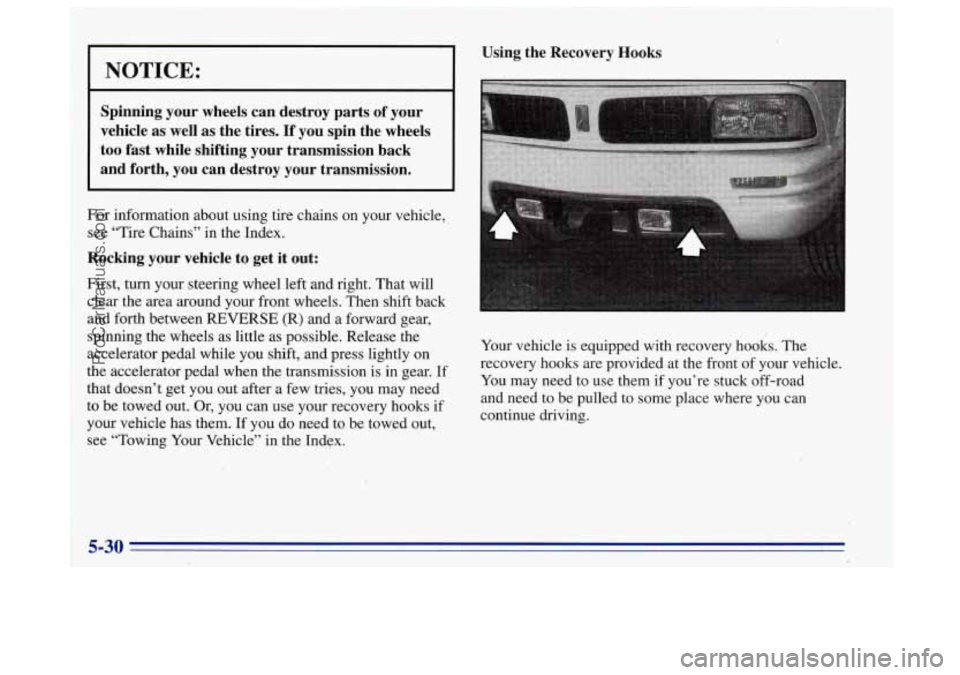
Using the Recovery Hooks
Your vehicle is equipped with recovery hooks. The
recovery hooks are provided at the front
of your vehicle.
You may need to use them if you’re stuck off-road
and need
to be pulled to some place where you can
continue driving.
ProCarManuals.com
Page 220 of 340
When you lift the hood, you’ll see these items:
A. Transmission Dipstick
B. Engine Oil
Fill
C. Brake Master Cylinder D.
Coolant Recovery Tank
E. Engine Oil Dipstick
E Power Steering Reservoir
G. Battery
H. Air Cleaner
I. Windshield Washer Fluid
6-8
ProCarManuals.com
Page 235 of 340
Radiator Pressure Cap
I
NOTICE:
Your radiator cap is a 15 psi (105 kPa)
pressure-type cap and must be tightly installed
to prevent coolant loss and possible engine
damage from overheating. Be sure the arrows on
the cap line up with the overflow tube on the
radiator filler neck.
Thermostat
Engine coolant temperature is controlled by a thermostat
in the engine coolant system. The thermostat stops the
flow of coolant through the radiator
until the coolant
reaches a preset temperature.
Power Steering Fluid
When to Check Power Steering Fluid
It is not necessary to regularly check power steering
fluid unless you suspect there is a leak in the system or
6-23
ProCarManuals.com
Page 236 of 340

you hear an unusual noise. A fluid loss in this system
could indicate a problem. Have the system inspected
and repaired.
How To Check Power Steering Fluid
When the engine compartment is cool, unscrew the cap
and wipe
the dipstick with a clean rag. Replace the cap
and completely tighten it. Then remove the cap again
and look at the fluid level on the dipstick.
The
level should be between the ADD and FULL marks.
If necessary, add only enough fluid to bring the level up
to the proper range.
What to Use
Refer to the Maintenance Schedule to determine what
kind of fluid to
use. See “Recommended Fluids and
Lubricants’’
in the Index. Always use the proper fluid.
Failure to use the proper fluid can cause leaks and
damage hoses and seals.
Windshield Washer Fluid
What to Use
When you need windshield washer fluid, be sure to read
the manufacturer’s instructions before
use. If you will be
operating your vehicle in an area where the temperature
may fall below freezing, use a fluid
that has sufficient
protection against freezing.
Adding Washer Fluid
Open the cap labeled WASHER FLUID ONLY. Add
washer fluid
until the tank is full.
6-24
ProCarManuals.com
Page 276 of 340

I Short Trip/City Maintenance Schedule
The services shown in this schedule up to 100,000 miles
( 166 000 km) should be performed after 100,000 miles
(166
000 km) at the same intervals.
Footnotes
? The U.S. Environmental Protection Agency or the
California Air Resources Board has determined that the
failure to perform this maintenance item will not nullify
the emission warranty or limit recall liability prior to the
completion of the vehicle’s useful life. We, however,
urge that all recommended maintenance services be
performed at the indicated intervals and the maintenance
be recorded.
# Lubricate the front suspension, ball joints, steering
linkage, parking brake cable guides, propshaft splines,
universal joints and brake pedal springs.
**Drive axle service:
Drain and refill at first oil change. At subsequent oil
changes, check fluid level and add fluid as needed.
If
driving in dusty areas or towing a trailer, drain fluid
and refill every
15,000 miles (25 000 km).
More frequent lubrication may be required for
off-paved-road use.
ProCarManuals.com
Page 298 of 340

I Long Tripmighway Maintenance Schedule 1
The services shown in this schedule up to 100,000 miles
(I 66 000 kin) should be performed after 100,000 miles
(166 000 km) at the same intervals.
Footnotes
The U.S. Environmental Protection Agency or the
California Air Resources Board has determined that the
failure to perform this maintenance item will not
nullify
the emission warranty or limit recall liability prior to the
completion of the vehicle’s useful life. We, however,
urge that all recommended maintenance services be
performed at
the indicated intervals and the maintenance
be recorded.
# Lubl-icat.e t.he front suspension, ball joints, steering
linkage, parking brake cable guides, propshaft splines,
universal joints and brake pedal springs.
-I-+Drive axle service:
0 Drain and refill at first oil change. At subsequent oil
changes, check fluid level and add fluid as needed. If
driving in dusty areas or towing a trailer, drain fluid
and refill every
15,000 miles (25 000 km).
0 More frequent lubrication may be required for
off-paved-road use.
. . .1.
ProCarManuals.com
Page 312 of 340

Steering Column Lock Check While parked, and with the parking brake set., try to turn
t.he key to
LOCK in each shift lever position.
0 The key should turn to LOCK only when the shift
lever
is in PARK (P).
0 The key should come out only in LOCK.
Parking Brake and Automatic Transmission
PARK
(P) Mechanism Check
When you are doing this check, your vehicle
could begin to move. You or others could be
injured and property could be damaged. Make
sure there
is room in front of your vehicle in case
it begins to roll. Be ready to apply the regular
brake at once should the vehicle begin to move. Park
on a fairly steep hill, with
the vehicle facing
downhill. Keeping your foot on the regular brake,
set the parking brake.
0 To check the parking brake: With the engine running
and transmission
in NEUTRAL (N), slowly remove
foot pressure from the regular brake pedal.
Do this
until the vehicle is held by the parking brake only.
To check the PARK (P) mechanism’s holding ability:
With the engine running, shift to PARK
(P). Then
release all brakes.
Underbody Flushing Service
At least every spring, use plain water to flush any
corrosive materials from the underbody. Take care to
clean thoroughly any areas where mud and other debris
can collect.
ProCarManuals.com

