Page 180 of 340
Trailer Wiring Harness
The light duty trailer wiring is a six-wire harness
assembly. The optional heavy duty trailer wiring is an
eight-wire harness assembly. The harnesses are stored
under the vehicle, on the driver’s side corner frame
crossmember. The heavy duty trailer wiring
has a
30-amp feed wire with an inline fuse located by the
junction block. See “Fuses and Circuit Breakers”
in the
Index. Both harnesses have no connector and should be
wired by a qualified electrical technician. The technician
can use the following color code chart when connecting
the wiring harness to your trailer.
0 DARK BLUE: Use for electric trailer brakes or
auxiliary wiring.
0 RED: Use for battery charging; it connects to the
starter solenoid (eight-wire harness only).
0 LIGHT GREEN: Back-up lamps (eight-wire
harness only).
BROWN: Taillamps and parking lamps.
YELLOW: Left stoplamp and turn signal.
DARK GREEN: Right stoplamp and turn signal.
WHITE (Heavy Gage): Ground wire.
WHITE (Light Gage): Auxiliary stoplamp.
Securely attach the harness to the trailer, then tape or
strap
it to your vehicle’s frame rail. Be sure you leave it
loose enough
so the wiring doesn’t bend or break, but
not
so loose that it drags on the ground. Store the
harness
in its original place. Wrap the harness together
and tie
it neatly so it won’t be damaged.
ProCarManuals.com
Page 237 of 340
~~ ~ NOTICE:
0
0
0
0
When using concentrated washer fluid,
follow
the manufacturer’s instructions
for
adding water.
Don’t mix water with ready-to-use washer
fluid. Water can cause the solution to freeze
and damage your washer fluid tank and
other parts of the washer system. Also,
water doesn’t clean as well as washer fluid.
Fill your washer fluid tank only
three-quarters full when it’s very cold. This
allows for expansion, which could damage
the tank if it is completely full.
Don’t use radiator antifreeze
in your
windshield washer. It can damage your
washer system and paint.
Brakes
Brake Fluid
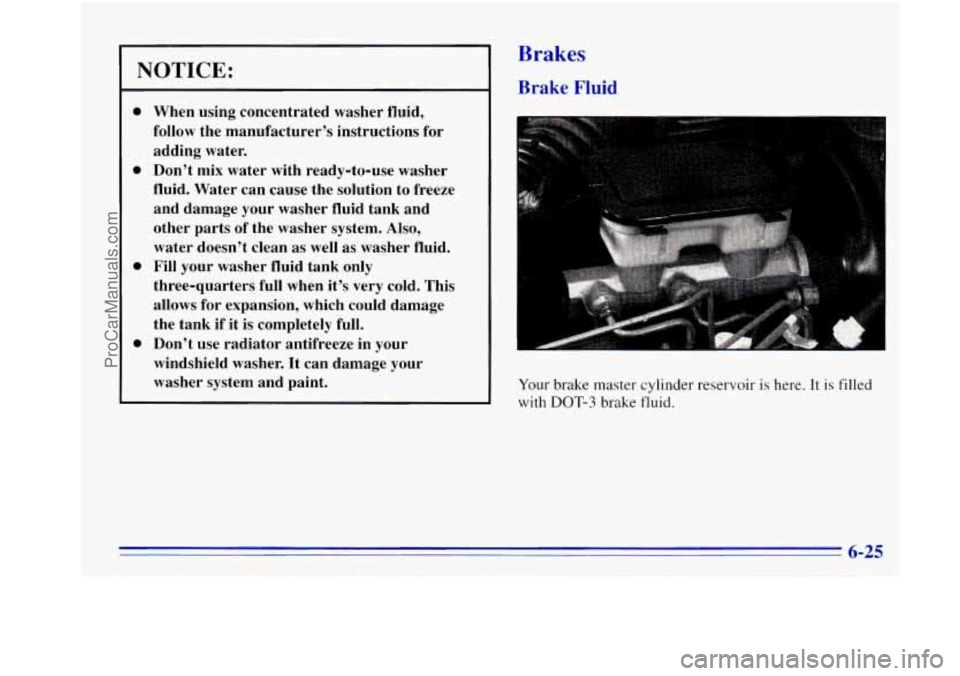
Your brake master cylinder reservoir is here. It is filled
with DOT-3 brake fluid.
ProCarManuals.com
Page 238 of 340

There are only two reasons why the brake fluid level in
the reservoir might go down. The first is that the brake
fluid goes down
to an acceptable level during normal
brake lining wear. When new linings are put
in, the fluid
level goes back up. The other reason is that fluid is
leaking out
of the brake system. If it is, you should have
your brake system fixed, since a leak means that sooner
or later your brakes won’t work well, or won’t work
at all.
So, it isn’t a good idea to “top off’ your brake fluid.
Adding brake fluid won’t correct a leak. If you
add fluid
when your linings are worn, then you’ll have too much
fluid when you get new brake linings.
You should add
(or remove) brake fluid, as necessary, only when work is
done
on the brake hydraulic system.
If you have too much brake fluid, it can spill
on the engine. The fluid will burn
if the engine
is hot enough. You or others could be burned,
and your vehicle could be damaged. Add brake
fluid only when work
is done on the brake
hydraulic system.
Refer to the Maintenance Schedule to determine when to
check your brake fluid. See “Periodic Maintenance
Inspections”
in the Index.
ProCarManuals.com
Page 239 of 340
Checking Brake Fluid What
to Add
You can check the brake fluid without taking off the cap.
Just look at
the windows on the brake fluid reservoir.
The fluid levels should be above MIN. If they aren’t,
have your brake system checked to see if there is a leak.
After work is done on the brake hydraulic system, make
sure the levels are above MIN and below the
top of
each window. When
you do need brake fluid, use only
DOT-3 brake
fluid
-- such as Delco Supreme 11 @ (GM Part
No. 1052535). Use new brake fluid from a sealed
container only, and always clean the brake fluid
reservoir cap before removing it.
A CAUTION:
With the wrong kind of fluid in your brake
system, your brakes may nott work well, or they
may not even work at all. This could cause a
crash. Always use the proper brake fluid.
6-27
ProCarManuals.com
Page 240 of 340

~~
~ NOTICE:
0
0 Using the wrong fluid can badly damage
brake system parts. For example, just a few
drops of mineral-based oil, such as engine
oil, in your brake system can damage brake
system parts
so badly that they’ll have to be
replaced. Don’t let someone put in the
wrong kind of fluid.
If you spill brake fluid on your vehicle%
painted surfaces, the paint finish can be
damaged. Be careful not
to spill brake fluid
on your vehicle.
If you do, wash.it off
immediately. See “Appearance Care” in
the Index.
Brake Wear
Your Oldsmobile has front disc brakes and rear
drum brakes.
Disc brake pads have built-in wear indicators that
make a high-pitched warning sound when the brake
pads are worn and new pads
are needed. The sound may
come and go or be heard all
the time your vehicle is
moving (except when you are pushing on the brake
pedal firmly).
I
The brake wear warning sound means that
sooner or later your brakes won’t work well.
That could lead to an accident. When you hear
the brake wear warning sound, have your
vehicle serviced.
6-28
ProCarManuals.com
Page 241 of 340
1 NOTICE:
Continuing to drive with worn-out brake pads
could result in costly brake repair.
Some driving conditions or climates may cause a brake
squeal when the brakes are first applied or lightly
applied. This does not mean something is wrong
with
your brakes.
Your rear drum brakes don’t have wear indicators, but
if
you ever hear a rear brake rubbing noise, have the rear
brake linings inspected. Also, the rear brake drums
should be removed and inspected each time the tires are
removed for rotation or changing. When you have
the
front brakes replaced, have the rear brakes inspected, too.
Brake linings should always be replaced as complete
axle sets.
Brake Pedal Travel
See your retailer if the brake pedal does not return to
normal height, or if there is
a rapid increase in pedal
travel. This could be
a sign of brake trouble.
Brake Adjustment
Every time you make a brake stop, your disc brakes
adjust for wear.
If your brake pedal goes down farther than normal, your
rear drum brakes may need adjustment. Adjust them by
backing up and firmly applying the brakes a few times.
Replacing Brake System Parts
The braking system on a modern vehicle is complex.
Its many parts have to be of top quality and work well
together
if the vehicle is to have really good braking.
Vehicles we design and test have top-quality
GM brake
parts
in them, as your Oldsmobile does when it is new.
When you replace parts
of your braking system -- for
example, when your brake linings wear down and
you
have to have new ones put in -- be sure you get new
genuine
GM replacement parts. If you don’t, your
brakes
may no longer work properly. For example, if
someone puts in brake linings that are wrong for your
vehicle, the balance between your front and rear brakes
can change
-- for the worse. The braking performance
you’ve come to expect can change
in many other ways
someone puts
in the wrong replacement brake parts. if
ProCarManuals.com
Page 312 of 340

Steering Column Lock Check While parked, and with the parking brake set., try to turn
t.he key to
LOCK in each shift lever position.
0 The key should turn to LOCK only when the shift
lever
is in PARK (P).
0 The key should come out only in LOCK.
Parking Brake and Automatic Transmission
PARK
(P) Mechanism Check
When you are doing this check, your vehicle
could begin to move. You or others could be
injured and property could be damaged. Make
sure there
is room in front of your vehicle in case
it begins to roll. Be ready to apply the regular
brake at once should the vehicle begin to move. Park
on a fairly steep hill, with
the vehicle facing
downhill. Keeping your foot on the regular brake,
set the parking brake.
0 To check the parking brake: With the engine running
and transmission
in NEUTRAL (N), slowly remove
foot pressure from the regular brake pedal.
Do this
until the vehicle is held by the parking brake only.
To check the PARK (P) mechanism’s holding ability:
With the engine running, shift to PARK
(P). Then
release all brakes.
Underbody Flushing Service
At least every spring, use plain water to flush any
corrosive materials from the underbody. Take care to
clean thoroughly any areas where mud and other debris
can collect.
ProCarManuals.com
Page 314 of 340
Drive Axle Service
Check readfront axle fluid level and add as needed.
Check constant velocity joints and axle seals for leakinp.
Transfer Case (All-Wht Drive) Inspection
Every 12 months or at oil change intervals, check front
axle and transfer case and add lubricant when necessary.
Oil the control lever pivot point and all exposed control
linkage. Check vent hose at transfer case for kinks and
proper installation.
Brake System Inspection
Inspect the complete system. Inspect brake lines and
hoses for proper hook-up, binding, leaks, cracks,
chafing, etc. Inspect disc brake pads for wear and rotors
for surface condition. Also inspect drum brake linings
for wear and cracks. Inspect other brake parts, including
drums, wheel cylinders, calipers, parking brake, etc.
Check parking brake adjustment.
You may need to have
your brakes inspected more often if your driving habits
or conditions result
in frequent braking.
ProCarManuals.com