Page 36 of 340
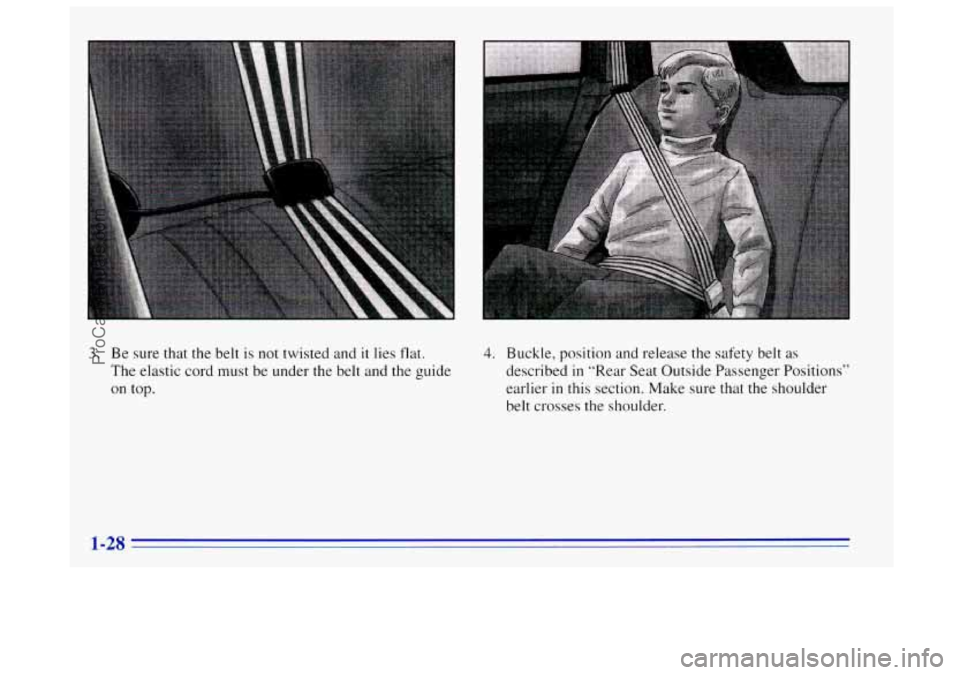
3. Be sure that the belt is not twisted and it lies flat.
The elastic cord must be under the belt and the guide
on top.
-
4. Buckle, position and release the safety belt as
described
in “Rear Seat Outside Passenger Positions”
earlier
in this section. Make sure that the shoulder
belt crosses the shoulder.
1-28
ProCarManuals.com
Page 37 of 340
To remove and store the comfort guides, just perform
these steps
in reverse order. Squeeze the belt edges
together
so that you can take them out from the guides.
Pull the guide upward to expose its storage clip, and
then slide the guide onto the clip. Rotate the guide and
clip inward and in between the seatback and the interior
body, leaving only the loop
of elastic cord exposed.
Lap Belt
Center Rear Passenger Position
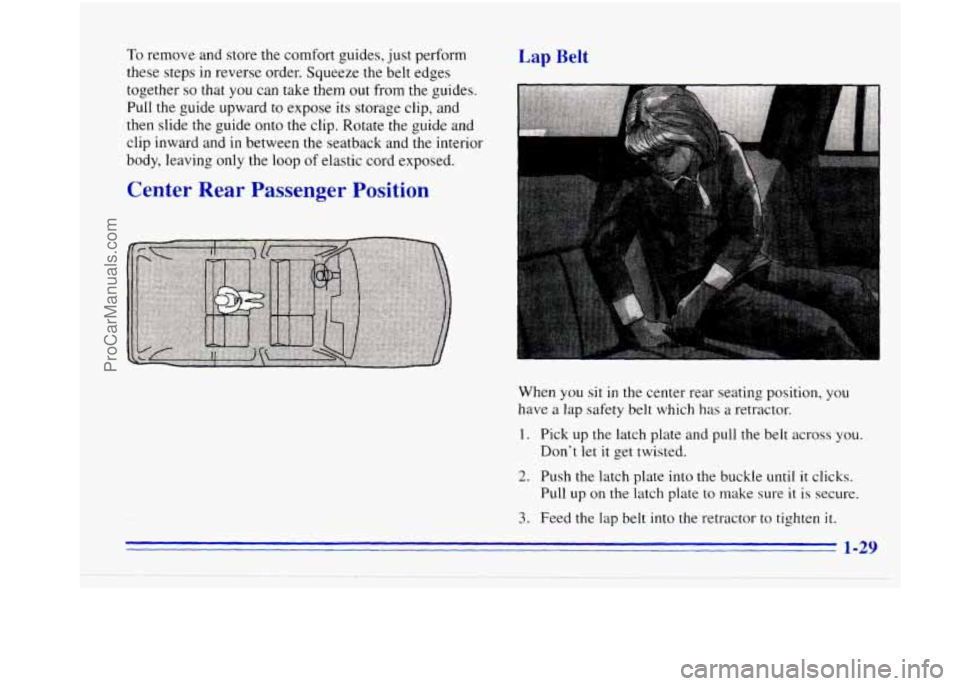
When you sit in the center rear seating position, you
have
a lap safety belt which has a retractor.
1. Pick up the latch plate and pull the belt across you.
2. Push the latch plate into the buckle until it clicks.
Don’t
let it get twisted.
Pull up
on the latch plate to make sure it is secure.
3. Feed the lap belt into the retractor to tighten it.
1-29
ProCarManuals.com
Page 38 of 340

Children
4. Position and release it the same way as the lap part
of a lap-shoulder belt.
If the belt isn’t long enough, see “Safety Belt
Extender” at the end
of this section. Make sure the
release button
on the buckle is positioned so you
would be able to unbuckle the safety belt quickly
if
you eves had to. Everyone
in
a vehicle needs protection! That includes
infants and all children smaller than adult size. In fact,
the law
in every state in the United States and in every
Canadian province says children up to some age must be
restrained while in a vehicle.
Smaller Children and Babies
A CAUTION:
Smaller children and babies should always be
restrained in a child or infant restraint. The
instructions for the restraint will say whether it is
the right type and size for your child.
A very
young child’s hip bones are
so small that a
regular belt might not stay low on the hips, as it
should. Instead, the belt will likely be over the
child’s abdomen. In a crash, the belt would apply
force right
on the child’s abdomen, which could
cause serious or fatal injuries.
So, be sure that
any child small enough for one
is always properly
restrained in a child or infant restraint.
1-30
ProCarManuals.com
Page 40 of 340

Child Restraints
Be sure the child restraint is designed to be used in a
vehicle.
If it is, it will have a label saying that it meets
Federal Motor Vehicle Safety Standards.
Then follow the instructions for the restraint. You may
find these instructions on
the restraint itself or in a
booklet, or both. These restraints use
the belt system in
your vehicle, but the child also has to be secured within
the restraint to help reduce the chance of personal injury.
The instructions that come with the infant or child
restraint will show you how to do that.
Where to Put the Restraint
Accident statistics show that children are safer if they
are restrained
in the rear rather than the front seat. We at
General Motors therefore recommend that you put your
child restraint in a rear seat outside position unless the
child is an infant and you’re the only adult in the
vehicle.
In that case, you might want to secure the
restraint in the right front seat where you can keep an
eye on
the baby.
Wherever
you install it, be sure to secure the child
restraint properly.
Keep
in mind that an unsecured child restraint can move
around in a collision or sudden stop and injure people in
the vehicle. Be sure
to properly secure any child
restraint in your vehicle
-- even when no child is in it.
ProCarManuals.com
Page 42 of 340
Securing a Child Restraint in a
Rear Outside Seat Position
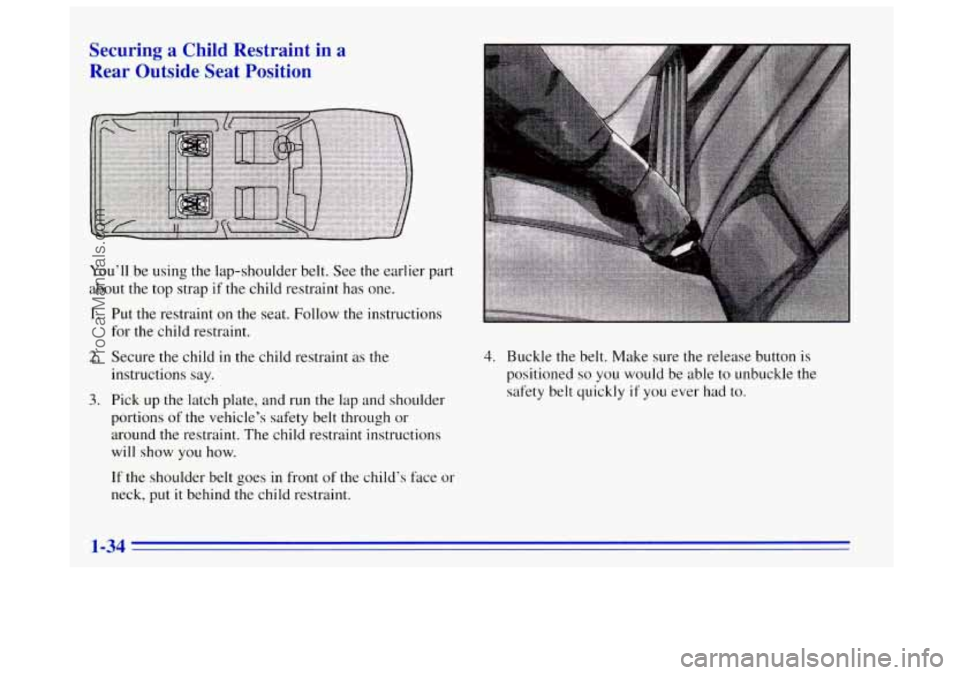
You’ll be using the lap-shoulder belt. See the earlier part
about the top strap
if the child restraint has one.
1.
2.
3.
Put the restraint on the seat. Follow the instructions
for the child restraint.
Secure
the child in the child restraint as the
instructions say.
Pick up the latch plate, and run the lap and shoulder
portions
of the vehicle’s safety belt through or
around the restraint. The child restraint instructions
will show you how.
If the shoulder belt goes in front of the child’s fixe or
neck, put it behind the child restraint.
4. Buckle the belt. Make sure the release button is
positioned
so you would be able to unbuckle the
safety belt quickly
if you ever had to.
ProCarManuals.com
Page 43 of 340
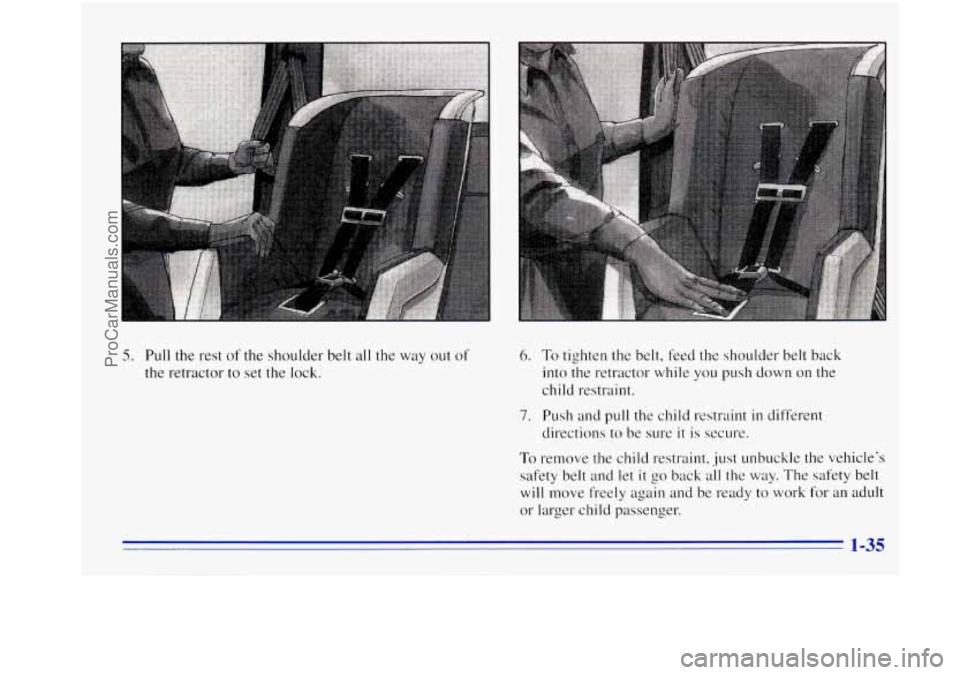
5. Pull the rest of the shoulder belt all the way out of
the retractor to set the lock.
6. To tighten the belt, feed the shoulder belt back
into the retractor while you push down on the
child restraint.
7. Push and pull the child restraint in different
directions to be sure
it is secure.
To remove the child restraint, just unbuckle the vehicle's
safety belt and let
it go back a11 the way. The safety belt
will move freely again and be ready to work for
an adult
or larger child passenger.
ProCarManuals.com
Page 44 of 340
Center Seat Position
Don’t use child restramts in these positions. The
restraints won’t work properly.
Securing a Child Restraint in the
Right Front Seat Position
You’ll be using the lap-shoulder belt. See the earlier part
about the top strap
if the child restraint has one.
1. Put the restraint on the seat. Follow the instructions
for the child restraint.
2. Secure the child in the child restraint as the
instructions say.
3. Pick up the latch plate, and run the lap and shoulder
portions
of the vehicle’s safety belt through or
around the restraint. The child restraint instructions
will show
yo~l how.
If the shoulder belt goes in front of the child’s face or
neck, put
it behind the child restraint.
1-36
ProCarManuals.com
Page 45 of 340
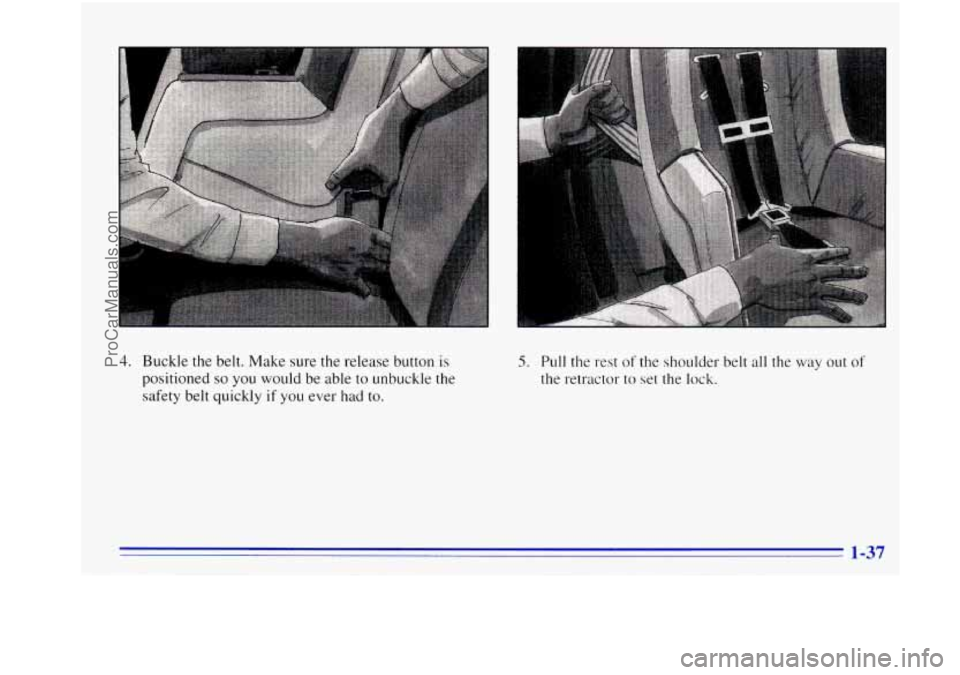
4. Buckle the belt. Make sure the release button is
positioned so you would be able to unbuckle the
safety belt quickly
if you ever had to.
5. Pull the rest of the shoulder belt all the way out of
the retractor to set the lock.
ProCarManuals.com