Page 186 of 340
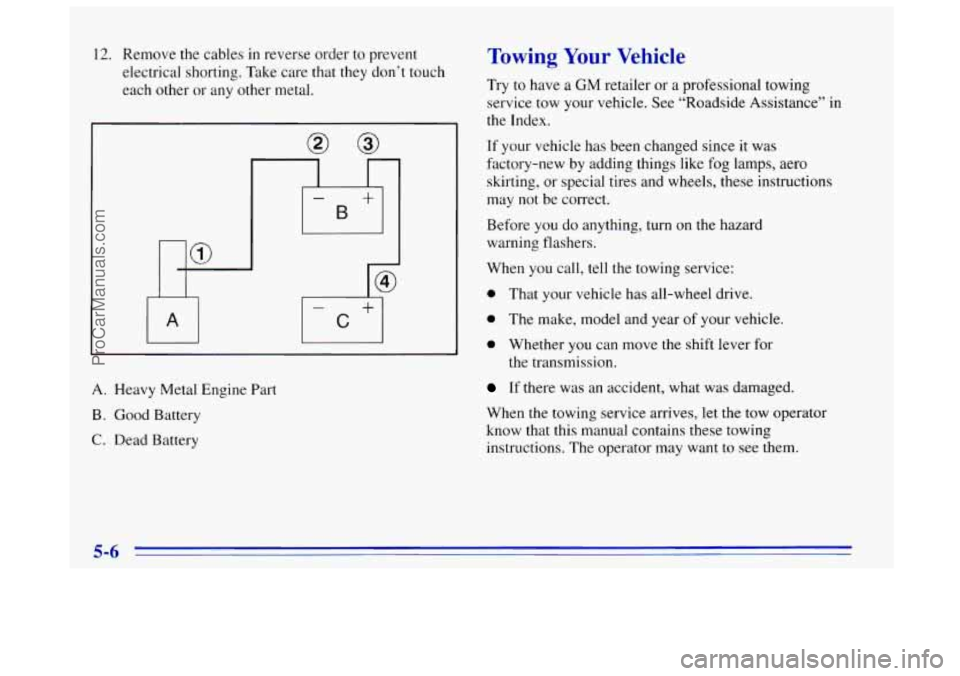
12. Remove the cables in reverse order to prevent
electrical shorting. Take care that they don’t touch
each other or any other metal.
A. Heavy Metal Engine Part
B. Good Battery
C. Dead Battery
Towing Your Vehicle
Try to have a GM retailer or a professional towing
service tow your vehicle. See “Roadside Assistance” in
the Index.
If your vehicle has been changed since it was
factory-new by adding things like fog lamps, aero
skirting, or special tires and wheels, these instructions
may not be correct.
Before you do anything, turn
on the hazard
warning flashers.
When you call, tell the towing service:
0 That your vehicle has all-wheel drive.
0 The make, model and year of your vehicle.
0 Whether you can move the shift lever for
the transmission.
If there was an accident, what was damaged.
When the towing service arrives, let the tow operator
know that this manual contains these towing
instructions. The operator may want to
see them.
5-6
ProCarManuals.com
Page 187 of 340

1 A CAUTION:
I
~ To help avoid injury to you or others:
0 Never let passengers ride in a vehicle that is
Never tow faster than safe or posted speeds.
Never tow with damaged parts not fully
Never get under your vehicle after it has
Always use separate safety chains on each
Never use J-hooks. Use T-hooks instead.
being
towed.
secured.
been lifted by the tow truck. side when towing a vehicle. I
A CAUTION:
A vehicle can fall from a car carrier if it isn’t
adequately secured. This can cause a collision,
serious personal injury and vehicle damage. The
vehicle should be tightly secured with chains or
steel cables before it
is transported.
Don’t use substitutes (ropes, leather straps,
canvas webbing, etc.) that can be cut by sharp
edges underneath the towed vehicle. Always use
T-hooks inserted in the T-hook slots. Never use
J-hooks. They
will damage drivetrain and
suspension components.
When your vehicle is being towed, have the ignition key
turned to the
OFF position. The steering wheel should
be clamped
in a straight-ahead position with a clamping
device designed for towing service.
Do not use the
vehicle’s steering column lock for this. The transmission
should be
in NEUTRAL (N). The parking brake should
be released.
5-7
ProCarManuals.com
Page 189 of 340
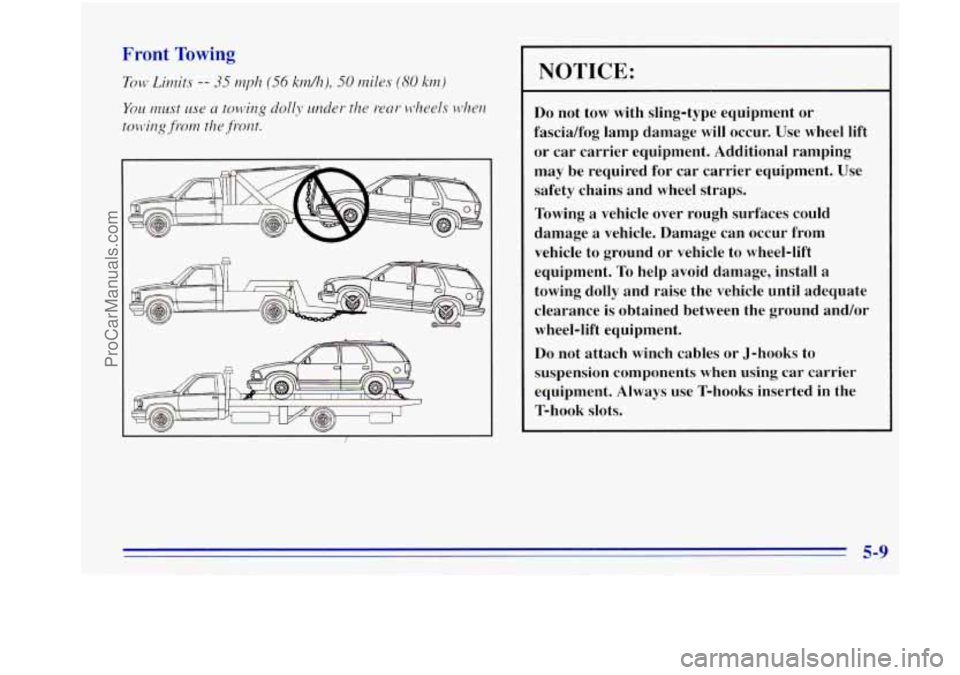
i
NOTICE:
Do not tow with sling-type equipment or
fascia/fog lamp damage will occur. Use wheel lift
or car carrier equipment. Additional ramping
may be required for car carrier equipment. Use
safety chains and wheel straps.
Towing
a vehicle over rough surfaces could
damage a vehicle. Damage can occur from
vehicle to ground or vehicle to wheel-lift
equipment.
To help avoid damage, install a
towing dolly and raise the vehicle until adequate
clearance
is obtained between the ground and/or
wheel-lift equipment.
Do not attach winch cables or J-hooks to
suspension components when using car carrier
equipment. Always use T-hooks inserted in the
T-hook slots.
ProCarManuals.com
Page 190 of 340
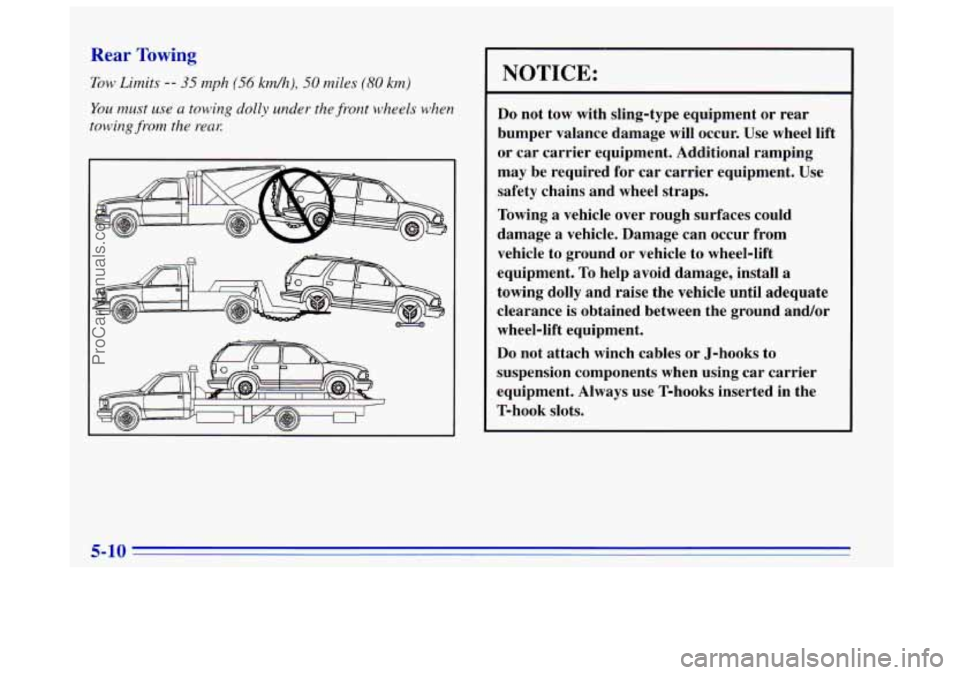
Rear Towing
Tow Limits -- 35 mph (56 kmh), 50 miles (80 km)
You must use a towing dolly under the front wheels when
towing from the rear.
NOTICE:
Do not tow with sling-type equipment or rear
bumper valance damage will occur. Use wheel lift
or car carrier equipment. Additional ramping
may be required for car carrier equipment. Use
safety chains and wheel straps.
Towing a vehicle over rough surfaces coula
damage a vehicle. Damage can occur from
vehicle
to ground or vehicle to wheel-lift
equipment. To help avoid damage, install
a
towing dolly and raise the vehicle until adequate
clearance is obtained between the ground and/or
wheel-lift equipment.
Do not attach winch cables or J-hooks to
suspension components when using car carrier
equipment. Always use T-hooks inserted in the
T-hook slots.
ProCarManuals.com
Page 210 of 340
I NOTICE:
Spinning your wheels can destroy parts of your
vehicle as well as the tires.
If you spin the wheels
too fast while shifting your transmission back
and forth, you can destroy your transmission.
For information about using tire chains on your vehicle,
see “Tire Chains” in the Index.
Rocking your vehicle to get it out:
First, turn your steering wheel left and right. That will
clear the area around your front wheels. Then shift back
and forth between REVERSE (R) and a forward gear,
spinning the wheels as little as possible. Release the
accelerator pedal while you shift, and press lightly on
the accelerator pedal when the transmission is in gear. If
that doesn’t get you out after a few tries, you may need
to be towed out. Or, you can use your recovery hooks if
your vehicle has them.
If you do need to be towed out,
see “Towing Your Vehicle” in the Index.
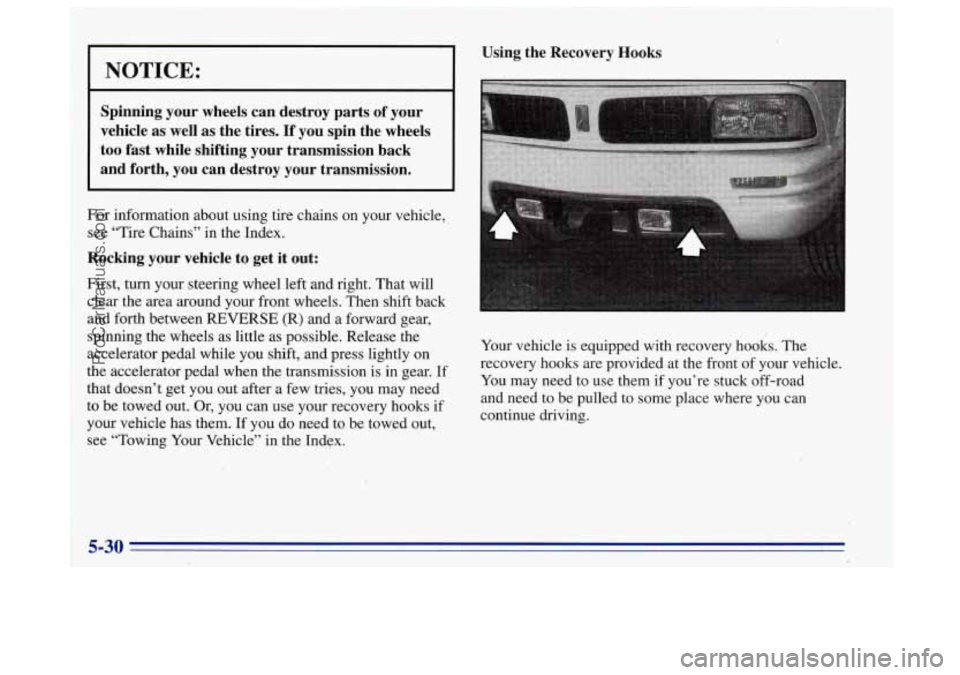
Using the Recovery Hooks
Your vehicle is equipped with recovery hooks. The
recovery hooks are provided at the front
of your vehicle.
You may need to use them if you’re stuck off-road
and need
to be pulled to some place where you can
continue driving.
ProCarManuals.com
Page 226 of 340

Automatic Transmission Fluid
When to Check and Change
A good time to check your automatic transmission fluid
level is when the engine oil is changed.
Change both the fluid and filter every
50,000 miles
(83 000 km) if the vehicle is mainly driven under one or
more
of these conditions:
In heavy city traffic where the outside temperature
regularly reaches
90°F (32°C) or higher.
In hilly or mountainous terrain.
0 When doing frequent trailer towing.
Uses such as found in taxi, police or delivery service.
If you do not use your vehicle under any of these
conditions,
the fluid and filter do not require changing.
See “Scheduled Maintenance Services” in the Index.
How to Check
Because this operation can be a little difficult, you may
choose to have this done at your Oldsmobile retail
facility Service Department.
If you do it yourself, be sure to follow all the instructions
here, or you could get a false reading on the dipstick.
I NOTICE:
- ~~
Too much or too little fluid can damage your
transmission.
Too much can mean that some of
the fluid could come out and fall on hot engine
parts
or exhaust system parts, starting a fire. Be
sure to get an accurate reading if you check your
transmission fluid.
Wait at least 30 minutes before checking the
transmission fluid level
if you have been driving:
0 When outside temperatures are above 90°F (32°C).
0 At high speed for quite a while.
0 In heavy traffic -- especially in hot weather.
0 While pulling a trailer.
To get the right reading, the fluid should be at normal
operating temperature, which
is 180°F to 200°F
(82°C to
93°C).
ProCarManuals.com
Page 276 of 340

I Short Trip/City Maintenance Schedule
The services shown in this schedule up to 100,000 miles
( 166 000 km) should be performed after 100,000 miles
(166
000 km) at the same intervals.
Footnotes
? The U.S. Environmental Protection Agency or the
California Air Resources Board has determined that the
failure to perform this maintenance item will not nullify
the emission warranty or limit recall liability prior to the
completion of the vehicle’s useful life. We, however,
urge that all recommended maintenance services be
performed at the indicated intervals and the maintenance
be recorded.
# Lubricate the front suspension, ball joints, steering
linkage, parking brake cable guides, propshaft splines,
universal joints and brake pedal springs.
**Drive axle service:
Drain and refill at first oil change. At subsequent oil
changes, check fluid level and add fluid as needed.
If
driving in dusty areas or towing a trailer, drain fluid
and refill every
15,000 miles (25 000 km).
More frequent lubrication may be required for
off-paved-road use.
ProCarManuals.com
Page 286 of 340
I Short TripKity Maintenance Schedule I
48,000 Miles (80 000 km)
0 Change engine oil and filter (or every
3 months, whichever occurs first).
An Emission Control Service.
0 Lubricate chassis components; see
footnote
# (or every 3 months,
whichever occurs first).
0 Check readfront axle fluid level and add
fluid as needed. Check constant velocity
joints and axle seals for leaking.
**
DATE ACTUAL MILEAGE SERVICED BY
50,000 Miles (83 000 km)
0 Change automatic transmission fluid and
filter
if the vehicle is mainly driven under
one
or more of these conditions:
- In heavy city traffic where the outside
temperature regularly reaches
90°F
(32°C) or higher.
- In hilly or mountainous terrain.
- When doing frequent trailer towing.
- Uses such as found in taxi, police or
If you do not use your vehicle under any of
these conditions, the fluid and filter do not
delivery service.
require changing.
DATE ACTUAL MILEAGE SERVICED BY
7-16
ProCarManuals.com