1996 OLDSMOBILE BRAVADA instrument panel
[x] Cancel search: instrument panelPage 115 of 340

Air Conditioning Heating
On hot
days, open the windows long enough to let hot
inside air escape. This reduces the time it takes for your
vehicle to cool down. Then keep your windows closed
for the air conditioner to work its best.
For quick cool-down
on very hot days, use MAX A/C
with the temperature knob turned counterclockwise.
This setting should be used to keep odors and/or dust
from entering the vehicle. For normal cooling on hot
days, use A/C with the temperature knob turned
counterclockwise.
On cool but sunny days, use
BI-LEVEL A/C to deliver
warm air to the floor and cooler air to the instrument
panel outlets.
When the air conditioner is on, you may sometimes
notice slight changes in your vehicle’s engine speed
and power.
This is normal because the system is
designed to cycle the compressor on and off to keep
the desired temperature. The
heater works best if you keep your windows closed
while using it. On cold days, use HEATER with the
temperature knob turned clockwise.
BLEND is useful in
cool weather when you have fog or ice on the
windshield or side windows.
If you use the optional engine coolant heater before
starting your engine, your heating system will produce
warmer air faster to heat the passenger compartment in
cold weather. See “Engine Coolant Heater” in the Index.
Ventilation System
For mild outside temperatures when little heating or
cooling is needed, use VENT to direct outside air
through your vehicle. Airflow is through the instrument
panel outlets.
Your vehicle’s ventilation system supplies outside air to
the inside
of your vehicle when it is moving. When the
vehicle is not moving, you can get outside air to flow
through by selecting any mode and any fan speed.
3-3
ProCarManuals.com
Page 116 of 340
Ventilation Tips
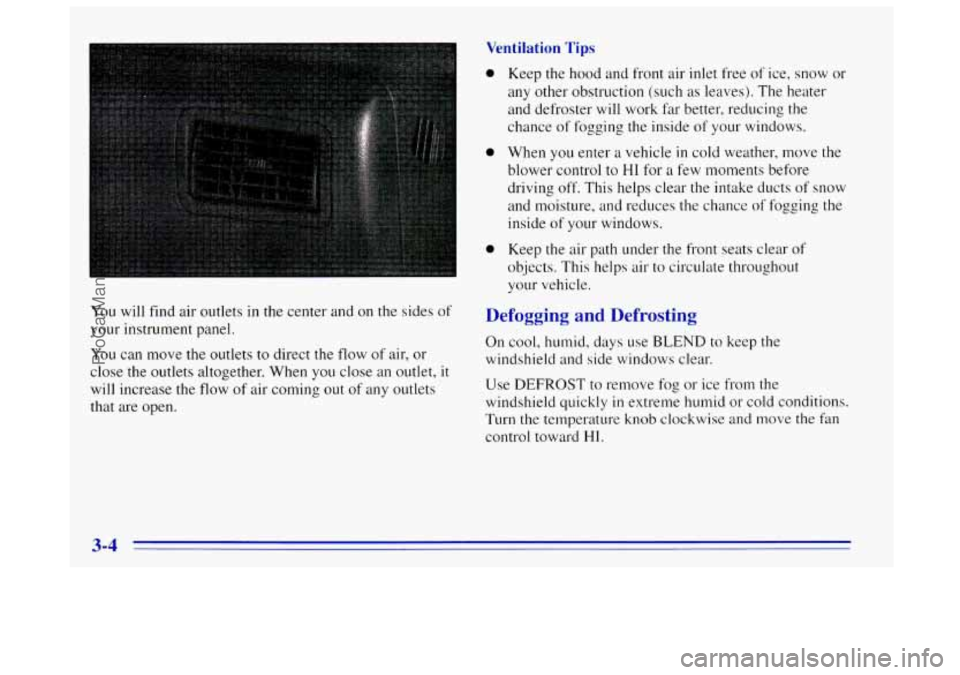
You will find air outlets in the center and on the sides of
your instrument panel.
You can move
the outlets to direct the flow of air, or
close the outlets altogether. When you close an outlet,
it
will increase the flow of air coming out of any outlets
that are open.
0
0
0 Keep the hood and front air inlet free of ice, snow or
any other obstruction (such as leaves). The heater
and defroster will work
far better, reducing the
chance
of fogging the inside of your windows.
When you enter a vehicle
in cold weather, move the
blower control to
HI for a few moments before
driving off. This helps clear the intake ducts of snow
and moisture, and reduces the chance of fogging the
inside of your windows.
Keep the air path under the front seats clear of
objects. This helps air
to circulate throughout
your vehicle.
Defogging and Defrosting
On cool, humid, days use BLEND to keep the
windshield and side windows clear.
Use
DEFROST to remove fog or ice from the
windshield quickly
in extreme humid or cold conditions.
Turn the temperature knob clockwise and move the fan
control toward
HI.
ProCarManuals.com
Page 117 of 340

Rear Window Defogger
I
The rear window has lines that warm the glass. For best
results, clear the window of
as much snow or ice as
possible before using the rear window defogger.
To turn on the rear window defogger, find the switch
marked
REAR DEFOG on your instrument panel below
the headlamp switch. Press
ON until the light in the
switch comes on, then release
it. It will only work if the
ignition switch is turned
to RUN.
The rear window defogger will stay on for five to
seven minutes, then turn off. If you need additional
warming time, turn it
on again. You can turn the
defogger off at any time by pressing
OFF.
Do not attach a temporary vehicle license, tape or decals
across the defogger grid
on the rear window.
NOTICE:
Don’t use a razor blade or something else sharp
on the inside
of the rear window. If you do, you
could cut
or damage the warming grid, and the
repairs wouldn’t be covered by your warranty.
3-5
ProCarManuals.com
Page 177 of 340
Following Distance
Stay at least twice as far behind the vehicle ahead as you
would when driving your vehicle without a trailer. This
can help you avoid situations that require heavy braking
and sudden turns.
Passing
You’ll need more passing distance up ahead when
you’re towing a trailer. And, because you’re
a good deal
longer, you’ll need to go much farther beyond the
passed vehicle before you can return
to your lane.
Backing Up
Hold the bottom of the steering wheel with one hand.
Then, to move the trailer to the left, just move that hand
to the left.
To move the trailer to the right, move your
hand to the right. Always back up slowly and,
if
possible, have someone guide you.
Making Turns
I NOTICE:
Making very sharp turns while trailering could
cause the trailer
to come in contact with the
vehicle. Your vehicle could
be damaged. Avoid
making very sharp turns while trailering.
When you’re turning with a trailer, make wider turns than
normal.
Do this so your trailer won’t strike soft shoulders,
curbs, road signs, trees or other objects. Avoid jerky or
sudden maneuvers. Signal well
in advance.
Turn Signals When Towing a Trailer
When you tow a trailer, your vehicle has to have extra
wiring and a heavy-duty turn signal flasher (included
in
the optional trailering package).
The green arrows on your instrument panel will flash
whenever you signal
a turn or lane change. Properly
hooked up, the trailer lamps will also flash, telling other
drivers you’re about to turn, change lanes
or stop.
ProCarManuals.com
Page 178 of 340

When towing a trailer, the green arrows on your
instrument panel
will flash for turns even if the bulbs on
the trailer are burned out. Thus, you may think drivers
behind you are seeing your signal when they are not. It’s
important
to check occasionally to be sure the trailer
bulbs are still working.
Driving On Grades
Reduce speed and shift to a lower gear before you start
down
a long or steep downgrade. If you don’t shift
down, you might have to use
your brakes so much that
they would get hot and no longer work well.
On a long uphill grade, shift down and reduce your
speed to around
45 mph (70 km/h) to reduce the
possibility of engine and transmission overheating.
You should use THIRD (3) when towing a trailer.
Operating your vehicle
in THIRD (3) when towing a
trailer will minimize heat buildup and extend
the life of
your transmission.
Parking on Hills
You really should not park your vehicle, with a trailer
attached, on
a hill. Tf something goes wrong, your rig
could start to move. People can be injured, and both
your vehicle and the trailer can be damaged.
But
if you ever have to park your rig on a hill, here’s
how to do it:
1. Apply your regular brakes, but don’t shift into
PARK
(P) yet. Then turn your wheels into the curb if
facing downhill or into traffic if facing uphill.
2. Have someone place chocks under the trailer wheels.
3. When the wheel chocks are in place, release the
regular brakes
until the chocks absorb the load.
4. Reapply the regular brakes. Then apply your parking
brake and shift into PARK (P).
5. Release the regular brakes.
4-50
ProCarManuals.com
Page 191 of 340

Engine Overheating
You will find a coolant temperature gage on your
vehicle’s instrument panel.
If Steam Is Coming From Your Engine
Steam from an overheated engine can burn you
badly, even if you just open the hood. Stay away
from the engine
if you see or hear steam coming
from it. Just turn it off and get everyone
away
from the vehicle until it cools down. Wait until
there is no sign of steam or coolant before
opening the hood.
If you keep driving when your engine is
overheated, the liquids in it can catch fire. You or
others could be badly burned. Stop your engine if
it overheats, and get out of the vehicle until the
engine is cool.
I NOTICE:
If your engine catches fire because you keep
driving with no coolant, your vehicle can be
badly damaged. The costly repairs would not be
covered by your warranty.
3-11
ProCarManuals.com
Page 215 of 340

If your vehicle is certified to meet California Emission
Standards (indicated
on the underhood tune-up label), it
is designed to operate
on fuels that meet California
specifications. If such fuels are not available in states
adopting California emissions standards, your vehicle
will operate satisfactorily on fuels meeting federal
specifications, but emission control system performance
may be affected. The malfunction indicator lamp
on
your instrument panel may turn on and/or your vehicle
may fail a smog-check test. If this occurs, return
to your
authorized Oldsmobile retailer for diagnosis to
determine the cause of failure. In the event
it is
determined that the cause
of the condition is the type of-
fuels used, repairs may not be covered by your warranty.
In Canada, some gasolines contain an octane-enhancing
additive called
MMT. If you use such fuels, your
emission control system performance may deteriorate
and the malfunction indicator lamp on your instrument
panel may turn on. If this happens, return
to your
authorized Oldsmobile retailer for service.
To provide cleaner air, all gasolines are now required to
contain additives that will help prevent deposits from
forming
in your engine and fuel system, allowing your
emission control system to function properly. Therefore,
you should
not have to add anything to the fuel. In
addition, gasolines containing oxygenates, such as
ethers and ethanol, and reformulated gasolines may
be available in your area to help clean the air. General
Motors recommends that you use these gasolines
if
they comply with the specifications described earlier.
I NOTICE:
Your vehicle was not designed for fuel that
contains methanol. Don’t use it. It can corrode
metal parts in your
fuel system and also damage
plastic and rubber parts. That damage wouldn’t
be covered under your warranty.
ProCarManuals.com
Page 218 of 340

When you put the cap back on, turn it to the right until
you hear at least three clicks. Make sure you fully install
the cap. The diagnostic system can determine if the fuel
cap has been left off or improperly installed. This would
allow fuel
to evaporate into the atmosphere. See
“Malfunction Indicator Lamp” in the Index.
NOTICE:
If you need a new cap, be sure to get the right
type. Your retailer can get one for you. If
you get
the wrong type, it may not
fit or have proper
venting, and
your fuel tank and emissions system
might be damaged.
Checking Things Under the Hood
To open the hood, first pull
the handle inside the vehicle
on
the lower driver’s side of
the instrument panel.
Then
go to the front of the vehicle and release the
secondary hood release.
ProCarManuals.com