1996 OLDSMOBILE BRAVADA engine
[x] Cancel search: enginePage 67 of 340

Ensure the shift lever is fully in PARK (P) range
before starting
the engine. Your vehicle has a
brake-transmission shift interlock. You have to fully
apply your regular brakes before you can shift from
PARK (P) when
the ignition key is in the RUN position.
If you cannot shift
out of PARK (P), ease pressure on
the shift lever -- press the button on the shift lever and
push the shift lever all the way into PARK
(P) as you
maintain brake application. Then move the shift lever
into the gear you wish. See “Shifting Out of PARK
(P)”
in the Index.
REVERSE (R): Use this gear to back up.
I NOTICE:
Shifting to REVERSE (R) while your vehicle is
moving forward could damage your transmission.
Shift to REVERSE (R) only after your vehicle
is stopped.
To rock your vehicle back and forth to get out of snow,
ice
or sand without damaging your transmission, see
“Stuck: In Sand, Mud, Ice or Snow” in the Index.
NEUTRAL (N): In this position, your engine doesn’t
connect with the wheels. To restart when you’re already
moving, use NEUTRAL
(N) only.
I
Shifting out of PARK (P) or NEUTRAL (N) while
your engine
is “racing” (running at high speed) is
dangerous. Unless your foot is firmly on the
brake pedal,
your vehicle could move very
rapidly. You could lose control and hit people or
objects. Don’t shift out
of PARK (P) or
NEUTRAL (N) while your engine is racing.
I NOTICE:
~~~
Damage to your transmission caused by shifting
out of PARK
(P) or NEUTRAL (N) with the
engine racing isn’t covered by your warranty.
ProCarManuals.com
Page 69 of 340

Locking Rear Axle
Your rear axle can give you additional traction on snow,
mud, ice, sand or gravel. It works like
a standard axle
most
of the time, but when one of the rear wheels has no
traction and the other does, the locking feature will
allow the wheel with traction to move the vehicle.
All-Wheel Drive
Your engine’s driving power is sent to all four wheels
for extra traction. All-wheel drive
is like four-wheel
drive, but there is no lever or switch
to engage or
disengage the front axle. It is
fully automatic and adjusts
itself
as needed for road conditions.
Parking Brake
To set the parking brake, hold the regular brake pedal
down with your right foot. Push down the parking brake
pedal with your left
foot. If the ignition is on, the brake
system warning light will come on.
To release the parking brake, hold the regular brake
pedal down. Pull the
BRAKE RELEASE
lever.
It is located on the
bottom driver’s side of the
instrument panel.
NOTICE:
Driving with the parking brake on can cause
your rear brakes to overheat. You may have to
replace them, and you could
also damage other
parts of your vehicle.
If you are towing a trailer and you must park on a hill,
see “Towing
a Trailer” in the Index. That section shows
what to do first to keep the trailer from moving.
2-17
ProCarManuals.com
Page 70 of 340

It can be dangerous to get out of your vehicle if
the shift lever is not fully in
PARK (P) with the
parking brake firmly set. Your vehicle can roll.
If you have left the engine running, the vehicle
can move suddenly. You
or others could be
injured.
To be sure your vehicle won’t move, even
when you’re on fairly level ground, use the steps
that follow.
If you’re pulling a trailer, see
“Towing
a Trailer’’ in the Index.
1. Hold the brake pedal down with your right foot and
set the parking brake.
2. Move the shift lever into PARK (P) position like this:
0 Hold in the button on the lever.
0 Push the lever all the way toward the front of
the vehicle.
3. Turn the ignition key to LOCK.
4. Remove the key and take it with you. If you can
remove the key and leave your vehicle, your vehicle
is
in PARK (P).
2-18
ProCarManuals.com
Page 71 of 340

Q
Leaving Your Vehicle With the
T“-lgi-- - Yunning
It can be dangerous to leave your vehicle with
the engine running. Your vehicle could move
suddenly if the shift lever is not fully in
PARK (P)
with the parking brake firmly set. And, if you
leave the vehicle with the engine running, it could
overheat and even catch fire. You or others could
be injured. Don’t leave your vehicle with the
engine running unless you have to.
If you have to leave your vehicle with the engine
running, be sure to firmly set your parking brake and
shift into PARK (P) before you leave
it. After you’ve
moved the shift lever into the PARK (P) position, hold
the regular brake pedal down. Then, see
if you can move
the shift lever away from PARK (P) without first pulling
it toward you. If you can, it means that the shift lever
wasn’t
fully locked into PARK (P).
Torque Lock
If you are parking on a hill and you don’t shift your
transmission into PARK (P) properly, the weight of the
vehicle may
put too much force on the parking pawl in
the transmission. You may find it difficult to pull the
shift lever out of PARK
(P). This is called “torque lock.”
To prevent torque lock, set the parking brake and then
shift into PARK (P) properly before
you leave the
driver’s seat.
To find out how, see “Shifting Into
PARK
(P)” in the Index.
When
you are ready to drive, move the shift lever out of
PARK (P) before you release the parking brake.
If torque lock does occur, you may need
to have another
vehicle push yours a
little uphill to take some of the
pressure from the transmission,
so you can pull the shift
lever out of PARK
(P).
ProCarManuals.com
Page 73 of 340
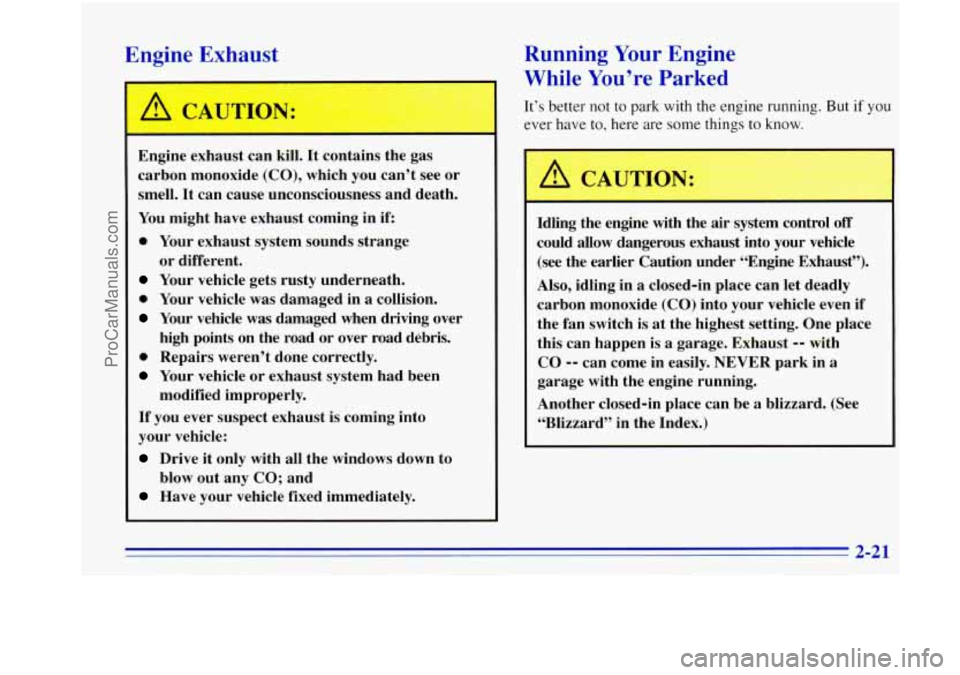
Engine Exhaust
Engine exhaust can kill. It contains the gas
carbon monoxide
(CO), which you can’t see or
smell. It can cause unconsciousness and death.
You might have exhaust coming in if:
0 Your exhaust system sounds strange
Your vehicle gets rusty underneath.
0 Your vehicle was damaged in a collision.
Your vehicle was damaged when driving over
high points on the road or over road debris.
0 Repairs weren’t done correctly.
Your vehicle or exhaust system had been
If you ever suspect exhaust is coming into
your vehicle:
Drive it only with all the windows down to
Have your vehicle fixed immediately.
or different.
modified improperly.
blow out any CO; and
Running Your Engine
While You’re Parked
It’s better not to park with the engine running. But if you
ever have to, here are some things to know.
A CAUTION:
Idling the engine with the air system control off
could allow dangerous exhaust into your vehicle
(see the earlier Caution under “Engine Exhaust”).
Also, idling in a closed-in place can let deadly
carbon monoxide
(CO) into your vehicle even if
the fan switch is at the highest setting. One place
this can happen is
a garage. Exhaust -- with
CO -- can come in easily. NEVER park in a
garage with the engine running.
Another closed-in place can be
a blizzard. (See
“Blizzard” in the Index.)
2-21
ProCarManuals.com
Page 74 of 340
It can be dangerous to get out of your vehicle if
the shift lever is not fully in
PARK (P) with the
parking brake firmly set. Your vehicle can roll.
Don’t leave your vehicle when the engine
is
running unless you have to. If you’ve left the
engine running, the vehicle can move suddenly.
You or others could be injured.
To be sure your
vehicle won’t move, even when you’re on fairly
level ground, always set your parking brake and
move the shift lever to
PARK (P).
Follow the proper steps to be sure your vehicle won’t
move. See “Shifting Into
PARK (P)” in the Index.
If you’re pulling a trailer, see “Towing a Trailer”
in the Index.
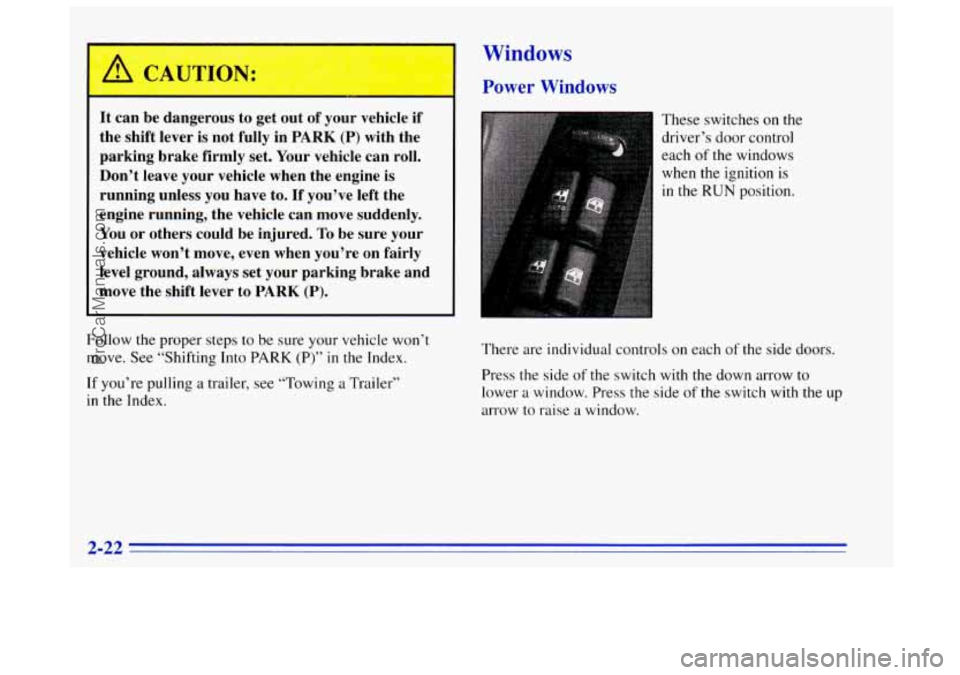
Windows
Power Windows
These switches on the
driver’s door control
each
of the windows
when the ignition is
in the RUN position.
There are individual controls
on each of the side doors.
rress the side
of the switch with the down arrow to
lower
a window. Press the side of the switch with the up
arrow to raise a window.
2-22
ProCarManuals.com
Page 96 of 340

The transmitter will learn and transmit the frequencies
of most current transmitters and is powered by your
vehicle’s battery and charging system.
This device complies
with Part 15 of the FCC Rules.
Operation is subject to the following two conditions:
(1) This device may not cause harmful interference, and
(2) This device must accept any interference received,
including interference that may cause undesired operation.
Programming the Transmitter
Do not use the transmitter with any garage door opener
that does not have the “stop and reverse” feature. This
includes any garage door opener model manufactured
before April
I, 1982.
Be sctre that people and objects ure clear of the garuge
door you are progrmnmin.g!
Your vehicle’s engine should be turned off while
programming the transmitter. Follow these steps to
program
up to three channels:
1.
2.
3.
If you have not previously programmed a universal
channel, proceed to Step
2. Otherwise, hold
down the two outside buttons on the universal
transmitter until the red light begins
to flash rapidly
(approximately
20 seconds). Then release the
buttons. This procedure initializes the memory and
erases any previous settings for all three channels.
Hold the end
of the hand-held transmitter against the
bottom surfixe of
the universal transmitter so that
you can still see the red light.
Decide which one
of the three channels you want to
program. Using both hands, press the hand-held
transmitter button and the desired button on the
universal transmitter. Continue to hold both buttons
through Step
4.
ProCarManuals.com
Page 101 of 340

Speedometer and Odometer
Your speedometer lets you see your speed in both miles
per hour (mph) and kilometers per hour (km/h).
Your odometer shows how far your vehicle has been
driven, in miles.
Your odometer
is tamper resistant. It will show silver
lines between the numbers
if someone tries to turn
it back.
You may wonder what happens
if your vehicle needs a
new odometer installed. If the new one can be set to the
mileage total
of the old odometer, then it must be. But if
it can’t, then it’s set at zero, and a label must be put on
the driver’s door to show the old mileage reading when
the new odometer was installed.
Trip Odometer
The trip odometer can tell you how far your vehicle has
been driven since
you last set the trip odometer to zero.
To set the trip odometer to zero, press the button near
the readout.
Tachometer
Each tachometer has a different limit depending on the
powertrain
in your vehicle. The tachometer has three
areas: normal operating range, red warning range and
red danger range.
The normal operating range shows your engine speed
during normal driving conditions. For example, when
the needle points to
2, it means the engine is running at
2,000 revolutions per minute (rpm). The tachometer
needle will vary all the time that the engine is running.
The red warning range tells you that your engine speed
is reaching its upper limits. Don’t drive very long with
the tachometer in the red warning range. Lift your foot
off
of the accelerator pedal.
The red danger range tells you that your engine speed is
at its upper limits.
You should immediately shift to a
higher gear, or lift your foot
off of the accelerator pedal.
I NOTICE:
Do not operate the engine with the tachometer in
the red range, or engine damage
will occur.
The tachometer displays the engine speed in revolutions
per minute (rpm).
2-49
ProCarManuals.com