1996 OLDSMOBILE BRAVADA change time
[x] Cancel search: change timePage 145 of 340

Scanning the Terrain
Off-road driving can take you over many different
kinds of terrain. You need to be familiar with the terrain
and its many different features. Here are some things
to consider.
Su$uce Condiriorzs. Off-roading can take you over
hard-packed dirt, gravel, rocks, grass, sand, mud, snow or
ice. Each of these surfaces affects the steering, acceleration
and braking of your vehicle
in different ways. Depending
upon the kind of surface
you are on, you may experience
slipping, sliding, wheel spinning, delayed acceleration,
poor traction and longer braking distances.
Surjiuce Obstacles. Unseen or hidden obstacles can be
hazardous.
A rock, log, hole, rut or bump can startle you if
you’re not prepared for them. Often these obstacles are
hidden by grass, bushes, snow or even the rise and fall of
the terrain itself. Here are some things to consider:
Is the path ahead clear?
Will the surface texture change abruptly up ahead?
Does the travel take you uphill or downhill? (There’s
more discussion of these subjects later.)
Will you have to stop suddenly or change
direction quickly? When
you drive over obstacles or rough terrain, keep
a
firm grip on the steering wheel. Ruts, troughs or other
surface features can jerk
the wheel out of your hands if
you’re not prepared.
When you drive over bumps, rocks, or other obstacles,
your wheels can leave the ground. If this happens, even
with one or two wheels,
you can’t control the vehicle as
well or at all.
Because you
will be on an unpaved surface, it’s
especially important to avoid sudden acceleration,
sudden turns or sudden braking.
In a way, off-road driving requires a different kind
of
alertness from driving on paved roads and highways.
There are no road signs, posted speed limits or signal
lights.
You have to use your own good judgment about
what is safe and what isn’t.
Drinking and driving can be very dangerous on any
road. And this is certainly true for off-road driving.
At
the very time you need special alertness and driving
skills, your reflexes, perceptions and judgment can be
affected by
even a small amount of alcohol. You could
have a serious
-- or even fatal -- accident if you drink
and drive or ride with a driver who has been drinking.
See “Drunken Driving”
in the Index.
4-17
ProCarManuals.com
Page 172 of 340

NOTICE:
Pulling a trailer improperly can damage your
vehicle and result in costly repairs not covered by
your warranty.
To pull a trailer correctly, follow
the advice in this part, and see your Oldsmobile
retailer
for important information about towing
a trailer with your vehicle.
Every Bravada is ready for some trailer towing. If yours
was built with trailering options, as many are, it’s ready
for heavier trailers. But trailering is different than just
driving your vehicle by itself. Trailering means changes
in handling, durability and fuel economy. Successful,
safe trailering takes correct equipment, and
it has to be
used properly.
That’s the reason for this part. In it are many
time-tested, important trailering tips and safety rules.
Many of these are important for your safety and that of
your passengers.
So please read this section carefully
before you pull a trailer.
If You Do Decide To Pull A Trailer
If you do, here are some important points:
0
0
0
0
0
There are many different laws, including speed limit
restrictions, having to do with trailering. Make sure
your rig will be legal, not
only where you live but
also where you’ll be driving.
A good source for this
information can be state or provincial police.
Consider using
a sway control if your trailer will
weigh
2,000 Ibs. (900 kg) or less. You should always
use
a sway control if your trailer will weigh more
than
2,000 lbs. (900 kg). You can ask a hitch dealer
about sway controls.
Don’t
tow a trailer at all during the first 500 miles
(800 km) your new vehicle is driven. Your engine,
axle or other parts could be damaged.
Then, during the first
500 miles (800 km) that you
tow
a trailer, don’t drive over 50 mph (80 Mh) and
don’t make starts at
full throttle. This helps your
engine and other parts of your vehicle wear in at the
heavier loads.
You should use THIRD (3) (or, as you need to, a
lower gear) when towing a trailer. Operating your
vehicle in THIRD
(3) when towing a trailer will
minimize heat buildup and extend the life of your
transmission.
ProCarManuals.com
Page 206 of 340
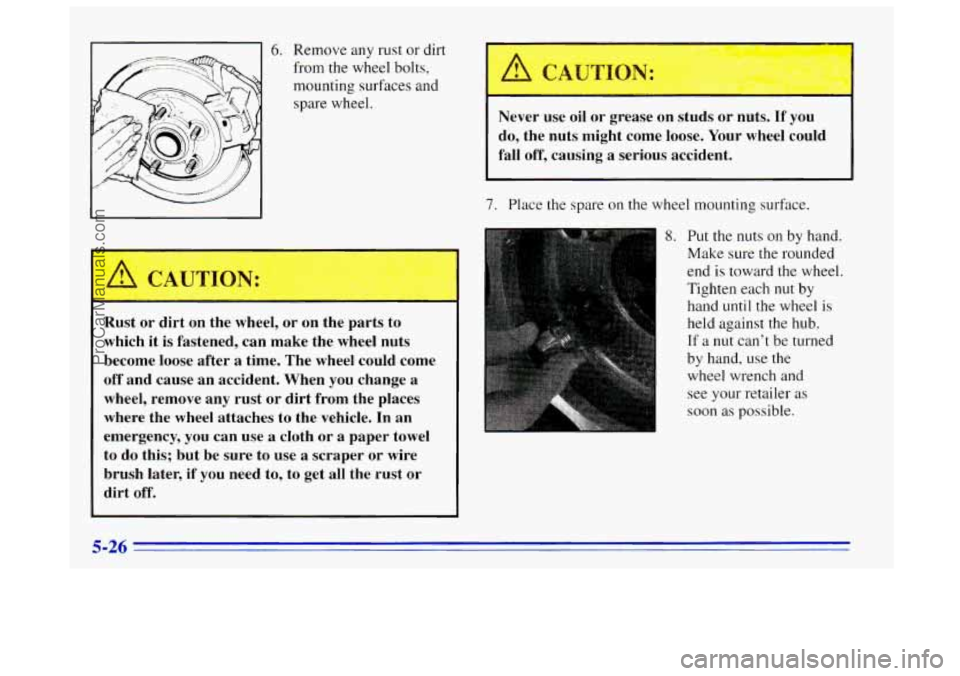
6. Remove any rust or dirt
from
the wheel bolts,
mounting surfaces and spare wheel.
Rust or dirt on the wheel, or on the parts to
which it is fastened, can make the wheel nuts
become loose after a time. The wheel could come
off and cause an accident. When
you change a
wheel, remove any rust or dirt from the places
where the wheel attaches to the vehicle.
In an
emergency, you can use
a cloth or a paper towel
to do this; but be sure to use a scraper or wire
brush later, if you need to, to get all the rust or
dirt off. Never use oil
or grease on studs
or nuts. If you
do, the nuts might come loose. Your wheel could
fall off, causing a serious accident.
7. Place the spare on the wheel mounting surface.
8. Put the nuts on by hand.
Make sure the rounded
end is toward the wheel.
Tighten
each nut by
hand
until the wheel is
held against the hub.
If a nut can't be turned
by hand, use the
wheel wrench and
see your retailer as
soon as possible,
ProCarManuals.com
Page 226 of 340

Automatic Transmission Fluid
When to Check and Change
A good time to check your automatic transmission fluid
level is when the engine oil is changed.
Change both the fluid and filter every
50,000 miles
(83 000 km) if the vehicle is mainly driven under one or
more
of these conditions:
In heavy city traffic where the outside temperature
regularly reaches
90°F (32°C) or higher.
In hilly or mountainous terrain.
0 When doing frequent trailer towing.
Uses such as found in taxi, police or delivery service.
If you do not use your vehicle under any of these
conditions,
the fluid and filter do not require changing.
See “Scheduled Maintenance Services” in the Index.
How to Check
Because this operation can be a little difficult, you may
choose to have this done at your Oldsmobile retail
facility Service Department.
If you do it yourself, be sure to follow all the instructions
here, or you could get a false reading on the dipstick.
I NOTICE:
- ~~
Too much or too little fluid can damage your
transmission.
Too much can mean that some of
the fluid could come out and fall on hot engine
parts
or exhaust system parts, starting a fire. Be
sure to get an accurate reading if you check your
transmission fluid.
Wait at least 30 minutes before checking the
transmission fluid level
if you have been driving:
0 When outside temperatures are above 90°F (32°C).
0 At high speed for quite a while.
0 In heavy traffic -- especially in hot weather.
0 While pulling a trailer.
To get the right reading, the fluid should be at normal
operating temperature, which
is 180°F to 200°F
(82°C to
93°C).
ProCarManuals.com
Page 241 of 340
1 NOTICE:
Continuing to drive with worn-out brake pads
could result in costly brake repair.
Some driving conditions or climates may cause a brake
squeal when the brakes are first applied or lightly
applied. This does not mean something is wrong
with
your brakes.
Your rear drum brakes don’t have wear indicators, but
if
you ever hear a rear brake rubbing noise, have the rear
brake linings inspected. Also, the rear brake drums
should be removed and inspected each time the tires are
removed for rotation or changing. When you have
the
front brakes replaced, have the rear brakes inspected, too.
Brake linings should always be replaced as complete
axle sets.
Brake Pedal Travel
See your retailer if the brake pedal does not return to
normal height, or if there is
a rapid increase in pedal
travel. This could be
a sign of brake trouble.
Brake Adjustment
Every time you make a brake stop, your disc brakes
adjust for wear.
If your brake pedal goes down farther than normal, your
rear drum brakes may need adjustment. Adjust them by
backing up and firmly applying the brakes a few times.
Replacing Brake System Parts
The braking system on a modern vehicle is complex.
Its many parts have to be of top quality and work well
together
if the vehicle is to have really good braking.
Vehicles we design and test have top-quality
GM brake
parts
in them, as your Oldsmobile does when it is new.
When you replace parts
of your braking system -- for
example, when your brake linings wear down and
you
have to have new ones put in -- be sure you get new
genuine
GM replacement parts. If you don’t, your
brakes
may no longer work properly. For example, if
someone puts in brake linings that are wrong for your
vehicle, the balance between your front and rear brakes
can change
-- for the worse. The braking performance
you’ve come to expect can change
in many other ways
someone puts
in the wrong replacement brake parts. if
ProCarManuals.com
Page 251 of 340

Tire Inspection and Rotation
Tires should be inspected every 6,000 to 8,000 miles
(I 0 000 to 13 000 km) for any signs of unusual wear.
If unusual wear is present, rotate your tires as soon
as
possible and check wheel alignment. Also check for
damaged tires or wheels. See “When It’s Time for New
Tires” and “Wheel Replacement” later
in this section for
more information.
The purpose of regular rotation
is to achieve more
uniform wear for all tires on the vehicle. The first
rotation is the most important. See “Scheduled
Maintenance Services”
in the Index for scheduled
rotation intervals. When rotating your tires,
always use the correct rotation
pattern shown here.
After the tires have been rotated, adjust the front and
rear inflation pressures as shown on the CertificatiodTire
label. Make certain that all wheel nuts are properly
tightened. See “Wheel Nut Torque”
in the Index.
Rust or dirt on a wheel, or on the parts to which
it is fastened, can make wheel nuts become loose
after a time. The wheel could come off and cause
an accident. When you change
a wheel, remove
any rust or dirt from places where the wheel
attaches to the vehicle. In an emergency, you can
use
a cloth or a paper towel to do this; but be
sure to use a scraper
or wire brush later, if you
need to, to get all the rust or dirt off. (See
“Changing
a Flat Tire” in the Index.)
6-39
ProCarManuals.com
Page 269 of 340
Capacities and Specifications
Engine Description ............ “VORTEC” 4300
Type
.................................... V6
VINCode
................................. W
Firing Order
...................... 1-6-5-4-3-2
Horsepower
................... 190 at 4,400 rpm
Thermostat Specification
........... 195°F (9 1 “C)
Spark Plug Gap
.......... 0.045 inches (0.114 cm)
Wheels and Tires
Wheel Nut Torque ............ 95 Ib-ft (1 30 Nem)
Tire Pressure ...................... Look at the
CertificatiodTire label.
See “Loading Your Vehicle” in
the Index.
Normal Maintenance Replacement Parts
Replacement part numbers listed in this section are
based on the latest information available at the time of
printing, and are subject to change.
If a part listed in this
manual is not the same as the part used in your vehicle
when
it was built, or if you have any questions, please
contact your retailer.
Oil Filter..
............................. PF52
Air Cleaner Filter
...................... A 1 163C
PCV Valve
.......................... CV746C
Automatic Transmission Filter
Kit ...... 24200796
Spark Plugs
.......................... .41-932
Fuel Filter
............................. GF48 1
Windshield Wiper Blade
, . Trico (20 inched50.8 cm) .
Backglass Wiper Blade ... Trico (14 inched35.6 cm)
6-57
ProCarManuals.com