CAUTION
cAfter rotating the tires, adjust the tire
pressure.
cRetighten the wheel nuts after the
wheels have been run for the first 600
miles (1,000 km) (also in cases of a
flat tire, etc.).
cDo not include the T-type spare tire or
any other small size spare tire in the
tire rotation.
Tire wear and damage
CAUTION
Tires should be periodically inspected
for wear, cracking, bulging, or objects
caught in the tread. If excessive wear,
cracks, bulging, or deep cuts are
found, the tire should be replaced.
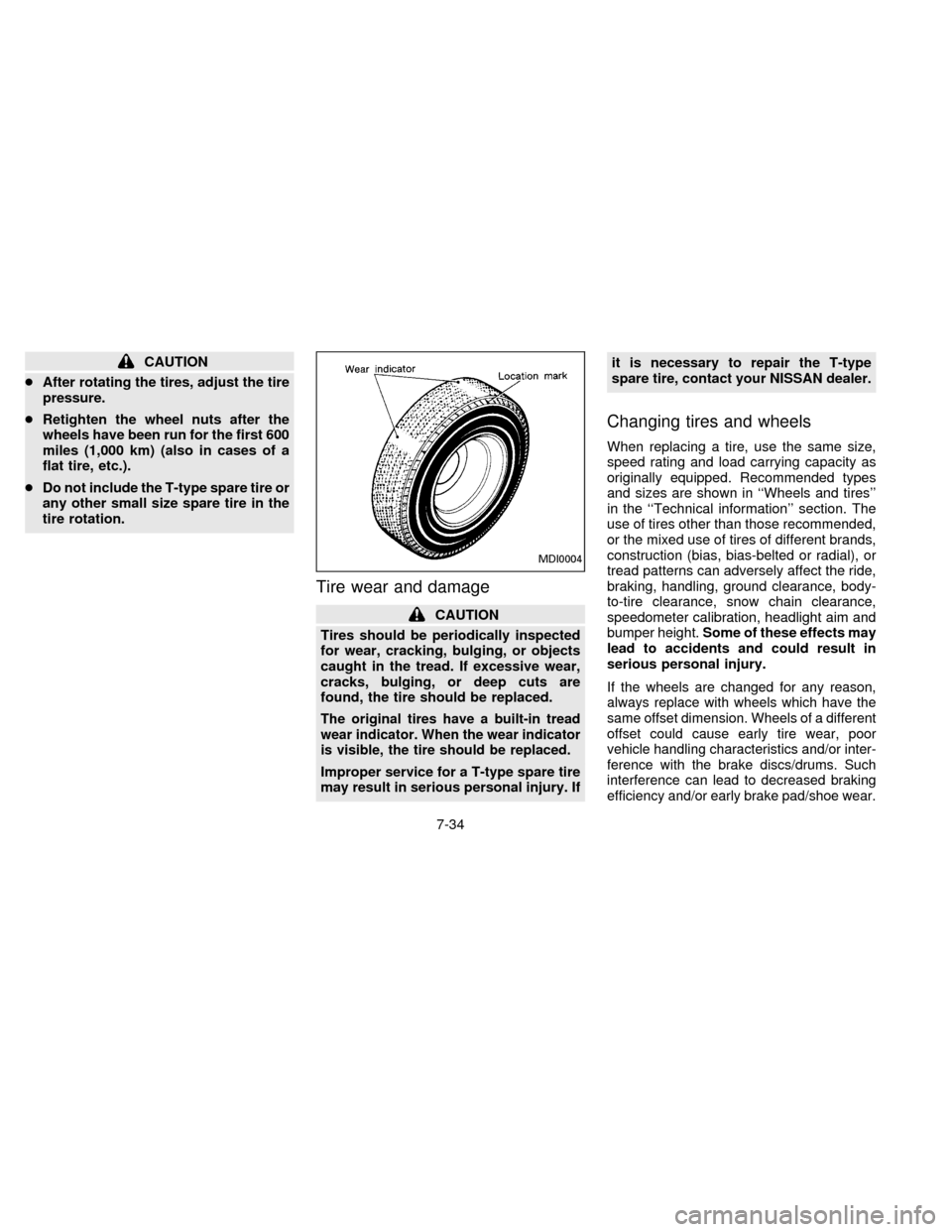
The original tires have a built-in tread
wear indicator. When the wear indicator
is visible, the tire should be replaced.
Improper service for a T-type spare tire
may result in serious personal injury. Ifit is necessary to repair the T-type
spare tire, contact your NISSAN dealer.
Changing tires and wheels
When replacing a tire, use the same size,
speed rating and load carrying capacity as
originally equipped. Recommended types
and sizes are shown in ``Wheels and tires''
in the ``Technical information'' section. The
use of tires other than those recommended,
or the mixed use of tires of different brands,
construction (bias, bias-belted or radial), or
tread patterns can adversely affect the ride,
braking, handling, ground clearance, body-
to-tire clearance, snow chain clearance,
speedometer calibration, headlight aim and
bumper height.Some of these effects may
lead to accidents and could result in
serious personal injury.
If the wheels are changed for any reason,
always replace with wheels which have the
same offset dimension. Wheels of a different
offset could cause early tire wear, poor
vehicle handling characteristics and/or inter-
ference with the brake discs/drums. Such
interference can lead to decreased braking
efficiency and/or early brake pad/shoe wear.
MDI0004
7-34
ZX