1996 NISSAN SENTRA engine coolant
[x] Cancel search: engine coolantPage 124 of 191
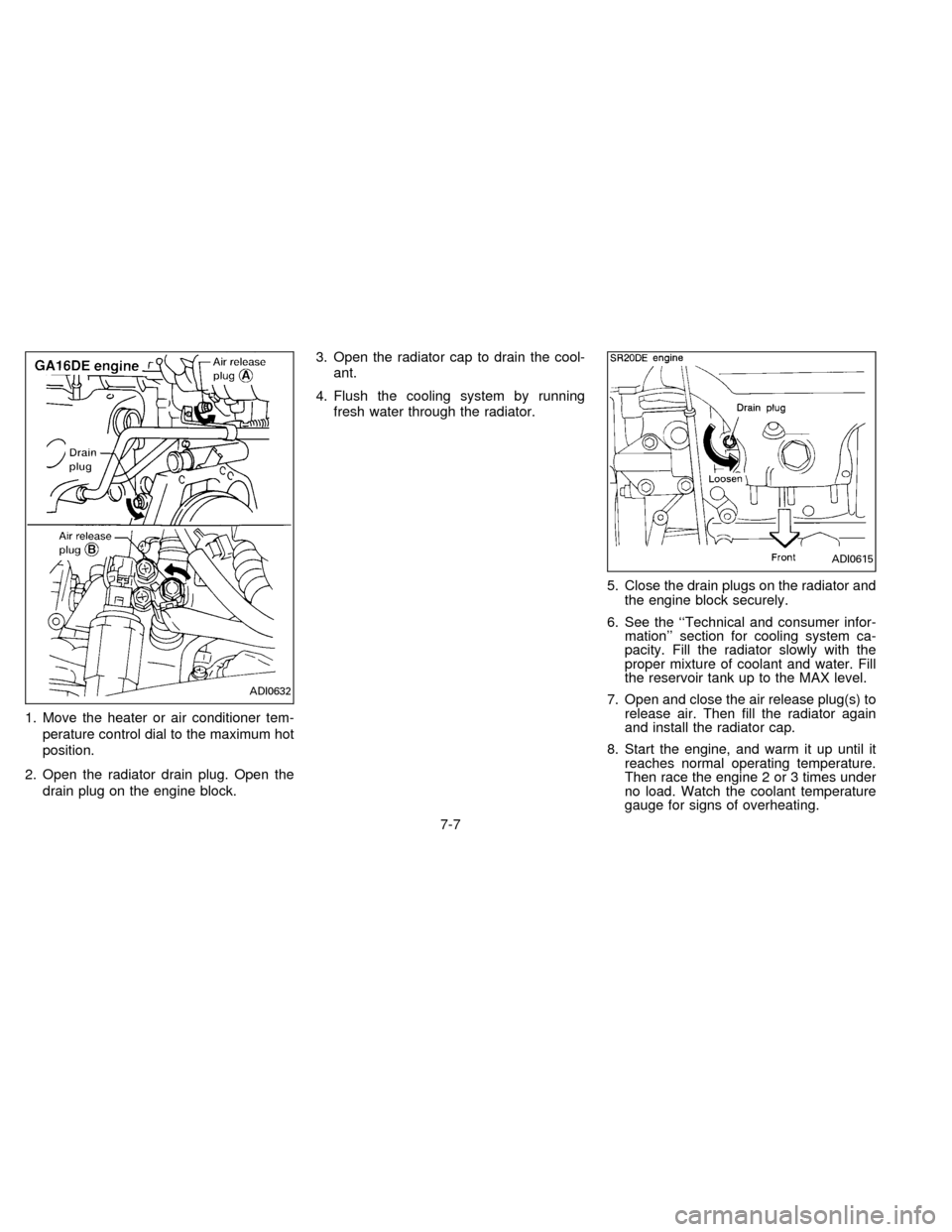
1. Move the heater or air conditioner tem-
perature control dial to the maximum hot
position.
2. Open the radiator drain plug. Open the
drain plug on the engine block.3. Open the radiator cap to drain the cool-
ant.
4. Flush the cooling system by running
fresh water through the radiator.
5. Close the drain plugs on the radiator and
the engine block securely.
6. See the ``Technical and consumer infor-
mation'' section for cooling system ca-
pacity. Fill the radiator slowly with the
proper mixture of coolant and water. Fill
the reservoir tank up to the MAX level.
7. Open and close the air release plug(s) to
release air. Then fill the radiator again
and install the radiator cap.
8. Start the engine, and warm it up until it
reaches normal operating temperature.
Then race the engine 2 or 3 times under
no load. Watch the coolant temperature
gauge for signs of overheating.
ADI0632
ADI0615
7-7
ZX
Page 131 of 191
cDo not spill the fluid on painted sur-
faces. This will damage the paint. If
fluid is spilled, wash with water.
For USA
Fill the window washer fluid reservoir peri-
odically. Perform the refilling operation
more often under driving conditions that
require an increased amount of window
washer fluid.
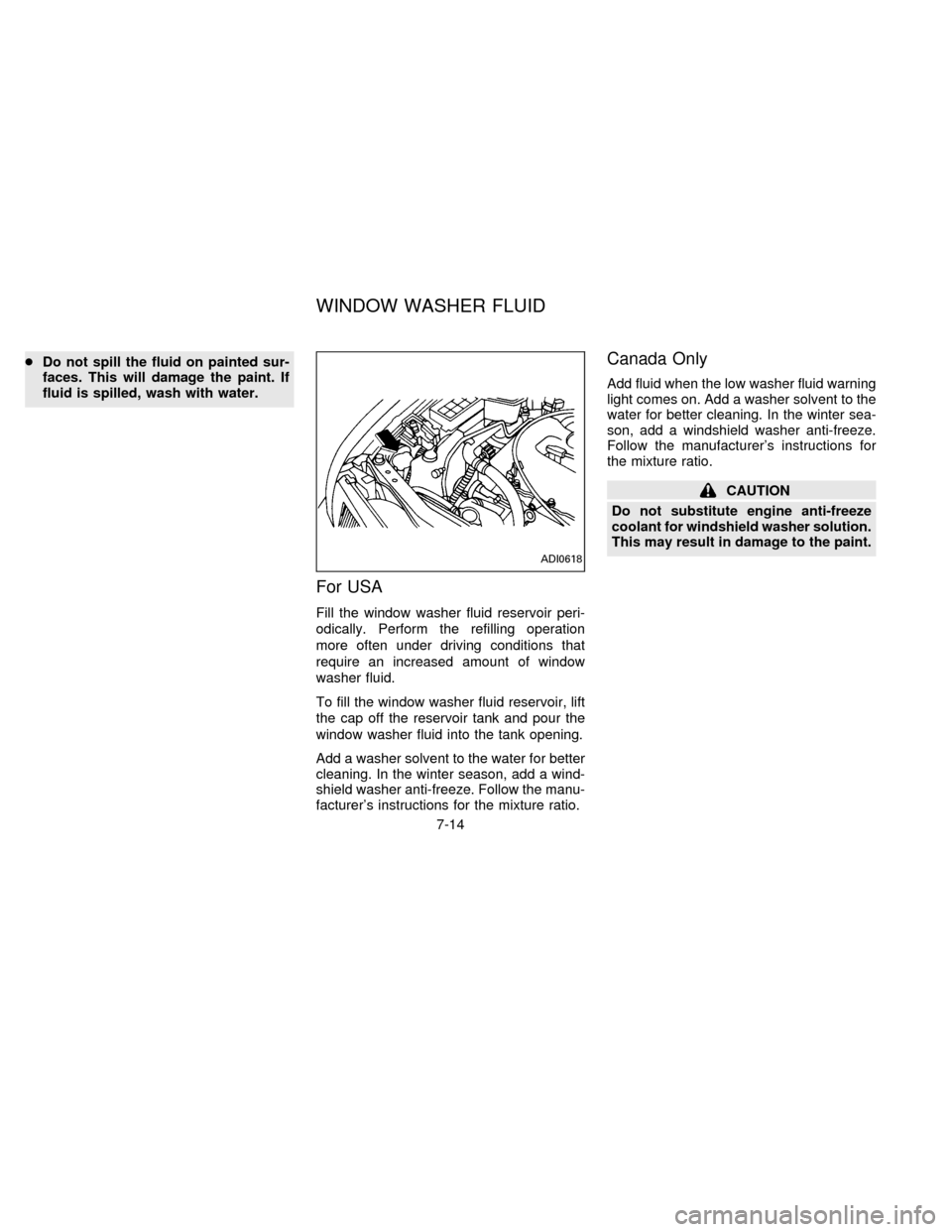
To fill the window washer fluid reservoir, lift
the cap off the reservoir tank and pour the
window washer fluid into the tank opening.
Add a washer solvent to the water for better
cleaning. In the winter season, add a wind-
shield washer anti-freeze. Follow the manu-
facturer's instructions for the mixture ratio.
Canada Only
Add fluid when the low washer fluid warning
light comes on. Add a washer solvent to the
water for better cleaning. In the winter sea-
son, add a windshield washer anti-freeze.
Follow the manufacturer's instructions for
the mixture ratio.
CAUTION
Do not substitute engine anti-freeze
coolant for windshield washer solution.
This may result in damage to the paint.
ADI0618
WINDOW WASHER FLUID
7-14
ZX
Page 142 of 191
HEADLIGHTS
The headlight is a semi-sealed beam type
which uses a replaceable headlight (halo-
gen) bulb. A bulb can be replaced from
inside the engine compartment without re-
moving the headlight assembly.
CAUTION
High pressure halogen gas is sealed
inside the halogen bulb. The bulb may
break if the glass envelope is scratched
or the bulb is dropped.
Hold the plastic base when handling
the bulb. Never touch the glass enve-
lope.
Removing the headlight bulb
1. Open the hood.
2. Disconnect the negative battery cable.
3. If removing the right-hand (passenger
side) headlight bulb, it is necessary to
first reposition the engine coolant reser-
voir.
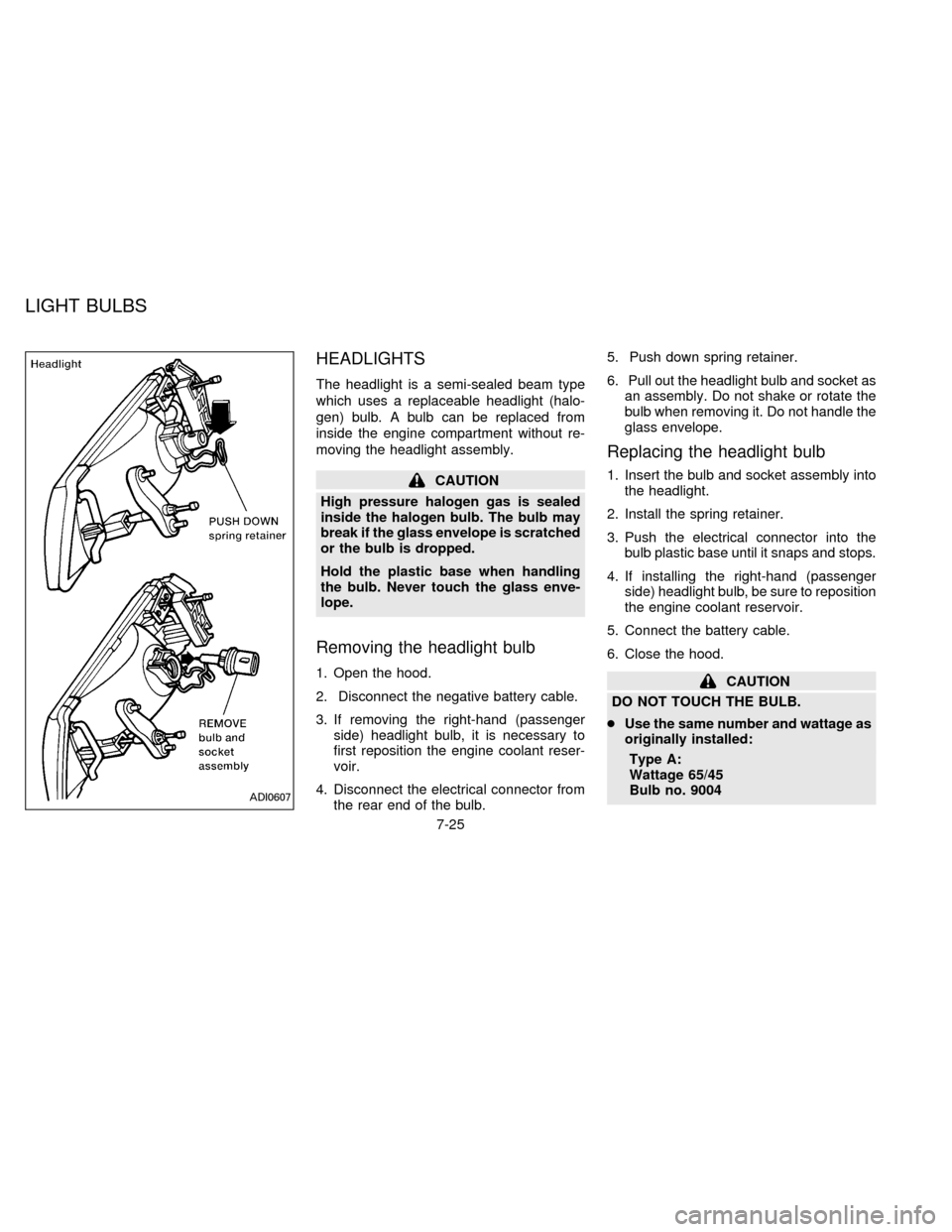
4. Disconnect the electrical connector from
the rear end of the bulb.5. Push down spring retainer.
6. Pull out the headlight bulb and socket as
an assembly. Do not shake or rotate the
bulb when removing it. Do not handle the
glass envelope.
Replacing the headlight bulb
1. Insert the bulb and socket assembly into
the headlight.
2. Install the spring retainer.
3. Push the electrical connector into the
bulb plastic base until it snaps and stops.
4. If installing the right-hand (passenger
side) headlight bulb, be sure to reposition
the engine coolant reservoir.
5. Connect the battery cable.
6. Close the hood.
CAUTION
DO NOT TOUCH THE BULB.
cUse the same number and wattage as
originally installed:
Type A:
Wattage 65/45
Bulb no. 9004
ADI0607
LIGHT BULBS
7-25
ZX
Page 157 of 191

with only the parking brake applied.
Automatic transmission ``Park'' mecha-
nismOn a fairly steep hill check that your
vehicle is held securely with the selector
lever in the P position without applying any
brakes.
UNDER THE HOOD AND
VEHICLE
The maintenance items listed here should
be checked periodically (e.g. each time you
check the engine oil or refuel).
Additional information on the following
items with ``*'' is found in the ``Do-it-
yourself operations'' section.
Windshield washer fluid*Check for ad-
equate fluid in the tank.
Engine coolant level*Check the coolant
level when the engine is cold.
Radiator and hosesCheck the front of the
radiator and clean off any dirt, insects,
leaves, etc., that may have accumulated.
Make sure the hoses have no cracks, de-
formation, rot or loose connections.
Brake fluid level*Make sure the brake and
clutch fluid level is between the ``MAX'' and``MIN'' lines on the reservoir.
Battery*Check the fluid level in each cell.
Engine drive belts*Make sure no belt is
frayed, worn, cracked or oily.
Engine oil level*Check the level after
parking the vehicle on a level spot and
turning off the engine.
Power steering fluid level* and lines
Check the level when the fluid is cold and
the engine is turned off. Check the lines for
proper attachment, leaks, cracks, etc.
Automatic transmission fluid level*
Check the level after putting the selector
lever in P with the engine idling.
Exhaust systemMake sure there are no
loose supports, cracks or holes. If the sound
of the exhaust seems unusual or there is a
smell of exhaust fumes, immediately locate
the trouble and correct it. (See the carbon
monoxide warning in the ``Starting and driv-
ing'' section.)
UnderbodyThe underbody is frequently
exposed to corrosive substances such as
those used on icy roads or to control dust. It
is very important to remove these sub-
stances, otherwise rust forms on the floorpan, frame, fuel lines and around the ex-
haust system. At the end of winter, the
underbody should be thoroughly flushed
with plain water, being careful to clean
those areas where mud and dirt may accu-
mulate. See the ``Appearance and interior
care'' section for additional information.
Fluid leaksCheck under the vehicle for
fuel, oil, water or other fluid leaks after the
vehicle has been parked for a while. Water
dripping from the air conditioner after use is
normal. If you should notice any leaks or if
gasoline fumes are evident, check for the
cause and have it corrected immediately.
8-4
ZX
Page 159 of 191
![NISSAN SENTRA 1996 B14 / 4.G Owners Manual SCHEDULE 1
Abbreviations: R = Replace I = Inspect. Correct or replace if necessary. [ ]: At the mileage intervals only
MAINTENANCE OPERATIONMAINTENANCE INTERVAL
Perform at number of miles,
kilometers](/manual-img/5/599/w960_599-158.png "NISSAN SENTRA 1996 B14 / 4.G Owners Manual SCHEDULE 1
Abbreviations: R = Replace I = Inspect. Correct or replace if necessary. [ ]: At the mileage intervals only
MAINTENANCE OPERATIONMAINTENANCE INTERVAL
Perform at number of miles,
kilometers")
SCHEDULE 1
Abbreviations: R = Replace I = Inspect. Correct or replace if necessary. [ ]: At the mileage intervals only
MAINTENANCE OPERATIONMAINTENANCE INTERVAL
Perform at number of miles,
kilometers or months,
whichever comes first.Miles ý 1,000 3.75 7.5 11.25 15 18.75 22.5 26.25 30 33.75 37.5 41.25 45 48.75 52.5 56.25 60
(km ý 1,000) (6) (12) (18) (24) (30) (36) (42) (48) (54) (60) (66) (72) (78) (84) (90) (96)
Months 3 6 9 12 15 18 21 24 27 30 33 36 39 42 45 48
Emission control system maintenance
Drive belts See NOTE (1).I*
Air cleaner filter See NOTE (2). [R] [R]
Idle rpm (GA16DE engine)I* I*
Vapor linesI* I*
Fuel linesI* I*
Fuel filter See NOTE (3)*.
Engine coolant See NOTE (4)*.R*
Engine oilRRRRRRRRRRRRRRRR
Engine oil filter (Use Nissan PREMIUM type or equivalent)RRRRRRRRRRRRRRRR
Spark plugs (GA16DE engine)[R] [R]
(SR20DE engine) (PLATINUM-TIPPED type) See NOTE (5)*.[R]
Intake & exhaust valve clearance (GA16DE engine) See NOTE (6)*.
NOTE: (1) After 60,000 miles (96,000 km) or 48 months, inspect every 15,000 miles (24,000 km) or 12 months.
(2) If operating mainly in dusty conditions, more frequent maintenance may be required.
(3) If vehicle is operated under extremely adverse weather conditions or in areas where ambient temperatures are either extremely low or extremely
high, the filters might become clogged. In such an event, replace them immediately.
(4) After 60,000 miles (96,000 km) or 48 months, replace every 30,000 miles (48,000 km) or 24 months.
(5) Original equipment platinum-tipped plugs should be replaced at 60,000 miles (96,000 km). Conventional spark plugs can be used but should be
replaced at 30,000 miles (48,000 km) intervals. (See ``Technical and consumer Information'' section for details.)
(6) If valve noise increases, inspect valve clearance.
* Maintenance items and intervals with ``*'' are recommended by NISSAN for reliable vehicle operation. The owner need not perform such
maintenance in order to maintain the emission warranty or manufacturer recall liability. Other maintenance items and intervals are required.
8-6
ZX
Page 161 of 191
![NISSAN SENTRA 1996 B14 / 4.G Owners Manual SCHEDULE 2
Abbreviations: R = Replace I = Inspect. Correct or replace if necessary. [ ]: At the mileage intervals only
MAINTENANCE OPERATIONMAINTENANCE INTERVAL
Perform at number of miles,
kilometers](/manual-img/5/599/w960_599-160.png "NISSAN SENTRA 1996 B14 / 4.G Owners Manual SCHEDULE 2
Abbreviations: R = Replace I = Inspect. Correct or replace if necessary. [ ]: At the mileage intervals only
MAINTENANCE OPERATIONMAINTENANCE INTERVAL
Perform at number of miles,
kilometers")
SCHEDULE 2
Abbreviations: R = Replace I = Inspect. Correct or replace if necessary. [ ]: At the mileage intervals only
MAINTENANCE OPERATIONMAINTENANCE INTERVAL
Perform at number of miles,
kilometers or months, whichever comes first.Miles ý 1,000 7.5 15 22.5 30 37.5 45 52.5 60
(km ý 1,000) (12) (24) (36) (48) (60) (72) (84) (96)
Months 6 12 18 24 30 36 42 48
Emission control system maintenance
Drive belts See NOTE (1).I*
Air cleaner filter[R] [R]
Idle rpm (GA16DE engine)I* I*
Vapor linesI* I*
Fuel linesI* I*
Fuel filter See NOTE (2)*.
Engine coolant See NOTE (3)*.R*
Engine oilRRRRRRRR
Engine oil filter (Use Nissan PREMIUM type or equivalent)RRRRRRRR
Spark plugs (GA16DE engine)[R] [R]
(SR20DE engine) (PLATINUM-TIPPED type) See NOTE (4)*.[R]
Intake & exhaust valve clearance (GA16DE engine) See NOTE (5)*.
NOTE: (1) After 60,000 miles (96,000 km) or 48 months, inspect every 15,000 miles (24,000 km) or 12 months.
(2) If vehicle is operated under extremely adverse weather conditions or in areas where outside temperatures are either extremely low or extremely high, the
filters might become clogged. In such an event, replace them immediately.
(3) After 60,000 miles (96,000 km) or 48 months, replace every 30,000 miles (48,000 km) or 24 months.
(4) Original equipment platinum-tipped plugs should be replaced at 60,000 miles (96,000 km). Conventional spark plugs can be used but should be replaced
at 30,000 miles (48,000 km) intervals. (See ``Technical and consumer information'' section for details.)
(5) If valve noise increases, inspect valve clearance.
* Maintenance items and intervals with ``*'' are recommended by NISSAN for reliable vehicle operation. The owner need not perform such maintenance in
order to maintain the emission warranty or manufacturer recall liability. Other maintenance items and intervals are required.
8-8
ZX
Page 163 of 191

EXPLANATION OF MAINTE-
NANCE ITEMS
Additional information on the following
items with ``*'' is found in the ``Do-it-
yourself operations'' section.
Emission control system
maintenance
Drive belts*Check drive belts for wear,
fraying or cracking and also for proper ten-
sion. Replace the drive belts if found dam-
aged.
Air cleaner filterUnder normal driving con-
ditions, the air cleaner filter should be re-
placed in accordance with the maintenance
schedule. However, driving the vehicle in
dusty areas may cause more rapid clogging
of the element. Consequently, the element
may have to be replaced more frequently.
Idle rpmInspection and adjustment should
be made with a tachometer to ensure
accuracy.
Vapor linesCheck vapor lines and connec-
tions for failure or looseness. If leaks are
found, replace them.
Fuel linesCheck the fuel hoses, pipingand connections for leaks, looseness or
deterioration. Replace any parts if they are
damaged.
Fuel filterIf the vehicle is operated under
extremely adverse weather conditions or in
areas where ambient temperatures are ei-
ther extremely low or extremely high, the
filter might become clogged. In such an
event, replace the filter immediately.
Engine coolant*Drain and flush the cool-
ing system.
Engine oil & oil filter*Under normal driving
conditions, the engine oil and oil filter should
be replaced in accordance with the mainte-
nance schedule. However, under severe
driving conditions, they may have to be
replaced more frequently.
Spark plugs*Replace with new plugs hav-
ing the correct heat range.
Intake & exhaust valve clearanceCheck
and adjust the valve clearance.
Chassis and body maintenance
Brake lines & cablesCheck the brake lines
and hoses (including brake booster vacuum
hoses, connections & check valve) and
parking brake cables for proper attachment,leaks, cracks, chafing, abrasion, deteriora-
tion, etc.
Brake pads, discs, drums & linings
Check these and the other neighboring
brake components for wear, deterioration
and leaks. Under severe driving conditions,
they may have to be inspected more fre-
quently.
Manual & automatic transmission gear
oil*Check the oil level and visually inspect
for signs of leakage.
Under severe driving conditions, the oil
should be replaced at the specified interval.
Steering gear & linkage, axle & suspen-
sion parts, and drive shaft bootsCheck
for damage, looseness and leakage of oil or
grease. Under severe driving conditions,
more frequent inspection should be per-
formed.
Steering linkage ball joints & front sus-
pension ball jointsCheck the ball joints for
damage, looseness and grease leakage.
Exhaust systemVisually check the ex-
haust pipes, muffler, and hangers for proper
attachment, leaks, cracks, chafing, abra-
sion, deterioration, etc. Under severe
8-10
ZX
Page 167 of 191
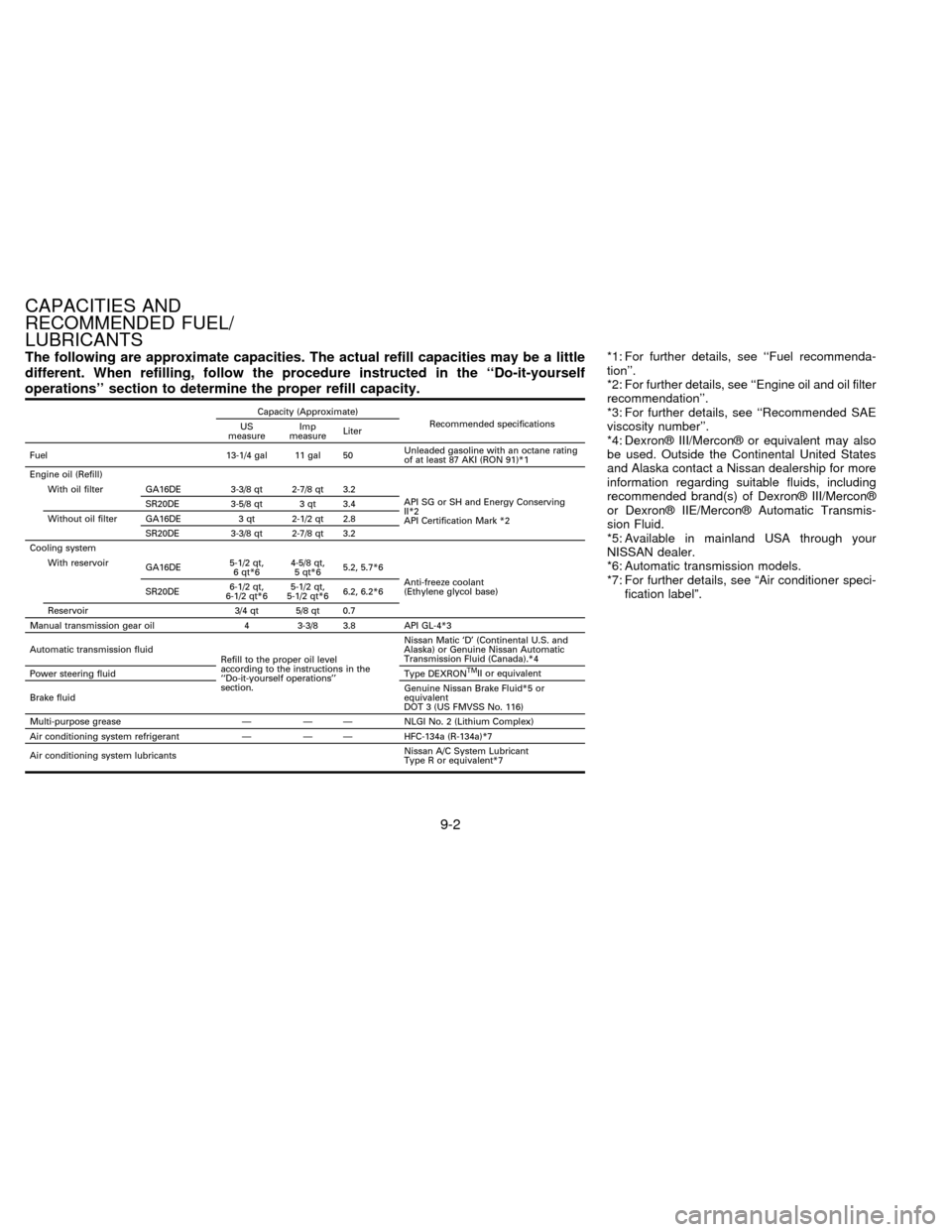
The following are approximate capacities. The actual refill capacities may be a little
different. When refilling, follow the procedure instructed in the ``Do-it-yourself
operations'' section to determine the proper refill capacity.
Capacity (Approximate)
Recommended specifications
US
measureImp
measureLiter
Fuel 13-1/4 gal 11 gal 50Unleaded gasoline with an octane rating
of at least 87 AKI (RON 91)*1
Engine oil (Refill)
With oil filter GA16DE 3-3/8 qt 2-7/8 qt 3.2
API SG or SH and Energy Conserving
II*2
API Certification Mark *2 SR20DE 3-5/8 qt 3 qt 3.4
Without oil filter GA16DE 3 qt 2-1/2 qt 2.8
SR20DE 3-3/8 qt 2-7/8 qt 3.2
Cooling system
With reservoir
GA16DE5-1/2 qt,
6 qt*64-5/8 qt,
5 qt*65.2, 5.7*6
Anti-freeze coolant
(Ethylene glycol base) SR20DE6-1/2 qt,
6-1/2 qt*65-1/2 qt,
5-1/2 qt*66.2, 6.2*6
Reservoir 3/4 qt 5/8 qt 0.7
Manual transmission gear oil 4 3-3/8 3.8 API GL-4*3
Automatic transmission fluid
Refill to the proper oil level
according to the instructions in the
``Do-it-yourself operations''
section.Nissan Matic `D' (Continental U.S. and
Alaska) or Genuine Nissan Automatic
Transmission Fluid (Canada).*4
Power steering fluid Type DEXRON
TMII or equivalent
Brake fluidGenuine Nissan Brake Fluid*5 or
equivalent
DOT 3 (US FMVSS No. 116)
Multi-purpose grease Ð Ð Ð NLGI No. 2 (Lithium Complex)
Air conditioning system refrigerant Ð Ð Ð HFC-134a (R-134a)*7
Air conditioning system lubricantsNissan A/C System Lubricant
Type R or equivalent*7
*1: For further details, see ``Fuel recommenda-
tion''.
*2: For further details, see ``Engine oil and oil filter
recommendation''.
*3: For further details, see ``Recommended SAE
viscosity number''.
*4: Dexronž III/Merconž or equivalent may also
be used. Outside the Continental United States
and Alaska contact a Nissan dealership for more
information regarding suitable fluids, including
recommended brand(s) of Dexronž III/Merconž
or Dexronž IIE/Merconž Automatic Transmis-
sion Fluid.
*5: Available in mainland USA through your
NISSAN dealer.
*6: Automatic transmission models.
*7: For further details, see ªAir conditioner speci-
fication labelº.
CAPACITIES AND
RECOMMENDED FUEL/
LUBRICANTS
9-2
ZX