1996 NISSAN SENTRA cooling
[x] Cancel search: coolingPage 122 of 191
The engine cooling system is filled at the
factory with a high-quality, year-round, anti-
freeze coolant solution. The anti-freeze so-
lution contains rust and corrosion inhibitors,
therefore additional cooling system addi-
tives are not necessary.
CAUTION
When adding or replacing coolant, be
sure to use only an ethylene glycol
anti-freeze with the proper mixture ra-
tio. Examples are shown below:
Outside tempera-
ture down toAnti-
freezeSoft wa-
ter
ÉC ÉF
þ35 þ30 50% 50%
The use of other types of coolant solu-
tions may damage your cooling system.
The radiator is equipped with a pressure
cap. Use a genuine NISSAN cap or its
equivalent when replacement is re-
quired.
Never remove the radiator cap when the
engine is hot. Serious burns could becaused by high pressure fluid escaping
from the radiator.
Wait until the engine and radiator cool
down. See precautions in ``If your ve-
hicle overheats'' found in the ``In Case Of
Emergency'' section.
CHECKING ENGINE COOLANT
LEVEL
With coolant reservoir
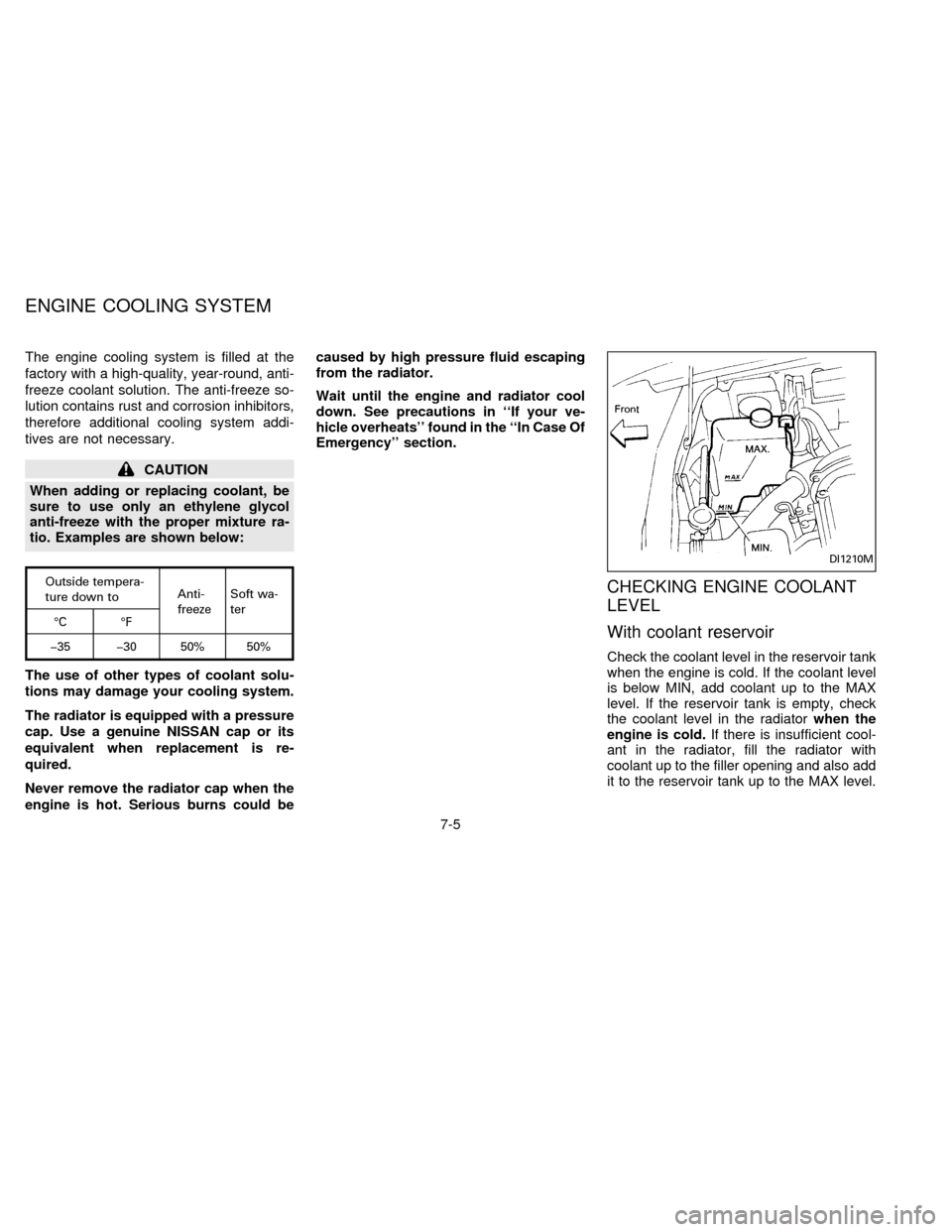
Check the coolant level in the reservoir tank
when the engine is cold. If the coolant level
is below MIN, add coolant up to the MAX
level. If the reservoir tank is empty, check
the coolant level in the radiatorwhen the
engine is cold.If there is insufficient cool-
ant in the radiator, fill the radiator with
coolant up to the filler opening and also add
it to the reservoir tank up to the MAX level.
DI1210M
ENGINE COOLING SYSTEM
7-5
ZX
Page 123 of 191
If the cooling system frequently requires
coolant, have the cooling system
checked by your NISSAN dealer.
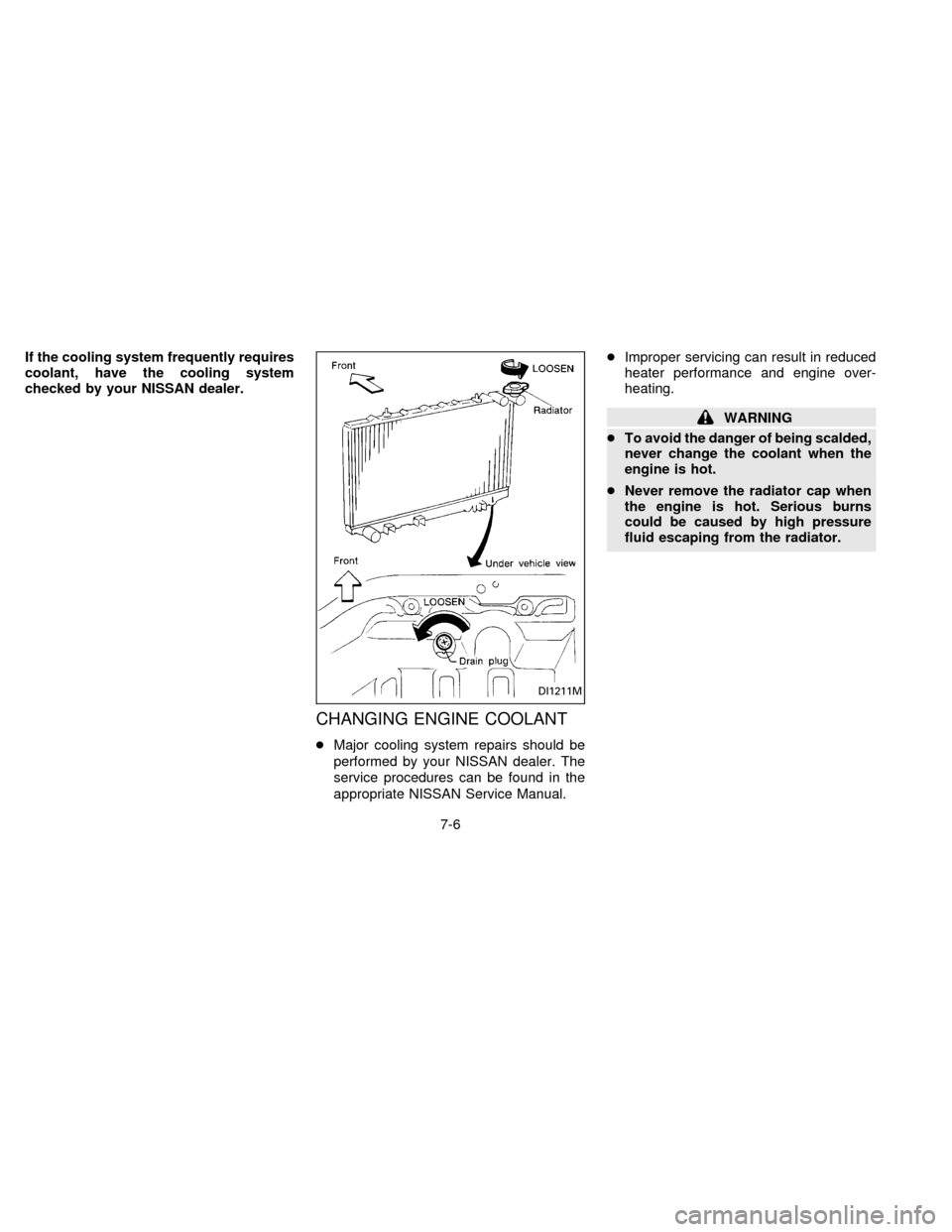
CHANGING ENGINE COOLANT
cMajor cooling system repairs should be
performed by your NISSAN dealer. The
service procedures can be found in the
appropriate NISSAN Service Manual.cImproper servicing can result in reduced
heater performance and engine over-
heating.
WARNING
cTo avoid the danger of being scalded,
never change the coolant when the
engine is hot.
cNever remove the radiator cap when
the engine is hot. Serious burns
could be caused by high pressure
fluid escaping from the radiator.
DI1211M
7-6
ZX
Page 124 of 191

1. Move the heater or air conditioner tem-
perature control dial to the maximum hot
position.
2. Open the radiator drain plug. Open the
drain plug on the engine block.3. Open the radiator cap to drain the cool-
ant.
4. Flush the cooling system by running
fresh water through the radiator.
5. Close the drain plugs on the radiator and
the engine block securely.
6. See the ``Technical and consumer infor-
mation'' section for cooling system ca-
pacity. Fill the radiator slowly with the
proper mixture of coolant and water. Fill
the reservoir tank up to the MAX level.
7. Open and close the air release plug(s) to
release air. Then fill the radiator again
and install the radiator cap.
8. Start the engine, and warm it up until it
reaches normal operating temperature.
Then race the engine 2 or 3 times under
no load. Watch the coolant temperature
gauge for signs of overheating.
ADI0632
ADI0615
7-7
ZX
Page 128 of 191
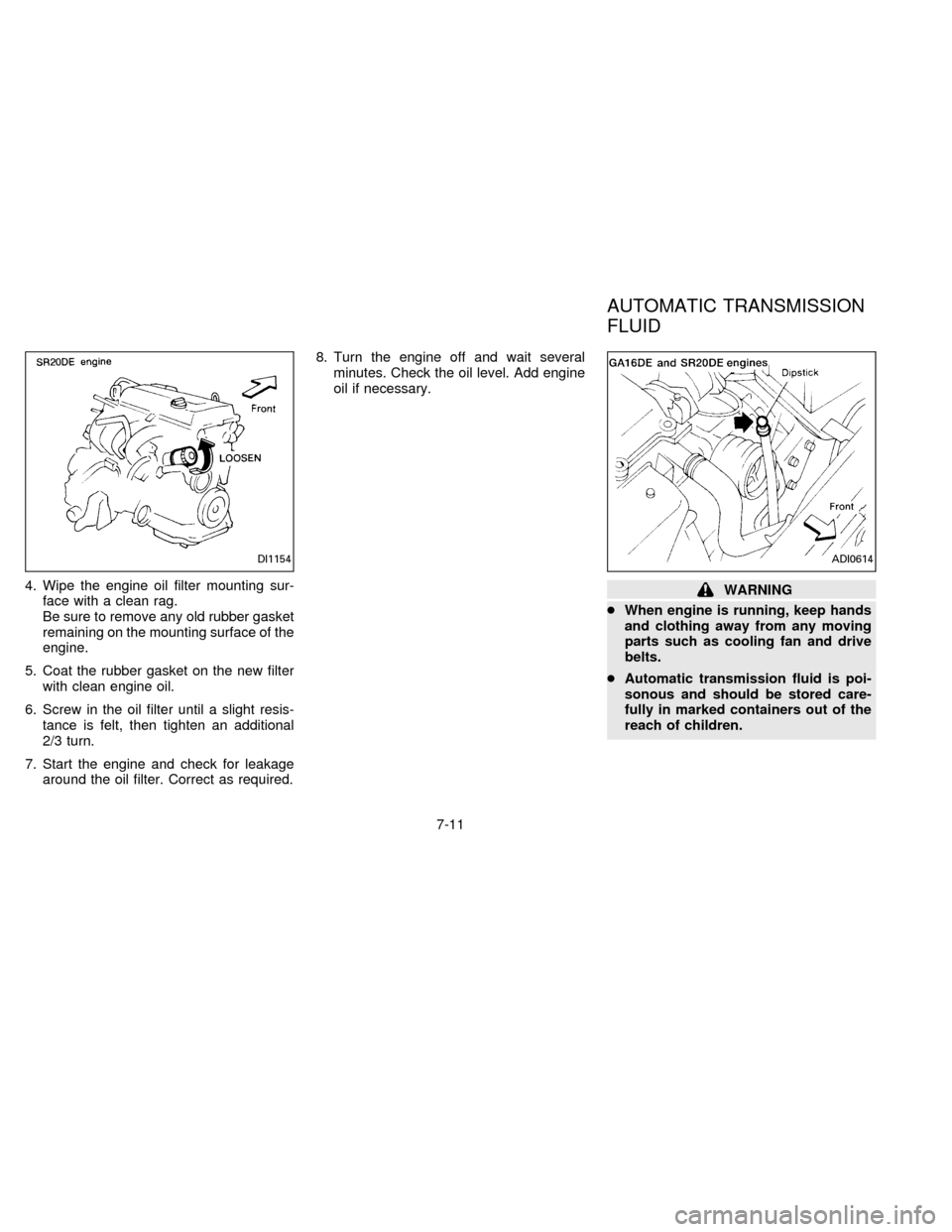
4. Wipe the engine oil filter mounting sur-
face with a clean rag.
Be sure to remove any old rubber gasket
remaining on the mounting surface of the
engine.
5. Coat the rubber gasket on the new filter
with clean engine oil.
6. Screw in the oil filter until a slight resis-
tance is felt, then tighten an additional
2/3 turn.
7. Start the engine and check for leakage
around the oil filter. Correct as required.8. Turn the engine off and wait several
minutes. Check the oil level. Add engine
oil if necessary.WARNING
cWhen engine is running, keep hands
and clothing away from any moving
parts such as cooling fan and drive
belts.
cAutomatic transmission fluid is poi-
sonous and should be stored care-
fully in marked containers out of the
reach of children.
DI1154ADI0614
AUTOMATIC TRANSMISSION
FLUID
7-11
ZX
Page 167 of 191
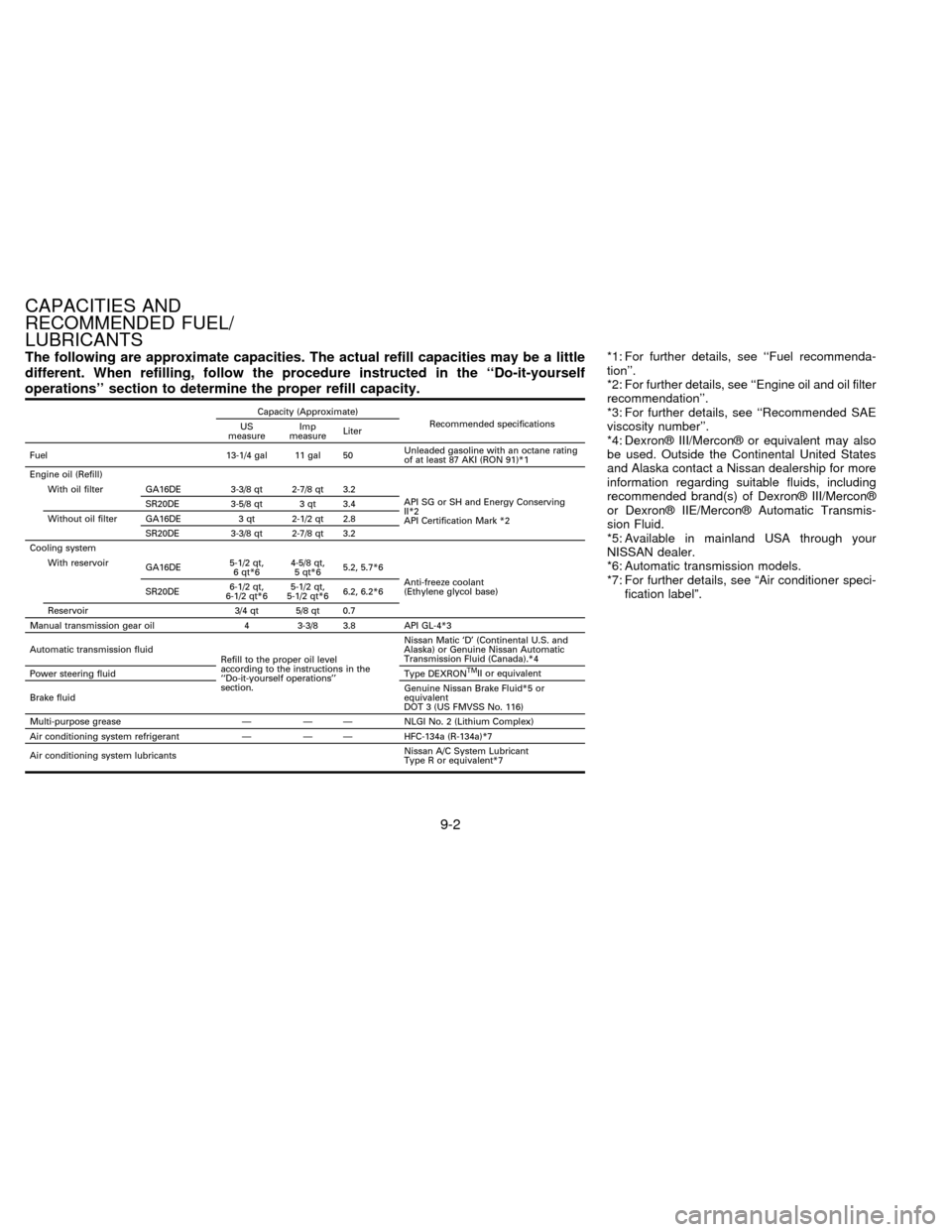
The following are approximate capacities. The actual refill capacities may be a little
different. When refilling, follow the procedure instructed in the ``Do-it-yourself
operations'' section to determine the proper refill capacity.
Capacity (Approximate)
Recommended specifications
US
measureImp
measureLiter
Fuel 13-1/4 gal 11 gal 50Unleaded gasoline with an octane rating
of at least 87 AKI (RON 91)*1
Engine oil (Refill)
With oil filter GA16DE 3-3/8 qt 2-7/8 qt 3.2
API SG or SH and Energy Conserving
II*2
API Certification Mark *2 SR20DE 3-5/8 qt 3 qt 3.4
Without oil filter GA16DE 3 qt 2-1/2 qt 2.8
SR20DE 3-3/8 qt 2-7/8 qt 3.2
Cooling system
With reservoir
GA16DE5-1/2 qt,
6 qt*64-5/8 qt,
5 qt*65.2, 5.7*6
Anti-freeze coolant
(Ethylene glycol base) SR20DE6-1/2 qt,
6-1/2 qt*65-1/2 qt,
5-1/2 qt*66.2, 6.2*6
Reservoir 3/4 qt 5/8 qt 0.7
Manual transmission gear oil 4 3-3/8 3.8 API GL-4*3
Automatic transmission fluid
Refill to the proper oil level
according to the instructions in the
``Do-it-yourself operations''
section.Nissan Matic `D' (Continental U.S. and
Alaska) or Genuine Nissan Automatic
Transmission Fluid (Canada).*4
Power steering fluid Type DEXRON
TMII or equivalent
Brake fluidGenuine Nissan Brake Fluid*5 or
equivalent
DOT 3 (US FMVSS No. 116)
Multi-purpose grease Ð Ð Ð NLGI No. 2 (Lithium Complex)
Air conditioning system refrigerant Ð Ð Ð HFC-134a (R-134a)*7
Air conditioning system lubricantsNissan A/C System Lubricant
Type R or equivalent*7
*1: For further details, see ``Fuel recommenda-
tion''.
*2: For further details, see ``Engine oil and oil filter
recommendation''.
*3: For further details, see ``Recommended SAE
viscosity number''.
*4: Dexronž III/Merconž or equivalent may also
be used. Outside the Continental United States
and Alaska contact a Nissan dealership for more
information regarding suitable fluids, including
recommended brand(s) of Dexronž III/Merconž
or Dexronž IIE/Merconž Automatic Transmis-
sion Fluid.
*5: Available in mainland USA through your
NISSAN dealer.
*6: Automatic transmission models.
*7: For further details, see ªAir conditioner speci-
fication labelº.
CAPACITIES AND
RECOMMENDED FUEL/
LUBRICANTS
9-2
ZX
Page 187 of 191
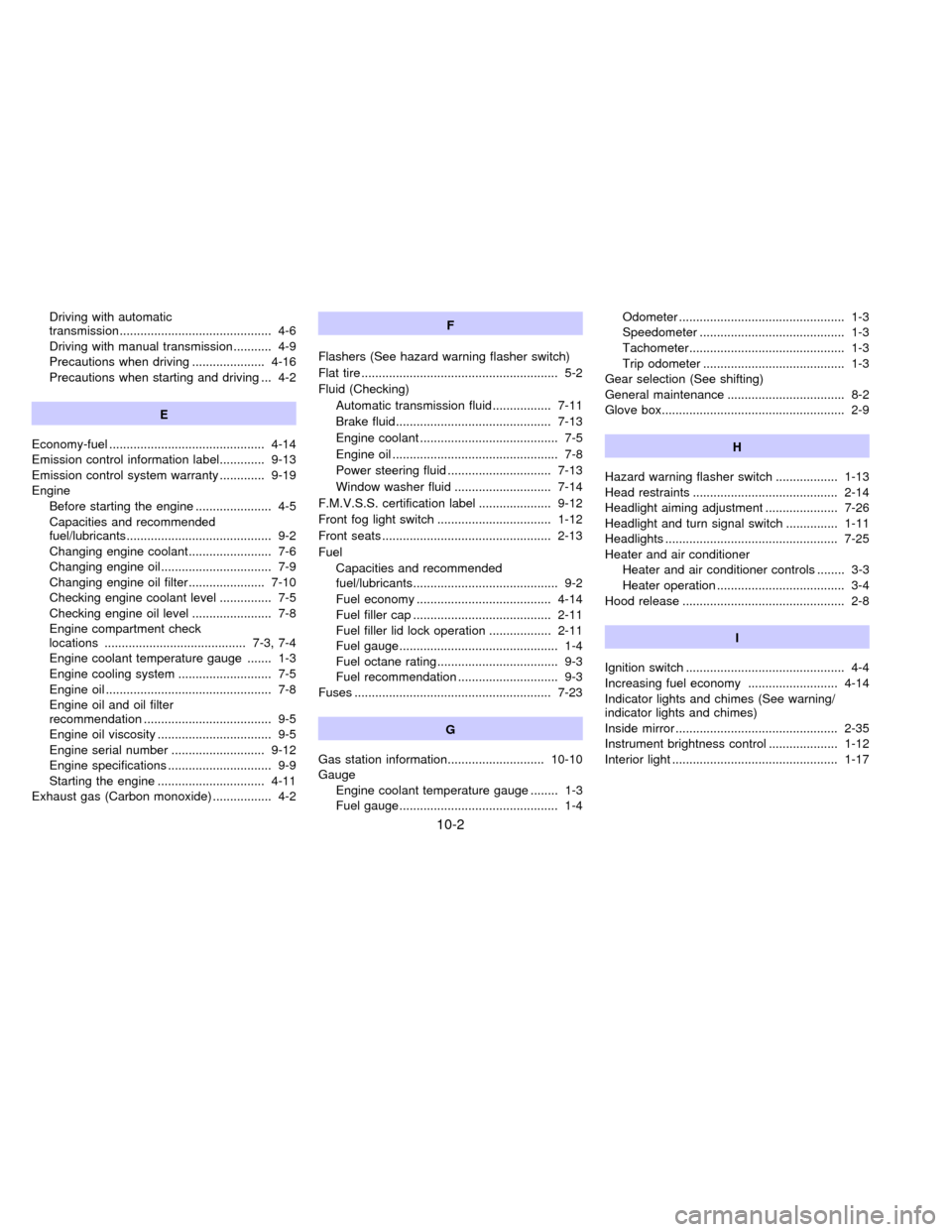
Driving with automatic
transmission............................................ 4-6
Driving with manual transmission ........... 4-9
Precautions when driving ..................... 4-16
Precautions when starting and driving ... 4-2
E
Economy-fuel ............................................. 4-14
Emission control information label............. 9-13
Emission control system warranty ............. 9-19
Engine
Before starting the engine ...................... 4-5
Capacities and recommended
fuel/lubricants.......................................... 9-2
Changing engine coolant........................ 7-6
Changing engine oil................................ 7-9
Changing engine oil filter...................... 7-10
Checking engine coolant level ............... 7-5
Checking engine oil level ....................... 7-8
Engine compartment check
locations ......................................... 7-3, 7-4
Engine coolant temperature gauge ....... 1-3
Engine cooling system ........................... 7-5
Engine oil ................................................ 7-8
Engine oil and oil filter
recommendation ..................................... 9-5
Engine oil viscosity ................................. 9-5
Engine serial number ........................... 9-12
Engine specifications .............................. 9-9
Starting the engine ............................... 4-11
Exhaust gas (Carbon monoxide) ................. 4-2F
Flashers (See hazard warning flasher switch)
Flat tire ......................................................... 5-2
Fluid (Checking)
Automatic transmission fluid ................. 7-11
Brake fluid............................................. 7-13
Engine coolant ........................................ 7-5
Engine oil ................................................ 7-8
Power steering fluid .............................. 7-13
Window washer fluid ............................ 7-14
F.M.V.S.S. certification label ..................... 9-12
Front fog light switch ................................. 1-12
Front seats ................................................. 2-13
Fuel
Capacities and recommended
fuel/lubricants.......................................... 9-2
Fuel economy ....................................... 4-14
Fuel filler cap ........................................ 2-11
Fuel filler lid lock operation .................. 2-11
Fuel gauge.............................................. 1-4
Fuel octane rating................................... 9-3
Fuel recommendation ............................. 9-3
Fuses ......................................................... 7-23
G
Gas station information............................ 10-10
Gauge
Engine coolant temperature gauge ........ 1-3
Fuel gauge.............................................. 1-4Odometer ................................................ 1-3
Speedometer .......................................... 1-3
Tachometer............................................. 1-3
Trip odometer ......................................... 1-3
Gear selection (See shifting)
General maintenance .................................. 8-2
Glove box..................................................... 2-9
H
Hazard warning flasher switch .................. 1-13
Head restraints .......................................... 2-14
Headlight aiming adjustment ..................... 7-26
Headlight and turn signal switch ............... 1-11
Headlights .................................................. 7-25
Heater and air conditioner
Heater and air conditioner controls ........ 3-3
Heater operation ..................................... 3-4
Hood release ............................................... 2-8
I
Ignition switch .............................................. 4-4
Increasing fuel economy .......................... 4-14
Indicator lights and chimes (See warning/
indicator lights and chimes)
Inside mirror ............................................... 2-35
Instrument brightness control .................... 1-12
Interior light ................................................ 1-17
10-2
ZX