1996 NISSAN SENTRA clock
[x] Cancel search: clockPage 84 of 191
1) Move the shift lever into the P position.
2) Turn the ignition key slightly in the ON
direction.
3) Turn the key toward the LOCK position.
4) Remove the key.
If the key is removed from the ignition
switch, the shift lever cannot be moved from
P (Park).The shift lever can be moved if
the ignition switch is in the ACC posi-
tion. The shift lever can also be moved if
the ignition switch is in the ON position
and the foot brake pedal is depressed.
There is an OFF position in between LOCK
and ACC, although it does not show on the
lock cylinder. When the ignition is in OFF
the steering wheel is not locked.
In order for the steering wheel to be locked,
it must be turned about 1/8 of a turn coun-
terclockwise from the straight up position,
and the key must be removed from the
ignition.WARNING
To lock the steering wheel, remove the
key. To unlock the steering wheel, in-
sert the key and turn it gently while
rotating the steering wheel slightly
right and left.
Never remove the key while driving. If
the key is removed, the steering wheel
will lock. This may cause the driver to
lose control of the vehicle and could
result in serious vehicle damage or
personal injury.
OFF (Manual transmission model) (1)
The engine can be turned off without locking
the steering wheel.
ACC (Accessories) (2)
This position activates electrical accesso-
ries such as the radio when the engine is
not running.
ON Normal operating position (3)
This position turns on the ignition system
and the electrical accessories.
START (4)
This position activates the starter motor,
which starts the engine.cMake sure the area around the vehicle is
clear.
cMaintenance items listed here should be
checked periodically, e.g., each time you
check engine oil.
cCheck that all windows and lights are
clean.
cVisually inspect tires for their appearance
and condition. Also check tires for proper
inflation.
cLock all doors.
cPosition seat and adjust head restraints.
cAdjust inside and outside mirrors.
cFasten seat belts and ask all passengers
to do likewise.
cCheck the operation of warning lights
when key is turned to the ON (3) position.
BEFORE STARTING THE
ENGINE
4-5
ZX
Page 86 of 191
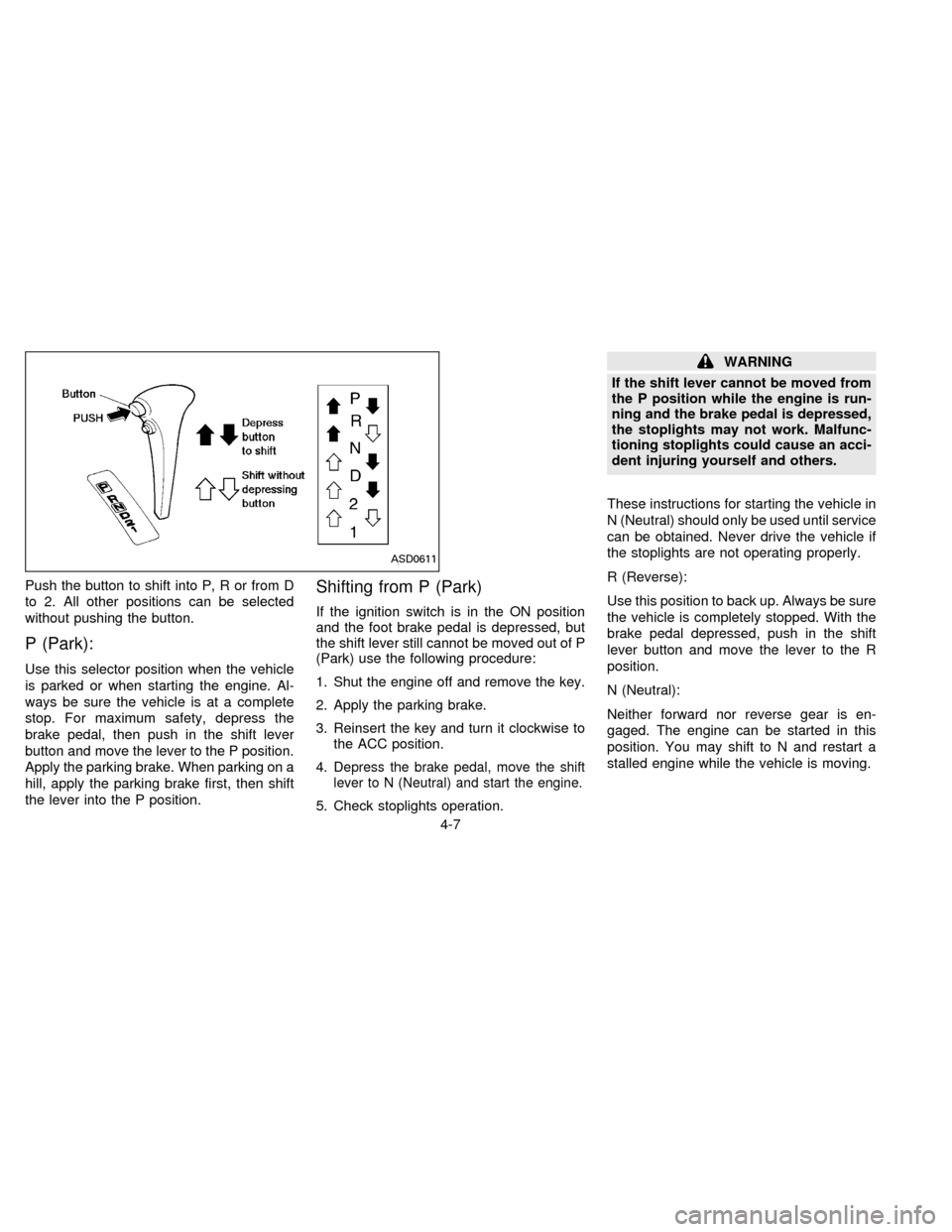
Push the button to shift into P, R or from D
to 2. All other positions can be selected
without pushing the button.
P (Park):
Use this selector position when the vehicle
is parked or when starting the engine. Al-
ways be sure the vehicle is at a complete
stop. For maximum safety, depress the
brake pedal, then push in the shift lever
button and move the lever to the P position.
Apply the parking brake. When parking on a
hill, apply the parking brake first, then shift
the lever into the P position.
Shifting from P (Park)
If the ignition switch is in the ON position
and the foot brake pedal is depressed, but
the shift lever still cannot be moved out of P
(Park) use the following procedure:
1. Shut the engine off and remove the key.
2. Apply the parking brake.
3. Reinsert the key and turn it clockwise to
the ACC position.
4.
Depress the brake pedal, move the shift
lever to N (Neutral) and start the engine.
5. Check stoplights operation.
WARNING
If the shift lever cannot be moved from
the P position while the engine is run-
ning and the brake pedal is depressed,
the stoplights may not work. Malfunc-
tioning stoplights could cause an acci-
dent injuring yourself and others.
These instructions for starting the vehicle in
N (Neutral) should only be used until service
can be obtained. Never drive the vehicle if
the stoplights are not operating properly.
R (Reverse):
Use this position to back up. Always be sure
the vehicle is completely stopped. With the
brake pedal depressed, push in the shift
lever button and move the lever to the R
position.
N (Neutral):
Neither forward nor reverse gear is en-
gaged. The engine can be started in this
position. You may shift to N and restart a
stalled engine while the vehicle is moving.
ASD0611
4-7
ZX
Page 102 of 191
Getting the spare tire and tools
1. Open the trunk. Lift the trunk floor carpet-
ing and spare tire cover. Remove the tool
bag and the spare tire. Use either end of
the jack rod (found in the tool bag) to
loosen the spare tire hold-down bolt.
Push the two release clips on the jack
access door.
2. Pull the jack access door open. To re-
move the jack, turn the jack screw coun-
terclockwise. Use either end of the jack
rod (found in the tool bag) to loosen the
jack from its storage position.
3. Close the jack access door.
4. When the spare tire is installed on the
vehicle, place the damaged tire in the
storage area. Put the jack rod in the tool
bag and place the tool bag in the storage
area.
5. Place the spare tire cover and the trunk
floor carpeting over the damaged tire.
6. Install the jack in its storage area and
tighten the jack screw.
7. Close the jack access door. Close the
trunk.
Blocking wheels
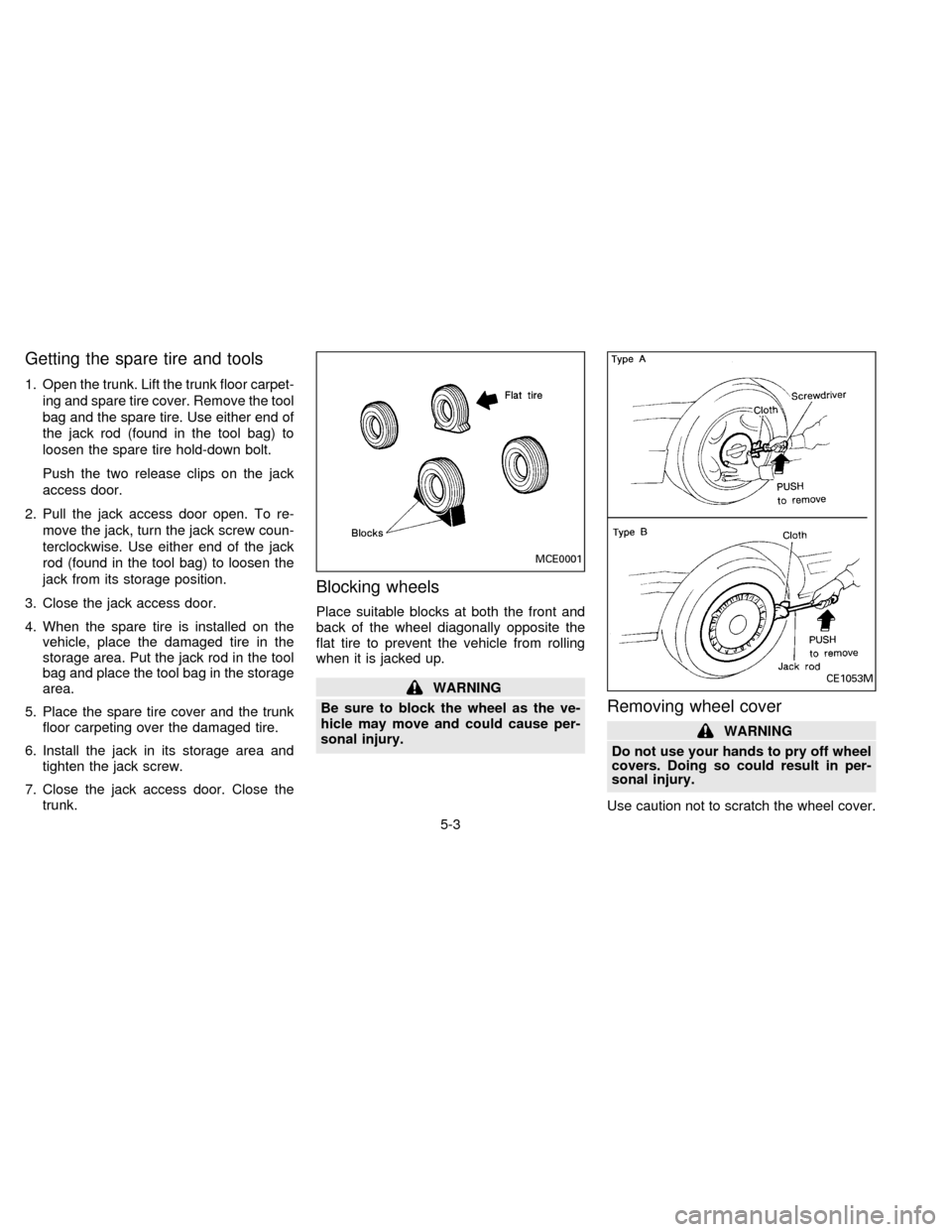
Place suitable blocks at both the front and
back of the wheel diagonally opposite the
flat tire to prevent the vehicle from rolling
when it is jacked up.
WARNING
Be sure to block the wheel as the ve-
hicle may move and could cause per-
sonal injury.
Removing wheel cover
WARNING
Do not use your hands to pry off wheel
covers. Doing so could result in per-
sonal injury.
Use caution not to scratch the wheel cover.
MCE0001
CE1053M
5-3
ZX
Page 104 of 191
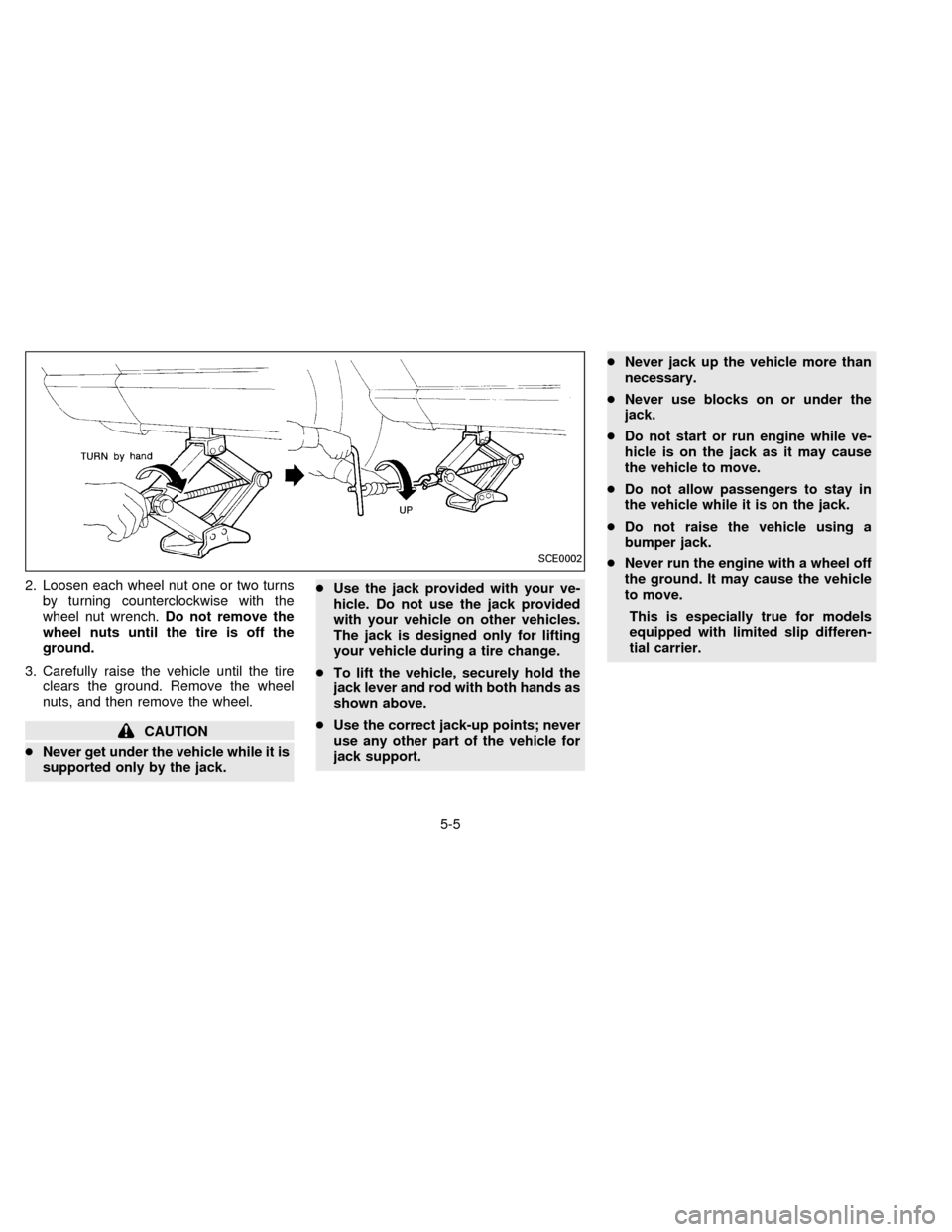
2. Loosen each wheel nut one or two turns
by turning counterclockwise with the
wheel nut wrench.Do not remove the
wheel nuts until the tire is off the
ground.
3. Carefully raise the vehicle until the tire
clears the ground. Remove the wheel
nuts, and then remove the wheel.
CAUTION
cNever get under the vehicle while it is
supported only by the jack.cUse the jack provided with your ve-
hicle. Do not use the jack provided
with your vehicle on other vehicles.
The jack is designed only for lifting
your vehicle during a tire change.
cTo lift the vehicle, securely hold the
jack lever and rod with both hands as
shown above.
cUse the correct jack-up points; never
use any other part of the vehicle for
jack support.cNever jack up the vehicle more than
necessary.
cNever use blocks on or under the
jack.
cDo not start or run engine while ve-
hicle is on the jack as it may cause
the vehicle to move.
cDo not allow passengers to stay in
the vehicle while it is on the jack.
cDo not raise the vehicle using a
bumper jack.
cNever run the engine with a wheel off
the ground. It may cause the vehicle
to move.
This is especially true for models
equipped with limited slip differen-
tial carrier.
SCE0002
5-5
ZX
Page 143 of 191
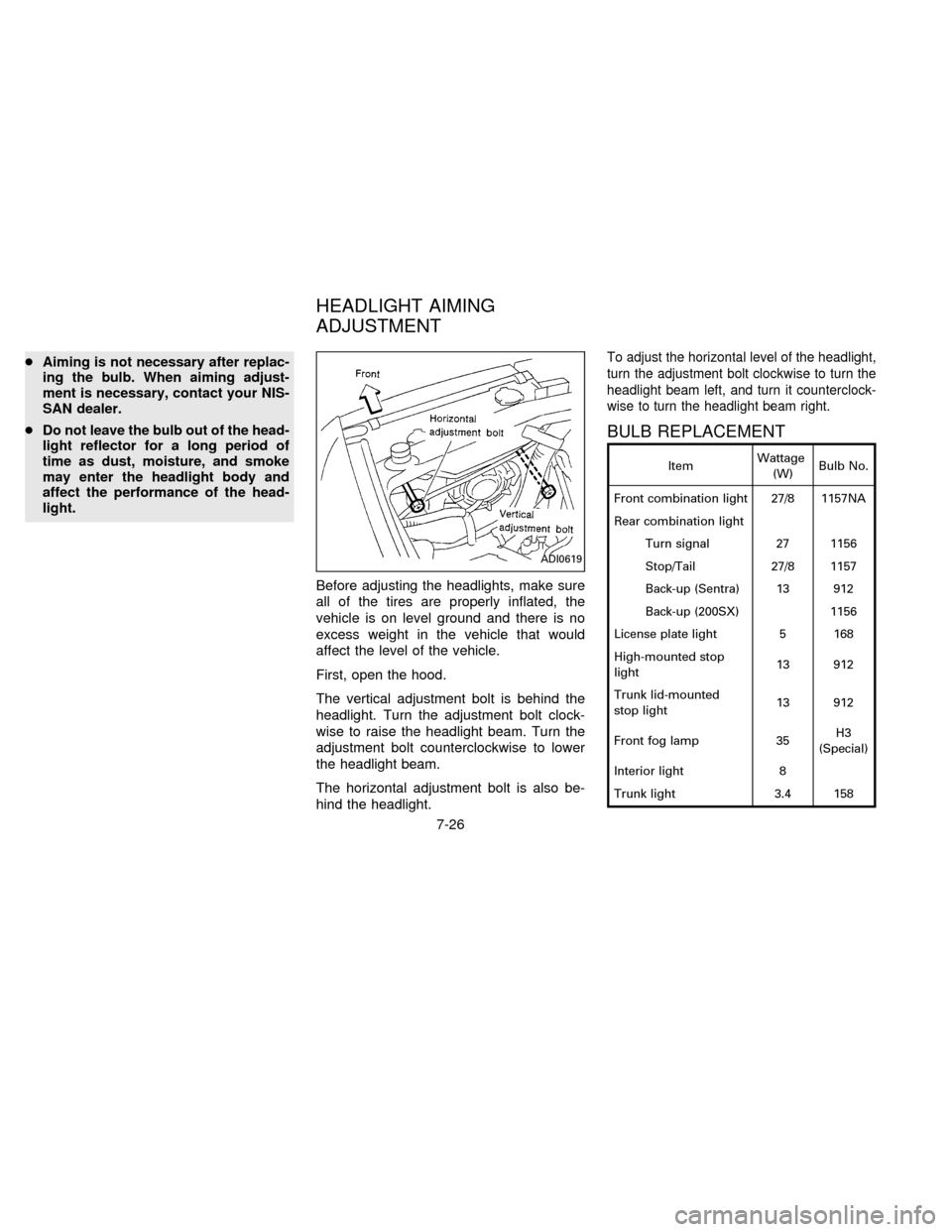
cAiming is not necessary after replac-
ing the bulb. When aiming adjust-
ment is necessary, contact your NIS-
SAN dealer.
cDo not leave the bulb out of the head-
light reflector for a long period of
time as dust, moisture, and smoke
may enter the headlight body and
affect the performance of the head-
light.
Before adjusting the headlights, make sure
all of the tires are properly inflated, the
vehicle is on level ground and there is no
excess weight in the vehicle that would
affect the level of the vehicle.
First, open the hood.
The vertical adjustment bolt is behind the
headlight. Turn the adjustment bolt clock-
wise to raise the headlight beam. Turn the
adjustment bolt counterclockwise to lower
the headlight beam.
The horizontal adjustment bolt is also be-
hind the headlight.To adjust the horizontal level of the headlight,
turn the adjustment bolt clockwise to turn the
headlight beam left, and turn it counterclock-
wise to turn the headlight beam right.
BULB REPLACEMENT
ItemWattage
(W)Bulb No.
Front combination light 27/8 1157NA
Rear combination light
Turn signal 27 1156
Stop/Tail 27/8 1157
Back-up (Sentra) 13 912
Back-up (200SX) 1156
License plate light 5 168
High-mounted stop
light13 912
Trunk lid-mounted
stop light13 912
Front fog lamp 35H3
(Special)
Interior light 8
Trunk light 3.4 158
ADI0619
HEADLIGHT AIMING
ADJUSTMENT
7-26
ZX
Page 186 of 191

10 Index
A
Air bag (See supplemental restraint system)
Air bag warning light (If so equipped) ....... 2-20
Air cleaner housing filter ............................ 7-19
Air conditioner
Air conditioner operation ........................ 3-5
Air conditioner specification label ......... 9-13
Heater and air conditioner controls ........ 3-3
Servicing air conditioning ....................... 3-9
Air conditioning system refrigerant and
lubricant recommendations.......................... 9-8
Air flow charts .............................................. 3-6
Anchor point locations ............................... 2-32
Antenna (manual) ...................................... 3-17
Anti-lock brake system (ABS) .................. 4-16
Audio system
AM-FM radio ........................................ 3-11
AM-FM radio with cassette player ........ 3-13
Automatic
Automatic power window switch ......... 1-16
Automatic transmission fluid ................. 7-11
Driving with an automatic
transmission............................................ 4-6B
Battery........................................................ 7-15
Belts (See drive belts)
Brake
Anti-lock brake system (ABS) .............. 4-16
Brake fluid............................................. 7-13
Brake booster ....................................... 7-22
Brake wear indicators ................... 1-7, 7-22
Brake pedal .......................................... 7-21
Parking brake check ............................. 7-21
Parking brake operation ....................... 4-11
Break-in schedule ...................................... 4-13
Bulb check/instrument panel ....................... 1-5
Bulb replacement ....................................... 7-26
C
Capacities and recommended
fuel/lubricants ............................................... 9-2
Cassette player (See audio system)
CB radio or car phone ............................... 3-18
Child restraints for infants and
small children ............................................. 2-28
Child safety rear door lock .......................... 2-7
Cigarette lighter (accessory) and ashtray . 1-13
Cleaning exterior and interior ...................... 6-2
Clock-radio ................................................. 3-13Clutch pedal ............................................... 7-23
Cold weather driving cautions ................... 4-18
Controls
Audio controls ............................. 3-10, 3-13
Heater and air conditioner ...................... 3-3
Coolant
Capacities and recommended
fuel/lubricants.......................................... 9-2
Changing engine coolant........................ 7-6
Checking engine coolant level ............... 7-5
Engine coolant temperature gauge ....... 1-3
Corrosion protection .................................... 6-5
Cruise control............................................. 4-12
Cup holder ................................................. 1-14
D
Daytime running light system
(Canada only) ............................................ 1-11
Defogger switch
Rear window defogger switch .............. 1-10
Dimensions and weights............................ 9-10
Door locks .................................................... 2-2
Freeing a frozen door lock ................... 4-18
Drive belts .................................................. 7-17
Driving
Cold weather driving cautions .............. 4-18
ZX