Page 69 of 235
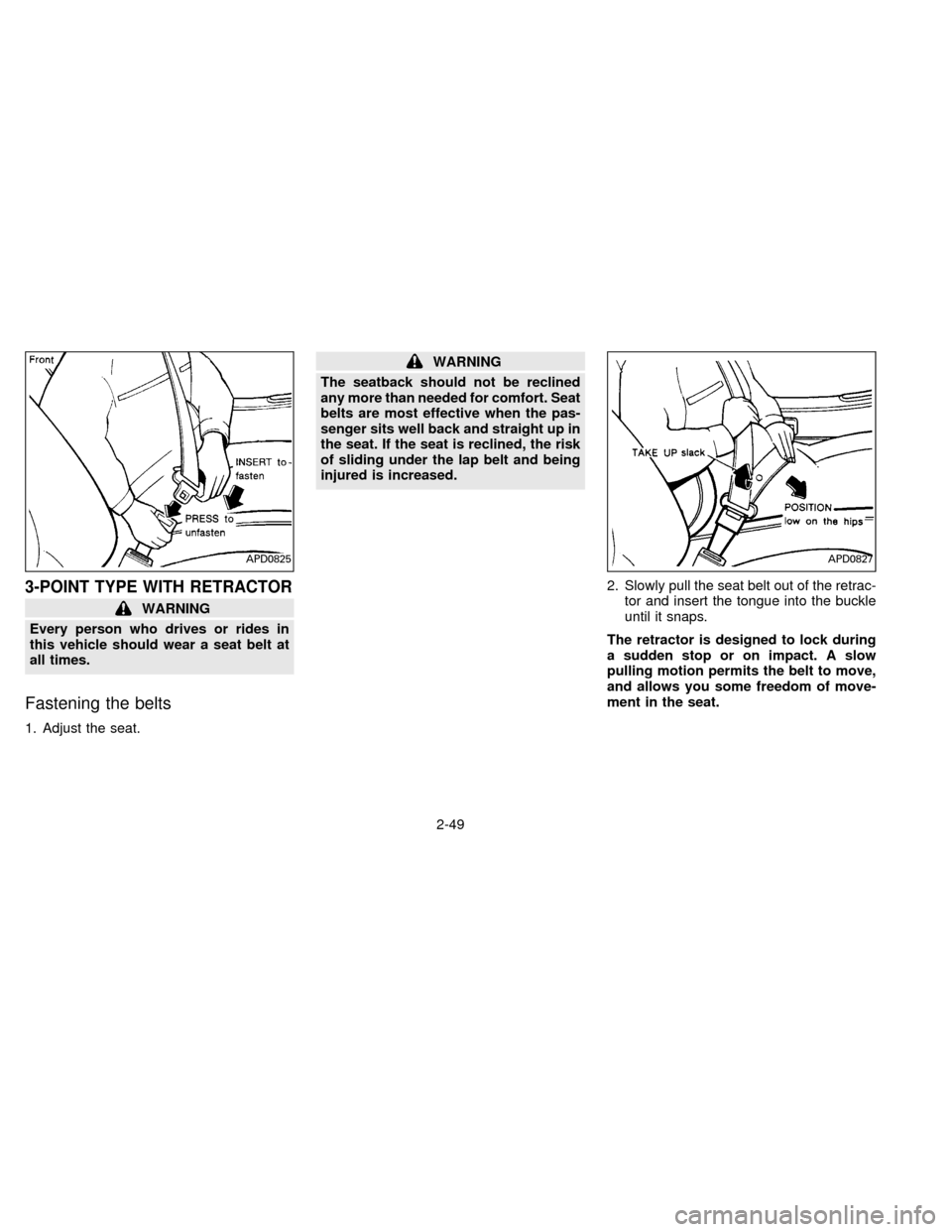
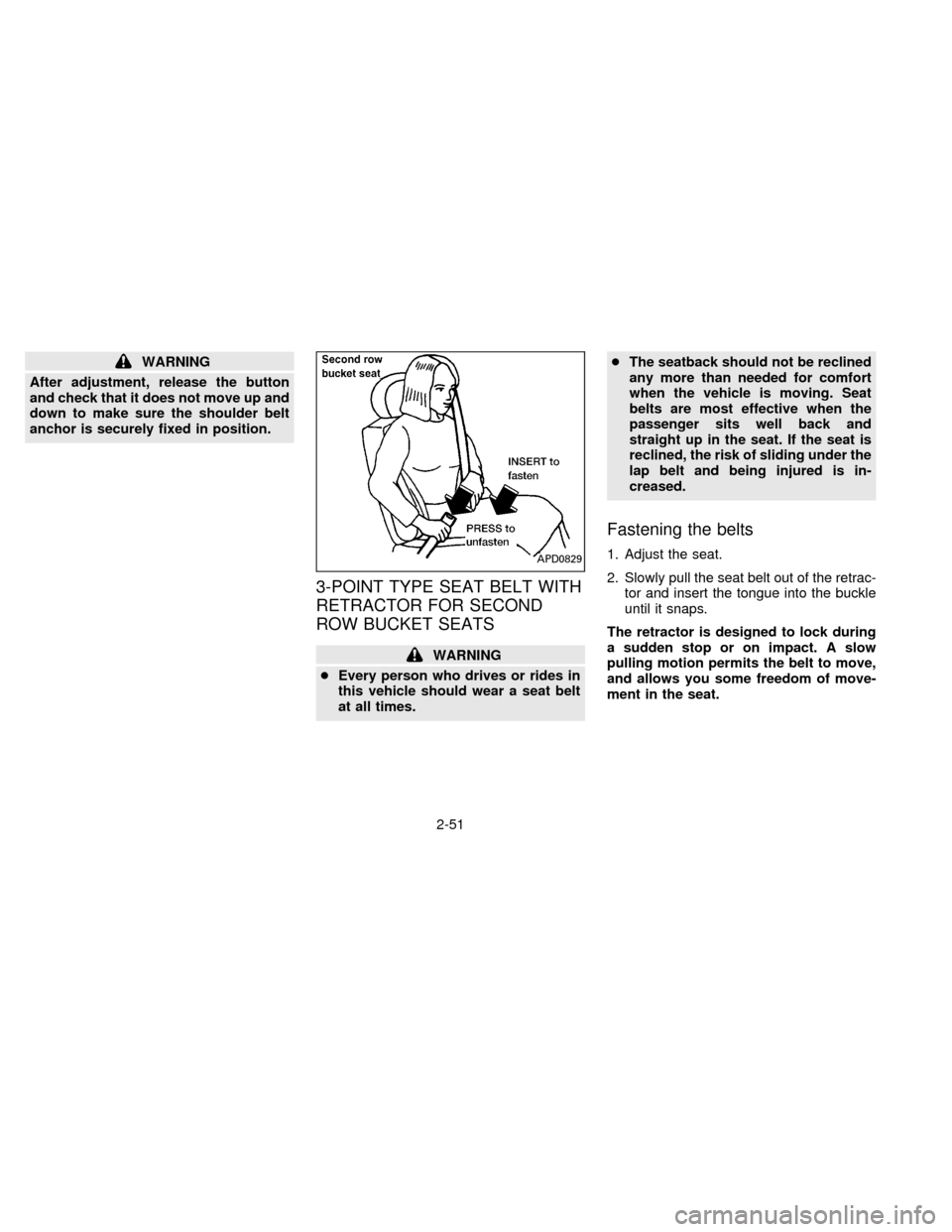
Sliding the three-passenger seat
Before sliding the seat, fasten the center
belt tongue to the center buckle and remove
the appropriate floor mats.1. Lift the seat cushion release lever.
2. Lift the seat cushion up into the locked
position.
3. Lift the slide release lever and grasp the
bar under the seat in the center.
4. Slide the seat until locked at a passenger
seating position or a storage position.
After the seat starts moving, release the
slide lever. The seat latches at the next
latching position. Continue to lift and
release the slide lever until the desired
position is obtained.
To lower the cushion, the seat must be
APD0147
APD0162
2-40
ZX
Page 70 of 235
locked at a passenger seating position. Lift
the seat cushion release lever and lower the
cushion until locked.
The seat cushion cannot be lowered in a
storage position. This prevents a pas-
senger from using a seat or seat belt that
is out of a seating position.
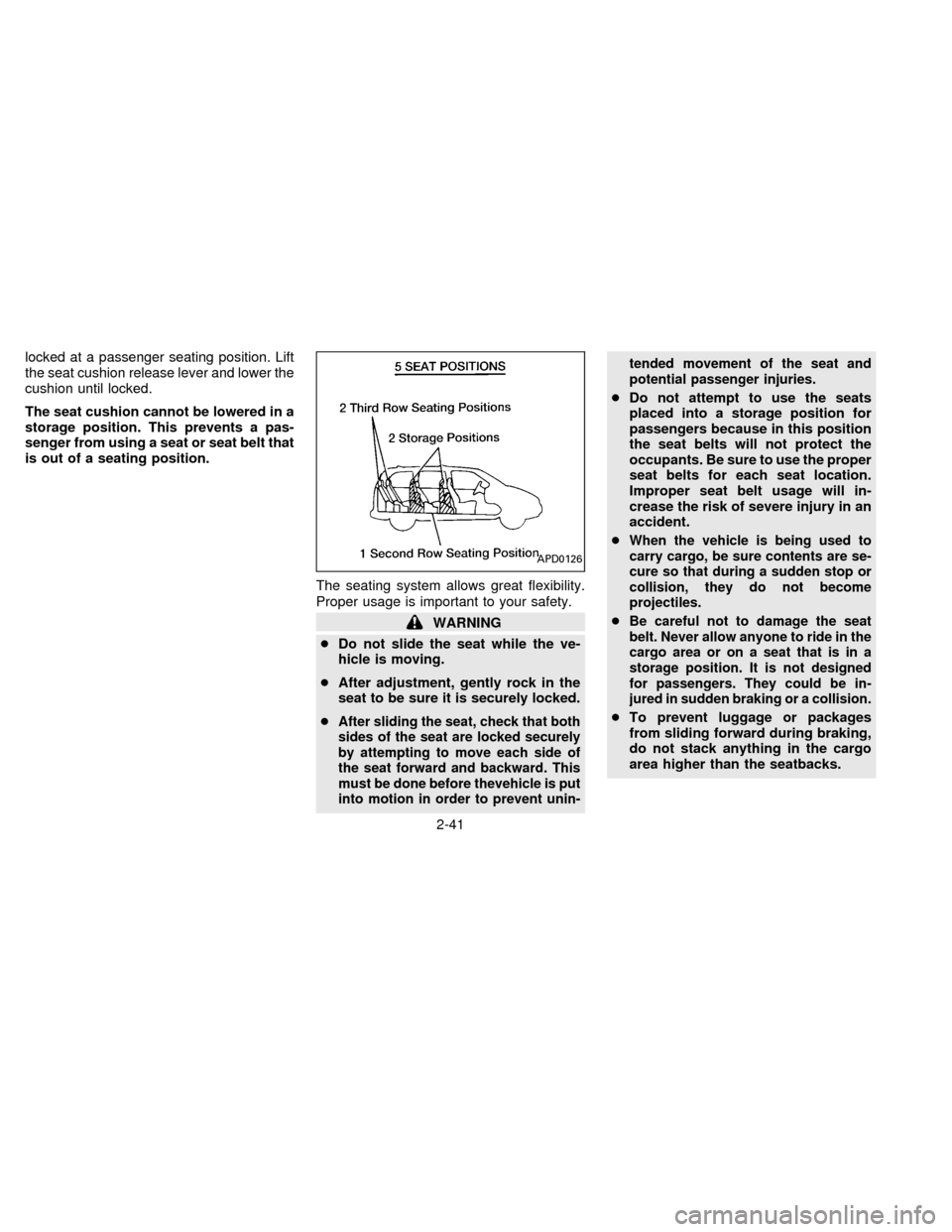
The seating system allows great flexibility.
Proper usage is important to your safety.
WARNING
cDo not slide the seat while the ve-
hicle is moving.
cAfter adjustment, gently rock in the
seat to be sure it is securely locked.
c
After sliding the seat, check that both
sides of the seat are locked securely
by attempting to move each side of
the seat forward and backward. This
must be done before thevehicle is put
into motion in order to prevent unin-tended movement of the seat and
potential passenger injuries.
cDo not attempt to use the seats
placed into a storage position for
passengers because in this position
the seat belts will not protect the
occupants. Be sure to use the proper
seat belts for each seat location.
Improper seat belt usage will in-
crease the risk of severe injury in an
accident.
c
When the vehicle is being used to
carry cargo, be sure contents are se-
cure so that during a sudden stop or
collision, they do not become
projectiles.
cBe careful not to damage the seat
belt. Never allow anyone to ride in the
cargo area or on a seat that is in a
storage position. It is not designed
for passengers. They could be in-
jured in sudden braking or a collision.
cTo prevent luggage or packages
from sliding forward during braking,
do not stack anything in the cargo
area higher than the seatbacks.
APD0126
2-41
ZX
Page 75 of 235
If any of the following conditions occur, the
supplemental air bag needs servicing and
should be taken to your nearest authorized
NISSAN dealer:
1. The supplemental air bag light does not
come on for 7 seconds and then go off as
described above.
2. The supplemental air bag light flashes
intermittently or remains on.
3. The supplemental air bag light does not
come on at all.
Under these conditions, the Supplemental
Restraint System Air Bag does not operate
properly. It must be checked and repaired.
Repair and replacement procedure
The supplemental air bag system is de-
signed to inflate on a one-time-only basis.
As a reminder, unless it is damaged, the
supplemental air bag light remains illumi-
nated after inflation has occurred. Repair
and replacement of the supplemental air
bag system should be done only by autho-
rized NISSAN dealers.To ensure long-
term functioning, the system must be
inspected 10 years after the date of
manufacture as noted on the certifica-tion label located on the driver side front
pillar.
When maintenance work is required on the
vehicle, the supplemental air bag system
and related parts should be pointed out to
the person conducting the maintenance.
The ignition key should always be in the
LOCK position when working under the
hood or inside the vehicle.
WARNING
cOnce the supplemental air bag in-
flates, the supplemental air bag
module will not function again and
must be replaced. The supplemental
air bag module cannot be repaired.
cAfter an air bag inflates, the front
instrument panel assembly should
be replaced if damaged, by your NIS-
SAN dealer.
cThe supplemental air bag system
should be inspected by an autho-
rized NISSAN dealer if there is any
damage to the front end portion of
the vehicle or replaced if the supple-
mental air bag has inflated.c
When selling your vehicle, we re-
quest that you inform the buyer about
the supplemental air bag system and
guide the buyer to the appropriate
sections in this Owner's Manual.
cIf you need to dispose of a supple-
mental air bag or scrap the vehicle,
contact an authorized NISSAN dealer.
Correct supplemental air bag dis-
posal procedures are set forth in the
appropriate NISSAN Service Manual.
Incorrect disposal procedures could
cause personal injury.
2-46
ZX
Page 78 of 235
3-POINT TYPE WITH RETRACTOR
WARNING
Every person who drives or rides in
this vehicle should wear a seat belt at
all times.
Fastening the belts
1. Adjust the seat.
WARNING
The seatback should not be reclined
any more than needed for comfort. Seat
belts are most effective when the pas-
senger sits well back and straight up in
the seat. If the seat is reclined, the risk
of sliding under the lap belt and being
injured is increased.
2. Slowly pull the seat belt out of the retrac-
tor and insert the tongue into the buckle
until it snaps.
The retractor is designed to lock during
a sudden stop or on impact. A slow
pulling motion permits the belt to move,
and allows you some freedom of move-
ment in the seat.
APD0825APD0827
2-49
ZX
Page 79 of 235
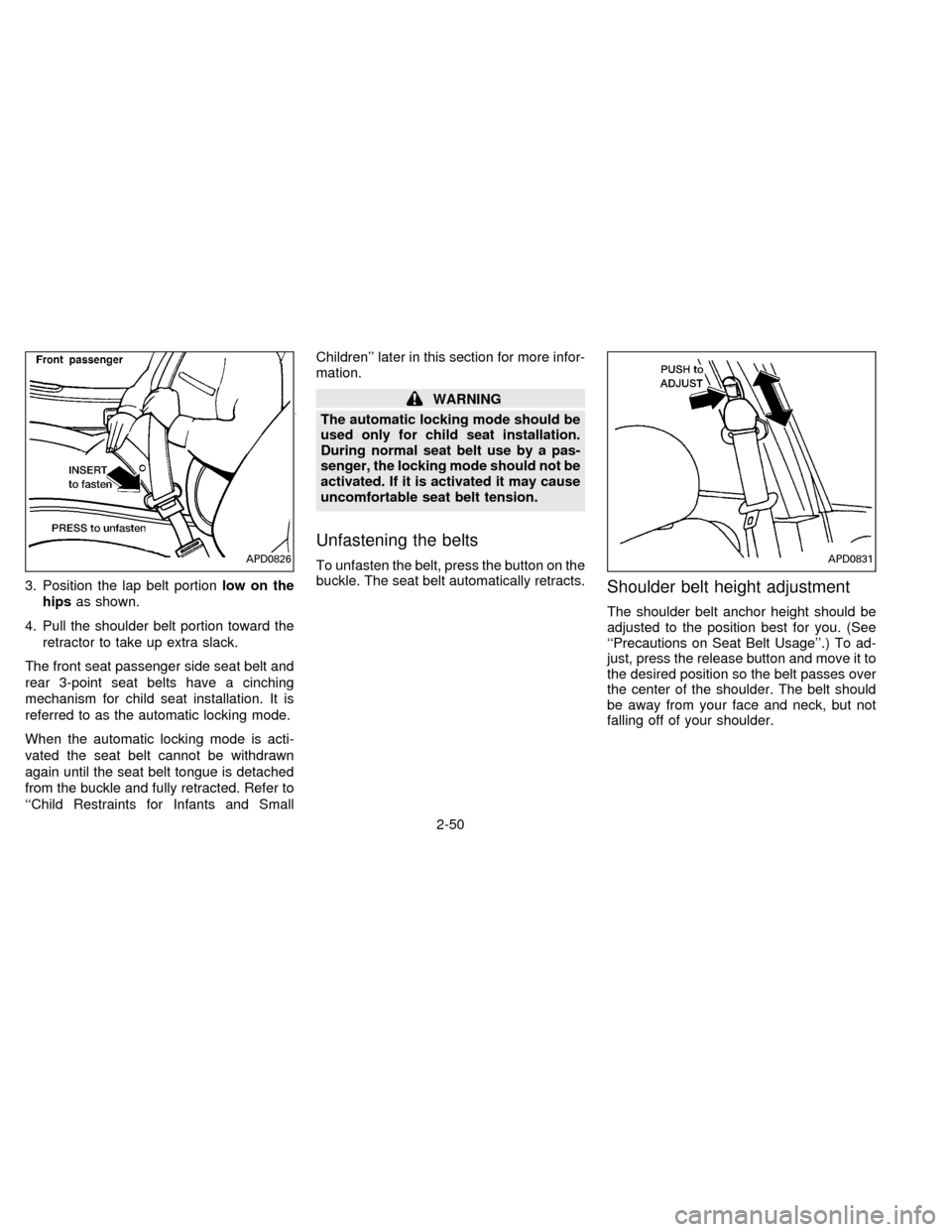
3. Position the lap belt portionlow on the
hipsas shown.
4. Pull the shoulder belt portion toward the
retractor to take up extra slack.
The front seat passenger side seat belt and
rear 3-point seat belts have a cinching
mechanism for child seat installation. It is
referred to as the automatic locking mode.
When the automatic locking mode is acti-
vated the seat belt cannot be withdrawn
again until the seat belt tongue is detached
from the buckle and fully retracted. Refer to
``Child Restraints for Infants and SmallChildren'' later in this section for more infor-
mation.
WARNING
The automatic locking mode should be
used only for child seat installation.
During normal seat belt use by a pas-
senger, the locking mode should not be
activated. If it is activated it may cause
uncomfortable seat belt tension.
Unfastening the belts
To unfasten the belt, press the button on the
buckle. The seat belt automatically retracts.
Shoulder belt height adjustment
The shoulder belt anchor height should be
adjusted to the position best for you. (See
``Precautions on Seat Belt Usage''.) To ad-
just, press the release button and move it to
the desired position so the belt passes over
the center of the shoulder. The belt should
be away from your face and neck, but not
falling off of your shoulder.
APD0826APD0831
2-50
ZX
Page 80 of 235
WARNING
After adjustment, release the button
and check that it does not move up and
down to make sure the shoulder belt
anchor is securely fixed in position.
3-POINT TYPE SEAT BELT WITH
RETRACTOR FOR SECOND
ROW BUCKET SEATS
WARNING
cEvery person who drives or rides in
this vehicle should wear a seat belt
at all times.cThe seatback should not be reclined
any more than needed for comfort
when the vehicle is moving. Seat
belts are most effective when the
passenger sits well back and
straight up in the seat. If the seat is
reclined, the risk of sliding under the
lap belt and being injured is in-
creased.
Fastening the belts
1. Adjust the seat.
2. Slowly pull the seat belt out of the retrac-
tor and insert the tongue into the buckle
until it snaps.
The retractor is designed to lock during
a sudden stop or on impact. A slow
pulling motion permits the belt to move,
and allows you some freedom of move-
ment in the seat.APD0829
2-51
ZX
Page 83 of 235
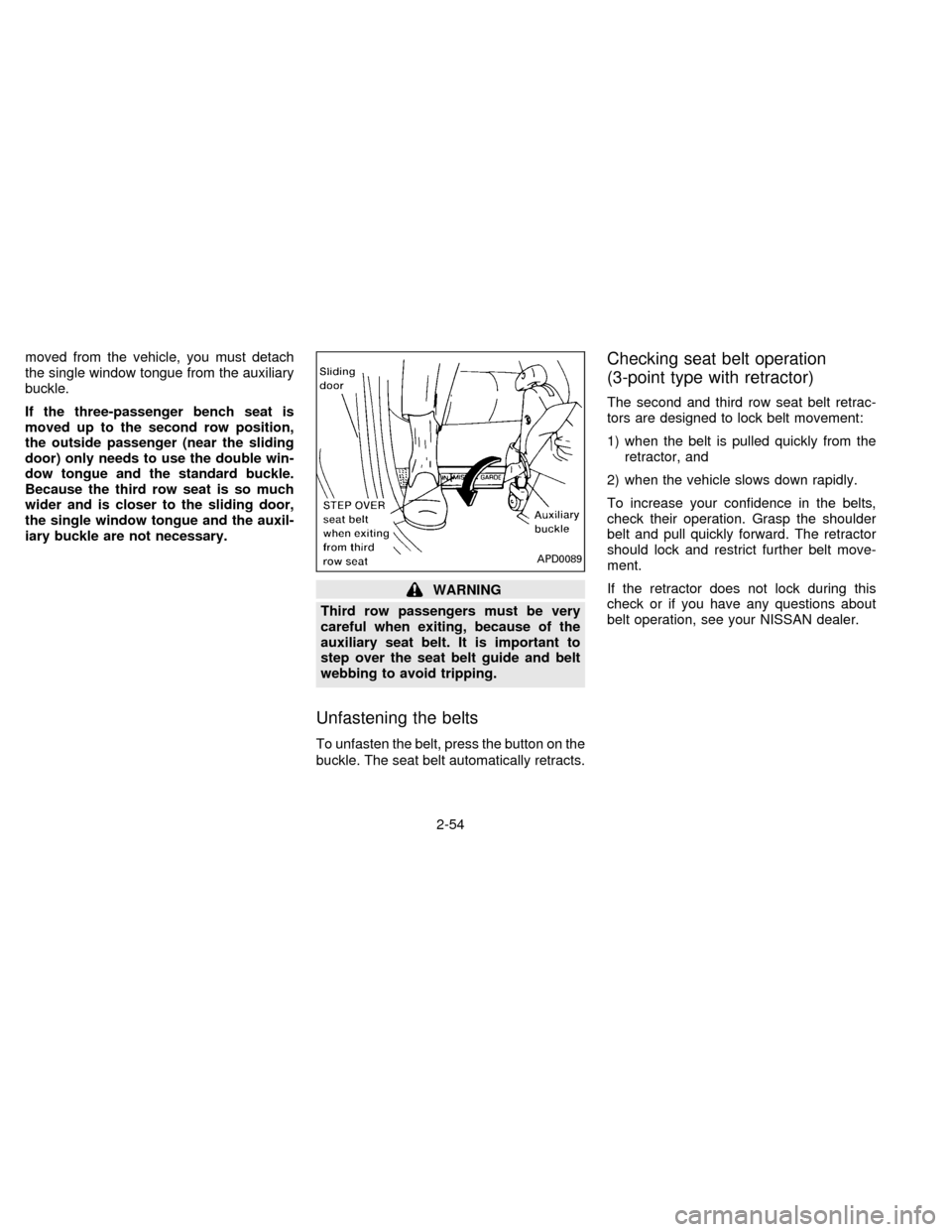
moved from the vehicle, you must detach
the single window tongue from the auxiliary
buckle.
If the three-passenger bench seat is
moved up to the second row position,
the outside passenger (near the sliding
door) only needs to use the double win-
dow tongue and the standard buckle.
Because the third row seat is so much
wider and is closer to the sliding door,
the single window tongue and the auxil-
iary buckle are not necessary.
WARNING
Third row passengers must be very
careful when exiting, because of the
auxiliary seat belt. It is important to
step over the seat belt guide and belt
webbing to avoid tripping.
Unfastening the belts
To unfasten the belt, press the button on the
buckle. The seat belt automatically retracts.
Checking seat belt operation
(3-point type with retractor)
The second and third row seat belt retrac-
tors are designed to lock belt movement:
1) when the belt is pulled quickly from the
retractor, and
2) when the vehicle slows down rapidly.
To increase your confidence in the belts,
check their operation. Grasp the shoulder
belt and pull quickly forward. The retractor
should lock and restrict further belt move-
ment.
If the retractor does not lock during this
check or if you have any questions about
belt operation, see your NISSAN dealer.
APD0089
2-54
ZX
Page 84 of 235
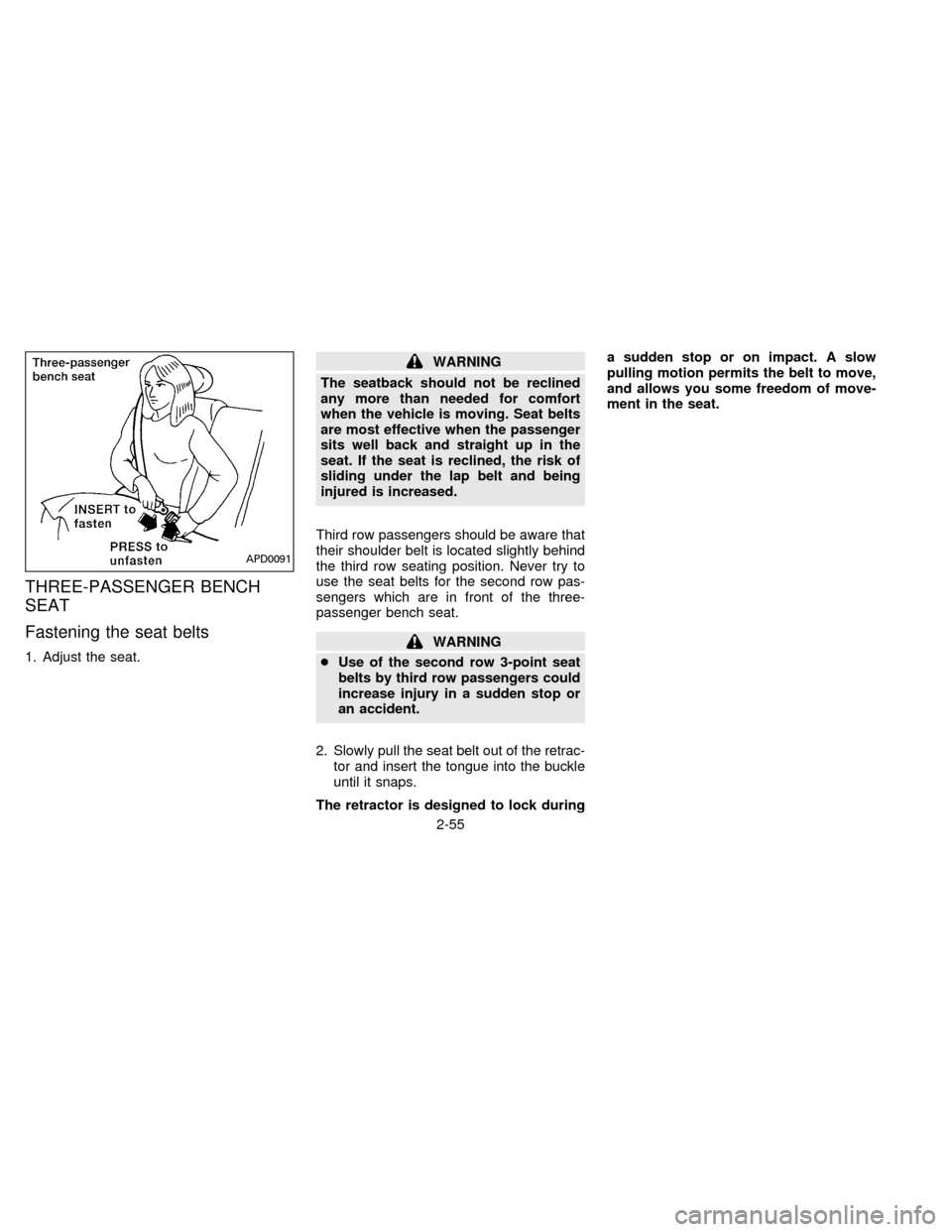
THREE-PASSENGER BENCH
SEAT
Fastening the seat belts
1. Adjust the seat.
WARNING
The seatback should not be reclined
any more than needed for comfort
when the vehicle is moving. Seat belts
are most effective when the passenger
sits well back and straight up in the
seat. If the seat is reclined, the risk of
sliding under the lap belt and being
injured is increased.
Third row passengers should be aware that
their shoulder belt is located slightly behind
the third row seating position. Never try to
use the seat belts for the second row pas-
sengers which are in front of the three-
passenger bench seat.
WARNING
cUse of the second row 3-point seat
belts by third row passengers could
increase injury in a sudden stop or
an accident.
2. Slowly pull the seat belt out of the retrac-
tor and insert the tongue into the buckle
until it snaps.
The retractor is designed to lock duringa sudden stop or on impact. A slow
pulling motion permits the belt to move,
and allows you some freedom of move-
ment in the seat.
APD0091
2-55
ZX