1996 NISSAN ALTIMA ECO mode
[x] Cancel search: ECO modePage 144 of 183
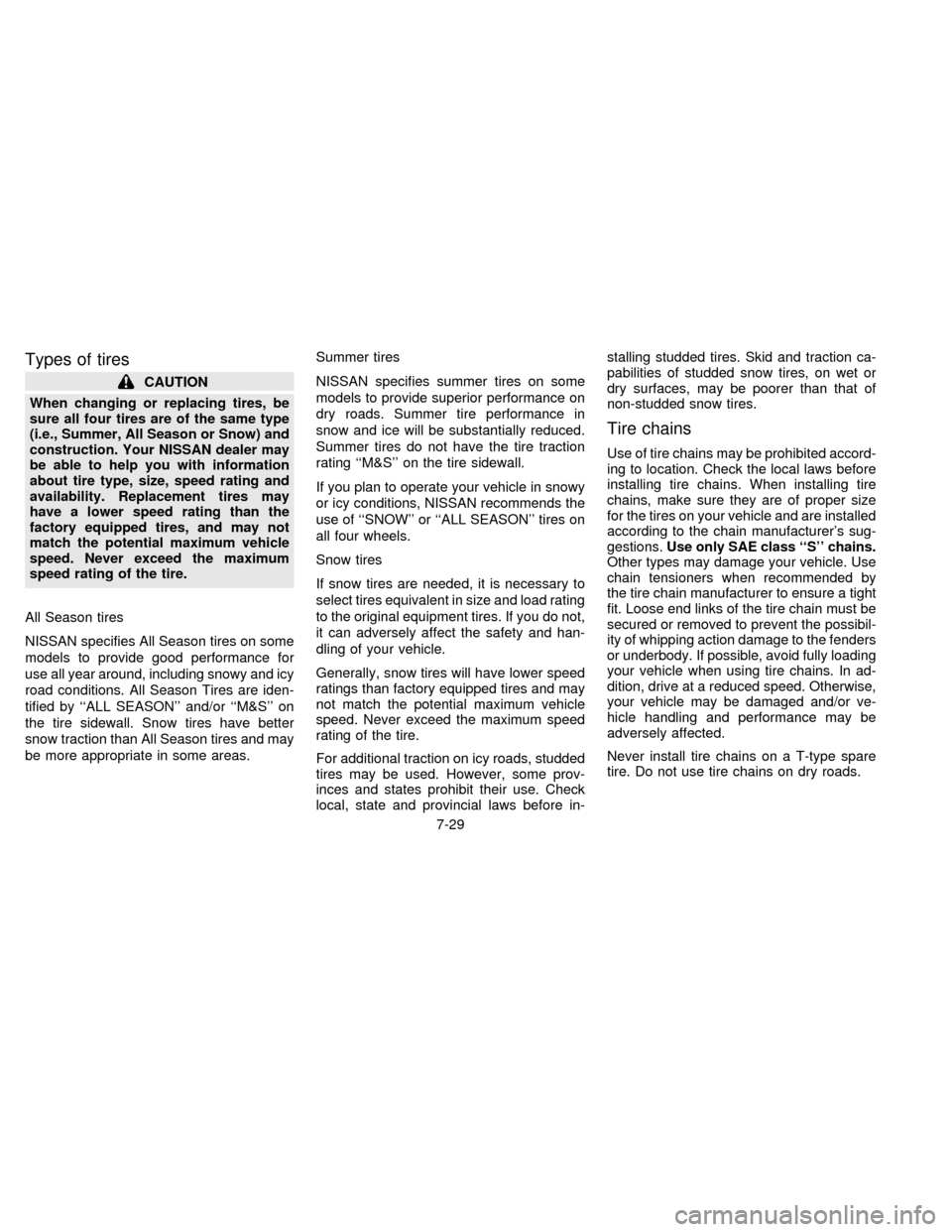
Types of tires
CAUTION
When changing or replacing tires, be
sure all four tires are of the same type
(i.e., Summer, All Season or Snow) and
construction. Your NISSAN dealer may
be able to help you with information
about tire type, size, speed rating and
availability. Replacement tires may
have a lower speed rating than the
factory equipped tires, and may not
match the potential maximum vehicle
speed. Never exceed the maximum
speed rating of the tire.
All Season tires
NISSAN specifies All Season tires on some
models to provide good performance for
use all year around, including snowy and icy
road conditions. All Season Tires are iden-
tified by ``ALL SEASON'' and/or ``M&S'' on
the tire sidewall. Snow tires have better
snow traction than All Season tires and may
be more appropriate in some areas.Summer tires
NISSAN specifies summer tires on some
models to provide superior performance on
dry roads. Summer tire performance in
snow and ice will be substantially reduced.
Summer tires do not have the tire traction
rating ``M&S'' on the tire sidewall.
If you plan to operate your vehicle in snowy
or icy conditions, NISSAN recommends the
use of ``SNOW'' or ``ALL SEASON'' tires on
all four wheels.
Snow tires
If snow tires are needed, it is necessary to
select tires equivalent in size and load rating
to the original equipment tires. If you do not,
it can adversely affect the safety and han-
dling of your vehicle.
Generally, snow tires will have lower speed
ratings than factory equipped tires and may
not match the potential maximum vehicle
speed. Never exceed the maximum speed
rating of the tire.
For additional traction on icy roads, studded
tires may be used. However, some prov-
inces and states prohibit their use. Check
local, state and provincial laws before in-stalling studded tires. Skid and traction ca-
pabilities of studded snow tires, on wet or
dry surfaces, may be poorer than that of
non-studded snow tires.
Tire chains
Use of tire chains may be prohibited accord-
ing to location. Check the local laws before
installing tire chains. When installing tire
chains, make sure they are of proper size
for the tires on your vehicle and are installed
according to the chain manufacturer's sug-
gestions.Use only SAE class ``S'' chains.
Other types may damage your vehicle. Use
chain tensioners when recommended by
the tire chain manufacturer to ensure a tight
fit. Loose end links of the tire chain must be
secured or removed to prevent the possibil-
ity of whipping action damage to the fenders
or underbody. If possible, avoid fully loading
your vehicle when using tire chains. In ad-
dition, drive at a reduced speed. Otherwise,
your vehicle may be damaged and/or ve-
hicle handling and performance may be
adversely affected.
Never install tire chains on a T-type spare
tire. Do not use tire chains on dry roads.
7-29
ZX
Page 159 of 183
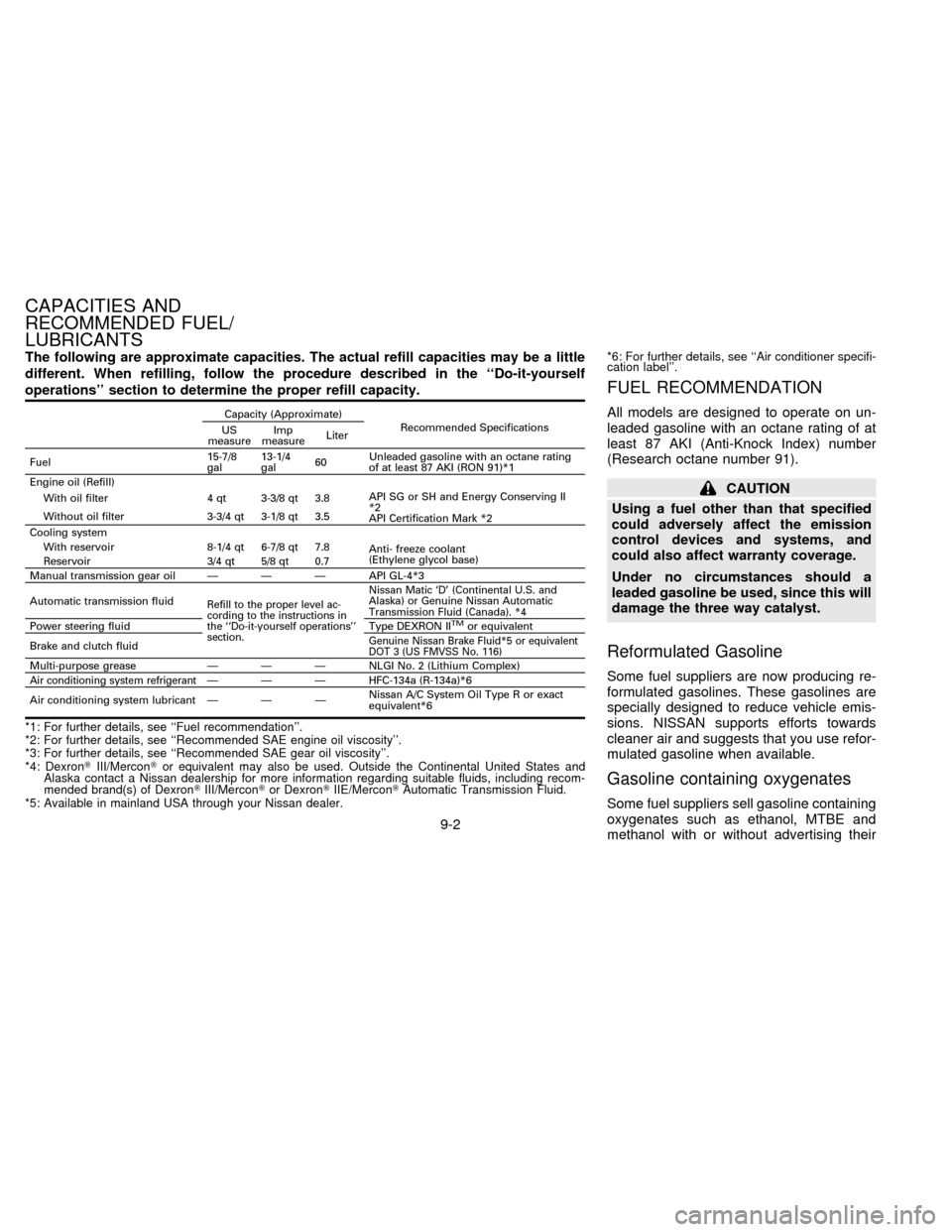
The following are approximate capacities. The actual refill capacities may be a little
different. When refilling, follow the procedure described in the ``Do-it-yourself
operations'' section to determine the proper refill capacity.
Capacity (Approximate)
Recommended Specifications
US
measureImp
measureLiter
Fuel15-7/8
gal13-1/4
gal60Unleaded gasoline with an octane rating
of at least 87 AKI (RON 91)*1
Engine oil (Refill)
With oil filter 4 qt 3-3/8 qt 3.8API SG or SH and Energy Conserving II
*2
API Certification Mark *2 Without oil filter 3-3/4 qt 3-1/8 qt 3.5
Cooling system
With reservoir 8-1/4 qt 6-7/8 qt 7.8
Anti- freeze coolant
(Ethylene glycol base)
Reservoir 3/4 qt 5/8 qt 0.7
Manual transmission gear oilÐ Ð Ð API GL-4*3
Automatic transmission fluid
Refill to the proper level ac-
cording to the instructions in
the ``Do-it-yourself operations''
section.Nissan Matic `D' (Continental U.S. and
Alaska) or Genuine Nissan Automatic
Transmission Fluid (Canada). *4
Power steering fluid Type DEXRON IITMor equivalent
Brake and clutch fluidGenuine Nissan Brake Fluid*5 or equivalent
DOT 3 (US FMVSS No. 116)
Multi-purpose greaseÐ Ð Ð NLGI No. 2 (Lithium Complex)Air conditioning system refrigerantÐ Ð Ð HFC-134a (R-134a)*6
Air conditioning system lubricant Ð Ð ÐNissan A/C System Oil Type R or exact
equivalent*6
*1: For further details, see ``Fuel recommendation''.
*2: For further details, see ``Recommended SAE engine oil viscosity''.
*3: For further details, see ``Recommended SAE gear oil viscosity''.
*4: DexronTIII/MerconTor equivalent may also be used. Outside the Continental United States and
Alaska contact a Nissan dealership for more information regarding suitable fluids, including recom-
mended brand(s) of DexronTIII/MerconTor DexronTIIE/MerconTAutomatic Transmission Fluid.
*5: Available in mainland USA through your Nissan dealer.*6: For further details, see ``Air conditioner specifi-
cation label''.
FUEL RECOMMENDATION
All models are designed to operate on un-
leaded gasoline with an octane rating of at
least 87 AKI (Anti-Knock Index) number
(Research octane number 91).
CAUTION
Using a fuel other than that specified
could adversely affect the emission
control devices and systems, and
could also affect warranty coverage.
Under no circumstances should a
leaded gasoline be used, since this will
damage the three way catalyst.
Reformulated Gasoline
Some fuel suppliers are now producing re-
formulated gasolines. These gasolines are
specially designed to reduce vehicle emis-
sions. NISSAN supports efforts towards
cleaner air and suggests that you use refor-
mulated gasoline when available.
Gasoline containing oxygenates
Some fuel suppliers sell gasoline containing
oxygenates such as ethanol, MTBE and
methanol with or without advertising their
CAPACITIES AND
RECOMMENDED FUEL/
LUBRICANTS
9-2
ZX
Page 173 of 183

or other possible causes of either condi-
tion.
cAlways secure items in the trailer to
prevent load shifts while driving.
cBe certain your rear view mirrors conform
to all federal, state or local regulations. If
not, install any mirrors required for towing
before driving the vehicle.
Trailer towing tips
In order to gain skill and an understanding
of the vehicle's behavior, you should prac-
tice turning, stopping and backing up in an
area which is free from traffic. Steering
stability and braking performance will be
somewhat different than under normal driv-
ing conditions.
cAlways secure items in the trailer to
prevent load shift while driving.
cAvoid abrupt starts, acceleration or
stops.
cAvoid sharp turns or lane changes.
cAlways drive your vehicle at a moderate
speed.
cAlways block the wheels on both vehicle
and trailer when parking. Parking on a
slope is not recommended; however, ifyou must do so, and if your vehicle is
equipped with an automatic transmis-
sion, first block the wheels and apply the
parking brake, and then move the shift
lever into the ``P'' position. If you move
the shift lever to the ``P'' position before
blocking the wheels and applying the
parking brake, transmission damage
could occur.
cWhen going down a hill, shift into a lower
gear and use the engine braking effect.
When ascending a long grade, downshift
the transmission to a lower gear and
reduce speed to reduce chances of en-
gine overloading and/or overheating.
cIf the engine coolant rises to an ex-
tremely high temperature when the air
conditioning system is on, turn off the air
conditioner. Coolant heat can be addi-
tionally vented by opening the windows,
switching the fan control to high and
setting the temperature control to the
``HOT'' position.
cTrailer towing requires more fuel than
normal circumstances.
cAvoid towing a trailer for the first 500
miles (800 km).
cHave your vehicle serviced more oftenthan at intervals specified in the recom-
mended Maintenance Schedule.
cWhen making a turn, your trailer wheels
will be closer to the inside of the turn than
your vehicle wheels. To compensate for
this, make a larger than normal turning
radius during the turn.
cCrosswinds and rough roads will ad-
versely affect vehicle/trailer handling,
possibly causing vehicle sway. When
being passed by larger vehicles, be pre-
pared for possible changes in crosswinds
that could affect vehicle handling. If
swaying does occur, firmly grip the steer-
ing wheel, steer straight ahead, and im-
mediately (but gradually) reduce vehicle
speed. This combination will help stabi-
lize the vehicle. Never increase speed.
cBe careful when passing other vehicles.
Passing while towing a trailer requires
considerably more distance than normal
passing. Remember the length of the
trailer must also pass the other vehicle
before you can safely change lanes.
cTo maintain engine braking efficiency
and electrical charging performance, do
not use fifth gear (manual transmission)
9-16
ZX