Page 192 of 320
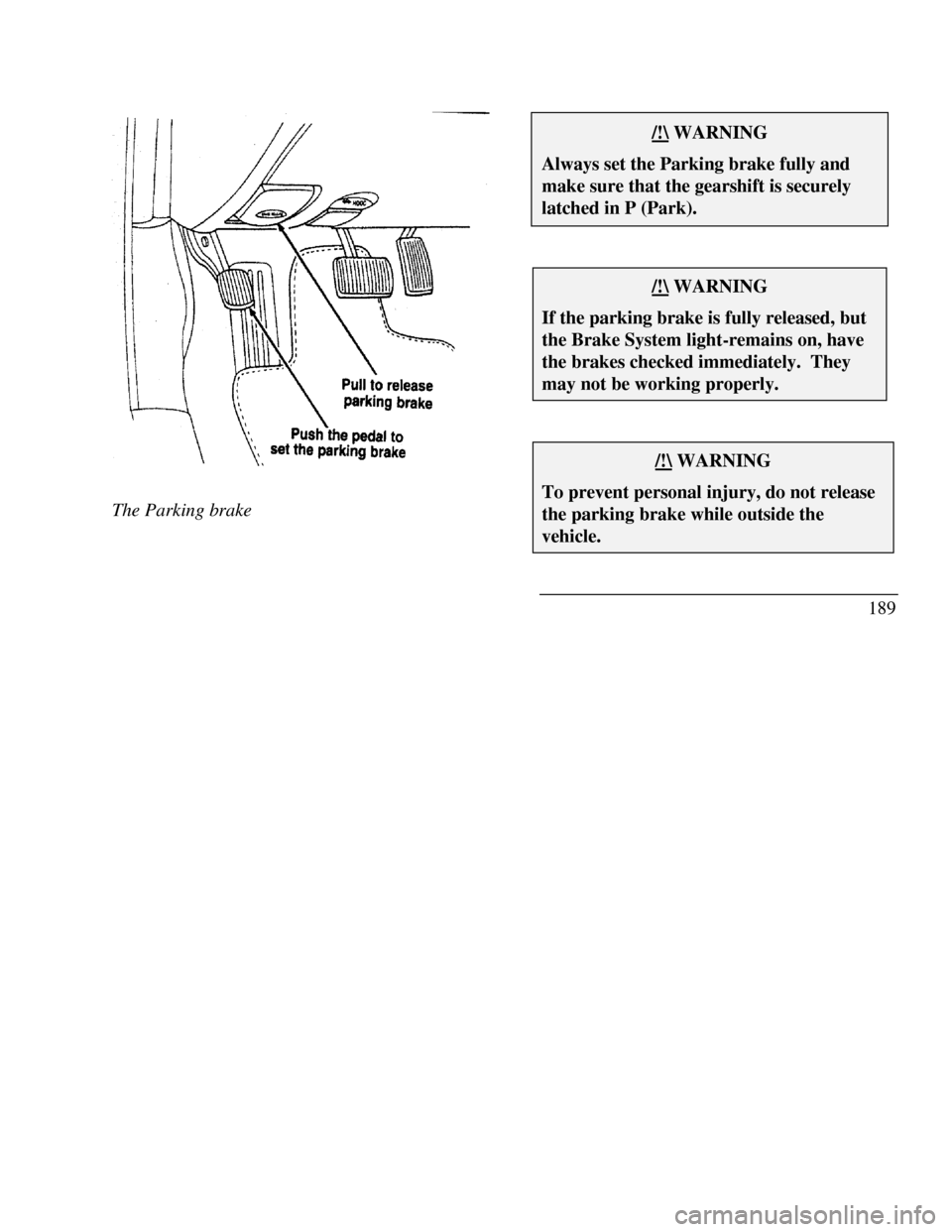
The Parking brake/!\ WARNINGAlways set the Parking brake fully andmake sure that the gearshift is securelylatched in P (Park)./!\ WARNINGIf the parking brake is fully released, butthe Brake System light-remains on, havethe brakes checked immediately. Theymay not be working properly./!\ WARNINGTo prevent personal injury, do not releasethe parking brake while outside thevehicle.189
Page 193 of 320

You have an automatic release for the parking brake.
The parking brake should automatically unlock when
you move the gearshift to any forward gear while the
engine is running. However, the automatic release
does not work when the gearshift is in reverse,
neutral or park.
To manually release the parking brake, pull the
BRAKE RELEASE handle located on the lower left
comer of the instrument panel. The Brake Warning
Light will illuminate if the parking brake is not fully
released when the engine is running.
The parking brake is not designed to stop a moving
vehicle, but you can use the parking brake to stop
your vehicle in an emergency if the normal brakes
fail. However, since the parking brake applies only
the rear brakes, the stopping distance will increase
greatly and the handling of your vehicle will be
adversely affected.
190Always check the Brake Warning light each
time you start your engine. Driving with the
parking brake on will cause the brakes to wear
out quickly and will reduce the fuel economy.
Driving Under Special Conditions
Tips for Safe Driving
As with any new vehicle, yours may drive and
handle differently from your previous vehicle.
Use care until you become accustomed to its
various features and driving characteristics.
Operate your vehicle within reasonable limits.
Sudden acceleration, deceleration, turning, or
combinations of these maneuvers can cause a
vehicle to behave differently than anticipated.
Page 195 of 320
/!\ WARNINGDo not spin the wheels at over 35 mph (55km/h). The tires may fail and injure apassenger or bystander.By moving the vehicle backward and forward, you
may gain enough momentum to move out of the
spot. Do not rock the vehicle for more than a few
minutes. This may overheat the engine, damage the
transaxle, or damage the tires. If you are still stuck
after a minute or two of rocking, call for a tow truck.
High water
Do not drive through flooded areas unless you are
sure that the water is below the bottom of the wheel
rims.
If you must drive through high water, drive slowly.
You may have limited traction or wet brakes, so
allow extra stopping distance because your vehicle
will not stop as quickly as usual.
192After you drive through the standing water,
apply your brakes gently several times as your
vehicle moves slowly. This helps to dry the
brakes.
Driving With a Heavy Load
There are limits to the amount of weight your
vehicle can carry or tow. The total weight of
your vehicle, plus the weight of the passengers
and cargo, should never be more than the
Gross Vehicle Weight Rating (GVWR). Also,
the weight that your vehicle carries over the
front axle and rear axle should never be more
than the Gross Axle Weight Rating (GAWR)
for the respective axle.
You can find your vehicle's GVWR and
GAWR on the Safety Compliance Certification
Label on the left front door lock facing or on
the door latch post pillar.
Page 200 of 320
To connect the trailer's safety chains:
1. Cross the chains under the trailer tongue and
attach them to your vehicle's frame or hook
retainers. Never attach the safety chains to your
vehicle's bumper. The bumper is not designed to
bear the weight of a trailer.
2. Make sure that you leave enough slack in the
chains to allow you to turn corners.
If you use a rental trailer, follow the instructions that
the rental agency gives you.
Connecting the trailer's brakes
Electric brakes and manual, automatic, or surge-type
hydraulic brakes are safe if you install them properly
and adjust them according to the manufacturer's
instructions. Be sure that your trailer's brakes meet
local and federal regulations.
Separate trailer brakes of adequate size should be
used for trailers weighing over 1.000 lbs. (454 kg)
loaded weight./!\ WARNINGDo not connect a trailer's hydraulicbrake system directly to your vehicle'sbrake system. Your vehicle may nothave enough braking power and yourchances of having a collision greatlyincrease.Connecting the trailer's lights
Do not connect a trailer's fighting system
wiring directly to your vehicle's fighting
system wiring. To get the proper equipment
for hooking up your trailer's lights, see your
local trailer dealer and your Ford dealer. Be
sure to follow their instructions carefully.
If you do not install trailer lights correctly, you
may cause damage to the vehicle's hghting
system.
197
Page 265 of 320

Brake Fluid
Under normal circumstances, your vehicle should
not use up brake fluid rapidly. However, expect the
level of the brake fluid to slowly fall as you put
more mileage on your vehicle and the brake lining
wears.
You should check the brake fluid at every scheduled
engine oil change, but be sure to check it at least
once a year. You can do this by looking at the fluid
level in the plastic reservoir on the master cylinder.
(See The Engine Type in this chapter to locate the
master cylinder.) The fluid level should be at or near
the MAX mark./!\ WARNINGBrake fluid is toxic.If brake fluid contacts eyes, flush eyes with running
water for 15 minutes. Get medical attention ifirritation persists. If taken internally, drink water and
induce vomiting. Get medical attention immediately.
If the fluid is low, carefully clean and remove the cap
from the reservoir. Fill the reservoir to the MAX
line with Ford High Performance DOT 3 Brake Fluid
C6AZ-19542-AA, C6AZ-19542-BA, or equivalent
DOT 3 fluid meeting Ford specification ESA-
M6C25-A./!\ WARNINGIf you use a brake fluid that is not DOT 3, youwill cause permanent damage to your brakes.Do not fill the reservoir above the MAX line.
If you find that the fluid level is excessively low
below the seam or ridge on the outside of the plastic
reservoir - have the brake system inspected.
263
Page 266 of 320
/!\ WARNINGDo not let the reservoir for the mastercylinder run dry. This may cause the brakesto fail.The brake fluid reservoir
264Power Steering Fluid
Check the level of the power steering fluid at least
twice a year (i.e., every Spring and Fall).
Checking and Adding Power Steering
Fluid
1. Start the engine and let it run until the power
steering fluid reaches normal operating
temperature. The power steering fluid will be at
the right temperature when the engine coolant
temperature gauge in the instrument cluster is
near the center of the NORMAL operating
temperature range.
2. While the engine idles, turn the steering wheel
back and forth several times. Make sure that the
cap assembly is installed at this time.
Page 294 of 320
Battery Check and recharge as necessary. Keep connections clean and covered with a light
coat of grease. If storing your vehicle for more than 30 days
without recharging the battery, disconnect the
battery cables to ensure battery charge is
maintained for quick starting. NOTE: If battery
cables are disconnected, it will be necessary to
reset any memory features (eg. radio presets).
Brakes Make sure brakes and parking brake are fully
released.
292Tires Maintain recommended air pressures.
Miscellaneous Make sure all linkages, cables, levers and
clevis pins under vehicle are covered with grease to
prevent rust. Move vehicles at least 25 feet (8 m) every 15
days to lubricate working parts and prevent
corrosion.
Page 306 of 320

Anti-theft system........................................ B..............................
arming the system............................109Backing up.............................................182
description.......................................108Basic vehicle warranty................................5
disarming an untriggered system......110Battery.........................................................
disarming a triggered system............111acid, treating emergencies..................200
triggering.........................................111battery saver......................................108
warning light......................................59charging system warning light..............55
Assistance (see Customer assistance)....213disconnecting.....................................253
Audio system.............................................how to service....................................252
(see Electronic sound system)............159jumping a disabled battery..................199
Automatic transaxle....................................maintenance-free................................252
fluid, adding.....................................262proper disposal, recycling...................253
fluid, checking.................................261replacement, specifications.................288
fluid, refill capacities........................287when storing your vehicle...................292
fluid, specification............................289Brake fluid
..............................................................brake warning light...............................52
..............................................................checking and adding...........................263
..............................................................description.........................................263
..............................................................specifications......................................289
..............................................................Brakes..........................................................
..............................................................adjustment..............................................187
..............................................................anti-lock.............................................187
308