Page 143 of 240
Periodic Checks
You should check the following items at the specified intervals. If
you are unsure of how to perform any check, turn to the page given. Engine oil level — Check every
time you fill the fuel tank. See
page 112.
Engine coolant level — Check the
radiator reserve tank every time
you fill the fuel tank. See page 113 .
Windshield washer fluid — Check the level in the reservoir monthly.If weather conditions cause you to
use the washers frequently, check
the reservoir each time you stop
for fuel. See page 154 .
Automatic transmission — Check the fluid level monthly. See page 155.
Brakes and power steering — Check the fluid level monthly. See
page 156. Tires — Check the tire pressure
monthly. Examine the tread for
wear and foreign objects. See page
169 .
Battery — Check its condition and
the terminals for corrosion monthly. See page 162 .
Air conditioning — Check its operation weekly. See page 168 .
Lights — Check the operation of
the headlights, parking lights,
taillights, high-mount brake light,
turn signals, brake lights, and
license plate lights monthly. See
page 175.
MaintenanceProCarManuals.comMain Menu s t Table of Contents
Page 148 of 240
Engine Oil
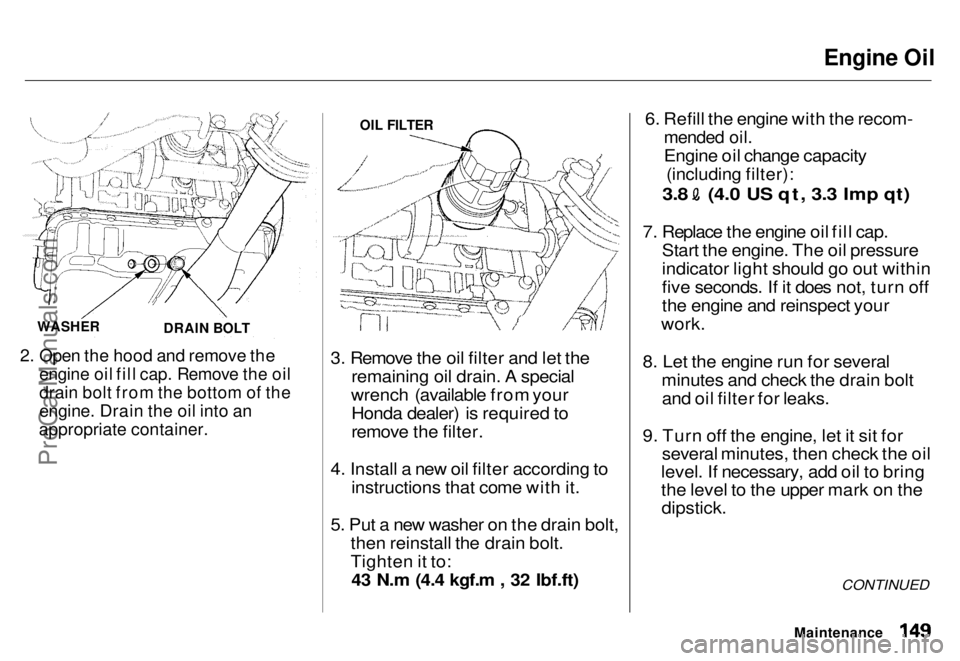
2. Open the hood and remove the
engine oil fill cap. Remove the oil
drain bolt from the bottom of the
engine. Drain the oil into an
appropriate container.
3. Remove the oil filter and let the
remaining oil drain. A special
wrench (available from your Honda dealer) is required to
remove the filter.
4. Install a new oil filter according to instructions that come with it.
5. Put a new washer on the drain bolt, then reinstall the drain bolt.
Tighten it to:43 N.m (4.4 kgf.m , 32 Ibf.ft) 6. Refill the engine with the recom-
mended oil.
Engine oil change capacity
(including filter):
3.8 (4.0 US qt, 3.3 Imp qt)
7. Replace the engine oil fill cap. Start the engine. The oil pressure
indicator light should go out within
five seconds. If it does not, turn off
the engine and reinspect your
work.
8. Let the engine run for several minutes and check the drain boltand oil filter for leaks.
9. Turn off the engine, let it sit for several minutes, then check the oil
level. If necessary, add oil to bring
the level to the upper mark on the
dipstick.
CONTINUED
Maintenance
WASHER
DRAIN BOLT OIL FILTER
ProCarManuals.comMain Menu s t Table of Contents
Page 153 of 240
Cooling System, Windshield Washers
10.Turn off the engine. Check the
level in the radiator, add coolant if
needed. Install the radiator cap,
tighten it fully.
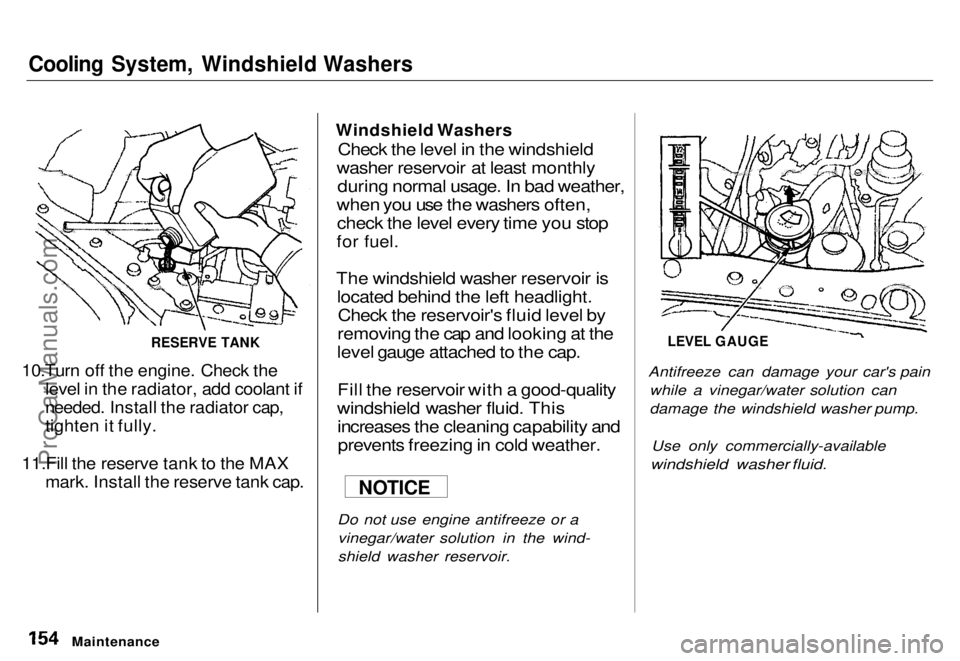
11.Fill the reserve tank to the MAX
mark. Install the reserve tank cap.
Windshield Washers
Check the level in the windshield
washer reservoir at least monthly during normal usage. In bad weather,
when you use the washers often, check the level every time you stop
for fuel.
The windshield washer reservoir is located behind the left headlight.Check the reservoir's fluid level by
removing the cap and looking at the
level gauge attached to the cap.
Fill the reservoir with a good-quality
windshield washer fluid. This increases the cleaning capability andprevents freezing in cold weather.
Do not use engine antifreeze or a vinegar/water solution in the wind-
shield washer reservoir.
LEVEL GAUGE
Antifreeze can damage your car's pain while a vinegar/water solution can
damage the windshield washer pump.
Use only commercially-available
windshield washer fluid.
Maintenance
RESERVE TANK
NOTICEProCarManuals.comMain Menu s t Table of Contents
Page 167 of 240
Air Conditioning
Your car's air conditioning is a sealed system. Any major maintenance,
such as recharging, should be done
by a qualified technician. There are a couple of things you can do to makesure the air conditioning works
efficiently.
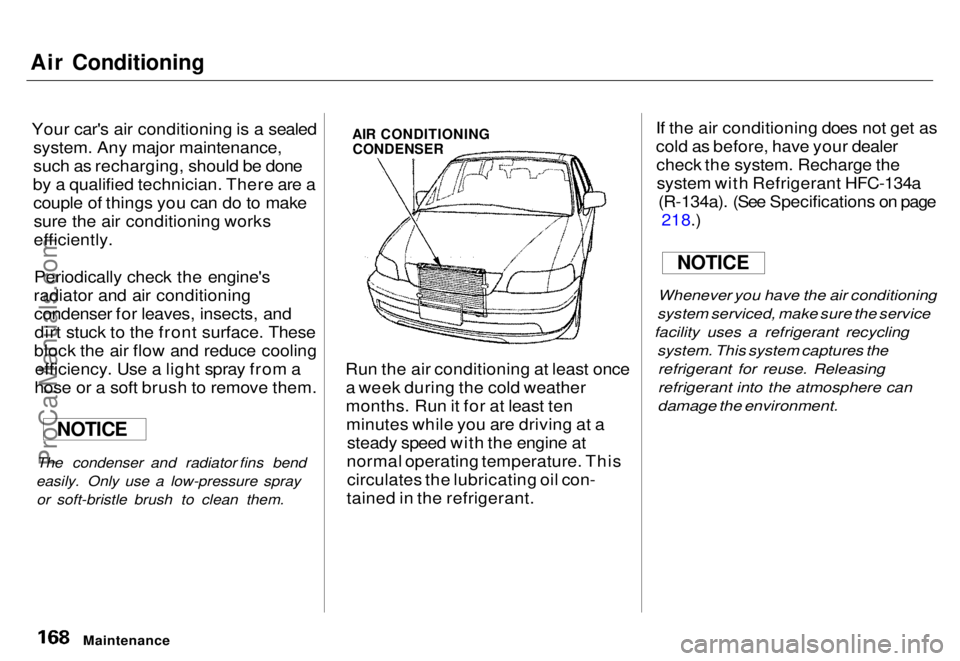
Periodically check the engine's
radiator and air conditioning condenser for leaves, insects, anddirt stuck to the front surface. These
block the air flow and reduce cooling efficiency. Use a light spray from a
hose or a soft brush to remove them.
The condenser and radiator fins bend
easily. Only use a low-pressure spray or soft-bristle brush to clean them.
AIR CONDITIONING
CONDENSER
Run the air conditioning at least once a week during the cold weather
months. Run it for at least tenminutes while you are driving at a steady speed with the engine at
normal operating temperature. This circulates the lubricating oil con-
tained in the refrigerant. If the air conditioning does not get as
cold as before, have your dealer
check the system. Recharge thesystem with Refrigerant HFC-134a (R-134a). (See Specifications on page 218.)
Whenever you have the air conditioning
system serviced, make sure the service
facility uses a refrigerant recycling
system. This system captures the
refrigerant for reuse. Releasing
refrigerant into the atmosphere can
damage the environment.
Maintenance
NOTICE
NOTICEProCarManuals.comMain Menu s t Table of Contents
Page 197 of 240
If Your Engine Won't Start
Diagnosing why your engine won't start falls into two areas, depending
on what you hear when you turn the
key to START (III): You hear nothing, or almost
nothing. The engine's starter
motor does not operate at all, oroperates very slowly. You can hear the starter motor
operating normally, but the engine
does not start up and run. Nothing Happens or the Starter
Motor Operates Very Slowly
When you turn the ignition switch to START (III), you do not hear the
normal noise of the engine trying to start. You may hear a clicking sound
or series of clicks, or nothing at all.Check these things:
Check the transmission interlock.
The transmission must be in Park or Neutral or the starter will not
operate.
Turn the ignition switch to ON (II).
Turn on the headlights and check their brightness. If the headlights are very dim or don't light at all,
the battery is discharged. See
Jump Starting on page 200. Turn the ignition switch to START
(III). If the headlights do not dim,
check the condition of the fuses. If
the fuses are OK, there is proba-
bly something wrong with the electrical circuit for the ignition
switch or starter motor. You will
need a qualified technician todetermine the problem. (See
Towing on page 213.)
If the headlights dim noticeably or
go out when you try to start theengine, either the battery is dis-
charged or the connections are
corroded. Check the condition of
the battery and terminal connec- tions (see page 162 ). You can
then try jump starting the car from a booster battery (see page 200 ).
Taking Care of the UnexpectedProCarManuals.comMain Menu s t Table of Contents
Page 198 of 240
If Your Engine Won't Start, Jump Starting
The Starter Operates Normally In this case, the starter motorsounds normal when you turn the
ignition switch to START (III), but
the engine does not run. Are you using the proper starting
procedure? Refer to Starting the
Engine on page 119 . Do you have fuel? Turn the
ignition switch to ON (II) for a
minute and watch the fuel gauge.
The low fuel level warning light may not be working, so you were
not reminded to fill the tank. There may be an electrical
problem, such as no power to the
fuel pump. Check all the fuses (see page 208).
If you find nothing wrong, you will
need a qualified technician to find
the problem. See Towing on page
213.
Jump Starting
If your car's battery has run down,
you may be able to start the engine by using a booster battery. Although
this seems like a simple procedure,
there are several precautions you should take. Follow the directions
closely.
You cannot start a Honda by pushing or pulling it. To jump start your car:
1. Open the hood and check the physical condition of the battery(see page 162 ). In very cold
weather, check the condition of the electrolyte. If it seems slushyor like ice, do not try jump starting
until it thaws.
If a battery sits in extreme cold, the
electrolyte inside can freeze.
Attempting to jump start with a frozen battery can cause it to rupture or
explode.
2. Turn off all the electrical acces- sories: heater, A/C, stereo system
lights, etc. Put the transmission in Neutral or
Park and set the parking brake.
Taking Care of the Unexpected
NOTICE
A battery can explode if you do
not follow the correct procedure,
seriously injuring anyone nearby.
Keep all sparks, open flames,
and smoking materials away
from the battery.ProCarManuals.coms t Main Menu Table of Contents
Page 202 of 240
Low Oil Pressure
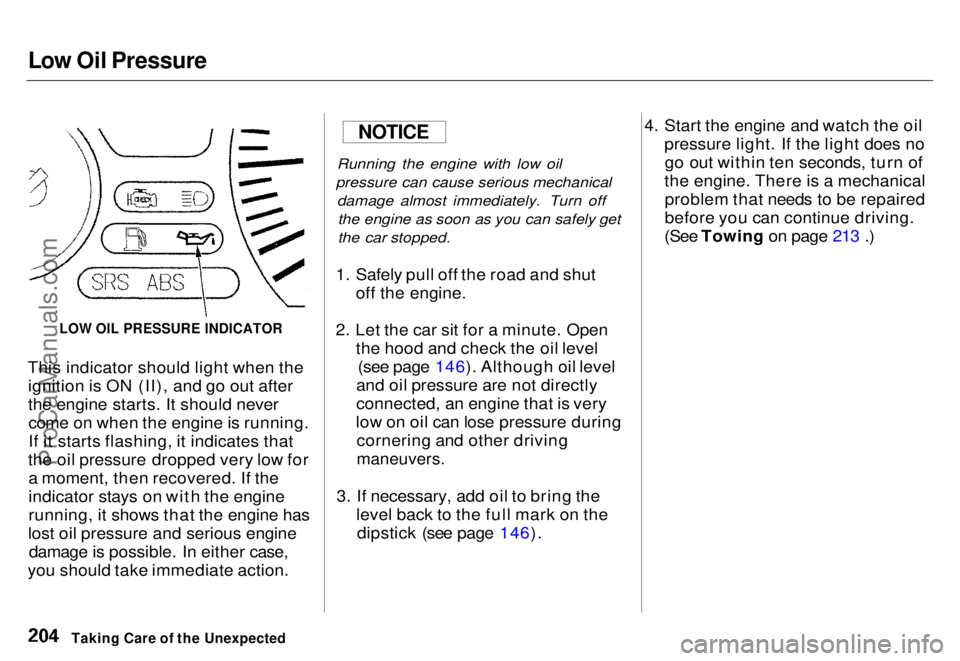
This indicator should light when the ignition is ON (II), and go out after
the engine starts. It should nevercome on when the engine is running.
If it starts flashing, it indicates that
the oil pressure dropped very low for a moment, then recovered. If the
indicator stays on with the engine
running, it shows that the engine has
lost oil pressure and serious engine damage is possible. In either case,
you should take immediate action.
Running the engine with low oil
pressure can cause serious mechanical damage almost immediately. Turn offthe engine as soon as you can safely get
the car stopped.
1. Safely pull off the road and shut off the engine.
2. Let the car sit for a minute. Open the hood and check the oil level(see page 146). Although oil level
and oil pressure are not directly
connected, an engine that is very
low on oil can lose pressure during cornering and other driving
maneuvers.
3. If necessary, add oil to bring the level back to the full mark on thedipstick (see page 146). 4. Start the engine and watch the oil
pressure light. If the light does nogo out within ten seconds, turn of
the engine. There is a mechanical problem that needs to be repaired
before you can continue driving.
(See Towing on page 213 .)
Taking Care of the Unexpected
NOTICE
LOW OIL PRESSURE INDICATORProCarManuals.comMain Menu s t Table of Contents
Page 204 of 240
Malfunction Indicator Lamp
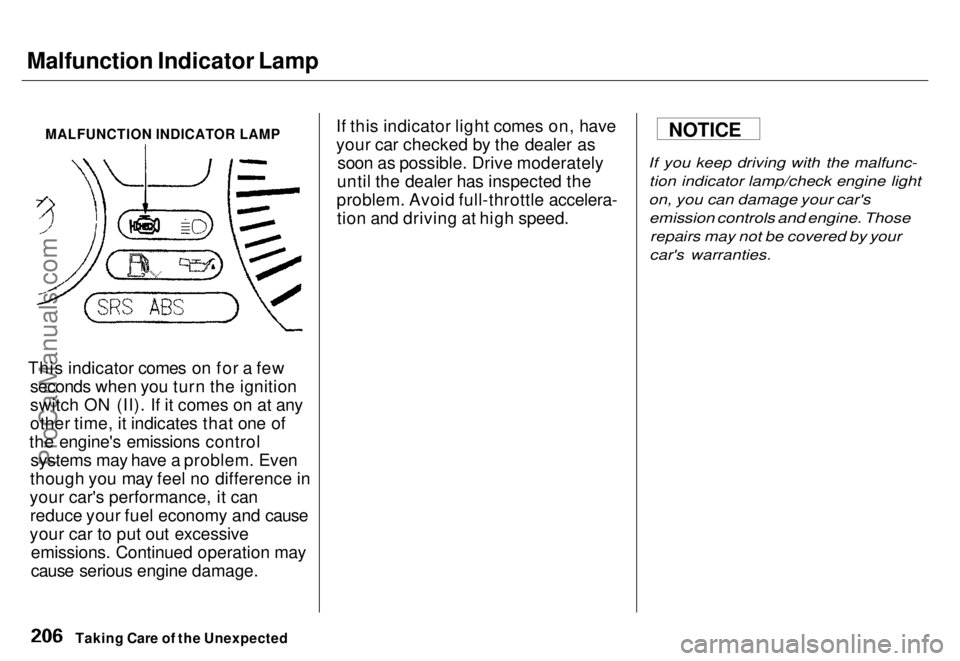
MALFUNCTION INDICATOR LAMP
This indicator comes on for a few seconds when you turn the ignition
switch ON (II). If it comes on at any
other time, it indicates that one of
the engine's emissions control systems may have a problem. Even
though you may feel no difference in
your car's performance, it can reduce your fuel economy and cause
your car to put out excessive emissions. Continued operation may
cause serious engine damage. If this indicator light comes on, have
your car checked by the dealer as
soon as possible. Drive moderately
until the dealer has inspected the
problem. Avoid full-throttle accelera- tion and driving at high speed.
If you keep driving with the malfunc-
tion indicator lamp/check engine light
on, you can damage your car's
emission controls and engine. Those
repairs may not be covered by your
car's warranties.
Taking Care of the Unexpected NOTICEProCarManuals.comMain Menu s t Table of Contents