1996 HONDA CIVIC Can
[x] Cancel search: CanPage 41 of 2189

(1999 modell
Emission Group ldentification
Example:
VEHICLE EMISSION CONTROL INFOEMATION
13 S VEH CLE CONFORMS IO U S EAPPL CABLETO I999 MOOELYEAR NEW PASSENCER
CATALYST
IAIV€ L{SHCOLDSPARTPLU6CAPEv
@oHONDA MOTOECO LTD
FEDERAL TIER 1:
THIS VEHICLE CONFORMS TO U.S, EPA REGULATIONS
APPLICABLE TO '1999 MODEL YEAR NEW PASSENGER
CARS.
CALIFORNIA + NLEV {RESTRICTEDI TLEV:
THIS VEHICLE CONFORIVIS TO CALIFORNIA REGULA-
TIONS APPLICABLE TO 1999 MODEL YEAR NEW TLEV
PASSENGER CARS AND TO U.S. EPA NLEV PROGRAM
REGULATIONS APPLICABLE TO 1999 NEW TLEV PAS-
SENGER CARS.
THIS VEHICLE MAY ONLY BE INTRODUCED INTO COM-
MERCE FOR SALE IN CALIFORNIA, A STATE THAT HAS
THE CALIFORNIA STANDARDS IN EFFECT TO WHICH
THIS VEHICLE HAS BEEN CERTIFIED, A STATE THAT
HAS OPTED INTO THE NLEV PROGRAM, OR A STATE
CONTIGUOUS THERETO.
50 STATE LEV + CFFV + NLEV {UNRESTRICTED}:
THIS VEHICLE CONFORMS TO U.S. EPA NLEV AND
CLEAN-FUEL VEHICLE AND CALIFORNIA REGULA'
TIONS APPLICABLE TO GASOLINE FUELED 1999
MODEL YEAR NEW LEV IPASSENGER CARS/LIGHT
DUW TRUCKS].
50 STATE TLEV + NLEV (UNRESTRICTED):
THIS VEHICLE CONFORMS TO U.S. EPA NLEV REGULA'
TIONS APPLICABLE TO 1999 MODEL YEAR NEW TLEV
PASSENGER CARS AND CALIFORNIA REGULATIONS
APPLICABLE TO 1999 MODEL YEAR NEW TLEV IPAS'
SENGER CARS/LIGHT DUW TRUCKS].
Engine and Evaporative Families
Engine Family:
Model Yeal
X:1999
X
T
JF1
T
AAD_T
Manutacturer
HNX: Honda
Tvpe
V: Light Duty Vehicle/Passenger Car
Disolacement
Sequence Characters
Type
R: ORVR
Canister Work CaPacitY (gramsl
Sequence Characters
Evaporative FamilY: + +
ModelYearIX:1999 lManufacturer
HNX: Honda
0090
T_
R
HNX V
rT
rl
0 t.6
1-39
Page 42 of 2189

Under-hood Emission Control Label (2000 model)
Emission Group ldentification
Example:
oRs'MM|LESt4,0oorml,wtscN
VEHICLE EMISSION CONTROL INFOBI\4ATIONT8ISVEH CLE CONFOfiMS TO U,S EPA RECIJLATIONSAPPLICABLE IO 'OOO MODEL YEAS NEW PASSENGER
CATALYST
vAtw LcsH rN 0.20:0 0? nnlcorDr EX 0 25:0 0? mhSPAAKPIIJGCAPNO OTNER AD.IUSIMENIS NE€OTO
t0N0a M0T08 (0. Lro
FEDERAL TIER 1:
THIS VEHICLE CONFORMS TO U,S. EPA REGULATIONSAPPLICABLE TO 2OOO MODEL YEAR NEW PASSENGERCARS.
CALIFORNIA + NLEV (RESTR|CTEDt TLEV:THIS VEHICLE CONFORMS TO CALIFORNIA REGULA-TIONS APPLICABLE TO 2OOO MODEL YEAR NEW TLEVPASSENGER CARS AND TO U,S. EPA NLEV PROGRAMREGULATIONS APPLICABLE TO 2OOO NEW TLEV PAS-SENGER CARS.
THIS VEHICLE MAY ONLY BE INTRODUCED INTO COM.MERCE FOR SALE IN CALIFORNIA. A STATE THAT HASTHE CALIFORNIA STANDARDS IN EFFECT TO WHICHTHIS VEHICLE HAS BEEN CERTIFIED, A STATE THATHAS OPTED INTO THE NLEV PROGRAM, OR A STATECONTIGUOUS THERETO.
50 STATE LEV + CFFV + NLEV {UNRESTRTCTED):THIS VEHICLE CONFORMS TO U.S, EPA NLEV ANDCLEAN.FUEL VEHICLE AND CALIFORNIA REGULA,TIONS APPLICABLE TO GASOLINE FUELED 2OOOMODEL YEAR NEW LEV PASSENGER CARS.EPA CERTIFICATION TEST FUEL: EPA UNLEADEDGASOLINE
50 STATE TLEV + NLEV (UNRESTRICTED}:
THIS VEHICLE CONFORMS TO U.S. EPA NLEV REGULA.TIONS APPLICABLE TO 2OOO MODEL YEAR NEW TLEVPASSENGER CARS AND CALIFORNIA REGULATIONSAPPLICABLE TO 2OOO MODEL YEAR NEW TLEV PAS-SENGER CARS.
n
1-40
L,
Engine and Evaporative Families
ro
Engine Family:Y HNX V 01,6 JF1
Model Yeal
Y; 2000
Manufaqturer
HNX: Honda
Type
V: Light Duty Vehicle/passenger CarDisplacoment
Sequence Charaqtgrs
Evaporative Family:Y HNX R OO99 AAD
Model Year
Y: 2000
Manufaeturer
HNX: Honda
Type
R: ORVR
Canister Work Capacity (grams)
Ssquence Characters
LO
Page 43 of 2189
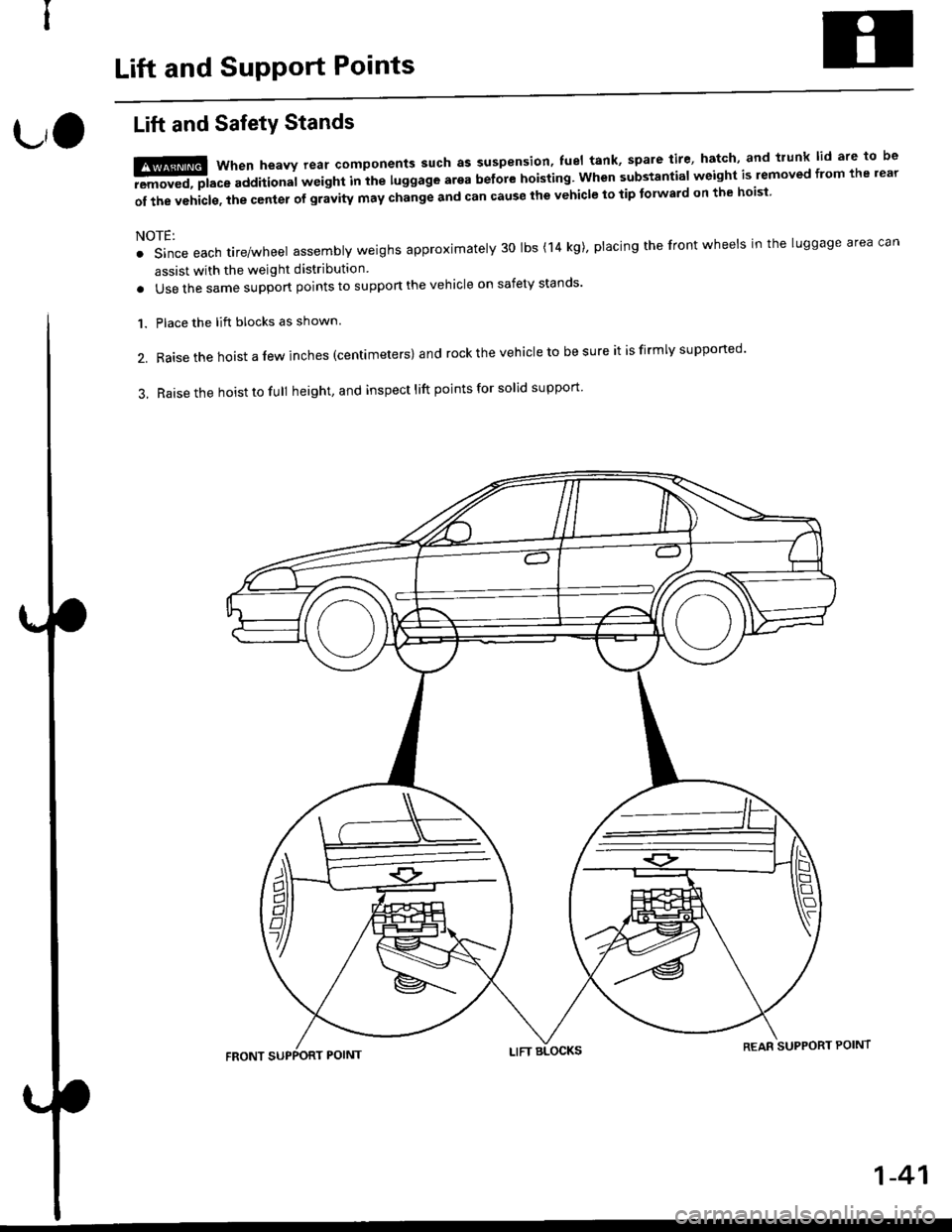
Lift and SupPort Points
L,O
Lift and SafetY Stands
t!ffi when heavv rear components such as suspension' fuel tank' spare tire' hatch' and trunk lid are to be
-aEremoved, place additional wetght Inihe luggage arga before hoisting. when substantial weight is lemoved from the rear
of the vehicls. the center of gravity may change and can cause the vehicle to tip tolward on the hoisi
NOTE:
. Since each tire/wheel assembly weighs approximately 30 lbs (14 kg)' placing the front wheels in the luggage area can
assist with the weight distribution
. Use the same support points to suppon the vehicle on safety stands'
Place the lift blocks as shown.
Raise the hoist a lew inches (centrmeters) and rock the vehicle to be sure it is firmly supported'
Raise the hoist to full height, and inspect lift points for solid support
1.
2.
3.
REAR SUPPORT POINT
1-41
Page 45 of 2189
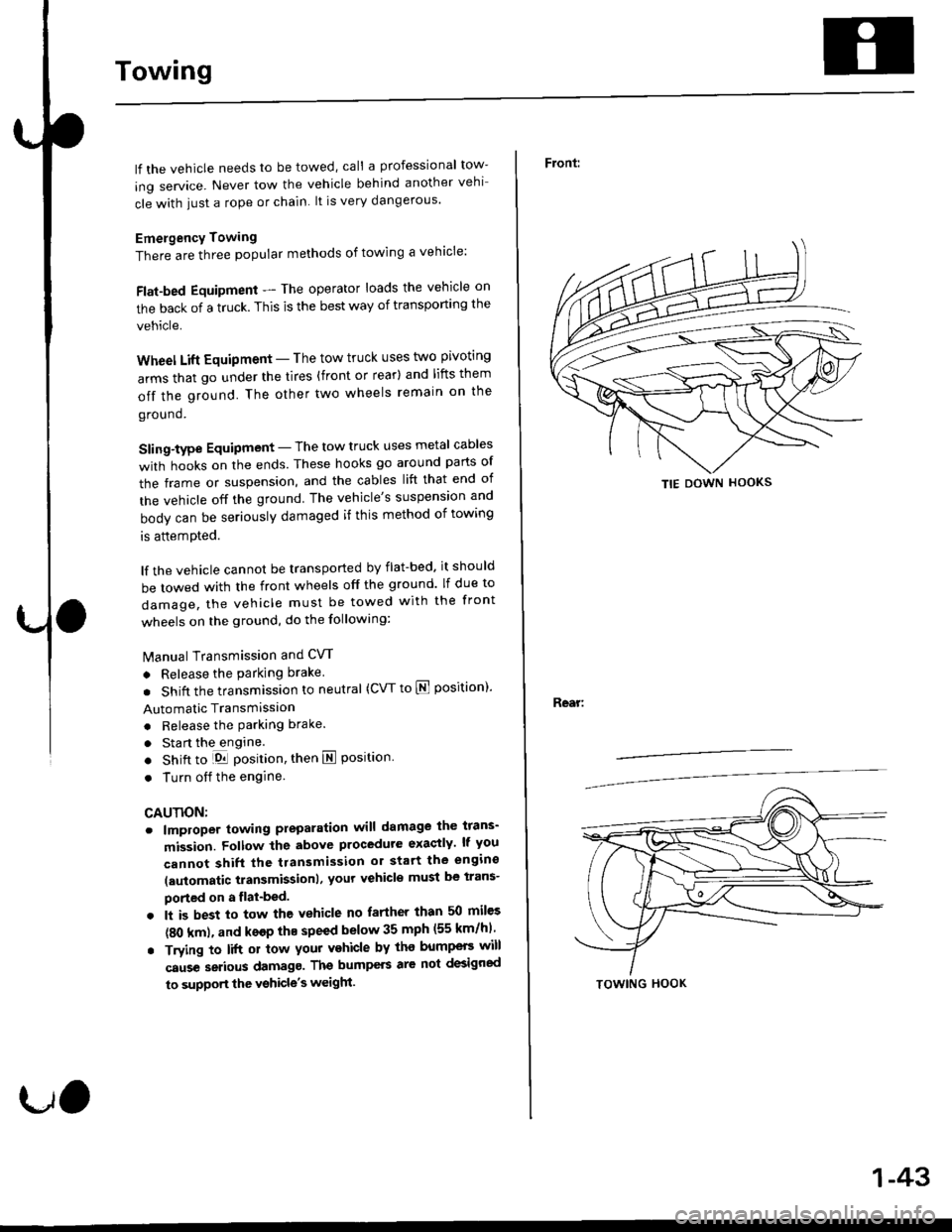
Towing
lf the vehicle needs to be towed, call a professional tow-
ing service. Never tow the vehicle behind another vehi
cle with iust a rope or chain lt is very dangerous'
Emergency Towing
There are three popular methods of towing a vehicle:
Flat-bed Equipment - The operator loads the vehicle on
the back of a truck. This is the best way of transporting the
vehicle.
Wheel Lift Equipment - The tow truck uses t\ivo pivoting
arms that go under the tires {front or rear} and lifts them
off the ground. The other two wheels remain on the
ground.
Sling-type Equipment - The tow truck uses metal cables
with hooks on the ends. These hooks go around parts of
the frame or suspension, and the cables lift that end of
the vehicle off the ground The vehicle's suspension and
body can be seriously damaged if this method of towing
is attemDted.
lf the vehicle cannot be transported by flat-bed. it should
be towed with the front wheels off the ground lf due to
damage, the vehicle must be towed with the front
wheels on the ground, do the following:
lvlanual Transmission and CW
. Release the parking brake
. Shift the transmission to neutral (CW to E position)'
Automatic Transmission
. Release the Parking brake.
. Sta rt the engine.
. Shift to LDll position, then E position.
. Turn oif the engine
CAUTION;
o lmploper towing preparation will damage ihe tfans-
mission. Follow the above procedute exaqtly lf you
cannot shift the tlansmission or start the engino
laulomatic transmissionl, yout vehicle must be trans-
ported on a flat-bed.
. lt is best to tow the vehicle no farther than 50 mil€s
(80 km), and ksop thE speed below 35 mph (55 km/hl
. Trying to lift 01 tow your vehicle by tho bump€F will
caus€ setious damagg. Ths bumpers are not dEigned
to supportthe vshicle's weigh.
tJO
1-43
Front:
Rear:
TIE DOWN HOOKS
TOWING HOOK
Page 52 of 2189

Unit of length: mm (in)
Fuel and Emission - Section
MEASUREMENTSTANOARO (NEW)
260 310 (2.7 - 3.2, 38 - 46)
260 - 310 (2.7 - 3.2, 38 - 46i
260 - 310 (2.7 - 3.2, 38 - 46)
210 - 320 Q.A - 3.3, 40 - 47 1
45 {11.9, 9.9)
M/T (neutral) I A/T or C\.T (lE or fd positioni
Fuel paessure
regulator
Pressure wilh fuel pressure regulator vacuum hose
disconnected kPa (kgvcm', Psi)D16Y5D 16Y7D16Y881642
FueltankCapacity I (US gal, lmp gal)
E ngineldle speed rpm
016Y5D16Y7D16Y8816A2
u.s.A.CanadaU,S,A.Canada
670 1 506701 50670150700 t 50
7501 507501 507501 50
700 t 50700 I 507001 50750150750 r 50
ldle CO %0.1 max.
Clutch - Serrtion 12
MEASUREMENTSTANDARD {NEWI I SERVICE LIMIT
Clutch pedalPedal height to floor
StrokePedal play
Disengagement height to floorto carpet
16s (6 1/2)130 140 (5 1/8 5 1/2)
12 -21 t1l2 - 13/16183 (3 1/4)44 (1 3/4) min. Reference
FlywheelClutch surface ruoout
Rivet head depthThickness
0.05 (0.002) max.0.15 (0.006)
Clutch disc1.3- 1.9 (0.05 - 0.07)
8.5 - 9.1 (0.33 - 0.36)
0.2 {0.01)5.5 (0.22)
Pressure plateWarpageDiaphragm spring fingers alignment
0.03 (0.001) max0.6 (0.02) max
0.15 (0.006)
1.0 (0.04)
Lro
3-7
lfllHlllllllllrltllli[
Page 63 of 2189
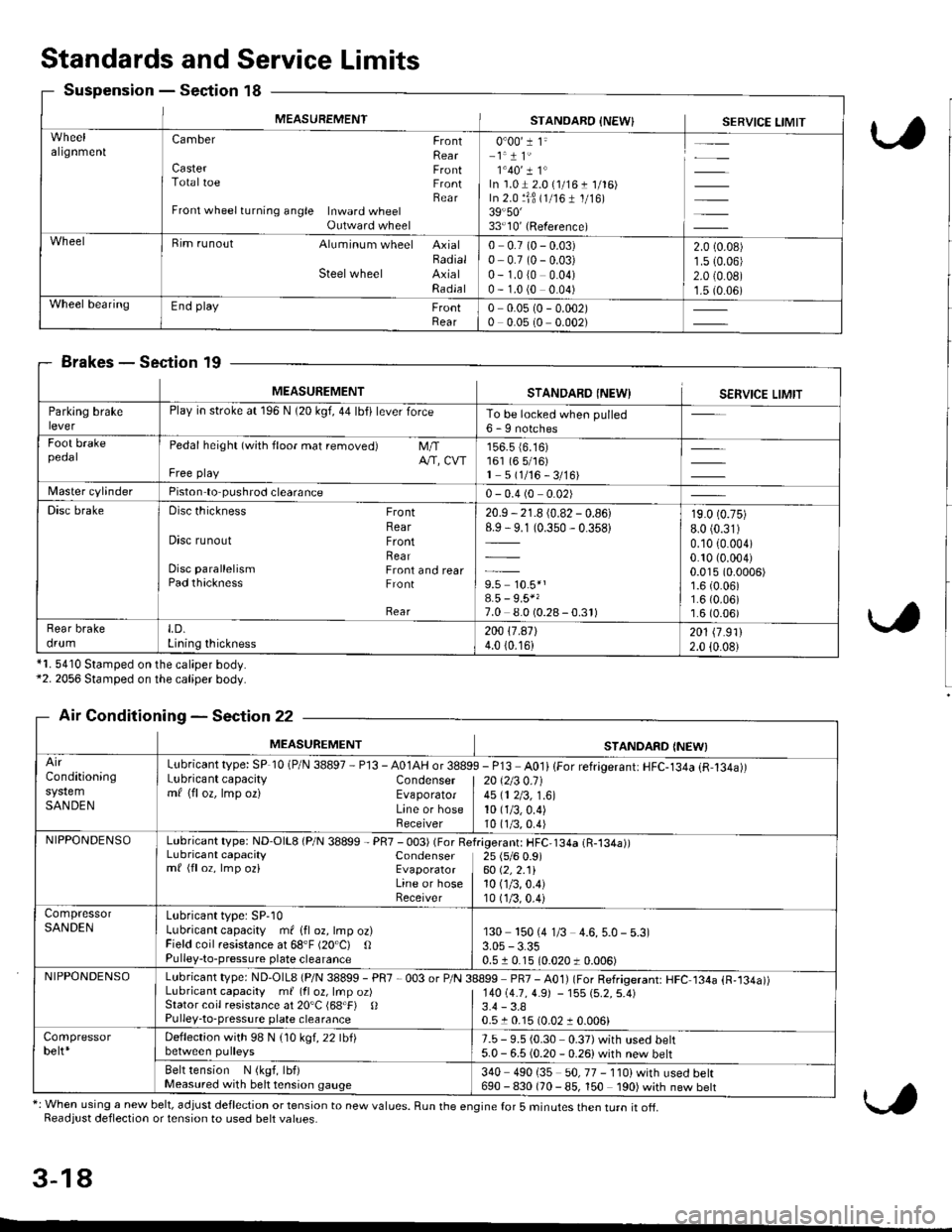
MEASUREMENTSTANOARO INEW}SERVICE LIMIT
algnmenlCamber FrontRearCaster FrontTotaltoe FrontBearFront wheel turning angle Inward wheelOutward wheel
0"00'1 1"-1.1 1'1'40' I 1"In'1.01 2.0 {1/16 t 1/'16)In 2.0 ljB (1/161 1/16)39.50'33'10'(Reference)
Bim runout Aluminum wheel AxialBadialSteelwheel AxialRadla I
0 0.7 (0 - 0.03)0- 0.7 (0 - 0.03)0 - 1.0 (0 0.04)0 - 1.0 (0 0.04)
2.0 (0.08)
1.5 10.06)2.0 {0.0B)1.5 (0.06)Wheel bearingEnd play FrontRear0 0.0s (0 - 0.002)0 0.05 (0 0.002)
Standards and Service Limits
Suspension - Section 18
Brakes - Section 19
*1. 5410 Stamped on the caliper body.*2. 2056 Stamped on the caliper body.
Air Conditioning - Section 22
*: When using a new belt, adjust deflection or tension to new values. Run the engine for 5 minutes then turn it of{.Readjust deflection or tension to used belt values.
3-18
MEASUREMENTSTANDARO INEWISERVICE LIMIT
Parklng brakePlay in stroke at 196 N (20 kgf, 44 lbfi lever forceTo be locked when pulled6 - I notchesFoot brakepeoalPedal height (with floor mat removed) M/TA/'T, CVTFree play
156.5 {6.16)161 (6 5/16)1 5(1/16-3/16)
Master cvlinderPiston to pushrod clearance0 - 0.4 (0 0.02)
Disc brakeDisc thickness FrontRearDisc runout FrontRearDisc parallelism Front and rearPad thackness Front
Rear
20.9 - 21.8 (0.82 - 0.86)8.9 - 9.1 (0.350 - 0.358)
9.5 10.5*'8.5 - 9.5*'7.0 8.0 (0.28-0.3r)
19.0 (0.75)
8.0 (0.31)
0.10 (0.004)
0.10 (0.004)
0.015 (0.0006)
1.6 (0.06)1.6 (0.06)'r.6 (0.06)
Rear brakedrumLD.Lining thickness200 17.a7l4.0 (0.16)201 \7 .9112.0 {0.08}
MEASUREMENTSTANDARD INEWI
Conditioning
SANDEN
Lubricant type: SP 10 (P/N 38897 - Pl3 - A01AH or 3889Lubricant capacity Condensermf (floz, lmp oz) EvaporatorLine or hoseReceiver
I - P13 A0li lFor refrigerant: HFC-134a (R,134a))
| 20 \2t3 0.11
I 45 (1 2/3, 1.6)10 (1/3,0.4)
10 t1/3,0.4)NIPPONDENSOLubricant type: ND'O|L8 (P/N 38899 - PR7 - 003) (For ReLubricant capacity Condensermf (floz, lmp oz) EvaporatorLine or hoseReceiver
f.igerant: HFC,134a (R-134a))25 (s/6 0.9)60 (2,2.11
10 (1/3,0.4)
10 (1/3.0.4)
CompressorSANDENLubricant type: SP-10Lubricant capacity ml lfl oz, lmp oz)Field coil resistance at 68'F (20"C) OPulley-to-pressure plate clearance
130 150 (4 1/3 4.6, 5.0 - 5.3)
0.5 r 0.15 10.020 t 0.006)
NIPPONDENSOLubricant type: ND-OlL8 {P/N 38899 - PR7 ,003 or P/N 38899 pR7 - AO1) (For Refrigerant: HFC 134a {R,134a))Lubricant capacity m{(fl oz, lrnpoz) | 14O(4.7,4.9J -15S{5.2.5.4)Stator coil resistance at 20'C (68.F) 0Pulley-to-pressure plate clearance3.4 - 3.80.510.15 (0.0210.006)
Compressorbelt*Deffection with 98 N (1Okgl.22lbllbetween pulleys7.5 - 9.5 (0.30 0.37) with used belt5.0 - 6.5 (0.20 - 0.26)with new belt
Belt tension N (kgf, lbf)Measured with belt tension gauge340 490 i35 50, 77 - 110) with used bell690 - 830 (70 - 85, 150 190) with new belt
Page 65 of 2189
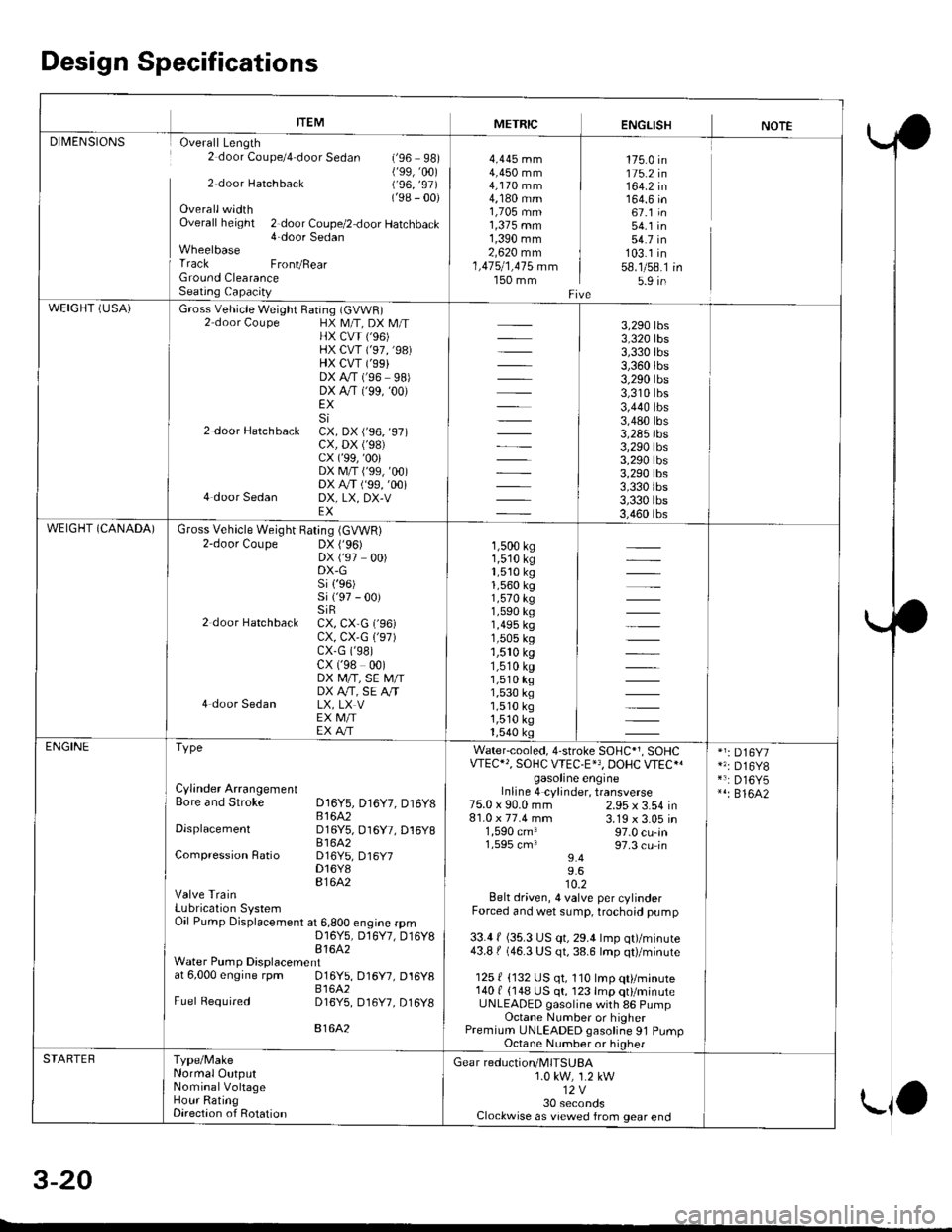
Design Specifications
ITEMMETRICENGLISHNOTEDII/IENSIONS Overall Length2 door Coupe/4 door Sedan (,96 98)('99,'00)2 door Hatchback (,96, ,97)
('98 - 00)OverallwidthOverall height 2 door Coupe/2 door Hatchback4-door SedanWheelbase
I Track FronvRearGround ClearanceSeatiog Capacity
4,445 mm4,450 mm4,170 mm4,180 mm1,705 mm1,375 mm1,390 mm2,620 mm1,475/1,415 mm150 mm
175.0 in115.2 in164.2 in164.6 in67.1 in54.1 in54.7 in103.1 in58.1/58.15.9 in
WEIGHT (USA)Gross Vehicle Weight Raring (GVWR)2 door Coupe HX M/T, DX M/THX CVI ('96)HX CVT ('97,'98)HX CVT ('99}DX A,/T (96 98,DX A"/T ('99, '00)
EXSi2 door Hatchbacl CX. DX r'96, 97,cx, DX ('98)cx (,99, ,00)
DXM/Ti'99,00iDX A/T ( 99, 00,4 door Sedan DX, LX, DX-VEX
3,290 tbs3,320 tbs3,330 tbs3,360 rbs3,290 rbs3,310 tbs3,440 tbs3,480 tbs3,285 tbs3,290 tbs3,290 tbs3,290 tbs3,330lbs3,330 tbs3,460 tbsWEIGHT (CANADA)Gross Vehicle Weight Bating (GVWR)2-door Coupe DX ('96)DX ('97 00)DX-Gsi 1,96)si ('97 - 00)siR2 door Hatchback CX, CX,G ('96)cx, cx,G 1,97)cx-G (,98)
cx ('98 00)DX M/T, SE M/IDX A,/T, SE A,/T4 door Sedan LX, LX VEX M/IEX A/T
1,500 ks1,510 kg1,510 kg1,560 kg1,570 kg1,590 ks1,495 kg1,505 kg1,510 ks1,510 ks1,510 kg1,530 kg1,510 kg1,510 ks1,540 ksENGINEType
Cylinder ArrangementBore and Stroke D16Y5, D16Y7, Dt6y8B 1642DisplacementD16Y5, D16Y7, Dl6Y881642Compression Ratio D16Y5, D16y7D16Y8816A2Valve TrainLubrication SystemOil Pump Displacement at 6,800 engine rprnD16Y5, D,l6Y7, D16Y881642Water Pump Displacementat 6,000 engine rpm 016Y5, D16Y7, D16y8816A2Fuel Required D16Y5, D16Y7, D16y8
816A2
Water-cooled, 4-stroke SOHC*1, SOHCVTEC"', SOHC WEC.E'3, DOHC VTEC{gasoline engineInline 4 cylinder, transverse2.95 x 3.54 in3.19 x 3.05 in97.0 cu-in97.3 cu in9.49.610.2Belt driven, 4 valve per cylinderForced and wet sump, trochoid pump
33.4 f (35.3 US qt, 29.4 lmp qt)/minute43.8 | (46.3 US qt, 38.6 lmp qt)/minute
125 { {132 US qt, 110 lmp qt}/minute140 f {148 US qt, 123 lmp qt}/minuteUNLEADED gasoline with 86 PumpOctane Number or higherPremium UNLEADED gasoline 91 PumpOctane Number or higher
75.0 x 90.0 mm81.0 x 77.4 mm1,590 cm31,595 cm3
*1: D16Y7*': D16Y8*3: D16Y5*': 816A2
STARTEBType/MakeNormal OutputNominalVohageHour RatingDirection of Rotation
Gear reduction/MITSUBA1.0 kw, 1.2 kw12V30 secondsClockwise as viewed from gear end
5-Z.V
-
Page 66 of 2189
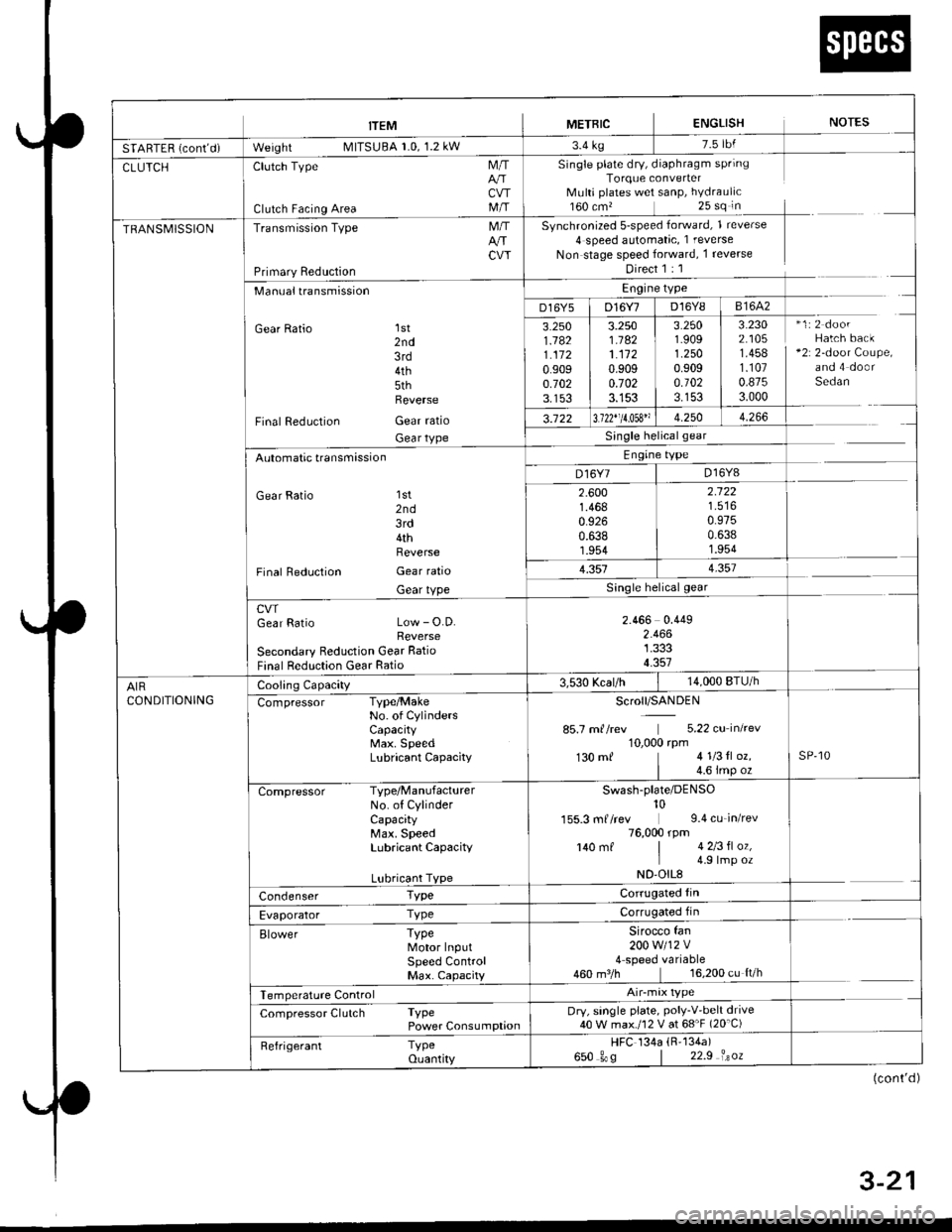
trEM I merntc ENGLISH NorEs
SfAnff n i*nt-i- W"'gf,t MllSUBA r.u, l.z kw r'4 rg
CLUTCHClutch Type
Clutch Facing Area
M/T
CVTM/T
Single plate dry, diaphragm springTorque converterMulti plates wet sanP, hYdraulic160 cm,25 sq in
Synchronized 5-speed forward, 1 reverse
4 speed automatic, 1 reverse
Non stage speed forward, 1 reverse
Direct 1 : 1
TRANSMISSIONTransmission Type
Primary Reduction
M/TArrCW
Manualtransmission
Gear Ratio 1st2nd3rd4th5thReverse
Final Reduction Gear ratio
Gear tYPe
Engine type
D16Y5 | D16Y7 D16Y8 I 81642
3.2501.1821.1120.9090.7023.153
3.2501.1821.1120.9090.7023.153
3.2501.9091.2500.9090.1023.153
3.2302.1051.4581.1070.8753.000
*1:2 doorHatch back+2r 2-door Coupe,and 4 doorSedan
3.122 13.122"11.053" 1 4.250 | 4.266
Single helicalgear
Engine type
D16Y7 | D16Y8Automatic transmission
Gear Ratio 'lst
2nd3rd4thReverse
Final Reduction Gear ratio
Gear tYPe
2.6001.4680.9260.6381.954
2.122
0.9750.6381.954
1.3514.357
cwGear Ratio Low - O.D.Reverse
Secondary Reduction Gear Ratio
Final Reduction Gear Ratio
2.466 0.4492.4661.3334.357
AIRCONDITIONING
Cooling Capacity3,530 Kcal/h14,000 BTU/h
Compressor Type/MakeNo. of CYlindersCaPacitYMax. SpeedLubricant CaPacitY
Scroll/SANDEN
85.7 m//rev 5.22 cu inkev10,000 rpm130 mf 41l3tl oz.
| 4.6 imp ozsP,10
Compressor Type/ManufacturerNo. of CylinderCapacityMax. SpeedLubricant CaPacitY
Lubricant TYPe
Swash-plate/DENso10155.3 mf /rev 9.4 cu_in/rev76,000 rpm140 mf | 4 2l3fl oz,I 4 9lmp ozND'OIL8
Condenser TypeCorrugated fin
Evaporator TyPeCorrugated fin
Elower TyPeMotor InputSPeed ControlMax. CaPacity
Sirocco fan200w112v4 speed variable460 m3/h 16,200 cu ft/h
Temperature Control
Compressor Clutch TyPePower ConsumPtionDry, single plate, PolY-V'belt drive40 W max./12 V at 68'F (20'C)
Refrigerant TyPeouantity
HFC 134a (R'134a)
650 gos | 22.9 isoz
(cont'd )
4 . J-Z I