Page 97 of 404
Winds1 . :Id Wipers
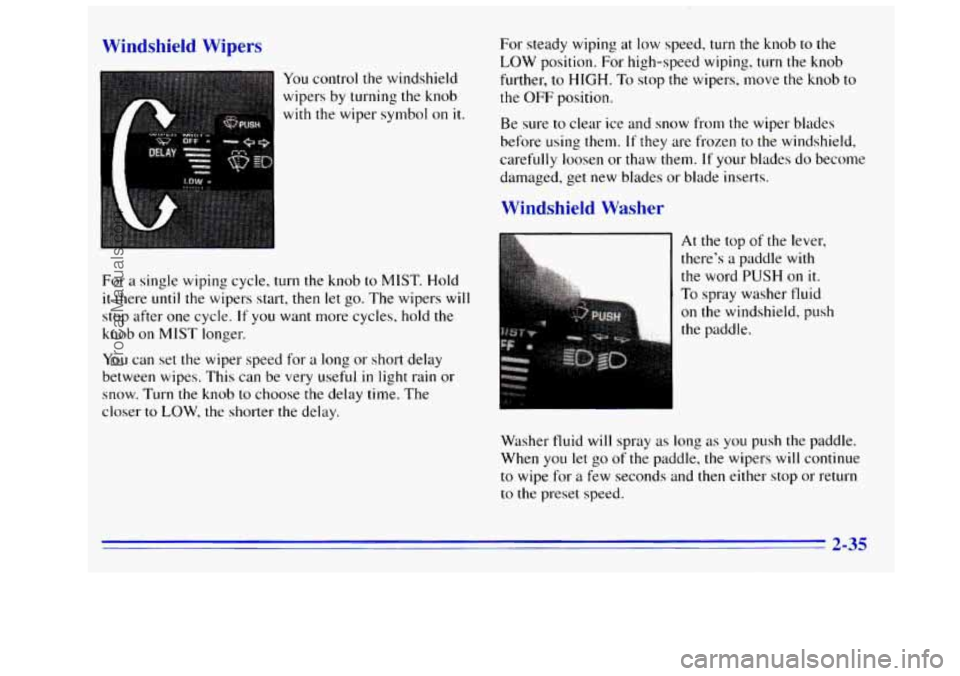
You control the windshield
wipers by turning the knob
with the wiper symbol on it.
For a single wiping cycle, turn the knob to MIST. Hold
it there until the wipers start, then let go. The wipers will
stop after one cycle.
If you want more cycles, hold the
knob on
MIST longer.
You can set the wiper speed for a long or short delay
between wipes.
This can be very useful in light rain or
snow. Turn the knob to choose the delay time. The
closer to LOW, the shorter the delay. For steady wiping
at
low speed, turn the knob to the
LOW position. For high-speed wiping, turn the knob
further,
to HIGH. To stop the wipers. move the knob to
the OFF position.
Be sure
to clear ice and snow from the wiper blades
before using them.
If they are frozen to the windshield,
carefully loosen or thaw them.
If your blades do become
damaged, get new blades or blade inserts.
Windshield Washer
At the top of the lever,
there’s a paddle with
the word
PUSH on it.
To spray washer tluid
on the windshield, push
Washer fluid will spray as long as you push the paddle.
When you
let go of the paddle, the wipers will continue
to wipe for a few seconds and then either stop or return
to the preset speed.
2-35
ProCarManuals.com
Page 98 of 404
Driving without washer fluid can be dangerous. A
bad mud splash can block your vision. You could hit
another vehicle or go off the road. Check your washer
fluid
level often.
A CAUTION:
In freezing weather, don't use your washer until
the windshield is warmed. Otherwise the washer
fluid can form ice on the windshield, blocking
your vision.
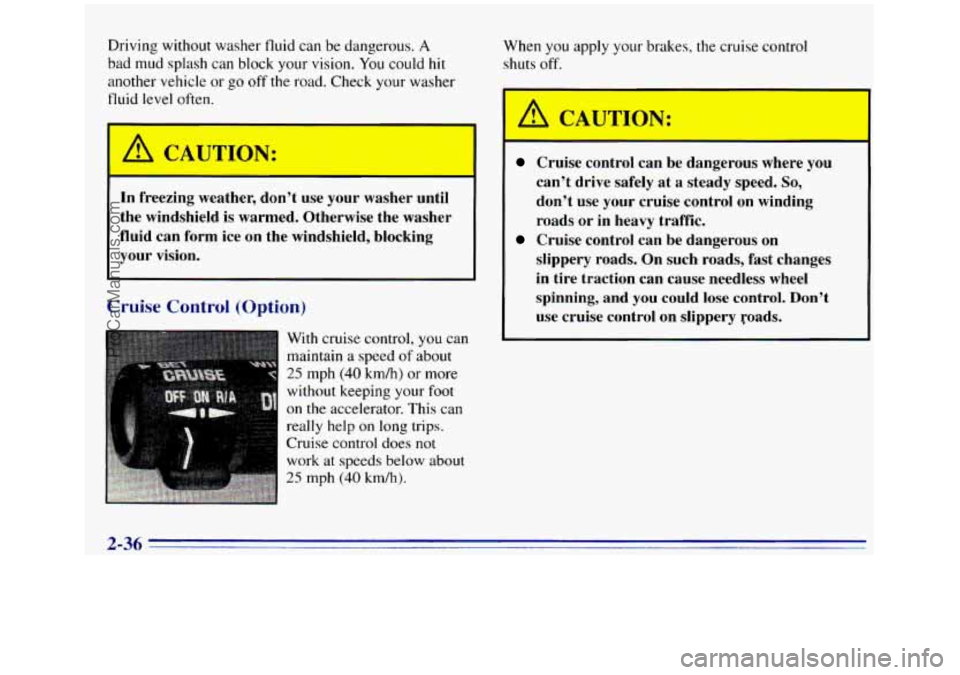
Cruise Control (Option)
With cruise control, y6u Cgn
maintain a speed of about
25 mph (40 kdh) or more
without keeping your
foot
on the accelerator. This can
really help on
long trips.
Cruise control does not
work at speeds below about
25 mph (40 km/h).
When you apply your brakes, the cruise control
shuts off.
Cruise control can be dangerous where you
can't drive safely at
a steady speed. So,
don't use your cruise control on winding
roads
or in heavy traffic.
slippery roads. On such roads, fast changes
in tire traction can cause needless wheel
spinning, and you
could lose control. Don't
use cruise control on slippery yoads.
Cruise control can be dangerous on
2-36
.
ProCarManuals.com
Page 184 of 404

Driving in Rain and on Wet Roads Rain and wet roads can mean driving trouble. On a wet
road, you can’t stop, accelerate or turn as well because
your tire-to-road traction isn’t as good as on dry roads.
And,
if your tires don’t have much tread left, you’ll get
even less traction.
It’s always wise to go slower and be
cautious
if rain starts to fall while you are driving. The
surface may get wet suddenly when your reflexes are
tuned for driving
on dry pavement.
The heavier the rain, the harder
it is to see. Even if’ your
windshield wiper blades are
in good shape, a heavy rain
can make
it harder to see road signs and traffic signals,
pavement markings, the edge
of the road and even
people walking.
It’s wise to keep your wiping equipment in good shape
and keep your windshield washer tank filled with
washer fluid. Replace your windshield wiper inserts
when they show signs
of streaking or missing areas on
the windshield, or when strips of rubber start to separate
from the inserts.
4-30
ProCarManuals.com
Page 192 of 404
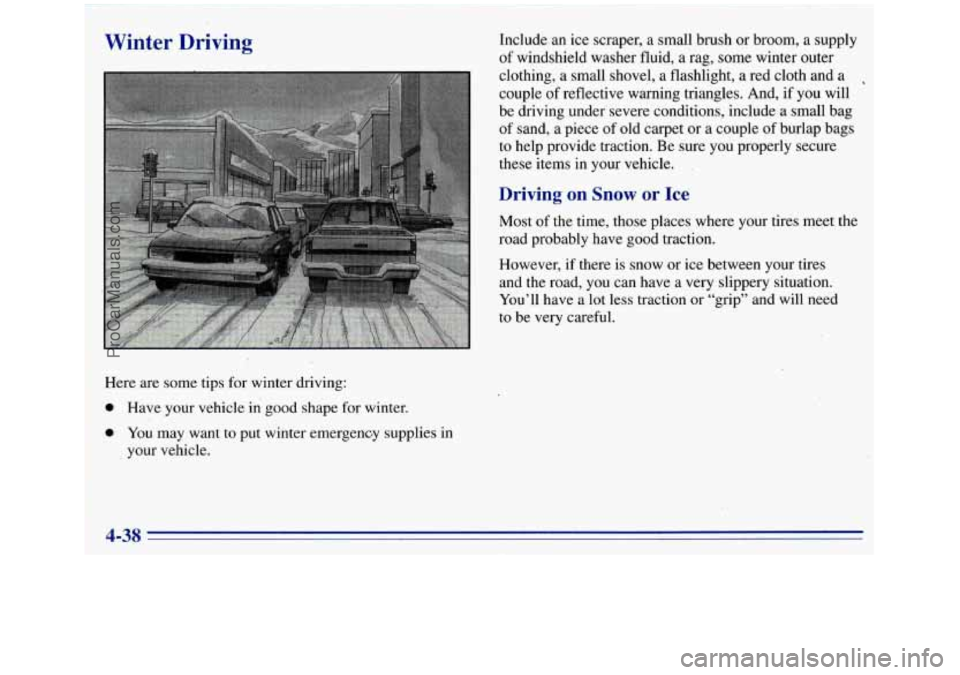
Winter Driving
Here are some tips for winter driving:
0 Have your vehicle in good shape for winter.
0 You may want to put winter emergency supplies in
your vehicle. 1nclude.an ice
scraper, a small brush
or broom, a supply
of windshield washer fluid, a rag, some winter outer
clothing, a small shovel, a flashlight, a red cloth and a
,
couple of reflective warning triangles. And, if you will
be driving under severe conditions, include
a small bag
of sand, a piece of old carpet or a couple of burlap bags
to help provide traction. Be sure you properly secure
these items in your vehicle.
Driving on Snow or Ice
Most of the time, those places where your tires meet the
road probably have good traction.
However,
if there is snow or ice between your tires
and the road,
you can have a very slippery situation.
You’ll have a lot less traction or “grip” and will need
to be very careful.
4-3s
ProCarManuals.com
Page 256 of 404

Be careful not to spill gasoline. Clean gasoline from
painted surfxes as soon
as possible. See “Cleaning the
Outside
of Your Vehicle” in the Index.
When you put the cap back
on, turn it to the right until
you hear at least three clicks. Make sure you fully install
the cap. The diagnostic system can determine if the fuel
cap has been
left off or improperly installed. This would
allow
fuel to evaporate into the atmosphere. See
“Malfunction Indicator Lamp” in the Index.
I NOTICE:
If you need a new cap, be sure to get the right
type. Your dealer can get one for you. If you get
the wrong type, it may not fit or have proper
venting, and your fuel tank and emissions system
might be damaged.
Checking Things Under the Hood
h
I ! CAUTION:
If your vehicle has air conditioning, the auxiliary
engine fan under the hood can start up and
hjure you even when the engine
is not running.
Keep hands, clothing and tools away from any
underhood electric fan.
Things that burn can get on hot engine parts and
start a fire. These include liquids like gasoline or
diesel fuel, oil, coolant, brake fluid, windshield
washer and other fluids, and plastic or rubber.
You
or others could be burned. Be careful not to drop
or spill things that will burn onto a hot engine.
6-6
ProCarManuals.com
Page 259 of 404
A. Battery
B. Air Cleaner
C. Radiator Cap
D. Coolant Recovery Tmk
E. Air Filter Restriction Indicator
E Engine Oil Dipstick
G. Automatic Transmission Dipstick
H. Fan
I. Power Steering Fluid Reservoir
J. Engine Oil Fill
K. Brake Fluid Reservoir
L. Windshield Washer Fluid Reservoir
M. FuseIRelay Center
N. Storage Compartment
ProCarManuals.com
Page 260 of 404
“VORTEC” 7400 Engine
I
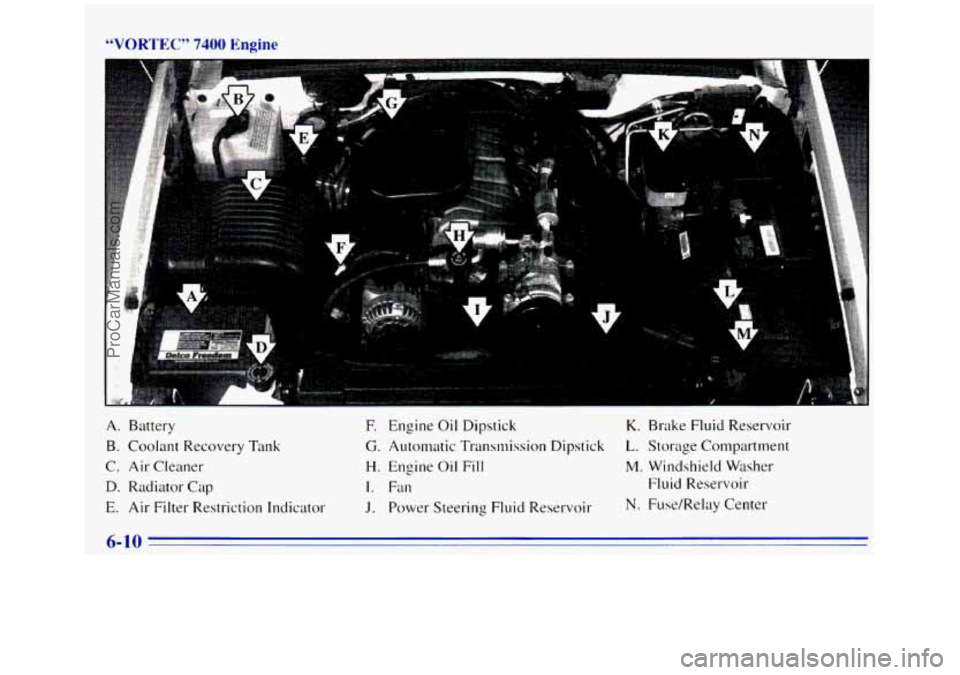
A. Battery
B. Coolant Recovery Tank
C. Air Cleaner
D. Radiator Cap
E. Air Filter Restriction Indicator
E Engine Oil Dipstick K. Brake Fluid Reservoir
G. Automatic Transmission Dipstick L. Storage Compartment
H. Engine Oil Fill M. Windshield Washer
I. Fan Fluid
Reservoir
J. Power Steering Fluid Reservoir Ne Fuse/RelaY Center
ProCarManuals.com
Page 281 of 404

Power Steering Fluid
When to Check Power Steering Fluid
It is not necessary to regularly check power steering
fluid unless
you suspect there is a leak in the system or
you hear an unusual noise. A fluid loss in this system
could indicate
a problem. Have the system inspected
and repaired.
How To Check Power Steering Fluid
When the engine cotnparttnent is cool, unscrew the cap
and
wipe the dipstick with a clean rag. Replace the cap
and completely tighten
it. Then remove the cap again
and
look at the fluid level on the dipstick.
The level should he at the FULL COLD mark. If
necessary, add only enough fluid to bring the level up
to the mark.
What to Use
Refer to the Maintenance Schedule to determine what
kind
of fluid to use. See “Recommended Fluids and
Lubricants” in the Index. Always use the proper fluid.
Failure to
use the proper fluid can cause leaks and
damage hoses and seals.
Windshield Washer Fluid
What to Use
When you need windshield washer fluid, be sure to read
the manufacturer’s instructions before use. If you will be
operating
your vehicle in an area where the tetnperature
may
fill1 below freezing, use a fluid that has sufficient
protection against freezing.
6-3 1
ProCarManuals.com