1996 GMC SIERRA tow
[x] Cancel search: towPage 123 of 404
Brake System Warning Light r
Your vehicle’s hydraulic brake system is divided into
two
parts. If one part isn’t working, the other part can
still work and stop you. For good braking, though, you
need both parts working well.
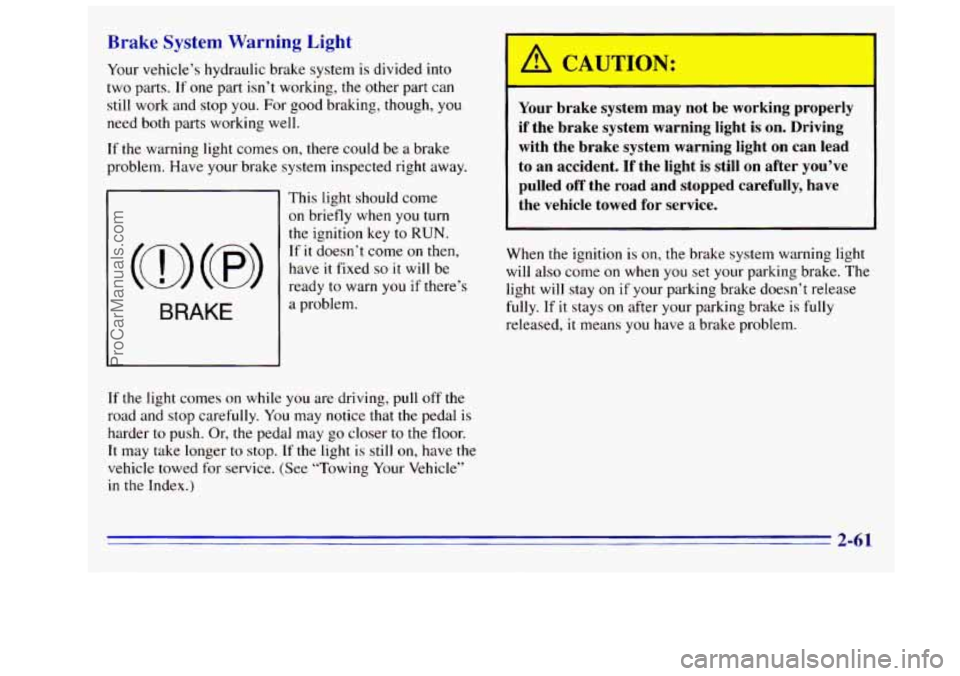
If the warning light comes on, there could be a brake
problem. Have your brake system inspected right away.
BRAKE
This light should come
on briefly when
you turn
the ignition key to
RUN.
If it doesn’t come on then,
have
it fixed so it will be
ready to
warn you if there’s
a problem.
If the light comes on while you are driving, pull off the
road and stop carefully. You may notice that the pedal is
harder to push. Or, the pedal may go closer to the floor.
It may take longer to stop. If
the light is still on, have the
vehicle towed for service. (See “Towing Your Vehicle”
in the Index.)
I! CAUTION:
Your brake system may not be working properly
if the brake system warning light is on. Driving
with the brake system warning light on can lead
to an accident. If the light
is still on after you’ve
pulled
off the road and stopped carefully, have
the vehicle towed for service.
When the ignition is on, the brake system warning light
will also come on when you set your parking brake. The
light will stay on if your parking brake doesn’t release
fully.
If it stays on after your parking brake is fully
released,
it means you have a brake problem.
2-61
ProCarManuals.com
Page 126 of 404
If the Light Is Flashing If the Light Is On Steady
The following may prevent more serious damage to
your vehicle:
Reduce vehicle speed.
Avoid hard accelerations.
Avoid steep uphill grades.
0 If towing a trailer, reduce the amount of cargo being
hauled
as soon as it is possible.
If the light stops flashing and remains
on steady, see “If
the Light
Is On Steady” following.
If the light continues to flash, when it is safe to do so,
stop the vehicle. Put your vehicle in PARK (P). Turn the
key off, wait at least
10 seconds and restart the engine.
If the light remains
on steady, see “If the Light Is On
Steady” following.
If the light is still flashing follow the
previous steps, and drive the vehicle
to your dealer or
qualified service center for service.
You may be able to correct the emission system
malfunction by considering the following:
Did you just put fuel
into your vehicle?
If so7 reinstall the fuel cap, making sure to fully install
the cap. The diagnostic system can determine if the fuel
cap has been left off or improperly installed. This will
allow fuel to evaporate into
the atmosphere. A few
driving trips should turn the light off.
Did
you just drive through a deep puddle of water?
If so, your electrical system may be wet. The condition
will
usually be corrected when the electrical system
dries out.
A few driving trips should turn the light off.
Are you low on fuel?
As your engine starts to run out of fuel, your engine may
not run as efficiently as designed since small amounts of
air are sucked into the fuel line causing a misfire. The
system can detect this. Adding fuel should correct this
condition. Make
sure to install the fuel cap properly. it
will take a few driving trips to turn the light off.
2-64
ProCarManuals.com
Page 131 of 404
Section 3 Comfort Controls and Audio Systems
In this section you’ll find out how to operate the comfort
control and audio systems offered
with your vehicle. Be
sure
to read about the particular systems supplied with
your vehicle.
Comfort Controls
Standard Climate Control System
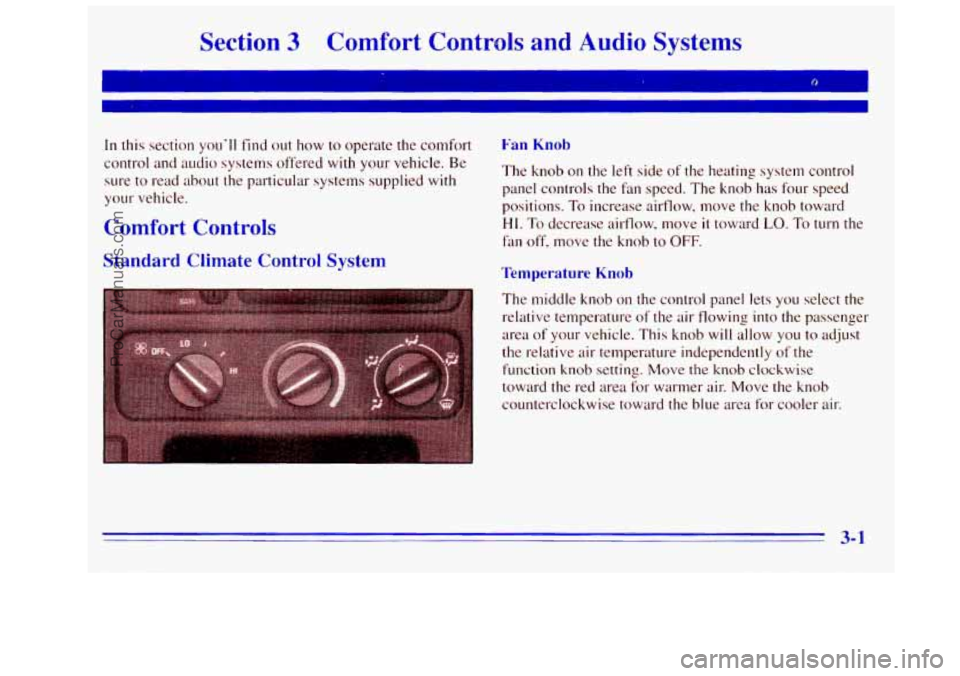
Fan Knob
The knob on the left side of the heating system control
panel controls the fan speed.
The knob has four speed
positions. To increase airflow, move
the knob toward
HI. To decrease airtlow, move it toward LO. To turn the
fan
off, move the knob to OFF.
Temperature Knob
The middle knob on the control panel lets you select the
relative temperature
of the air flowing into the passenger
area of your vehicle. This knob will allow you to adjust
the relative air temperature independently
of the
function
knob setting. Move the knob clockwise
toward the red area for warmer air. Move the knob
counterclockwise toward the
blue area for cooler air.
3-1
ProCarManuals.com
Page 132 of 404

Mode Knob Optional Climate Control System
The right knob on the control panel allows you to
choose
the direction of air delivery. The control knob
can be placed in any position between two mode settings
to blend the
flow of air.
+e
/J VENT: This setting directs air through the
instrument panel outlets.
+’ VENT/HEAT Use this setting to divide airflow
between
the floor outlets and instrument panel outlets.
+iJ HEATB; This setting directs air through the
floor outlets.
6fl DEFOG: This setting directs air to the heater
outlets and toward the windshield.
9 DEFROST: This setting directs air toward
the windshield.
+*
e
(ii3, Fan Knob
The knob on the left side of the heating system control
panel controls the fan speed. The knob has four speed
positions. To increase airflow, move the knob toward
HI. To decrease airflow, move it toward LO. To turn the
fan off, move the knob to
OFF. If you have the air
conditioner on. moving
the fan knob to OFF also turns
off the A/C compressor.
3-2
ProCarManuals.com
Page 133 of 404
Temperature Knob
The middle knob on the control panel lets you select the
relative temperature
of the air flowing into the passenger
area of your vehicle. This knob will allow you to adjust
the relative air temperature independently
of the
function knob setting. Move the knob clockwise
toward
the red area for warmer air. Move the knob
counterclockwise toward the blue area for cooler air.
The right knob on the control panel allows you to
choose the direction of air delivery. The control knob
can be placed
in any position between two mode settings
to blend the flow of air.
/J VENT: This setting directs air through the
instrument panel outlets.
+H VENT/HEAT Use this setting to divide airflow
between the floor outlets and instrument panel outlets.
+’ HEATER: This setting directs air through the
heater floor outlets.
+e
+.
0
Qe
+’ DEFOG: This setting directs air to the heater
outlets and toward
the windshield.
DEFROST This setting directs air toward the
windshield.
Air Conditioning
On hot days, open the windows long enough to let hot
air inside escape. This reduces the time it takes for your
vehicle
to cool down. Then keep your windows closed
for
the air conditioner to work it’s best.
The recirculation button, between the fan and
temperature knobs, allows the air inside your vehicle to
be recirculated. This setting helps
to maximize your air
conditioner’s performance and your vehicle’s fuel
economy. This setting also
cools the air the fastest and
can be used
to keep unwanted odors and/or dust from
entering the vehicle. When using the air conditioner,
turn off recirculation after the vehicle reaches a
comfortable interior temperature. When the right knob
on the control panel is between HEATER and
DEFROST, the recirculation feature will
not function.
ProCarManuals.com
Page 135 of 404

Ventilation Tips
Your vehicle has air outlets in the center and on the sides
of your instrument panel. You can move the outlets from
side to side or up and down to direct the
flow of air, or
close the outlets altogether. When
you close an outlet, it
will increase the flow of air coming out of any outlets
that are open. These outlets do not completely
shut off
airflow when
in the closed position.
0
0
0
Keep the hood and front air inlet free of ice, snow or
any other obstruction (such
as leaves). The heater
and defroster
will work far better, reducing the
chance of fogging the inside
of your windows.
When you enter
a vehicle in cold weather, turn the
blower fan to HI for a few moments before driving.
This helps clear the intake ducts
of snow and
moisture, and reduces the chance
of fogging the
inside
of your windows.
Keep the air path under the front seats clear
of
objects. This helps air to circulate throughout
your vehicle.
Defogging and Defrosting
On cool, humid days, use DEFOG to keep the
windshield and side windows clear.
Use DEFROST
to remove fog or ice from the windshield in extremely
humid or cold conditions. Use DEFROST
with the
temperature knob toward
the red area and the fan control
toward
HI.
ProCarManuals.com
Page 200 of 404

Trailer Recommendations
You must subtract your hitch loads from the CWR for
your vehicle. Weigh your vehicle with
the trailer attached,
so that you won’t go over the GVWR or GAM.
You’ll get the best performance if you spread out the
weight
of your load the right way, and if you choose the
correct hitch and trailer brakes.
For more information, see “Trailer Towing” in the Index.
Camper Wiring Harness (Option)
A five-wire harness is stored in the front stake pocket on
the driver’s side of the bed. The harness has
no
connector and should be wired by a qualified electrical
technician.
It must be routed out. of your vehicle and
securely attached
so that it won’t be pulled or rubbed
while you’re using it. Store the harness in it’s original
position. Wrap the harness together and tie
it neatly so it
won’t be damaged.
Pickup Conversion to Chassis Cab
General Motors is aware that some vehicle owners may
consider having the pickup box removed and
a
commercial or recreational body installed. Before you
do so, first contact the GM Zone Office for your area for
information on such conversions specific to this vehicle. (See the
“Warranty and Owner Assistance” booklet for
Zone Office.) Owners should be aware that, as
manufactured, there are differences between
a chassis
cab and a pickup with
the box removed which may
affect vehicle
safety. The components necessary to adapt
a pickup to permit its safe use with a specialized body
should be installed by a body builder in accordance with
the information available from the Zone Office.
Towing a Trail-r
If you don’t use the correct equipment and drive
properly, you can lose control when you pull a
trailer. For example, if the trailer
is too heavy, the
brakes may not
work well -- or even at all. You
and your passengers could be seriously injured.
Pull a trailer only if you have followed all the
steps in this section. Ask your
GM dealer for
advice and information about towing a trailer
with your vehicle.
I
4-46
ProCarManuals.com
Page 201 of 404
NOTICE:
Pulling a trailer improperly can damage your
vehicle and result in costly repairs not covered by
your warranty.
To pull a trailer correctly, follow
the advice in this part, and see your
GM dealer
for-important information about towing a trailer
with your vehicle.
Every vehicle is ready for some trailer towing. If yours
was built with trailering options, as many are, it’s ready
for heavier trailers. But trailering is different than just
driving your vehicle by itself. Trailering means changes
in handling, durability and fuel economy. Successful,
safe trailering takes correct equipment, and it has to be
used properly.
That’s the reason for this part. In it are many
time-tested, important trailering tips and safety rules.
Many of these
are important for your safety and that of
your passengers.
So please read this section carefully
before you pull
a trailer.
If You Do Decide To Pull A Trailer
If you do, here are some important points:
0
0
0
0
There are many different laws, including speed limit
restrictions, having to do with trailering. Make sure-
your rig will be lega1,not only where you live but
also where you’ll be driving. A good source for this
information can be state or provincial police.
Consider using a sway control if your trailer will
weigh
4,000 lbs. (1 800 kg) or less. You should
always use a sway control if your trailer will weigh
more than
4,000 lbs. (1 800 kg). You can ask a hitch
dealer about sway controls.
Don’t tow a trailer at all‘during the first
500 miles
(800 km) your new vehicle is driven. Your engine,
axle or other parts could be damaged.
Then; during the first
500 miles (800 km) that you
tow a trailer, don’t drive over
50 mph (80 ktn/h) and
don’t make starts at full throttle. This helps your
engine and other parts of your vehicle wear in at the
heavier loads.
4-47
ProCarManuals.com