1996 GMC SIERRA automatic transmission
[x] Cancel search: automatic transmissionPage 331 of 404
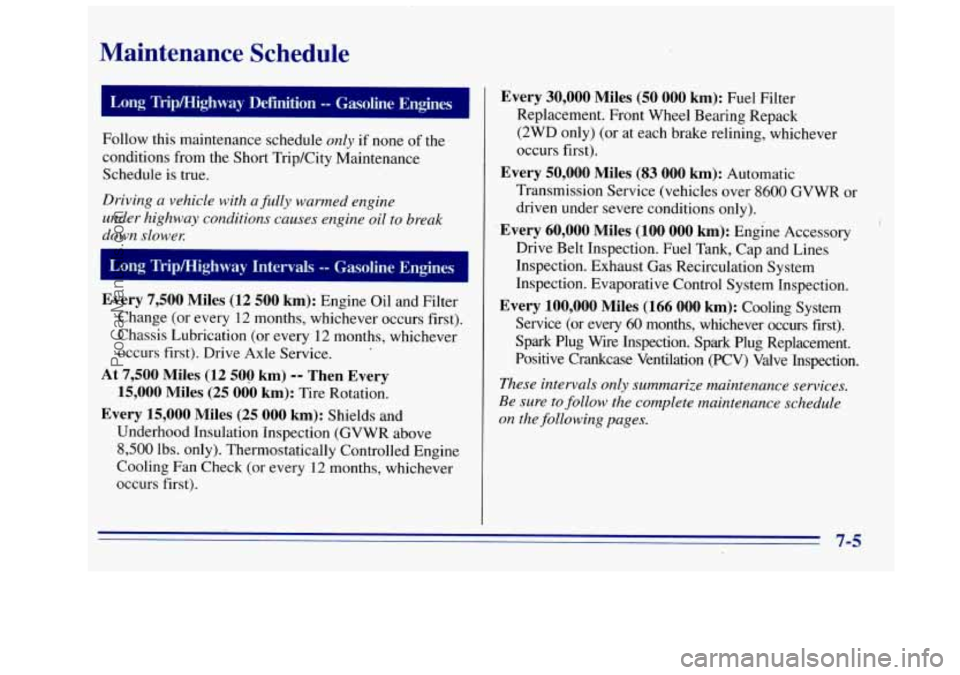
Maintenance Schedule
Long Trip/Highway Definition -- Gasoline Engines 1
Follow this maintenance schedule only if none of the
conditions from the Short TripKity Maintenance
Schedule is true.
Driving a vehicle with a fully warmed engine
under highway conditions causes engine oil to break
down slower:
I Long Tripmighway Intervals -- Gasoline Engines I
Every 7,500 Miles (12 500 km): Engine Oil and Filter
Change (or every
12 months, whichever occurs first).
Chassis Lubrication (or every
12 months, whichever
occurs first). Drive Axle Service.
At 7,500 Miles (12 500 km) -- Then Every
15,000 Miles (25
000 km): Tire Rotation.
Every 15,000 Miles (25 000 km): Shields and
Underhood Insulation Inspection (GVWR above
8,500 lbs. only). Thermostatically Controlled Engine
Cooling Fan Check (or every
12 months, whichever
occurs first).
Every 30,000 Miles (50 000 km): Fuel Filter
Replacement. Front Wheel Bearing Repack
(2WD only) (or at each brake relining, whichever
occurs first).
Transmission Service (vehicles over
8600 GVWR or
driven under severe conditions only).
-Every 60,000 Miles (100 000 km): Engine Accessory I
Drive Belt Inspection. Fuel Tank, Cap and Lines
Inspection. Exhaust Gas Recirculation System
Inspection. Evaporative Control System Inspection.
Every 100,000 Miles (166 000 km): Cooling System
Service (or every
60 months, whichever occurs first).
Spark Plug Wire Inspection. Spark Plug Replacement.
Positive Crankcase Ventilation (PCV) Valve Inspection.
These intervals only summarize maintenance services.
Be sure to follow the complete maintenance schedule
on the following pages.
Every 50,000 Miles (83 000 km): Automatic
7-5
ProCarManuals.com
Page 342 of 404
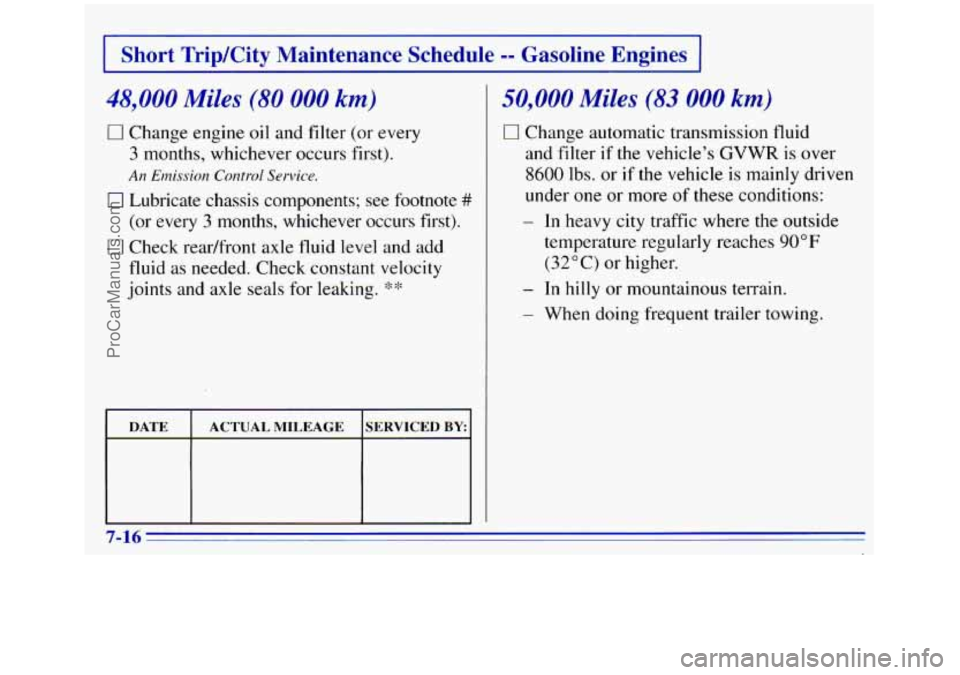
I Short TripKity Maintenance Schedule -- Gasoline Engines I
48,000 Miles (80 000 km)
0 Change engine oil and filter (or every
3 months, whichever occurs first).
An Emission Control Service.
0 Lubricate chassis components; see footnote #
(or every 3 months, whichever occurs first).
0 Check readfront axle fluid level and add
fluid as needed. Check constant velocity
joints and axle seals for leaking. w
DATE SERVICED BY ACTUAL MILEAGE
50,000 Miles (83 000 k
0 Change automatic transmission fluid
and filter
if the vehicle’s GVWR is over
8600 lbs. or if the vehicle is mainly driven
under one or more of these conditions:
- In heavy city traffic where the outside
temperature regularly reaches
90°F
(32°C) or higher.
- In hilly or mountainous terrain.
- When doing frequent trailer towing.
7-16
ProCarManuals.com
Page 354 of 404

I Short TripKity Maintenance Schedule -- Gasoline Engines 1
100,000 Miles (166 000 km)
Drain, flush and refill cooling system (or
every
60 months since last service, whichever
occurs
first). See "Engine. Coolant" in the
Index for what to use. Inspect hoses. Clean
radiator, condenser, pressure cap and neck.
Pressure test cooling system and pressure cap.
An Emission Control Service.
0 Inspect spark plug wires.
Replace spark plugs. An Emission Contd Service.
0 Change automatic transmission fluid
and filter
if the vehicle's GVWR is over
8600 Ibs. or if the vehicle is mainly driven
under one
or more of these conditions:
- In heavy city traffic where the outside
temperature regularly reaches
90" F
(32 * C) or higher.
An Emission Control Service.
- In hilly or mountainous terrain.
- When doing frequent trailer towing.
- Uses such as found in taxi, police or
delivery service.
If' .e you c/o rzot LLW your vehicle under crny of
these corzciitiorzs, the.fluid and filter do not
require chcrnging.
Manual transmission fluid doesn't require change.
0 Inspect Positive Crankcase Ventilation
(Pcv) valve.
An Emission Control Service.
DATE SERVICED BY ACTUAL
MILEAGE
7-28
ProCarManuals.com
Page 360 of 404
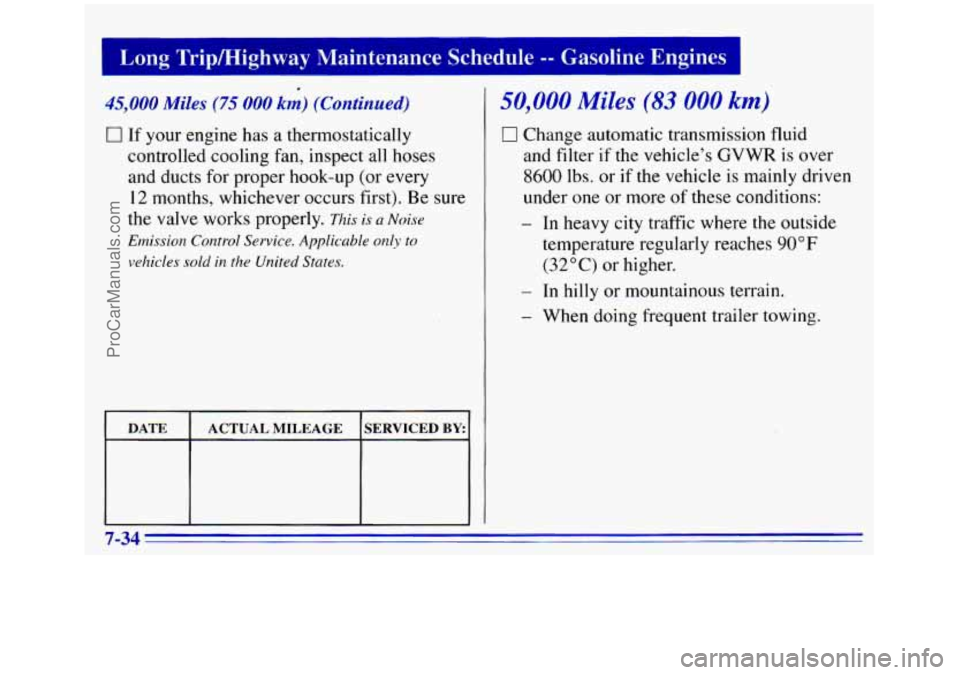
Long Tripmighway Maintenance Schedule -- Gasoline Engines I
45,000 Miles (75 000 km) (Continued)
0 If your engine has a thermostatically
controlled cooling fan, inspect all hoses
and ducts for proper hook-up (or every
12 months, whichever occurs first). Be sure
the
valve works properly. This is a Noise
Emission Control Service. Applicable only to
vehicles sold in the United States.
DATE ACTUAL MILEAGE SERVICED BY I
50,000 Miles (83 000 km)
0 Change automatic transmission fluid
and filter
if the vehicle's GVWR is over
8600 lbs. or if the vehicle is mainly driven
under one or more
of these conditions:
- In heavy city traffic where the outside
temperature regularly reaches
90" F
(32°C) or higher.
- In hilly or mountainous terrain.
- When doing frequent trailer towing.
7-34
ProCarManuals.com
Page 367 of 404

1 Long Tripmighway Maintenance Schedule -- Gasoline Engines I
100,000 Miles (1 66 000 km)
0 Drain, flush and refill cooling system (or
every
60 months since last service,
whichever occurs first). See “Engine
Coolant” in
the Index for what to use.
Inspect hoses. Clean radiator, condenser,
pressure cap and neck. Pressure test the
cooling system and pressure cap.
An Emission Con.tro1 Service. 3-
0 Inspect spark plug wires.
0 Replace spark plugs. An Emission Control Service.
Change automatic transmission fluid
and filter
if the vehicle’s GVWR is over
8600 lbs. or if the vehicle is mainly driven
under one or more of these conditions:
- In heavy city traffic where the outside
temperature regularly reaches
90” F
(32°C) or higher.
An Emission Control Service.
- In hilly or mountainous terrain.
- When doing frequent trailer towing.
- Uses such as found in taxi, police or
delivery service.
vyou do not ILY~ your- vehicle under my uf
these c*orlditions, the fluid and filter do not
require chwgirzg.
Manual transmission fluid doesn’t require change.
Inspect Positive Crankcase Ventilation
(Pcv) valve. An Enlission Control Service.
DATE ACTUAL MILEAGE SERVICED BY:
ProCarManuals.com
Page 369 of 404
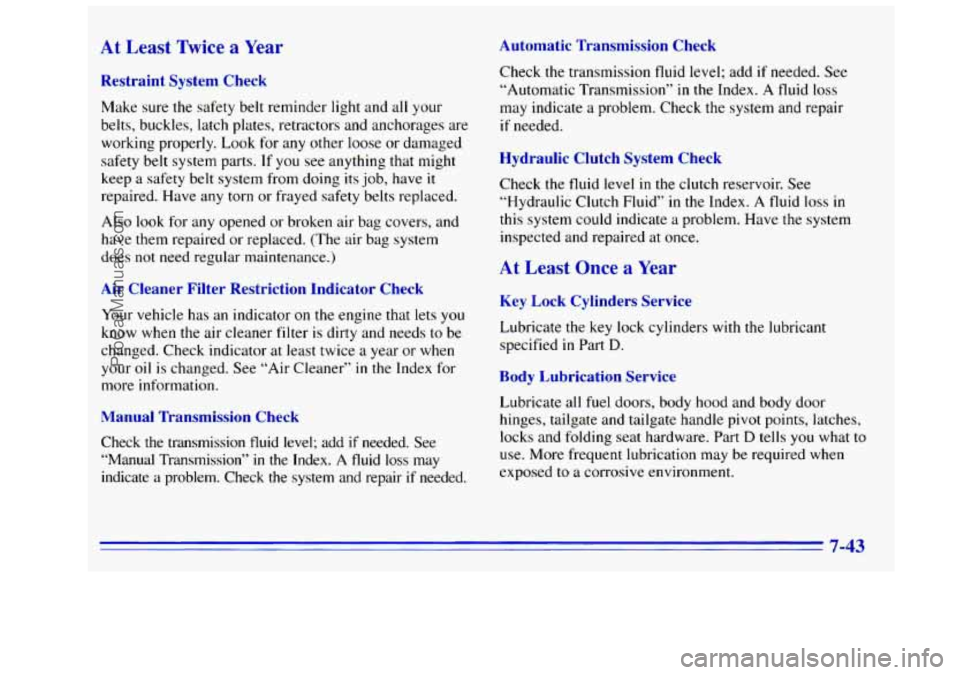
Automatic Transmission Check
Restraint System Check
Make sure the safety belt reminder light and all your
belts, buckles, latch plates, retractors and anchorages are
working properly. Look
for any other loose or damaged
safety belt system parts.
If you see anything that might
keep a safety belt system from doing its job, have
it
repaired. Have any torn or frayed safety belts replaced.
Also
look for any opened or broken air bag covers, and
have them repaired or replaced. (The air bag
system
does not need regular maintenance.)
Air Cleaner Filter Restriction Indicator Check
Your vehicle has an indicator on the engine that lets you
know when the air cleaner filter is dirty and needs to be
changed. Check indicator at least twice
a year or when
your
oil is changed. See “Air Cleaner” in the Index for
more information.
Manual Transmission Check
Check the transmission fluid level; add if needed. See
“Manual Transmission” in
the Index. A fluid loss may
indicate
a problem. Check the system and repair if needed. Check the transmission
fluid level; add if needed. See
“Automatic Transmission”
in the Index. A fluid loss
may indicate a problem. Check the system and repair
if needed.
Hydraulic Clutch System Check
Check the fluid level in the clutch reservoir. See
“Hydraulic Clutch Fluid”
in the Index. A fluid loss in
this system could indicate a problem. Have the system
inspected and repaired
at once.
At Least Once a Year
Key Lock Cylinders Service
Lubricate the key lock cylinders with the lubricant
specified
in Part D.
Body Lubrication Service
Lubricate all fuel doors, body hood and body door
hinges, tailgate and tailgate handle pivot points, latches,
locks and folding seat hardware. Part
D tells you what to
use. More frequent lubrication may be required when
exposed to a corrosive environment.
ProCarManuals.com
Page 370 of 404

Starter Switch Check When
you are doing this check, the vehicle could
move suddenly.
If it does, you or others could be
injured. Follow the steps below.
1.
2.
3.
Before you start, be sure you have enough room
around the vehicle.
Firmly apply both the parking brake
(see “Parking
Brake” in the Index if necessary) and the regular brake.
NOTE: Do not use the accelerator pedal, and be
ready
to turn off the engine immediately if it starts.
On automatic transmission vehicles, try
to start the
engine in each gear. The starter should work only in
PARK (P) or NEUTRAL (N). If the starter works in
any other position, your vehicle needs service.
On manual transmission vehicles, put the shift lever
in NEUTRAL (N), push.the clutch down halfway
and
try to start the engine. The starter should work
only when the clutch is pushed down
all the way to
the floor.
If the starter works when the clutch isn’t
pushed all the way down, your vehicle needs service.
Brake-Transmission Shift Interlock (BTSI)
Check (Automatic Transmission)
I A CAUTION:
When you are doing this check, the vehicle could
move suddenly.
If it does, you or others could be
injured. Follow the steps below.
1.
2.
3.
Before you start, be sure you have enough
room around the vehicle. It should be parked
on
a level surface.
Firmly apply the parking brake (see “Parking Brake”
in the Index if necessary).
NOTE: Be ready to
apply the regular brake
immediately
if the vehicle begins to move.
With the engine off,
turn the key to the RUN
position, but don’t start the engine. Without applying
the regular brake, try
to move the shift lever out of
PARK (P) with normal effort. If the shift lever moves
out of PARK
(P), your vehicle’s BTSI needs service.
7-44
ProCarManuals.com
Page 371 of 404

Steering Column Lock Check
While parked, and with
the parking brake set, try to turn
the key
to LOCK in each shift lever position.
With an automatic transmission, the key should turn
With a manual transmission, the key should turn
to LOCK only when the shift lever is in PARK (P).
to LOCK only when the shift lever is in
REVERSE
(R).
On vehicles with a key release button, try to turn the key
to LOCK without pressing the button. The key should
turn to LOCK
only when you press the key button.
On all vehicles, the key should come out
only in LOCK. Parking Brake and Automatic Transmission
PARK
(P) Mechanism Check
I CAUTION:
When
you are doing this check, your vehicle
could begin to move.
You or others could be
injured and property could be damaged.
Make
sure there is room in front of your vehicle in case
it begins to roll. Be ready to apply the regular
brake at once should the vehicle begin to move.
Park
on a fairly steep hill, with the vehicle facing
downhill. Keeping your foot
on the regular brake, set
the parking brake.
0 To check the parking brake: With the engine running
and transmission in NEUTRAL
(N), slowly remove
foot pressure from the regular brake pedal.
Do this
until the vehicle
is held by the parking brake only.
To check the PARK (P) mechanism’s holding ability:
With the engine running, shift
to PARK (P). Then
release all brakes.
7-45
--- -
ProCarManuals.com