1996 GMC SIERRA instrument panel
[x] Cancel search: instrument panelPage 134 of 404

The A/C button, between the temperature and mode
knobs, allows
the air coming into your vehicle to be
cooled. This setting
is useful for normal cooling on hot
days. When
you use A/C with the recirculation button
pushed
in, turn off recirculation as soon as the vehicle
reaches a comfortable interior temperature.
With the
A/C on, move the temperature knob to MAX
for maximum cooling.
This setting also puts the system
in the recirculation mode and helps
to maximize your air
conditioner’s performance and your vehicle’s fuel
economy. This setting also cools the air the fastest. After
the vehicle’s interior reaches a comfortable temperature,
move the temperature knob clockwise to place the air
conditioning system
in the normal mode.
Heating
The heater works best if you keep your windows closed
while using
it. On cold days, use the HEATER or
VENT/HEAT setting with the temperature knob in the
red area.
If you use the engine coolant heater before starting your
engine (in cold weather (20°F (-8°C) or lower), your
heating system
will produce warmer air faster, to heat
the passenger compartment
in cold weather. The
use
of an engine coolant heater also reduces the
time
it takes for the engine to reach normal operating
temperature, and shortens the time
it takes the heater to
reach full output. For more information, see “Engine
Coolant Heater”
in the Index.
Ventilation System
For mild outside temperature when little heating or
cooling
is needed, use VENT to direct outside air
through
your vehicle. Air will flow through the
instrument panel outlets.
Your vehicle’s ventilation systeril supplies outside air
to the inside of your vehicle when it is moving. With
the side windows closed, air will flow into the front
air inlet grilles, through the vehicle, and out the air
exhaust valves.
Outside air will
also enter the vehicle when the heater or
the air conditioning fan is running, unless you have
the
recirculation button pushed in. For more information on
the recirculation button, see “Air Conditioning” earlier
in this section.
3-4
ProCarManuals.com
Page 135 of 404

Ventilation Tips
Your vehicle has air outlets in the center and on the sides
of your instrument panel. You can move the outlets from
side to side or up and down to direct the
flow of air, or
close the outlets altogether. When
you close an outlet, it
will increase the flow of air coming out of any outlets
that are open. These outlets do not completely
shut off
airflow when
in the closed position.
0
0
0
Keep the hood and front air inlet free of ice, snow or
any other obstruction (such
as leaves). The heater
and defroster
will work far better, reducing the
chance of fogging the inside
of your windows.
When you enter
a vehicle in cold weather, turn the
blower fan to HI for a few moments before driving.
This helps clear the intake ducts
of snow and
moisture, and reduces the chance
of fogging the
inside
of your windows.
Keep the air path under the front seats clear
of
objects. This helps air to circulate throughout
your vehicle.
Defogging and Defrosting
On cool, humid days, use DEFOG to keep the
windshield and side windows clear.
Use DEFROST
to remove fog or ice from the windshield in extremely
humid or cold conditions. Use DEFROST
with the
temperature knob toward
the red area and the fan control
toward
HI.
ProCarManuals.com
Page 211 of 404

Turn Signals When Towing a Trailer
The green arrows on your instrument panel will flash
whenever
you signal a turn or lane change. Properly
hooked up, the trailer lamps will also flash, telling other
drivers you’re about to turn, change lanes or stop.
When towing a trailer, the green arrows
on your
instrument panel will flash for turns even
if the bulbs on
the trailer are burned out. Thus, you may
think drivers
behind
you are seeing your signal when they are not. It’s
important to check occasionally to be sure the trailer
bulbs are
still working.
Driving On Grades
Reduce speed and shift to a lower gear be~m you start
down
a long or steep downgrade. If you don’t shift
down,
you might have to use your brakes so much that
they would get hot and
no longer work well.
On a long uphill grade,
shift down and reduce your
speed
to around 45 mph (70 km/h) to reduce the
possibility
of engine and transmission overheating.
If you have an automatic transmission, you should use
THIRD
(3) (or, as you need to, a lower gear) when
towing a trailer. Operating your vehicle in THIRD
(3)
when towing a trailer will minimize heat build-up and
extend
the life of your transmission
If
you have a manual transmission and you are towing a
trailer,
it’s better not to use FIFTH (5) gear. Just drive in
FOURTH (4) gear (or, as you need to, a lower gear).
When towing at high altitude on steep uphill grades,
consider the following: Engine coolant will boil at a
lower temperature than at normal altitudes. If
you turn
your engine off‘ immediately after towing at high altitude
on steep uphill grades, your vehicle may show signs
similar
to engine overheating. To avoid this, let the
engine
run while parked (preferably on level ground)
with the automatic transmission
in PARK (P) (or the
manual transmission out
of gear and the parking brake
applied) for a few minutes before turning
the engine off.
If you do get the overheat warning, see “Engine
Overheating’’
in the Index.
ProCarManuals.com
Page 226 of 404
Engine Overheating
(Gasoline Engine)
You will find a coolant temperature gage on your
vehicle’s instrument panel.
If your vehicle has a
diesel engine, see “Engine Overheating” in the Diesel
Engine Supplement.
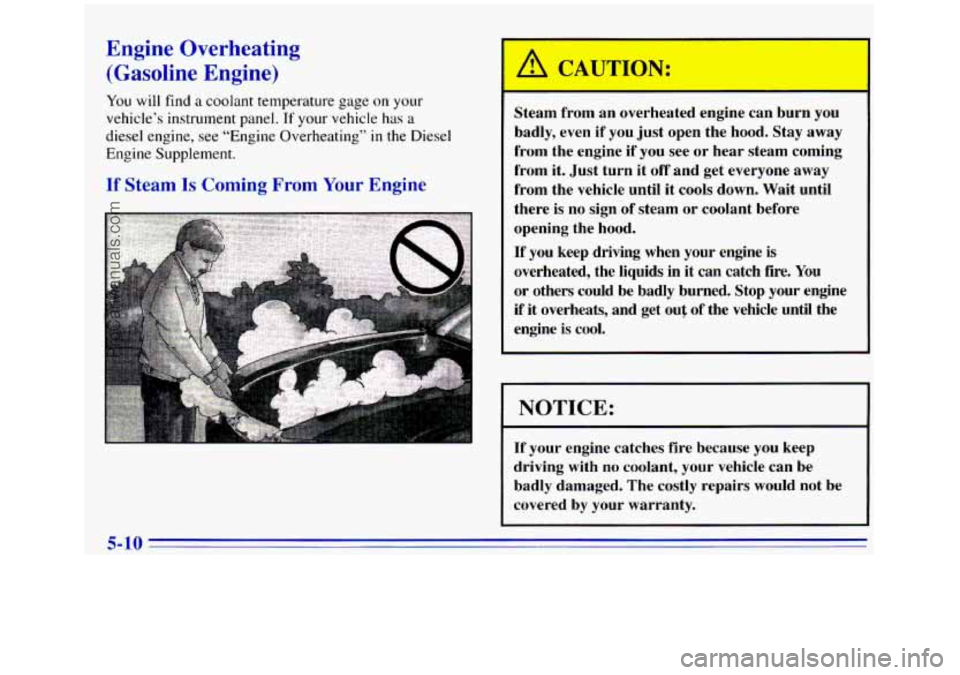
If Steam Is Coming From Your Engine
A CAUTION:
Steam from an overheated engine can burn you
badly, even if you just open the hood. Stay away
from the engine if you see
or hear steam coming
from it. Just turn it
off and get everyone away
from the vehicle until it cools down. Wait until
there is no sign
of steam or coolant before
opening the hood.
If you keep driving when your engine is
overheated, the liquids in it can catch
fire. You
or others could be badly burned. Stop your engine
if it overheats, and get out of the vehicle until the
engine is cool.
NOTICE:
If your engine catches fire because you keep
driving with no coolant, your vehicle can be
badly damaged. The costly repairs would not be
covered by your warranty.
5-10
ProCarManuals.com
Page 253 of 404
If your vehicle is certified to meet California Emission
Standards (indicated on the underhood tune-up label),
it
is designed to operate on fuels that meet California
specifications.
If such fuels are not available in states
adopting California emissions standards,
your vehicle
will operate satisfactorily
on fuels meeting federal
specifications, but emission control system performance
may be affected. The malfunction indicator lamp on
your instrument panel may
turn on and/or your vehicle
may fail a smog-check test.
If this occurs, return to your
authorized GM dealer for diagnosis
to determine the
cause
of failure. In the event it is determined that the
cause
of the condition is the type of fuels used, repairs
may not be covered by
your warranty.
In Canada. some gasolines contain an octane-enhancing
additive called
MMT. If you use such fuels, your
emission control system performance may deteriorate
and the tnalfunction indicator lamp
on your instrument
panel may turn on. If this happens, return to your
authorized
CM dealer for service.
To provide cleaner air, all gasolines are now required to
contain additives that will help prevent deposits from
forming
in your engine and fuel system, allowing your
emission control system
to function properly. Therefore,
you should not have to add anything to the fuel. In
addition, gasolines containing oxygenates, such as ethers
and ethanol, and reformulated gasolines may be
available
in your area to help clean the air. General
Motors recommends that
you use these gasolines if they
comply with the specifications described earlier.
NOTICE:
Your vehicle was not designed for fuel that
contains methanol. Don’t use it.
It can corrode
metal parts
in your fuel system and also damage
plastic and rubber parts. That damage wouldn’t
be covered under your warranty.
6-3
ProCarManuals.com
Page 311 of 404
Cleaning Leather
Use a soft cloth with lukewarm water and a mild soap or
saddle
soap.
For stubborn stains, use a GM VinyVLeather Cleaner
or equivalent product.
Never use oils, varnishes, solvent-based or abrasive
cleaners, furniture polish or shoe polish
on leather.
Soiled leather should be cleaned immediately. If
dirt is allowed to work into the finish, it can harm
the leather.
Cleaning the Top of the Instrument Panel
Use only mild soap and water to clean the top surfxes
of the instrument panel. Sprays containing silicones or
waxes
may cause annoying reflections in the windshield
and even make
it difficult to see through the windshield
under certain conditions.
Care of Safety Belts
Keep belts clean and dry.
-. '4 -
Do not bleach or dye safety belts. If you do, it
may severely weaken them. In a crash, they
might not
be able to provide adequate protection.
Clean safety belts only with mild soap and
lukewarm water.
Glass
Glass should be cleaned often. GM Glass Cleaner (GM
Part No. 1050427) or a liquid household glass cleaner
will remove normal tobacco smoke and dust films.
Don't use abrasive cleaners
on glass, because they may
cause scratches. Avoid placing decals
on the inside rear
window, since they may have to be scraped off later.
If
abrasive cleaners are used on the inside of the rear
window, an electric defogger element may be damaged.
Any temporary license should not be attached across the
defogger grid.
6-61
ProCarManuals.com
Page 317 of 404

Vehicle Identification Number (VIN)
ENGlNEA996 7 - ASSEMBLY
CODE MODEL YEAR PLANT
This is the legal identifier for your vehicle. It appears on
a plate in the front corner of the instrument panel, on the
driver’s side.
You can see it if you look through the
windshield from outside your vehicle. The
VIN also
appears on the Vehicle Certification and Service Parts
labels and
the certificates of title and registration.
Engine Identification
The eighth character in your VIN is the engine code.
This code will help
you identify your engine,
specifications and replacement parts.
Service Parts Identification Label
You’ll find this label on the inside of the glove box.
It’s very helpful if you ever need to order parts. On
this label
is:
your VIN,
the model designation,
0 paint information, and
a list of all production options and
special equipment.
Be sure that this label
is not removed from the vehicle.
6-67
ProCarManuals.com
Page 319 of 404

Fu ~ ~ s and Circuit Breakers
The wiring circuits in your vehicle are protected from
short circuits by a combination of
fuses, circuit breakers
and fusible thermal links. This greatly reduces the
chance
of fires caused by electrical problems.
Look at the silver-colored band inside the fuse. If the
band is broken or melted, replace the fuse. Be sure
you
replace a bad fuse with a new one of the identical size
and rating.
If you ever have a problem on the road and don’t have a
spare fuse,
you can borrow one that has the same
amperage.
Just pick some feature of your vehicle that
you can get along without -- like the radio or cigarette
lighter
-- and use its fuse, if it is the correct amperage.
Replace
it as soon as you can.
Instrument Panel Fuse Block
The fuse block access door
is on the driver’s side edge
of the instrument panel. Pull
off the cover
to access the
fuse block.
You can remove fuses with a fuse extractor. The fuse
extractor
is mounted to the fuse block access door. To
remove fuses if you don’t have a fuse extractor, hold the
end of the fuse between your thumb and index finger
and
pull straight out.
ProCarManuals.com