Page 213 of 404
When You Are Ready to Leave After
Parking on a Hill
1. Apply your regular brakes and hold the pedal down
while
you:
0 Start your engine;
Shift into a gear; and
0 Release the parking brake.
2. Let up on the brake pedal.
3. Drive slowly until the trailer is clear of the chocks.
4. Stop and have someone pick up and store the chocks.
Maintenance When Trailer Towing
Your vehicle will need service more often when you’re
pulling
a trailer. See the Maintenance Schedule for more
on this. Things
that are especially important in trailer
operation are automatic transmission fluid (don’t
overfill), engine oil, axle lubricant, belt, cooling system
and brake adjustment. Each of these is covered
in this
manual, and the Index will help you find them quickly.
If you’re trailering, it’s a good idea
to review these
sections before you start your trip.
Check periodically
to see that all hitch nuts and bolts
are tight.
Trailer Wiring Harness
A seven-wire harness is stored under the rear end of
your vehicle. between the frame rails. An electrical
connector
will need to be installed at the trailer end of
the harness, by a qualified electrical technician. For
additional trailer wiring and towing information please
consult your
GM dealer. Securely attach the harness to
the trailer, then tape or strap it to your vehicle’s frame
rail.
Be sure you leave it loose enough so the wiring
won’t bind or break when turning with the trailer, but
not so loose that it drags on the ground. Store the
harness in its original position. Wrap the harness
together and tie
it neatly so it won’t be damaged. If you
tow a trailer, your Center High-Mounted Stoplamp
(CHMSL) may not be properly visible from behind.
You should select a trailer with
a CHMSL on it or, if
one is not available, have one installed. See your GM
dealer about how to connect your vehicle’s wiring to
a trailer CHMSL.
4-59
ProCarManuals.com
Page 228 of 404
Cooling System -- Gasoline Engines
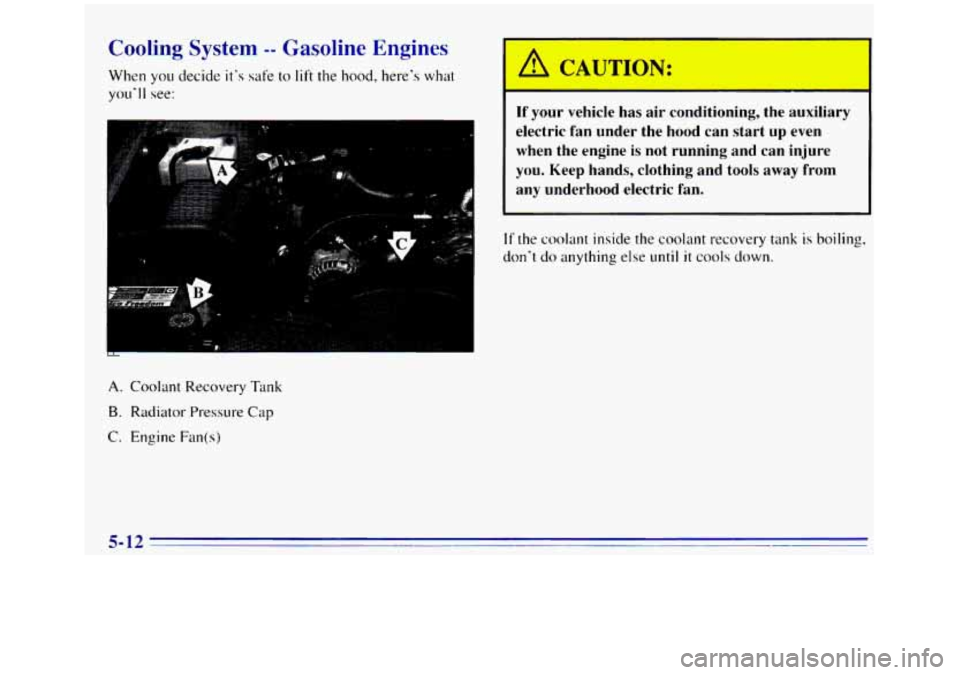
When you decide it's safe to lift the hood, here's what
you'll see:
A. Coolant Recovery Tdnk
B. Radiator Pressure Cap
C. Engine Fan(s)
A CAUTION:
If your vehicle has air conditioning, the auxiliary
electric fan under the hood can start up even when the engine is not running and can injure
you. Keep hands, clothing and tools away from
any underhood electric fan.
If the coolant inside the coolant recovery tank is boiling,
don't do anything else
until it cools down.
ProCarManuals.com
Page 230 of 404

NOTICE:
I
I
I
Engine damage from running your engine without coolant isn’t covered by your warranty.
If there seems to be no leak, start the engine again. See
if the fan speed increases when idle speed is doubled by
pushing the accelerator pedal down.
If it doesn’t, your
vehicle needs service. Turn
off the engine.
How to Add Coolant to the Coolant
Recovery Tank
If you haven’t found a problem yet, but the coolant level
isn’t at or above the
COLD mark, add a SO/SO mixture
of ciecu? wter (preferably distilled) and DEX-COOL”
(orange-colored, silicate-free) antifreeze at the coolant
recovery tank.
(See (‘Engine Coolant” in the Index for
more information.)
I A CAUTION:
Adding only plain water to your cooling system
can be dangerous. Plain water, or some other
liquid like
alcohol, can boil before the proper
coolant mix
will. Your vehicle’s coolant warning
system
is set for the proper coolant mix. With
plain water or the wrong mix, your engine could
get too hot but you wouldn’t get the overheat
warning. Your engine could catch fire and you or
others
could be burned. Use a 50/50 mix of clean
water and
DEX-COOL TM antifreeze.
I NOTICE:
In cold weather, water can freeze and crack
the engine, radiator, heater core and other parts.
Use the recommended coolant and the proper
coolant mix.
5- 14
ProCarManuals.com
Page 254 of 404
Fuels in Fo ign Countries -- Gasoline
Engines
If you plan on driving in another country outside the
United States or Canada, the proper
fuel may be hard to
find. Never use leaded gasoline or any other fuel not
recommended
in the previous text on fuel. Costly repairs
caused by use
of improper fuel wouldn’t be covered by
your warranty.
To check on fuel availability, ask an auto club, or
contact a major oil company that does business in the
country where you’ll be driving.
You can
also write us at the following address for
advice. Just tell us where you’re going and give your
Vehicle Identification Number (VIN).
General Motors Overseas Distribution Corporation,
North American
Export Sales (NAES)
1908 Colonel Sam Drive
Oshawa, Ontario
L 1 H 8P7
Filling Your Tank
The fuel cap is behind a
hinged door on the left side
of your vehicle.
On a chassis-cab model, refuel the front
tank first, or in
instances when only a partial fuel fill is desired.
6-4
ProCarManuals.com
Page 256 of 404

Be careful not to spill gasoline. Clean gasoline from
painted surfxes as soon
as possible. See “Cleaning the
Outside
of Your Vehicle” in the Index.
When you put the cap back
on, turn it to the right until
you hear at least three clicks. Make sure you fully install
the cap. The diagnostic system can determine if the fuel
cap has been
left off or improperly installed. This would
allow
fuel to evaporate into the atmosphere. See
“Malfunction Indicator Lamp” in the Index.
I NOTICE:
If you need a new cap, be sure to get the right
type. Your dealer can get one for you. If you get
the wrong type, it may not fit or have proper
venting, and your fuel tank and emissions system
might be damaged.
Checking Things Under the Hood
h
I ! CAUTION:
If your vehicle has air conditioning, the auxiliary
engine fan under the hood can start up and
hjure you even when the engine
is not running.
Keep hands, clothing and tools away from any
underhood electric fan.
Things that burn can get on hot engine parts and
start a fire. These include liquids like gasoline or
diesel fuel, oil, coolant, brake fluid, windshield
washer and other fluids, and plastic or rubber.
You
or others could be burned. Be careful not to drop
or spill things that will burn onto a hot engine.
6-6
ProCarManuals.com
Page 259 of 404
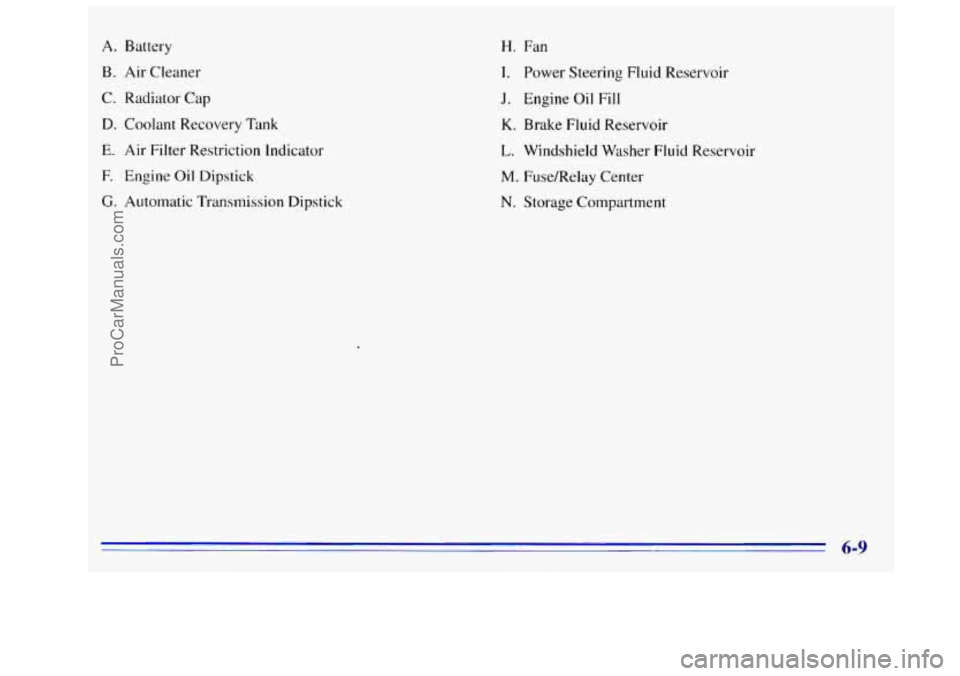
A. Battery
B. Air Cleaner
C. Radiator Cap
D. Coolant Recovery Tmk
E. Air Filter Restriction Indicator
E Engine Oil Dipstick
G. Automatic Transmission Dipstick
H. Fan
I. Power Steering Fluid Reservoir
J. Engine Oil Fill
K. Brake Fluid Reservoir
L. Windshield Washer Fluid Reservoir
M. FuseIRelay Center
N. Storage Compartment
ProCarManuals.com
Page 260 of 404
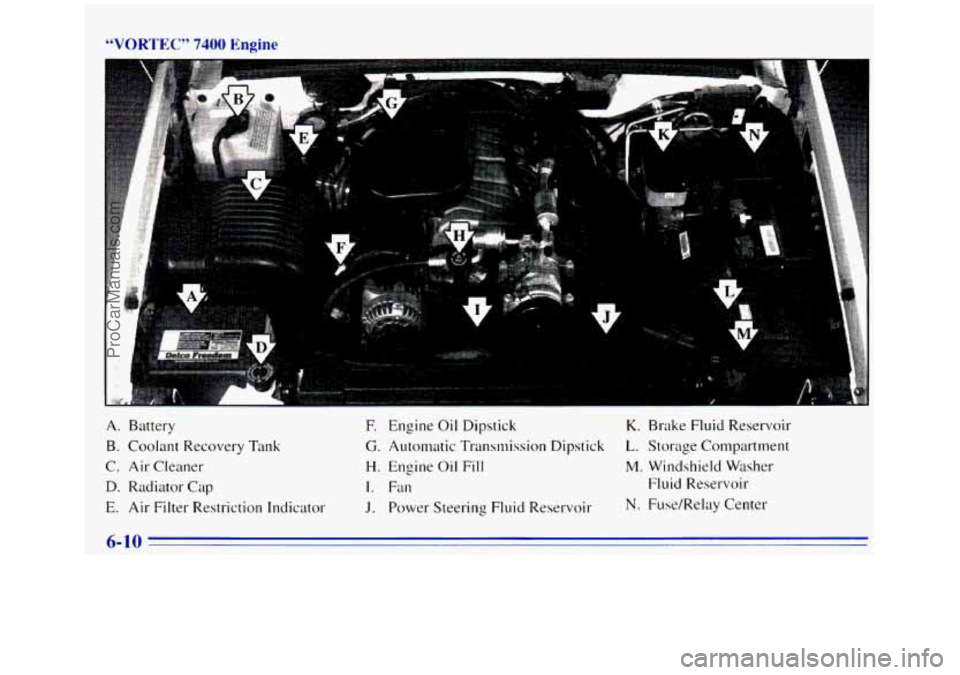
“VORTEC” 7400 Engine
I
A. Battery
B. Coolant Recovery Tank
C. Air Cleaner
D. Radiator Cap
E. Air Filter Restriction Indicator
E Engine Oil Dipstick K. Brake Fluid Reservoir
G. Automatic Transmission Dipstick L. Storage Compartment
H. Engine Oil Fill M. Windshield Washer
I. Fan Fluid
Reservoir
J. Power Steering Fluid Reservoir Ne Fuse/RelaY Center
ProCarManuals.com
Page 262 of 404
Engine Oil (Gasoline Engine)
If your vehicle has a diesel engine, see “Engine Oil
(Diesel Engine)” in the Diesel Engine Supplement.
It’s a good idea to check your engine oil every time you
get fuel. In order to get an accurate reading, the
oil must
be warm and the vehicle must
be on level ground. Turn
off the
engine and give the oil a few minutes to
drain back into the oil pan.
If you don’t, the oil dipstick
might not.show the actual level.
Checking Engine Oil
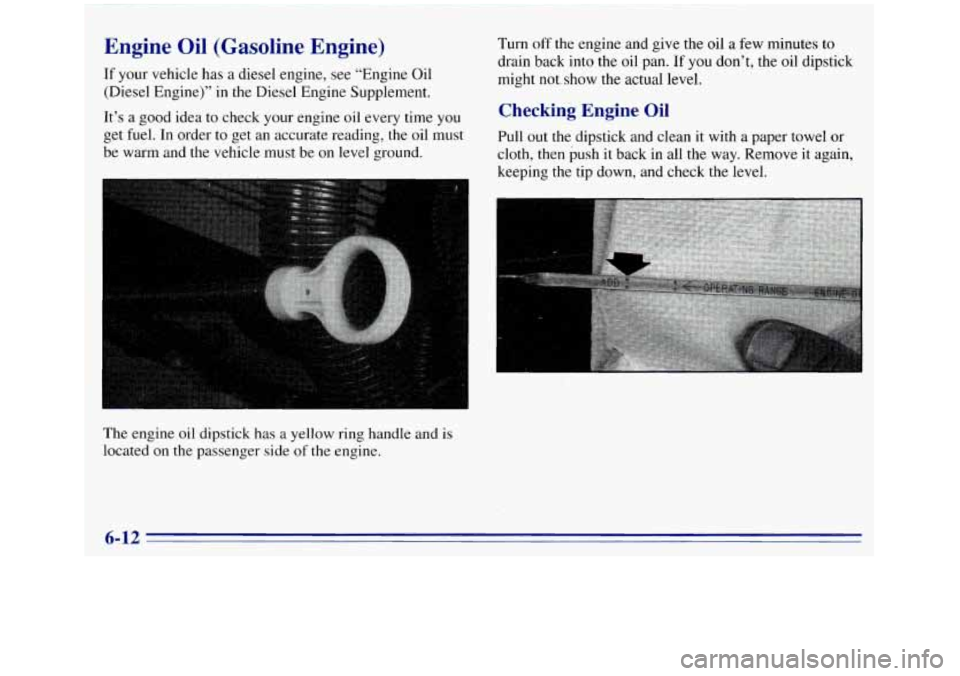
Pull out the dipstick and clean it with a paper towel or
cloth, then
push it back in all the way. Remove it again,
keeping the tip down, and check the level.
The engine oil dipstick has a yellow ring handle and is
located on the passenger side
of the engine.
6-12
ProCarManuals.com