1996 GMC SIERRA engine
[x] Cancel search: enginePage 80 of 404
NEUTRAL (N): Use this position when YOLI start
or idle your engine.
REVERSE (R): To back up, first press down the
clutch pedal. Wait about five seconds for the internal
parts
to stop spinning and then shift into REVERSE (R).
Let up on the clutch pedal slowly while pressing the
accelerator pedal.
NOTICE:
Shift to REVERSE (R) only after your vehicle is
stopped. Shifting
to REVERSE (R) while your
vehicle is moving could damage your transmission.
Also, use REVERSE (R), along with the parking brake,
when turning off your engine and parking your vehicle.
5-Speed (Without Low Gear)
Here’s how to operate your transmission:
FIRST (1): Press the clutch pedal and shift into
FIRST
(I ). Then, slowly let up on the clutch pedal
as you press the accelerator pedal.
You can shift into FIRST
( 1 ) when you’re going less
than
20 mph (32 km/h). If you’ve come to a complete
stop and it’s hard to shift
into FIRST (l), put the shift
lever
in NEUTRAL (N) and let up on the clutch. Press
the clutch pedal back down. Then shift into FIRST
(1).
SECOND (2): Press the clutch pedal as you let up on
the accelerator pedal and shift
into SECOND (2). Then,
slowly let up on the clutch pedal as you press the
accelerator pedal.
THIRD (3), FOURTH (4) and FIFTH (5): Shift into
THIRD
(3), FOURTH (4) and FIFTH (5) the same way
you do for SECOND (2). Slowly let up on the clutch
pedal
as you press the accelerator pedal.
To stop, let up on the accelerator pedal and press the
brake pedal. Just before the vehicle stops, press the
clutch pedal and the brake pedal, and shift
to
NEUTRAL (N).
2-18
ProCarManuals.com
Page 81 of 404
NEUTRAL (N): Use this position when you start or
idle your engine.
REVERSE (R): To back up, first press down the
clutch pedal.
Wait about five seconds for the internal
parts
to stop spinning and then, shift into REVERSE (R).
Let up on the clutch pedal slowly while pressing
the accelerator pedal.
.
NOTICE:
Shift to REVERSE (R) only after your vehicle is
stopped. Shifting to
REVERSE (R) while your
vehicle is moving could damage your transmission.
Also, use REVERSE (R), along with the parking brake,
when turning off
your engine and parking your vehicle.
Shift Speeds
A CAUTION:
If you skip more than one gear when you
downshift, you could lose control of your
vehicle. And you could injure yourself or
others. Don’t shift down more than one gear
when you downshift.
NOTICE:
If you skip more than one gear when you
downshift, or
if you race the engine when you
downshift, you can damage the engine, clutch
or transmission.
2-19
ProCarManuals.com
Page 82 of 404
If your speed drops below 20 mph (32 km/h), or if the
engine
is not running smoothly, you should downshift to
the next lower gear. You may have to downshift two or
more gears to keep the engine running smoothly
or for
good performance.
If you have a five-speed manual transmission with low
gear (RPO MW3), the following charts show when to
shift to the
next higher gear for best fuel economy.
Acceleration Shift Speeds
VIN Code 2 to 3 3 to 4
4.3L V6 (W) 15 mph 40 mph
(24 km/h) (64 km/h)
Cruise Shift Speeds
4 to 5
SO mph
(80 km/h)
4.3L V6 (W) 15 rnph 25-40 mph 45-SO mph
(24 hdh) (40-64 kdh) (72-80 km/h)
Shift Light
SHIFT
If you have a manual
transmission, you may have
a SHIFT light. This light
will show
you when to shift
to the next higher gear for
best fuel economy.
When this light comes
on, you can shift to the next
higher gear
if weather, road and traffic conditions let
you. For the best fuel economy, accelerate slowly and
shift when the light comes on.
While
you accelerate, it is normal for the light to go
on and off if you quickly change the position of the
accelerator. Ignore the
SHIFT light when you downshift.
If your vehicle has four-wheel drive and is equipped
with
a manual transmission, disregard the SHIFT light
when
the transfer case is in 4L.
2-20
ProCarManuals.com
Page 83 of 404
Locking Rear Axle (Option)
If you have this feature, your rear axle can give you
additional traction on snow, mud, ice, sand
or gravel. It
works like a standard axle most of the time, but when
one
of the rear wheels has no traction and the other does,
the locking feature will allow the wheel with traction to
move the
vehicle.
Four- Wheel Drive
If your vehicle has four-wheel drive, you can send your
engine's driving power to all four wheels for extra
traction.
To get the most satisfaction out of four-wheel
drive,
you must be Familiar with its operation. Read the
part that follows before using four-wheel drive. You
should use
2-WHEEL HIGH (2H) for most normal
driving conditions.
NOTICE:
Driving in the 4-WHEEL HIGH (4H) or
4-WHEEL LOW (4L) positions for a long
time on
dry or wet pavement could shorten
the life
of your vehicle's drivetrain.
Front Axle Locking Feature
The front axle locks and unlocks automatically when
you shift the transfer case. Some delay for the axle to
lock or unlock is normal. If the outside temperature
is very
hot, or the vehicle has been used under hard
driving conditions. there may be a slight delay
for the
axle
to unlock.
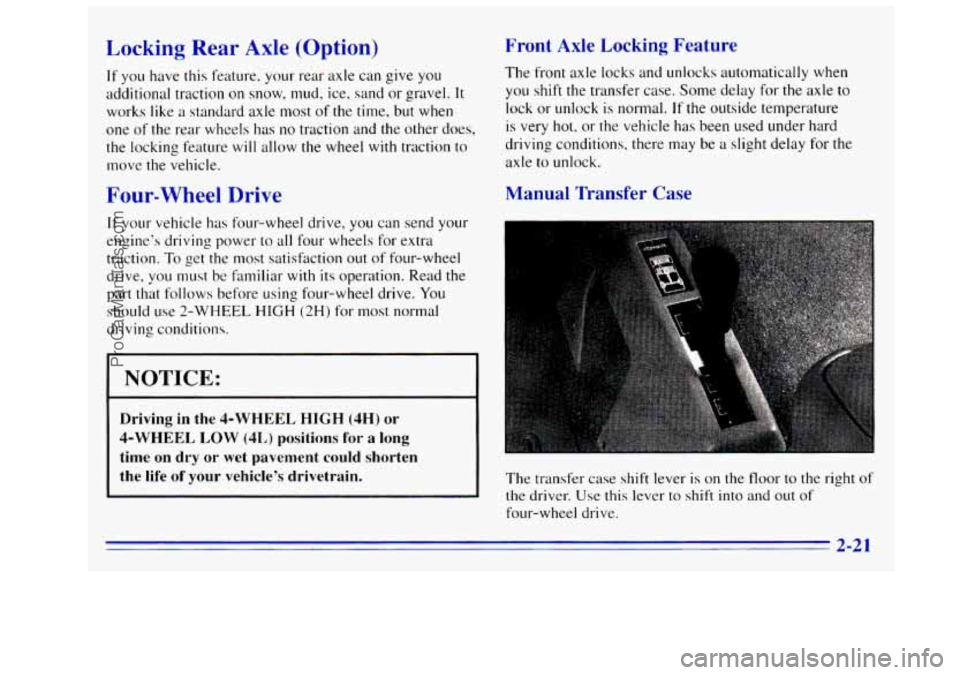
Manual Transfer Case
The transfer case shift lever is on the floor to the right of
the driver. Use this lever to shift into and out of
four-wheel drive.
2-21
ProCarManuals.com
Page 88 of 404
NOTICE:
Driving with the parking brake on can cause
your rear brakes to overheat.
You may have
to replace them, and you could also damage
other parts of your vehicle. Always check to be
sure your parking brake is fully released before
you drive.
If you are towing a trailer and are parking on any hill,
see “Towing a Trailer” in the Index. That section shows
what
to do first to keep the trailer from moving.
If you have a 3500 HD model, it is recommended that
the propshaft mounted parking brake be burnished as
part of the new vehicle break-in. The parking brake will
work best after it has been burnished following these
instructions.
Make
10 stops, using the parking brake foot pedal, from
20 mph (32 km/h) about 2 1/2 miles (4 km) apart. In
between stops, drive the vehicle at 20 mph (32 km/h).
Shifting Into PARK (P) (Automatic
Trawrission
Models Only)
It can be dangerous to get out of your vehicle if
the shift lever
is not fully in PARK (P) with the
parking brake firmly set. Your vehicle can
roll.
If you have left the engine running, the vehicle
can move suddenly. You or others could be
injured.
To be sure your vehicle won’t move,
even when you’re on fairly level ground, use
the steps that follow. If you have four-wheel
drive and your transfer case is in NEUTRAL
(N)?
your vehicle will be free to roll, even if your shift
lever
is in PARK (P). So, be sure the transfer case
is in
a drive gear -- not in NEUTRAL (N). If
you’re pulling a trailer, see “Towing a Trailer’’
in the Index.
2-26
ProCarManuals.com
Page 90 of 404
Leaving Your Vehicle With the Engine
Running (Automatic Transmission
Models Only)
I A ‘CAUTION:
It can be dangerous to leave your vehicle with the
engine running. Your vehicle could move suddenly
if the shift lever is not fully in PARK
(P) with the
parking brake firmly set.
If you have four-wheel
drive with
a manual transfer case shift lever and
your transfer case is in NEUTRAL
(N), your
vehicle will be free to roll, even if your shift lever
is in PARK (P). So be sure the transfer case is in a
drive gear
-- not in NEUTRAL (N). And, if you
leave the vehicle with the engine running, it could
overheat and even catch fire. You or others could
be injured. Don’t leave your vehicle with the
engine running unless you have to.
If you have to leave your vehicle with the engine
running, be sure your vehicle
is in PARK (P) and the
parking brake is firmly set before you leave
it. After you
move the shift lever into PARK (P), hold the regular
brake pedal down. Then, see
if you can move the shift
lever away from PARK (P) without first pulling
it
toward you. If you can, it means that the shift lever
wasn’t fully locked into PARK (P).
Torque Lock (Automatic Transmission)
If you are parking on a hill and you don’t shift your
transmission into PARK
(P) properly, the weight of
the vehicle may put too much force on the parking
pawl
in the transmission. You may find it difficult to
pull the shift lever out
of PARK (P). This is called
“torque lock.”
To prevent torque lock, set the parking
brake and then shift into PARK (P) properly before you
leave the driver’s seat.
To find out how, see “Shifting
Into PARK (P)” in the Index.
When
you are ready to drive, move the shift lever out of
PARK (P) before you release the parking brake.
If torque lock does occur, you may need to have another
vehicle push yours a little uphill to take some of the
pressure from the transmission,
so you can puIl the shift
lever out
of PARK (P).
2-28
ProCarManuals.com
Page 91 of 404
Parking Your Vehicle (Manual
Transmission Models Only)
Before you get out of your vehicle, put your manual
transmission in REVERSE (R), turn
off the engine, and
firmly apply the parking brake.
If you have four-wheel drive, be sure your transfer case
is in
a drive gear. Your vehicle could roll if it isn’t.
If you are parking
on a hill, or if you are pulling a
trailer, see “Towing a Trailer” in the Index.
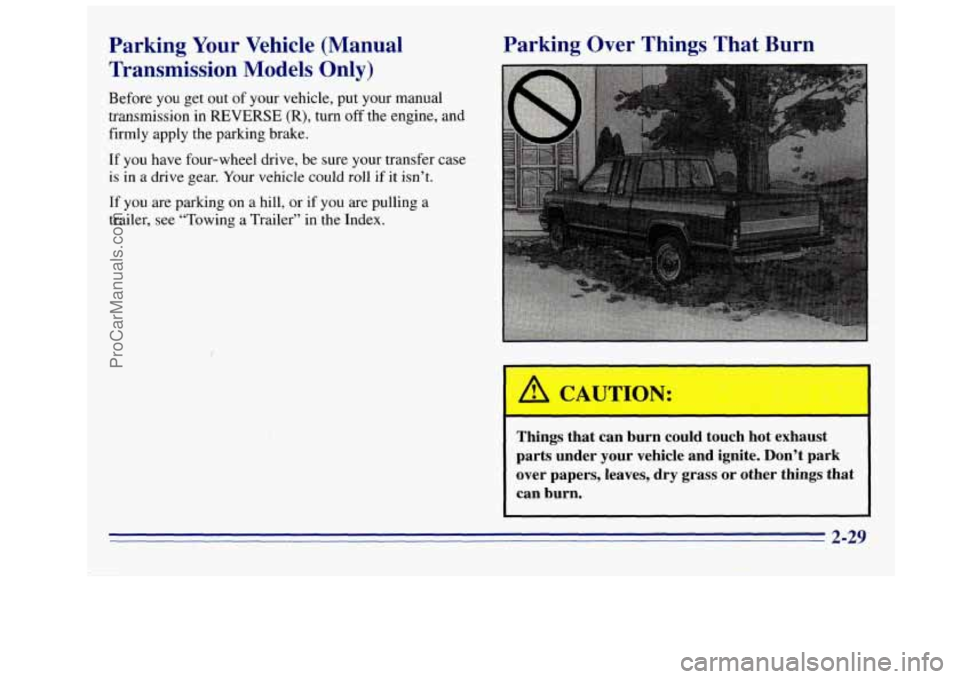
Parking Over Things That Burn
f
A CAUTION:
Things that can burn could touch hot exhaust
parts under your vehicle and ignite. Don’t park
over papers, leaves, dry grass or other things that
can burn.
2-29
ProCarManuals.com
Page 92 of 404
Engine Exhaust
I
A CAUTION:
-
Engine exhaust can kill. It contains the gas
carbon monoxide
(CO), which you can’t see or
smell. It can cause unconsciousness and death.
You might have exhaust coming in if:
Your exhaust system sounds strange or different.
Your vehicle gets rusty underneath.
Your vehicle was damaged in a collision.
Your vehicle was damaged when driving over
high points on the road or over road debris.
Repairs weren’t done correctly.
Your vehicle or exhaust system had been
If you ever suspect exhaust is coming into
your vehicle:
Drive it only with all the windows down to
Have your vehicle fixed immediately.
modified improperly.
blow
out any
CO; and
I
Zunning Your Engine While You’re
larked (Automatic Transmission)
It’s better not to park with the engine running. But if you
ever have to, here are some things to know.
Idling the engine with the air system control off
could allow dangerous exhaust into your vehicle
(see the earlier Caution under “Engine Exhaust”).
Also, idling in
a closed-in place can let deadly
carbon monoxide
(CO) into your vehicle even if
the fan switch is at the highest setting. One place
this can happen
is a garage. Exhaust -- with
CO -- can come in easily. NEVER park in a
garage with the engine running.
Another closed-in place can be a blizzard. (See
“Blizzard”
in the Index.)
2-30
ProCarManuals.com