1996 GMC SIERRA brake light
[x] Cancel search: brake lightPage 176 of 404

Driving Downhill
When off-roading takes you downhill, you’ll want to
consider
a number of things:
How steep is the downhill? Will I be able to maintain
vehicle control?
What’s the surface like? Smooth? Rough? Slippery?
Hard-packed dirt? Gravel?
Logs? Boulders?
Are there hidden surface obstacles? Ruts?
What’s at the bottom of the hill‘? Is there a hidden
creek bank or even a river bottom
with large rocks?
If you decide YOU can go down a hill safely, then try to
keep your vehicle headed straight down, and use a low
gear. This way, engine drag can help your brakes and
they won’t have to do all
the work. Descend slowly,
keeping your vehicle under control at all times,
’ A CAUTION:
-
Heavy braking when going down a hill can
cause your brakes to overheat and fade. This
could cause loss
of control and a serious accident.
Apply the brakes lightly when descending
a
hill and use a low gear to keep vehicle speed
under control.
Are there some things
I should not do when
driving down a hill?
At Yes! These are important because if you ignore them
you could lose control and have a serious accident.
0 When driving downhill, avoid turns that take you
across the incline
of the hill. A hill that’s not too
steep to drive down may be too steep to drive across.
You could roll over if you don’t drive straight down.
0 Never go downhill with the transmission in
NEUTRAL (N), or with the clutch pedal depressed
in a manual shift, This is called “free-wheeling.”
Your brakes will have to
do all the work and could
overheat and fade.
ProCarManuals.com
Page 181 of 404

Driving in Water
Light rain causes no special off-road driving problems.
But heavy rain can mean flash flooding, and flood
waters demand extreme caution.
Find out how deep the water
is before you drive through
it.
If it’s deep enough to cover your wheel hubs, axles or
exhaust pipe, don’t try
it -- you probably won’t get
through. Also, water that deep can damage your axle
and other vehicle parts.
If the water isn’t too deep, then drive through it
slowly. At fast speeds, water splashes on your ignition
system and your vehicle can stall. Stalling can also
occur
if you get your tailpipe under water. And, as
long as your tailpipe
is under water, you’ll never be
able to start your engine. When you go through water,
remember that when your brakes get wet,
it may take
you longer
to stop. Driving mrough rushing water can be dangerous.
Deep water can sweep your vehicle downstream
and you and your passengers could drown.
If it’s
only shallow water, it can still wash away the
ground from under your tires, and you could lose
traction and roll the vehicle over. Don’t drive
through rushing water.
See “Driving Through Water” in the Index for more
information on driving through water.
4-27
ProCarManuals.com
Page 185 of 404

Driving too fast through large water puddles or even
going through some vehicle washes can
cause problems,
too. The water may affect your brakes. Try to avoid
puddles. But
if you can’t, try to slow down before you
hit them.
I
Wet brakes can cause accidents. They won’t work
well in a quick stop and may cause pulling to one
side. You could lose control
of the vehicle.
After driving through a large puddle
of water or
a vehicle wash, apply your brake pedal lightly until your brakes work normally.
ProCarManuals.com
Page 219 of 404
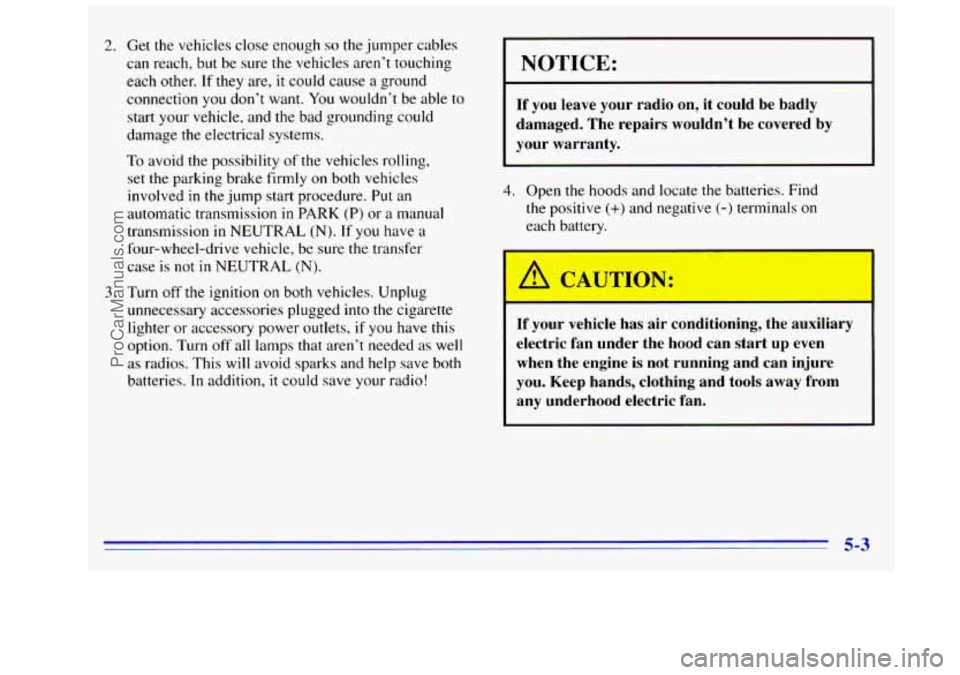
2. Get the vehicles close enough so the jumper cables
can reach, but be sure the ve.hicles aren’t touching
each other.
If they are, it could cause a ground
connection you don’t want. You wouldn’t be able to
start
your vehicle, and the bad grounding could
damage the electrical systems.
To avoid the possibility
of the vehicles rolling,
set the parking brake firmly on both vehicles
involved
in the jump start procedure. Put an
automatic transmission
in PARK (P) or a manual
transmission
in NEUTRAL (N). If you have a
four-wheel-drive vehicle, be sure the transfer
case is not in NEUTRAL
(N).
3. Turn off the ignition on both vehicles. Unplug
unnecessary accessories plugged into the cigarette
lighter or accessory power outlets,
if you have this
option. Turn
off all lamps that aren’t needed as well
as radios. This will avoid sparks and help save both
batteries.
In addition, it could save your radio!
NOTICE:
I
~~~ ~
If you leave your radio on, it could be badly
damaged. The repairs wouldn’t be covered by
your warranty.
4. Open the hoods and locate the batteries. Find
the positive
(+) and negative (-) terminals 011
each battery.
A CAUTION:
If your vehicle has air conditioning, the auxiliary
electric fan under the hood can start up even
when the engine
is not running and can injure
you. Keep hands, clothing and tools
away from
any underhood electric fan.
5-3
ProCarManuals.com
Page 286 of 404

NOTICE: .
Continuing to drive with worn-out brake pads
could result in costly brake repair.
Some driving conditions or climates may cause a brake
squeal when the brakes are first applied or lightly
applied. This does not mean something is wrong with
your brakes.
Free movement
of brake calipers and properly torqued
wheel nuts
are necessary to help prevent brake
pulsation. When tires
are rotated, inspect.brake calipers
for movement, brake pads for wear, and evenly torque
wheel nuts in the proper sequence
to GM specifications.
If you have rear drum brakes, they don’t have wear
indicators, but
if you ever hear a rear brake rubbing
noise, have the rear brake linings inspected.
Also, the
rear brake drums should be remoQed and inspected each
time the tires are removed for rotation or changing.
When you have the front brakes replaced, have the rear
brakes inspected,
too. I
Brake linings should always be replaced as complete
axle sets.
Brake Pedal Travel
See your dealer if the brake pedal does not return to
normal height, or if there is a rapid increase in pedal
travel. This could be a sign of brake trouble.
Brake Adjustment
Every time you make a brake stop, your disc brakes
adjust for wear.
If your brake pedal goes down farther than normal, your
rear drum brakes may need adjustment. Adjust them by
backing up and firmly applying the brakes a few times.
Replacing Brake System Parts
The braking system on a modern vehicle is complex. Its
many parts have to be
of top quality and work well
together if the vehicle is to have really good braking.
Vehicles we design and test have top-quality
GM brake
parts
in them, as your vehicle does when it is new. When
you replace parts of your braking system -- for example,
when- your brhke linings wear do.wn and you have
to
haye new ones put in -- be sure you get new genuine
GM replacement parts. If you don’t, your brakes may
no longer work properly. For example,
if someone
puts in brake linings that are wrong for your vehicle,
the balance between your front and rear brakes can
change
-- for the worse. The braking performance
you’ve come to expect can change
in many other ways
if someone puts in the wrong replacement brake parts.
I
I
6-36
ProCarManuals.com
Page 321 of 404
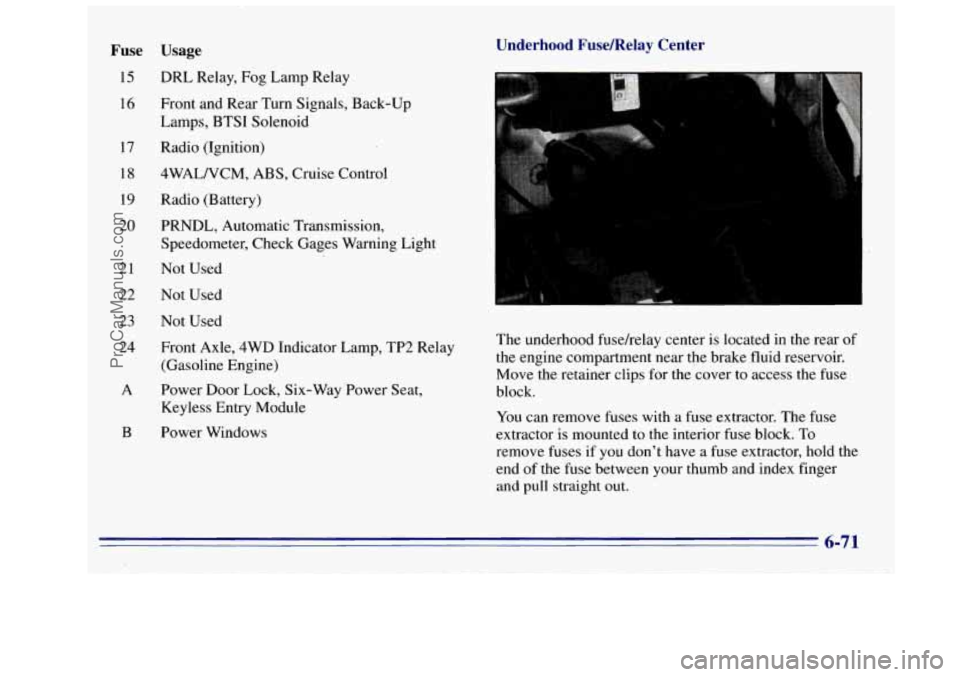
Fuse Usage
15 DRL Relay, Fog Lamp Relay
Underhood Fusemelay Center
16
17
18
19
20
21
22
23 24 Front and Rear Turn
Signals, Back-up
Lamps, BTSI Solenoid
Radio (Ignition)
4WALNCM, ABS, Cruise Control
Radio (Battery)
PRNDL, Automatic Transmission,
Speedometer, Check Gages Warning Light
Not Used
Not Used
Not Used
Front Axle, 4WD Indicator Lamp, TP2 Relay
(Gasoline Engine)
A Power Door Lock, Six-Way Power Seat,
Keyless Entry Module
B Power Windows The underhood
fusehelay center is located in the rear
of
the engine compartment near the brake fluid reservoir.
Move the retainer clips for the cover to access the fuse
block.
You can remove fuses with a fuse extractor. The fuse
extractor
is mounted to the interior fuse block. To
remove fuses if
you don’t have a fuse extractor, hold the
end of the fuse between your thumb and index finger
and
pull straight out.
6-71
ProCarManuals.com
Page 322 of 404
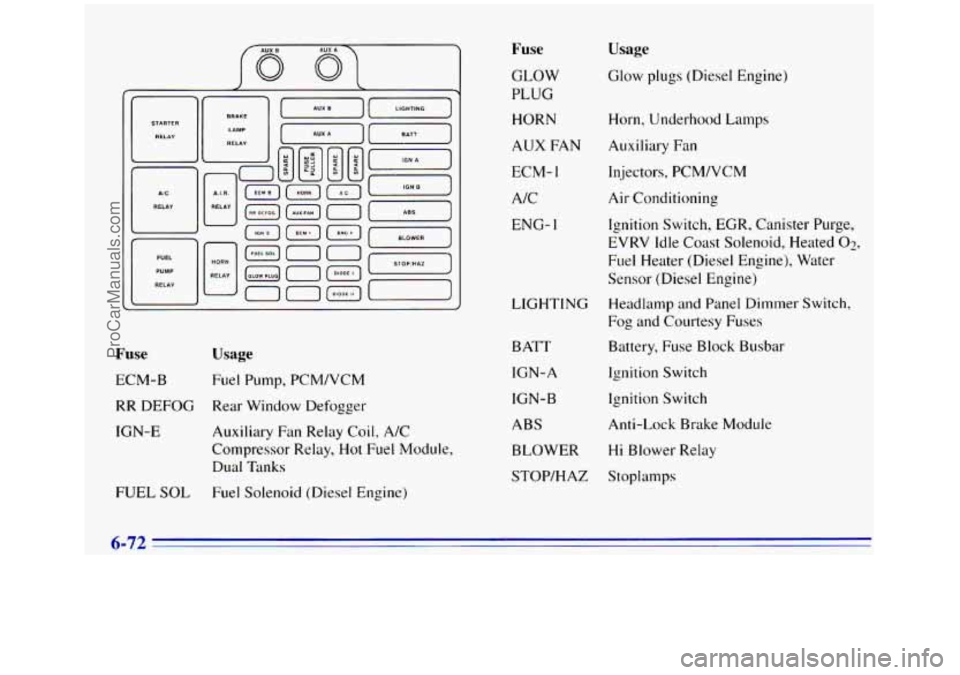
Fuse
ECM-B
Usage
Fuel Pump, PCM/VCM
RR DEFOG Rear Window Defogger
IGN-E Auxiliary Fan Relay Coil, A/C
Compressor Relay, Hot Fuel Module,
Dual Tanks
FUEL SOL Fuel Solenoid (Diesel Engine)
Fuse
GLOW
PLUG
HORN
AUX FAN
ECM-
1
A/C
ENG-
1
Usage
Glow plugs (Diesel Engine)
Horn, Underhood Lamps Auxiliary Fan
Injectors, PCM/VCM
Air Conditioning
Ignition Switch, EGR, Canister Purge,
EVRV Idle Coast Solenoid, Heated
02,
Fuel Heater (Diesel Engine), Water
Sensor (Diesel Engine)
LIGHTING Headlamp and Panel Dimmer Switch,
Fog and Courtesy Fuses
Battery,
Fuse Block Busbar
BATT
IGN-A
IGN-B
ABS Ignition Switch
Ignition Switch
Anti-Lock Brake Module
BLOWER
Hi Blower Relay
STOP/HAZ Stoplamps
ProCarManuals.com
Page 391 of 404
Section 9 Index
I
Accessory Power Outlet ......................... 2-53
AirBag
....................................... 1-21
Adding Equipment
............................ 1 -26
How Does it Restrain .......................... 1-24
How
it Works ................................ 1-23
Location
.................................... 1-23
Readiness Light
......................... 1-22, 2-59
Servicing ................................... 1-26
What Makes
it Inflate .......................... 1-24
What Will
You See After it Inflates ............... 1-24
When Should
it Inflate ......................... 1-23
Aircleaner
.................................... 6-16
Air Cleaner Filter Restriction Indicator Check
........ 7-43
Air Conditioning
................................ 3-3
Air Conditioning Refrigerants
..................... 6-76
Alignment and Balance, Tire
...................... 6-55
Aluminum Wheels, Cleaning
...................... 6-64
Antenna
...................................... 3-24
Antifreeze
..................................... 6-26
Anti-Lock
Brakes
...................................... 4-6
Brake System Warning Light
................ 2-62, 4-6
I
Appearance Care ............................... 6-58
Appearance Care Materials ....................... 6-66
Arbitration Program
.............................. 8-7
Armrest Storage Compartment
.................... 2-51
Ashtrays
...................................... 2-52
Audio Equipment. Adding
........................ 3-23
Audio Systems
.................................. 3-6
Automatic Transmission
......................... 2-11
Check
...................................... 7-43
Fluid
....................................... 6-19
Park Mechanism Check
........................ 7-45
Starting Your Engine
.......................... 2-11
Operation ................................... 2-13
Axle. Front .................................... 6-26
Axle. Locking Rear
............................. 2-21
Axle. Rear .................................... 6-24
Battery
...................................... 6-37
Jump Starting
................................. 5-2
Replacement. Keyless Entry
..................... 2-6
Warnings
................................ 5-2. 5-4
BBB Auto Line
................................. 8-7
Better Business Bureau Mediation ................... 8-7
9-1
ProCarManuals.com