1996 GMC SAVANA wheel torque
[x] Cancel search: wheel torquePage 77 of 372

DRIVE (D): This position is for normal driving. If you
need more power for passing, and you’re:
Going less than about 35 mph (56 km/h), push your
accelerator pedal about halfway down.
Going about 35 mph (56 km/h) or more, push the
accelerator all the way down.
You’ll shift down to the next gear and have more power.
You should use DRIVE
(D) (or, as you need to, a lower
gear) when towing
a trailer. Operating your vehicle in
DRIVE (D) when towing a trailer will minimize heat
build-up and extend the life of your transmission.
THIRD (3): This position is also used for normal
driving, however,
it offers more power and lower fuel
economy than DRIVE
(D). You should use THIRD (3)
when carrying a heavy load or driving on steep hills.
SECOND (2): This position gives you more power
but lower fuel economy.
You can use SECOND (2)
on hills. It can help control your speed as you go
down steep mountain roads, but
then you would also
want to use your brakes off and on. If you manually
select
SECOND (2), the transmission will drive in
second gear. You may use this feature for reducing
torque to the rear wheels when
you are trying to start
your vehicle from a stop on slippery road surfdces.
FIRST (1): This position gives you even more power
(but lower fuel economy) than SECOND
(2). You can
use
it on very steep hills, or in deep snow or mud. If
the selector lever is put in FIRST ( 1)’ the transmission
won’t shift into first gear
until the vehicle is going
slowly enough.
w
NOTICE:
If your rear wheels can’t rotate, don’t try to
drive. This might happen if you are stuck in
very deep sand or mud
or are up against a solid
object. You could damage your transmission.
Also, if you stop when going uphill, don’t hold
your vehicle there with only the accelerator
pedal. This could overheat and damage the
transmission. Use your brakes or shift into
PARK (P) to hold your vehicle in position on
a hill.
2-19
ProCarManuals.com
Page 220 of 372

A CAUTION:
Incorrect wheel nuts or improperly tightenea
wheel nuts can cause the wheel to become loose
and even come off. This could lead to an accident.
Be sure to use the correct wheel nuts.
If you have
to replace them, be sure to get new
GM original
equipment wheel nuts.
Stop, somewhere
as soon as you can and have
the nuts tightened with a torque wrench to
122 lb-ft (165 N-m).
NOTICE:
Improperly tightened wheel nuts can lead to
brake pulsation and rotor damage.
To avoid
expensive brake repairs, evenly tighten the wheel
nuts in the proper sequence and to the proper'
torque specification.
11. Put the wheel cover back on, if you have one.
Remove any wheel blocks.'
Remember that the jack, jacking equipment and tire
must
be properly stored in their original storage
position before you begin driving again. The next
part will show you how.
5-32
ProCarManuals.com
Page 253 of 372

Some driving conditions or climates may cause a brake
squeal when the brakes are first applied or lightly
applied. This does not mean something is wrong with
your brakes.
Free movement
of brake calipers and properly torqued
wheel
nuts are necessary to help prevent brake
pulsation. When tires are rotated, inspect brake calipers
for movement, brake pads for wear, and evenly torque
wheel
nuts in the proper sequence to GM specifications.
Your rear drum brakes don’t have wear indicators, but if
you ever hear
a rear brake rubbing noise, have the rear
brake linings inspected. Also,
the rear brake drums should
be removed and inspected each time the tires are removed
for rotation or changing. When
you have the front brakes
replaced, have
the rear brakes inspected, too.
Brake linings should always be replaced
as complete
axle sets.
:a1 ~ Pedal Travel
see your dealer if the brake pedal does not return to
normal height, or
if there is a rapid increase in pedal
travel. This could be
a sign of brake trouble.
Brake Adjustment
Every time you make a brake stop, your disc brakes
adjust for wear.
If your brake pedal goes down farther than normal, your
rear drum brakes may need adjustment. Adjust them by
backing up and firmly applying the brakes a few times.
6-29
ProCarManuals.com
Page 267 of 372
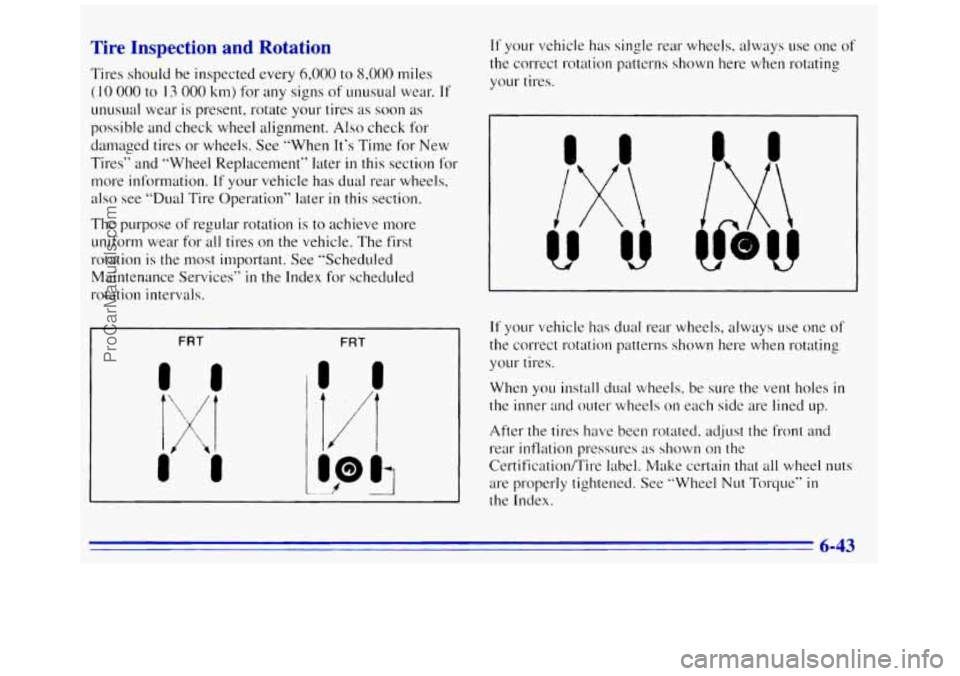
nspectior
1 Ires should be inspected every 6,000 to 8,000 miles
(I 0 000 to 13 000 km) for any signs of unusual wear. If
unusual wear is present, rotate your tires as soon as
possible and check wheel alignment. Also check for
damaged tires
or wheels. See “When It’s Time for New
Tires” and “Wheel Replacement” later
in this section for
more information.
If your vehicle has dual rear wheels,
also see “Dual Tire Operation“ later
in this section.
The purpose of regular rotation is to achieve more
uniform wear
for all tires on the vehicle. The first
rotation is the most important. See “Scheduled
Maintenance Services”
in the Index for scheduled
rotation intervals.
If your vehicle has single rear wheels, always use one of
the correct rotation patterns shown here when rotating
your tires.
If your vehicle has dual rear wheels, always use one of
FRT FRT the. correct rotation patterns shown here when rotating
KC
your tires.
When you install dual wheels, be sure the vent
holes in
the inner and outer wheels on each side are lined up.
After the tires have been rotated, adjust the front and
rear inflation pressures as shown on
the
CertificatidTire label. Make certain that all wheel nuts
are properly tightened. See “Wheel
Nut Torque” in
the Index.
6-43
ProCarManuals.com
Page 269 of 372

Dual Tire Operation
When the vehicle is new, or whenever a wheel, wheel
bolt or wheel
nut is replaced, check the wheel nut torque
after
100, 1,000 and 6,000 miles ( 160, 1 600 and
10 000 km) of driving. For proper torque, see “Wheel
Nut Torque”
in the Index.
The outer tire
on a dual wheel setup generally wears
faster than
the inner tire. Your tires will wear more
evenly and last longer if
you rotate the tires periodically.
If you’re going to be doing a lot of driving on
high-crown roads, you can reduce tire wear by adding
5 psi (35 kPa) to the tire pressure in the outer tires. Be
sure to return
to the recommended pressures when no
longer driving under those conditions. See “Changing a
Flat Tire” in the Index for more information.
A CAUTION:
If you operate your vehicle with a tire that is
badly underinflated, the tire can overheat. An
overheated tire can lose air suddenly
or catch
fire. You or others could be injured. Be sure all
tires (including the spare) are properly inflated.
Buying New Tires
To find out what kind and size of tires you need, look at
the Certification/Tire label.
The tires installed on your vehicle when
it was new had
a Tire Performance Criteria Specification (TPC Spec)
number
on each tire’s sidewall. When you get new tires,
get ones
with that same TPC Spec number. That way
your vehicle will continue to have tires that are designed
to give proper endurance, handling, speed rating,
traction, ride and other things during normal service
on
your vehicle. If your tires have an all-season tread
design, the TPC number will be followed by an
“MS”
(for mud and snow).
If you ever replace your tires with those not having a
TPC Spec number, make sure they are the same size,
load range, speed rating and construction type (bias,
bias-belted or radial) as your original tires.
ProCarManuals.com
Page 273 of 372

NOTICE:
The wrong wheel can also cause problems with
bearing life, brake cooling, speedometer or
odometer calibration, headlamp aim, bumper
height, vehicle ground clearance and tire or tire
chain clearance to the
body and chassis.
Whenever
a wheel, wheel bolt or wheel nut is replaced
on
a dual wheel setup, check the wheel nut torque after
100, 1,000 and 6,000 miles (160, 1 600 and 10 000 km)
of driving. For proper torque, see “Wheel Nut Torque”
in the Index.
See “Changing a Flat Tire” in the Index for
more information. Used
Replacement Wheels
Putting
a used wheel on your vehicle is
dangerous.
You can’t know how it’s been used or
how many miles it’s been driven. It could fail
suddenly and cause an accident. If
you have to
replace a wheel, use a new GM original
equipment wheel.
6-49
ProCarManuals.com
Page 289 of 372

Capacities and Specifications
Normal Maintenance Replacement Parts
Replacement part numbers listed in this section are based on the latest information available at the time of printing,
and are subject
to change. If a part listed in this manual is not the same as the part used in your vehicle when it was
built, or if you have any questions, please contact your GM truck dealer.
These specifications are for information only.
If you have any questions, see the service manual for the chassis or
refer to the body manufacturer’s publications.
Engine Identification -- Gasoline Engines
Type V6 V8
Engine “VORTEC” 4300 ”VORTEC” 5000
VIN Code W M
Fuel System SFI 1 SFI 1
‘Sequential Central Port Fuel Injection
Wheel Nut Torque
MODEL TORQUE
All 122 ft-lb (165 Nem)
“VORTEC” 5700 “VORTEC” 7400
V8
V8
R J
SF1 I SFI’
? -Sequential Multi-Port Fuel Injection
ProCarManuals.com
Page 339 of 372

Part €5: Owner Checks and Services
Listed below are owner checks and services which
should be performed at the intervals specified
to help
ensure the safety, dependability and emission control
performance of your vehicle.
Be sure any necessary repairs are completed at once.
Whenever any fluids or lubricants are added to
your
vehicle, make sure they are the proper ones, as shown
in Part D.
At the First 100, 1,000 and 6,000 Miles
(160,1600
and 10 000 km)
For vehicles with dual wheels, check dual wheel nut
torque. For proper torque, see “Wheel Nut Torque” in
the Index.
Engine Oil Level Check
Check the engine oil level and add the proper oil if
necessary. See “Engine Oil“
in the Index for
further details.
Engine Coolant Level Check
Check the engine coolant level and add the proper
coolant
mix if necessary. See “Engine Coolant” in the
Index
for further details.
Windshield Washer Fluid Level Check
Check the windshield washer fluid level in the
windshield washer tank and add the proper fluid if
necessary. See “Windshield Washer Fluid” in the Index
for further details.
7-43
ProCarManuals.com