Page 201 of 372
A CAUTIO1 . .
Heater and radiator hoses, and other engine
parts, can be very hot. Don’t touch them. If you
do,
you can be burned.
Don’t run the engine if there is a leak. If you run
the engine, it could lose all coolant. That could
cause an engine fire, and you could be burned.
Get any leak fixed before you drive the vehicle.
I NOTICE:
Engine damage from running your engine
without coolant isn’t covered by your warranty.
~~ ~ ~
If there seems to be no leak, start the engine again. See
if the fan speed increases when idle speed is doubled by
pushing
the accelerator pedal down. If it doesn’t, your
vehicle needs service. Turn
off the engine.
How to Add Coolant to the Coolant
Recovery Tank
If you haven’t found a problem yet, but the coolant level
isn’t at the
FULL COLD mark, add a 50150 mixture of
clean water (preferably distilled) and DEX-COOL
(orange-colored, silicate-free) antifreeze at the coolant
recovery tank. (See “Engine Coolant”
in the Index for
more information.)
Adding only plain water
to your cooling system
can be dangerous. Plain water, or some other
liquid like alcohol, can boil before the proper
coolant mix will. Your vehicle’s coolant warning
system is set for the proper coolant mix. With
plain water or the wrong mix, your engine could
get too hot but you wouldn’t get the overheat
warning. Your engine could catch fire and you or
others could be burned. Use
a 50/50 mix of clean
water and DEX-COOL
TM antifreeze.
5-13
ProCarManuals.com
Page 202 of 372
I NOTICE:
In cold weather, water can freeze and crack the
engine, radiator, heater core and other parts. Use the recommended coolant and the proper
coolant mix.
I A CAUTION:
You can be burned if you spill coolant on hot
engine parts. Coolant contains ethylene glycol
and it
will burn if the engine parts are hot
enough. Don’t spill coolant on a hot engine.
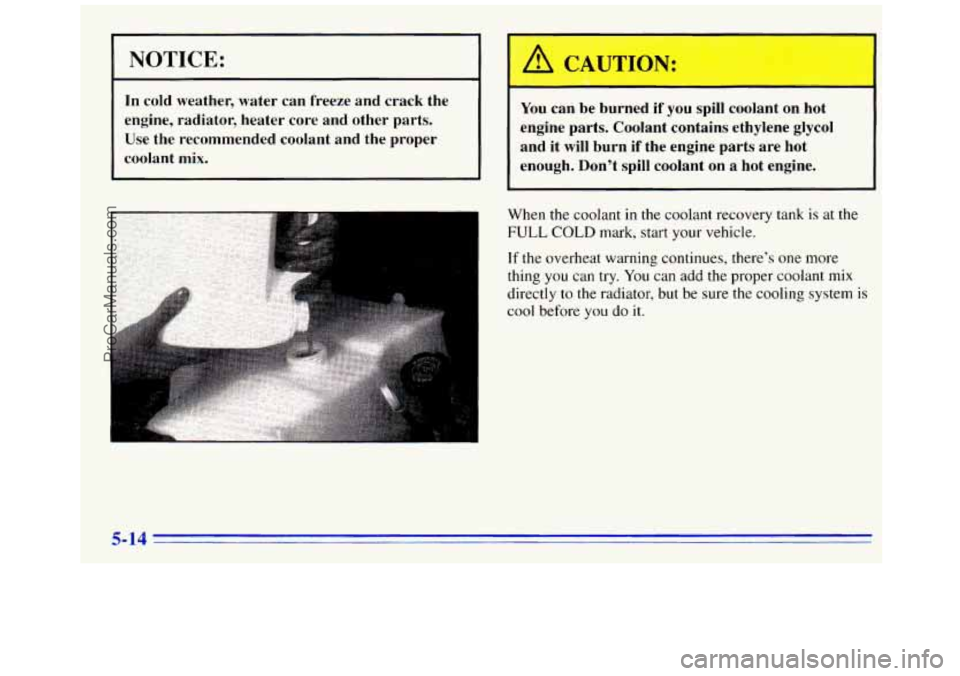
When the coolant
in the coolant recovery tank is at the
FULL COLD mark, start your vehicle.
If the overheat warning continues, there’s one more
thing you can try. You can add the proper coolant mix
directly to the radiator, but be sure the cooling system
is
cool before you do it.
5-14
ProCarManuals.com
Page 203 of 372
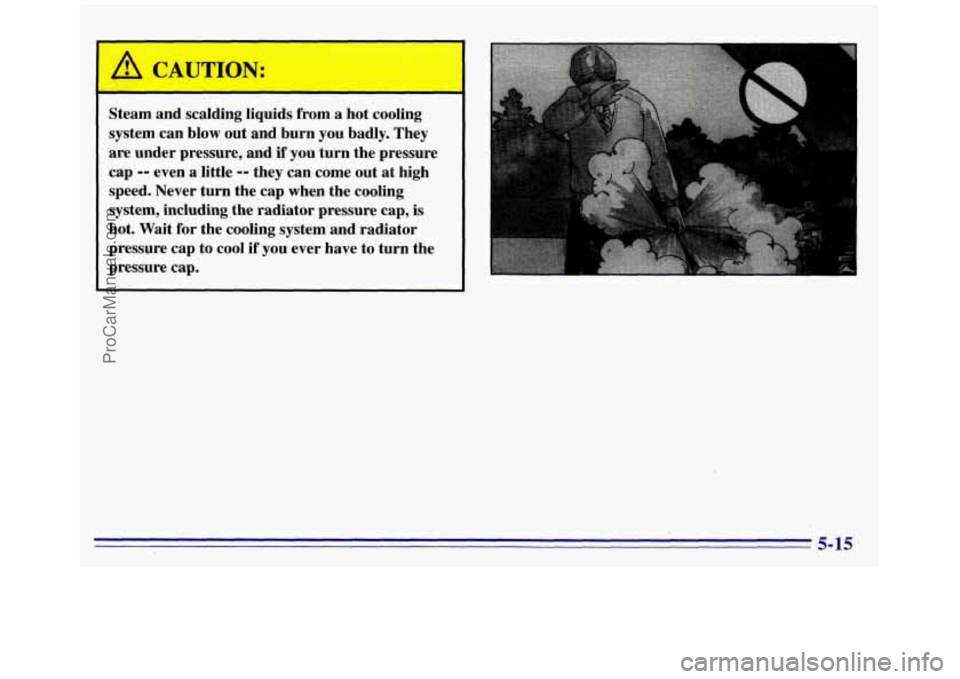
Steam and scalding liquids from a hot cooling
system can blow out and burn
you badly. They
are under pressure, and
if you turn the pressure
cap
-- even a little -- they can come out at high
speed. Never turn the cap when the cooling
system, including the radiator pressure cap,
is
hot. Wait for the cooling system and radiator
pressure cap to cool if you ever have to turn the
pressure cap.
ProCarManuals.com
Page 204 of 372
How to Add Coolant to the Radiator
I
1.
I
2. Then keep turning the pressure cap, but now push
down
as you turn it. Remove the pressure cap.
You can remove the radiator pressure cap when the
cooling system, including the radiator pressure cap
and upper radiator hose,
is no longer hot. Turn the
pressure
cap slowly counterclockwise until it first
stops. (Don’t press down while turning the
pressure cap.)
If you hear a hiss, wait for that to stop. A hiss means
there is still some pressure left.
5-16
ProCarManuals.com
Page 207 of 372
Under heavy vehicle loading, trailer towing andor high
outside temperatures, the fan speed increases as
the clutch
more fully engages.
So you may hear an increase in fan
noise. This is normal and should
not be mistaken as the
transmission slipping or making extra shifts. It is merely
the cooling system functioning properly. The fan will
the clutch partially disengages.
- slow down when additional cooling is not required and
8. Then replace the pressure cap. At any time during
this procedure
if coolant begins to flow out of the
filler neck, reinstall the pressure cap. Be sure the
arrows on
the pressure cap line up like this.
You may also hear this fan noise when you start
the engine.
It will go away as the fan clutch
partially disengages.
5-19
ProCarManuals.com
Page 244 of 372

Engine Coolant
The cooling system in your vehicle is filled with new
DEX-COOL TM (orange-colored, silicate-free) engine
coolant. This coolant is designed to remain
in your
vehicle for
5 years or 100,000 miles (166 000 km),
whichever occurs first.
The following explains your cooling system and how
to
add coolant when it is low. If you have a problem with
engine overheating, see “Engine Overheating” in
the Index.
A 50/50 mixture of water and the proper coolant for
your vehicle will:
Give freezing protection down to -34°F (-37°C).
Give boiling protection up to 265 “F ( 129 O C).
0 Protect against rust and corrosion.
Help keep the proper engine temperature.
Let the warning lights and gages work as they should.
NOTICE:
When adding coolant it is important that you use
DEX-COOL TM (orange-colored, silicate-free)
coolant meeting GM Specification 6277M.
If
silicated coolant is added to the system,
premature engine, heater core or radiator
corrosion may result. In addition, the engine
coolant will require change sooner
-- at
30,000 miles (50 000 km) or 24 months,
whichever occurs first.
6-20
ProCarManuals.com
Page 245 of 372
What to Use
Use a mixture of one-half clean water (preferably
distilled) and one-half
DEX-COOL TM (orange-colored,
silicate-free) antifreeze that meets
GM Specification
6277M, which won’t damage aluminum parts. Use
GM Engine Coolant Supplement (sealer) (GM Part
No. 3634621) with any complete coolant change. If you
use this mixture, you don’t need to add anything else. Adding
only plain water to your cooling system
can be dangerous. Plain water,
or some other
liquid like alcohol, can boil before the proper
coolant mix will. Your vehicle’s coolant warning
system is set for the proper coolant mix. With
plain water or the wrong mix, your engine could get too hot but you wouldn’t get the overheat
warning. Your engine could catch fire and you or
others could be burned. Use a
50/50 mix of clean
water and
DEX-COOL TM (orange-colored,
silicate-free) antifreeze.
6-21
ProCarManuals.com
Page 246 of 372
NOTICE:
~~
If you use an improper coolant mix, your engine
could overheat and be badly damaged. The
repair cost wouldn’t be covered by your
warranty.
Too much water in the mix can freeze
and crack the engine, radiator, heater core and
other parts.
If you have to add coolant more than four times a year,
have your dealer check your cooling system.
I NOTICE:
If you use the proper coolant, you don’t have to
add extra inhibitors or additives which claim to
improve the system. These can be harmful.
Checking Coolant
When your engine is cold, the coolant level should be at
FULL COLD, or a little higher.
6-22
k
ProCarManuals.com