1996 CHEVROLET S10 ECU
[x] Cancel search: ECUPage 58 of 375
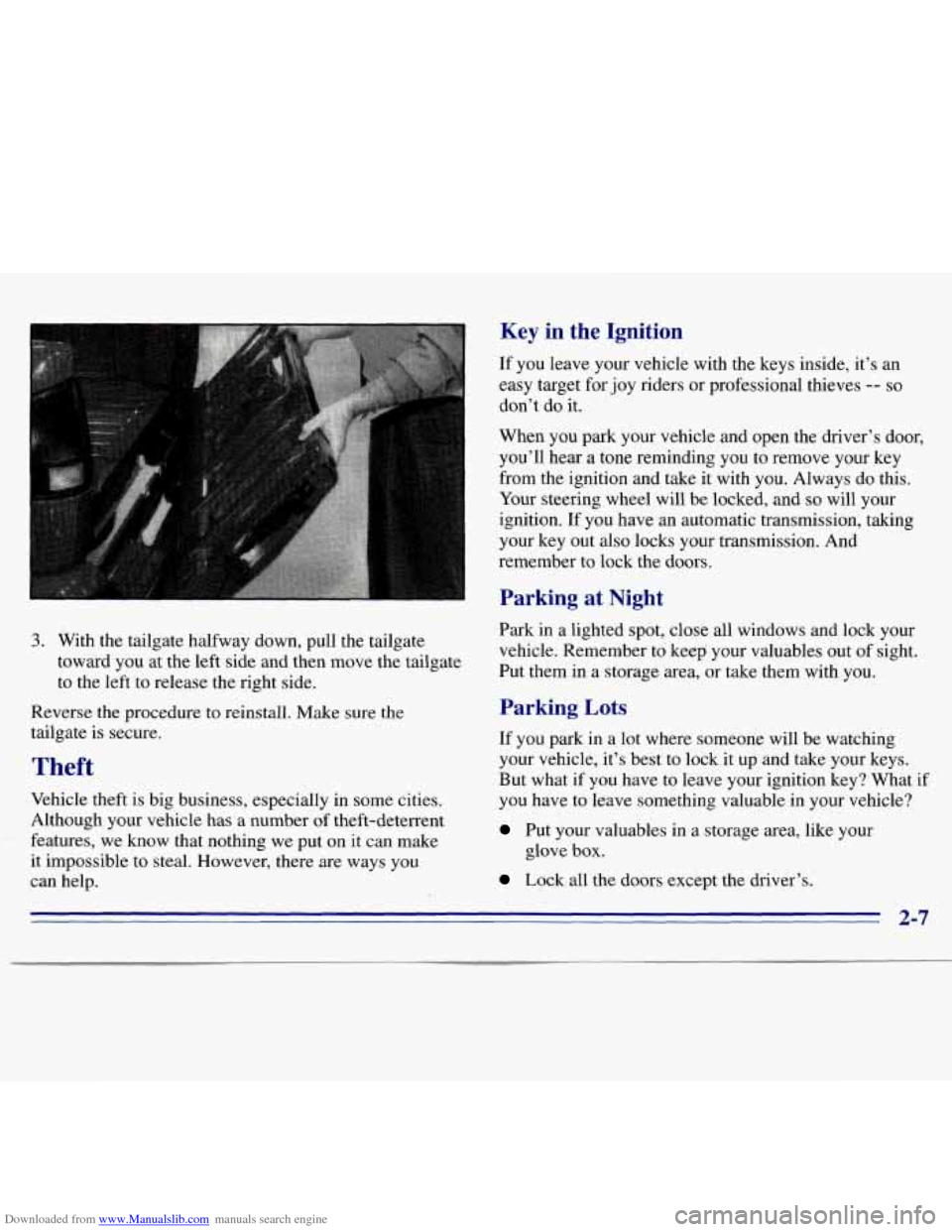
Downloaded from www.Manualslib.com manuals search engine 3. With the tailgate halfway down, pull the tailgate
toward you at the left side and then move the tailgate
to the left to release the right side.
Reverse the procedure to reinstall. Make sure the
tailgate is secure.
Theft
Vehicle theft is big business, especially in some cities.
Although your vehicle has a number
of theft-deterrent
features, we know that nothing we put on it can make
it impossible to steal. However, there are ways you
can help.
Key in the Ignition
If you leave your vehicle with the keys inside, it’s an
easy target for joy riders or professional thieves
-- so
don’t do it.
When you park your vehicle and open the driver’s door,
you’ll hear a tone reminding you to remove your key
from the ignition and take it with you. Always do this.
Your steering wheel will
be locked, and so will your
ignition. If you have
an automatic transmission, taking
your key out
also locks your transmission. And
remember to lock the doors.
Parking at Night
Park in a lighted spot, close all windows and lock your
vehicle. Remember to keep your valuables out of sight.
Put them in a storage area, or take them with you.
Parking Lots
If you park in a lot where someone will be watching
your vehicle, it’s best to lock it up
and take your keys.
But what if you have to leave your ignition key? What if
you have to leave something valuable in your vehicle?
Put your valuables in a storage area, like your
Lock all the doors except the driver’s. glove
box.
2-7
Page 128 of 375
Downloaded from www.Manualslib.com manuals search engine Locking the Theft System
1.
2.
3.
4.
5.
6.
7.
8.
9.
10.
11. Write down
any six-digit number
and keep it in a
safe place separate from the vehicle.
Turn the ignition
to the ACCESSORY or
RUN position.
Press
POWER to turn the radio off.
Press the 1 and 4 buttons together. Hold them down
until
--- shows on the display. Next you will use the
secret code number which you have written down.
Press
SET and 000 will appear on the display.
Press SCAN
to make the first digit appear.
Press SEEK right arrow or SEEK left arrow
to
make the next two digits agree with your code.
Press BAND and
000 will appear on the display
again. Now you are ready
to enter the last three
digits of your code.
Repeat Steps
6 and 7 for the last three digits of
your code.
Press
BAND and the display will show REP for about
five seconds and then 000 will appear on the display.
Repeat Steps
6 through 10. This time the display will
show SEC to let you know that your radio
is secure.
Unlocking the Theft System After a Power Loss
Enter your secret code as follows; pause no more than
15 seconds between steps:
1. Turn the ignition on with the radio off.
2. Press SET and 000 will appear on the display.
3. Press SCAN to make the first digit appear.
4. Press SEEK right arrow or SEEK left arrow to make
the next two digits agree with your code.
5. Press BAND and 000 will appear on the display
again. Now you are ready to enter
the last three
digits
of your code.
6. Repeat Steps 3 and 4 for the last three digits of
7. Press BAND after you have confirmed that the code
matches the secret code you have written down. The
time will be displayed indicating that the system
is
disabled. If the display shows SEC, the numbers
entered did
not match your secret code and the unit
is
still secured.
your code.
When battery power is given
to a secured radio, the
radio won’t turn on and LOC will appear on the display.
3-15
Page 129 of 375
Downloaded from www.Manualslib.com manuals search engine Disabling the Theft System
1.
2.
3.
4.
5.
6.
7.
Press the 1 and 4 buttons together for five seconds
with the ignition on but the radio off.
SEC will
appear on the display to show that the unit is in the
secure mode.
Press SET and
000 will appear on the display.
Press
SCAN to make the first digit appear.
Press
SEEK right arrow or SEEK left arrow to make
the next two digits agree with your code. The display
will show the numbers you entered.
Press
BAND and 000 will appear on the display.
Enter the second three digits
of the code. The display
will show the numbers you entered.
Press
BAND. The disabling sequence was correct
if
--- shows on the display. The disabling sequence
was incorrect if
SEC shows on the display.
Understanding Radio Reception
FM Stereo
FM stereo will give you the best sound. But FM signals
will reach only about 10
to 40 miles ( 16 to 65 km). Tall
buildings or hills can interfere with FM signals, causing
the sound
to come and go.
AM
The range for most AM stations is greater than for FM,
especially at night. The longer range, however, can
cause stations
to interfere with each other. AM can pick
up noise from things like storms and power lines. Try
reducing the treble to reduce this noise if you ever get it.
3-16
Page 145 of 375
Downloaded from www.Manualslib.com manuals search engine ~ ~~ . ~ ~~
Before You GO Off-Roading
There are some things to do before
you go out. For
. example, be sure to have all necessary maintenance and
service work done. Check to make sure all underbody
shields (if
so equipped) are properly attached. Be sure
you read all the information about your four-wheel-drive
, ‘ vehicle in this manual. Is there enough fuel? Is the spare
tire fully inflated? Are the fluid levels up where they should be? What are the local laws that apply to
off-roading where you’ll be driving?
If you don’t know,
- you should check with law enforcement people in the
area. Will you be
on someone’s private land? If so, be
sure to get the necessary permission.
Loading Your Vehicle for Off-Road Driving
There are some important things to remember about
how to load your vehicle.
The heaviest things should be on the load floor and
, forward of your rear axle. Put heavier items as far
forward as you can.’
Be’ sure the load is secured properly, so driving on
’ the off-road ten@ doesn’t toss things around. Cargo on the load floor
piled higher than
the seatbacks can be thrown forward
during
a sudden stop. You or your
passengers could be injured. Keep cargo
below the top of the seatbacks.
Unsecured cargo on the load floor can be
tossed about when driving over rough
terrain. You or your passengers can be
struck by flying objects. Secure the
cargo properly.
Heavy loads on the roof raise the vehicle’s
center of gravity, making it more likely to
roll over.
You can be seriously or fatally
injured if the vehicle rolls over. Put heavy
loads inside the cargo area, not on the roof. Keep cargo in the cargo area
as far forward
and low
as possible.
You’ll find other important information
in this manual.
See “Vehicle Loading,” “Luggage Carrier” and “Tires”
in the Index.
4-14
Page 168 of 375
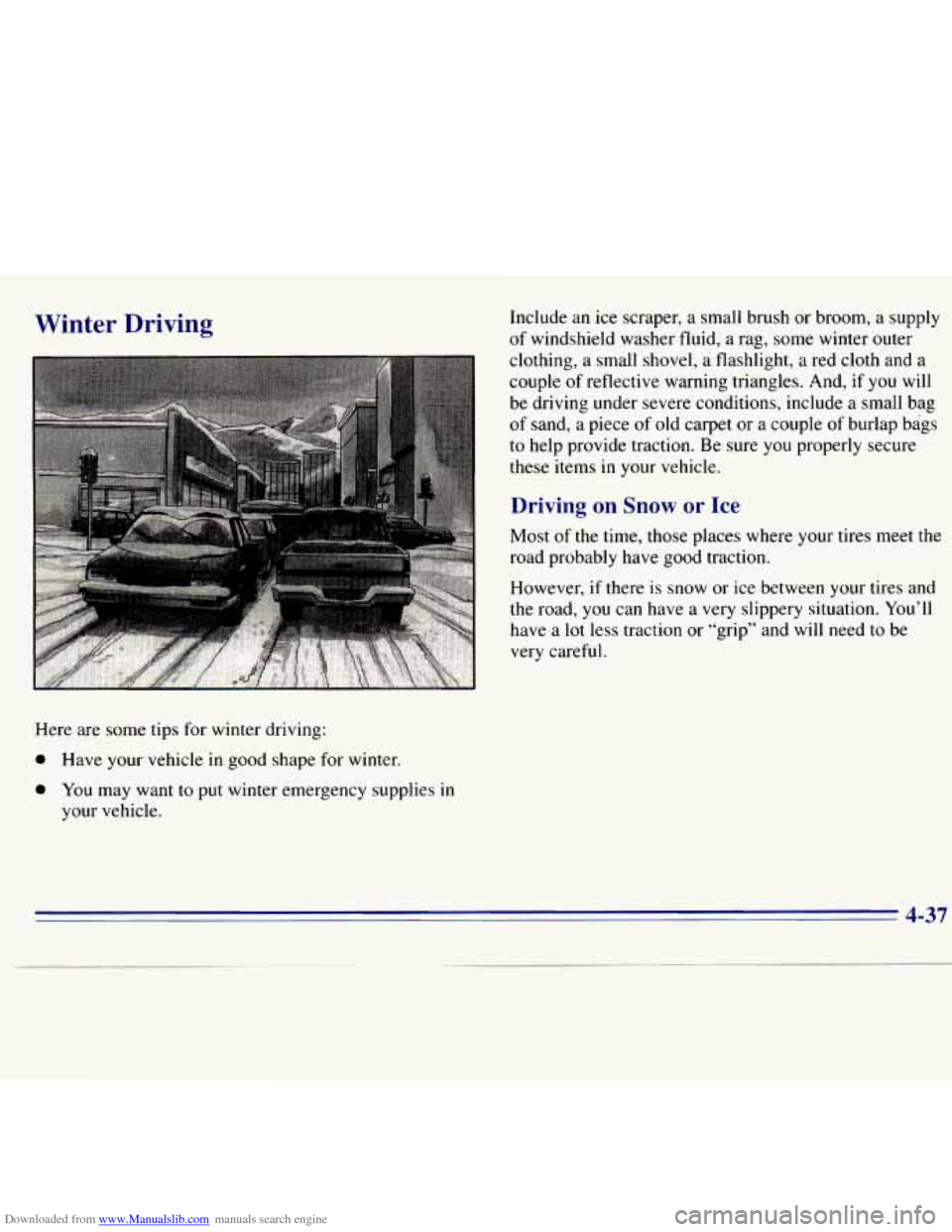
Downloaded from www.Manualslib.com manuals search engine Winter Driving Include an ice scraper, a small brush, or broom, a supply
of windshield washer fluid, a rag, some winter outer
clothing, a small shovel, a flashlight, a red cloth and a
couple
of reflective warning triangles. And, if you will
be driving under severe conditions, include
a small bag
of sand, a piece of old carpet or a couple of burlap bags
to help provide traction. Be sure you properly secure
these items
in your vehicle.
Driving on Snow or Ice
Most of the time, those places where your tires meet the
road probably have good traction.
However, if there
is snow or ice between your tires and
the road,
you can have a very slippery situation. You’ll
have a
lot less traction or “grip” and will need to be
very careful.
Here are some tips for winter driving:
0 Have your vehicle in good shape for winter.
0 You may want to put winter emergency supplies in
your vehicle.
4-37
Page 173 of 375
Downloaded from www.Manualslib.com manuals search engine Loading Your Vehicle
< SEE OWNER'S MANUAL FOR ADDITIONAL INFORMATION uu-
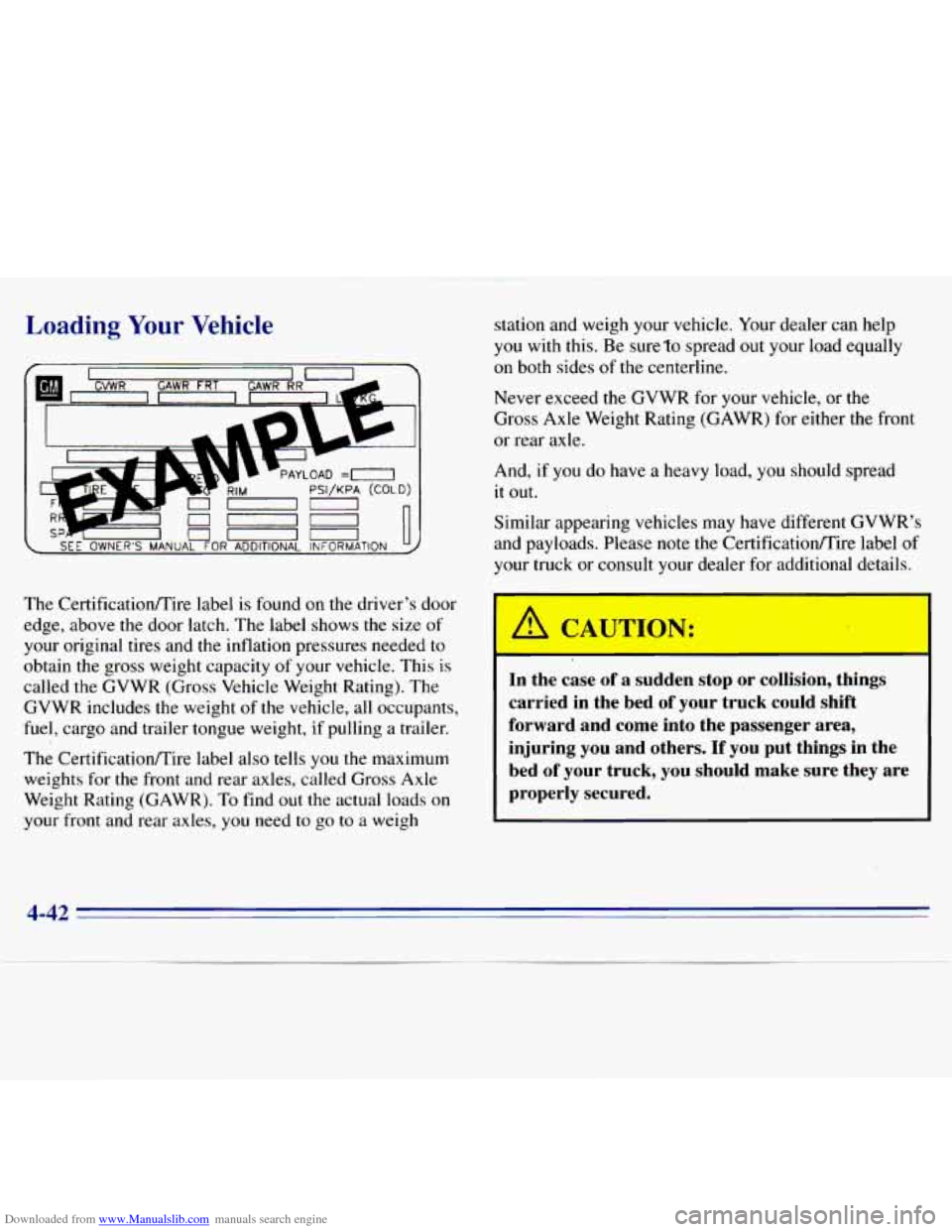
The CertificatiodTire label is found on the driver's door
edge, above
the door latch. The label shows the size of
your original tires and the inflation pressures needed to
obtain the gross weight capacity of your vehicle. This is
called the GVWR (Gross Vehicle Weight Rating). The
GVWR includes the weight
of the vehicle, all occupants,
fuel, cargo and trailer tongue weight, if pulling a trailer.
The Certificationmire label also
tells you the maximum
weights for the front and rear axles, called Gross Axle
Weight Rating (GAWR). To find out the actual loads
on
your front and rear axles, you need to go to a weigh station and weigh your vehicle.
Your dealer can help
you with this. Be sure'to spread out your load equally
on both sides of the centerline.
Never exceed the GVWR for your vehicle, or
the
Gross Axle Weight Rating (GAWR) for either the front
or rear axle.
And, if you do have a heavy load, you should spread
it out.
Similar appearing vehicles may have different GVWR's
and payloads. Please note the Certificationire label
of
your truck or consult your dealer for additional details.
I
. A CAUTION:
I
In the case of a sudden stop or collision, things
carried in the bed of your truck could shift
forward and come into the passenger area,
injuring you and others.
If you put things in the
bed of your truck, you should make, sure they are
properly secured.
4-42
Page 174 of 375
Downloaded from www.Manualslib.com manuals search engine ’ A CAUTIGA:
Do not load your vehicle any heavier than the
GVWR, or either the maximum front or rear
GAWR.
If you do, parts on your vehicle can
break, or it can change the
way your vehicle
handles. These could cause you to lose control.
Also, overloading can shorten the life of
your vehicle.
Using heavier suspension components to get added
durability might
not change your weight ratings. Ask
your dealer
to help you load your vehicle the right way.
NOTICE:
Your warranty does not cover parts or
components that fail because
of overloading. If
you put
things inside your vehicle -- like suitcases,
tools, packages, or anything else
-- they will go as fast
as the vehicle goes. If
you have to stop or turn quickly,
or
if there is a crash, they’ll keep going.
Things you put inside your vehicle can strike
and injure people in a sudden stop or turn, or in
a crash.
0 Put things in the cargo area of your vehicle.
0 Never stack heavier things, like suitcases,
Try to spread the weight evenly.
inside the vehicle
so that some of them are
above the tops
of the seats.
0 Don’t leave an unsecured child restraint in
your vehicle.
When you carry something inside the
vehicle, secure it whenever you can.
There’s also important loading information for off-road
driving in this manual. See “Loading Your Vehicle” in
the Index.
Page 175 of 375
Downloaded from www.Manualslib.com manuals search engine 2-Tiered Loading
By positioning four 2” x 6” wooden planks across the
width of the pickup box, you can create an upper load
platform. The planks
must be inserted in the pickup box
depressions. The length of the planks must allow for at
least a
314 inch bearing surface on each end of the plank.
When using this upper load platform, be sure the load is
securely tied down to prevent
it from shifting. The
load’s center
of gravity should be positioned in a zone
over the rear axle. The zone is located
in the area
between the front
of each fenderwell and the rear of
each fenderwell. The center of gravity height must not
extend above
the top of the pickup box flareboard.
Any load that extends beyond the vehicle’s taillamp area
must be properly marked according to local laws and
regulations.
Remember not to exceed the Gross Axle Weight Rating
(GAWR) of the rear axle. See “Loading Your Vehicle”
in the Index.
Payload
The payload capacity is shown on the Certification/Tire
label. This is the maximum load capacity that your
vehicle can carry. Be sure to include the weight of the
occupants as part of your load. If you added any
accessories or equipment after your vehicle left the
factory, remember
to subtract the weight of these things
from the payload. Your dealer can help you with this.
Add-on Equipment
When you carry removable items, you may need to put a
limit on how many people you carry inside your vehicle.
Be sure to weigh your vehicle before you buy and install
the new equipment.
NOTICE:
I
Your warranty doesn’t cover parts or
components that fail because of, overloading.
4-44
~ .~ .