Page 200 of 376
Downloaded from www.Manualslib.com manuals search engine Front Towing
A towing dolly must be used under the drive wheels
when towing from the
front.
Tow Limits -- 35 mph (56 km/h), 50 miles (80 km)
NOTICE:
Do not tow with sling-type equipment or the
front bumper system will be damaged. Use
wheel-lift or car-carrier equipment. Additional
ramping may be required for car-carrier
equipment. Use safety chains and wheel straps.
Towing a vehicle over rough surfaces could
damage
a vehicle or wheel-lift equipment.
To help avoid damage, install
a towing dolly
a,nd raise the vehicle until adequate clearance
is obtained between the ground and/or
wheel-lift equipment.
Page 201 of 376
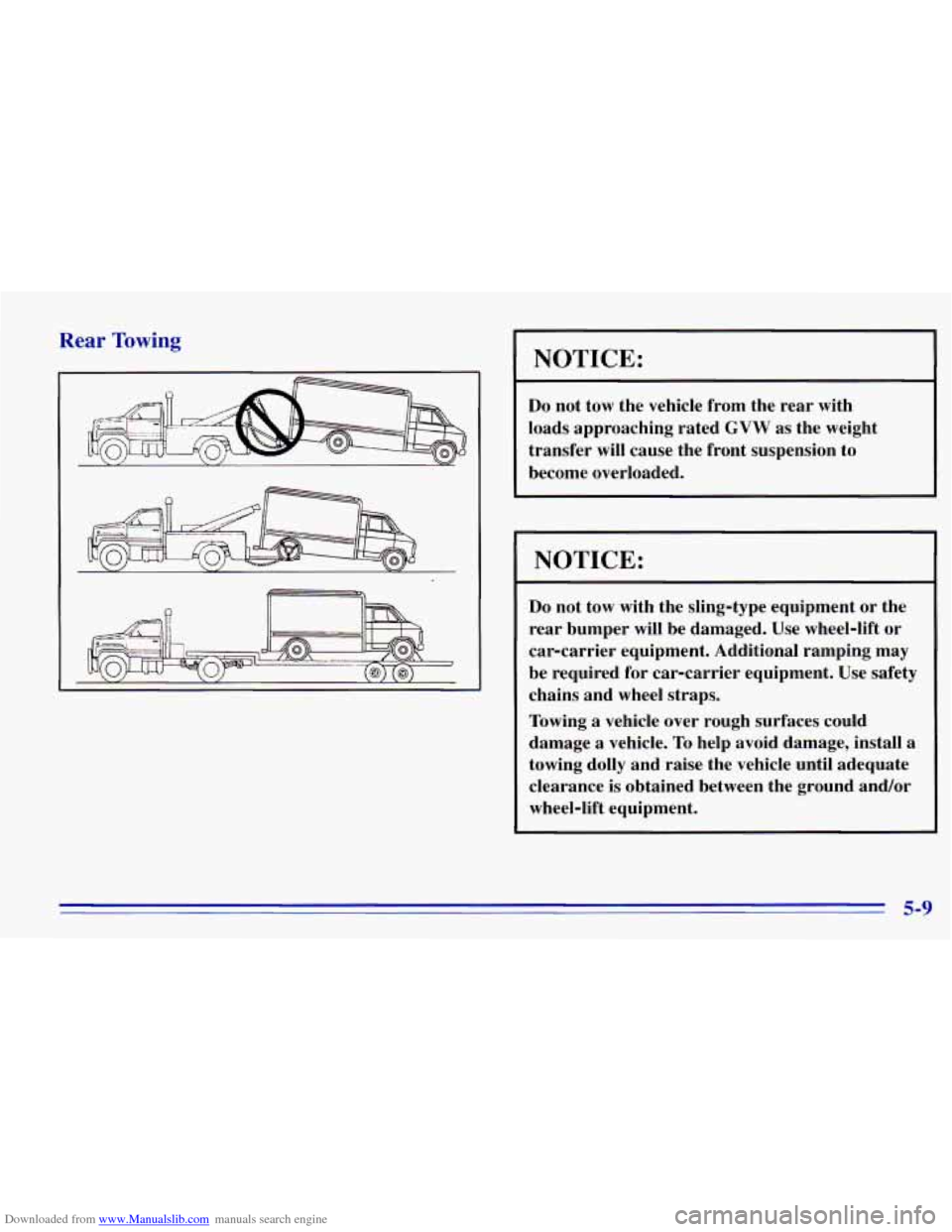
Downloaded from www.Manualslib.com manuals search engine Rear Towing
NOTICE:
Do not tow the vehicle from the rear with
loads approaching rated
GVW as the weight
transfer will cause the front suspension to
become overloaded.
NOTICE:
Do not tow with the sling-type equipment or the
rear bumper will be damaged. Use wheel-lift
or
car-carrier equipment. Additional ramping may
be required for car-carrier equipment. Use safety
chains and wheel straps.
Towing a vehicle over rough surfaces could
damage
a vehicle. To help avoid damage, install a
towing dolly and raise the vehicle until adequate
clearance is obtained between the ground and/or
wheel-lift equipment.
5-9
Page 211 of 376

Downloaded from www.Manualslib.com manuals search engine 8. Then replace the pressure cap. At any time during
this procedure
if coolant begins to flow out of the
filler neck, reinstall the pressure cap. Be sure the
arrows
on the pressure cap line up like this.
Engine Fan Noise
Your vehicle has a clutched engine cooling fan. When the
clutch is engaged,
the fan spins faster to provide more air
to cool the engine. In most every day driving conditions,
the fan
is spinning slower and clutch is not fully engaged.
This improves fuel economy and reduces fan noise.
Under heavy vehicle loading, trailer towing and/or high
outside temperatures, the fan speed increases
as the clutch
more
fully engages. So you may hear an increase in fan
noise. This
is normal and should not be mistaken as the
transmission slipping
or making extra shifts. It is merely
the cooling system functioning properly. The fan will
slow down when additional cooling is not required and
the clutch partially disengages.
You may also hear this Fan noise when you start
the engine. It will go away as the fan clutch
partially disengages.
5-19
Page 214 of 376

Downloaded from www.Manualslib.com manuals search engine NOTICE:
Never remove or restore a tire frondto a stowage
position under the vehicle while the vehicle
is
supported by a jack. Always tighten the tire
fully against the underside of the vehicle when restowing
A flat rear tire reduces clearance to remove the spare
tire. If there is less than
12 inches (30.48 cm) between
the ground and the rear bumper or any trailer hitch, jack
up the vehicle
until the flat tire is off the ground.
(See “Removing
the Flat Tire” and “Installing the
Spare Tire,’’ Steps
4 through 8, in this section.)
Unless your vehicle has a flat rear tire, do not remove
or
restore a tire from/to a stowage position under the
vehicle while the vehicle is supported by a jack. Always
tighten the tire
fully against the underside of the vehicle
when restowing.
If you have a vehicle which was completed from a cab
and chassis, refer to the information from the body
suppliedinstaller.
The spare tire
is a full size tire, like the other tires on
your vehicle.
For cargo vans, the jack
is secured
in the rear
Remove the retaining wing bolt and lift
it off the
mounting bracket. Set the jack and jacking equipment
near the
flat tire.
5-22
Page 228 of 376
Downloaded from www.Manualslib.com manuals search engine I NOTICE:
Spinning your wheels can destroy parts of your vehicle as well as the tires. If you spin the wheels
too fast while shifting your transmission back
and forth, you can destroy your transmission.
~ ~ ~~
For information about using tire chains on your vehicle,
see “Tire Chains” in the Index.
Rocking your vehicle to get it out:
First, turn your steering wheel left and right. That will
clear the area around your front wheels. Then shift back
and forth between REVERSE (R) and
a forward gear,
spinning the wheels as little as possible. Release
the
accelerator pedal while you shift, and press lightly on
the accelerator pedal when the transmission is in gear. If
that doesn’t get
you out after a few tries, you may need
to be towed out. If you do need to be towed out, see
“Towing Your Vehicle”
in the Index.
5-36
Page 244 of 376

Downloaded from www.Manualslib.com manuals search engine Automatic Transmission Fluid
When to Check and Change
A good time to check your automatic transmission fluid
level is when the engine oil is changed.
Change both the fluid and filter every
50,000 miles
(83
000 km) if the vehicle’s GVWR is over 8,600 or
if
the vehicle is mainly driven under one or more of
these conditions:
0 In heavy city traffic where the outside temperature
0 In hilly or mountainous terrain.
regularly reaches
90°F (32°C) or
higher.
0 When doing frequent trailer towing.
0 Uses such as found in taxi, police or delivery service.
If your vehicle’s
GVWR is not over 8,600 and you do
not use your vehicle under any
of these conditions, the
fluid and filter do
not require changing.
See “Scheduled Maintenance Services” in the Index.
How to Check
.Because this operation can be a little difficult, you
may choose to have this done at your GM dealer
Service Department.
If you do it yourself, be sure
to follow all the
instructions here, or you could get a false reading
on
the dipstick.
NOTICE:
Too much or too little fluid can damage your
transmission. Too much can mean that some of
the
fluid could come out and fall on hot engine
parts or exhaust system parts, starting a fire. Be
sure to get an accurate reading if you check your
transmission
fluid.
6-16
-
Page 304 of 376

Downloaded from www.Manualslib.com manuals search engine Maintenance Schedule
I Short Trip/City Definition -- Gasoline Engines
Follow the Short TripKity Maintenance Schedule if any
one of these conditions is true for your vehicle:
Most trips are less than 5 to 10 miles (8 to 16 km).
I
This is particularly important when outside
temperatures are below freezing.
Most trips include extensive idling (such as frequent
driving in stop-and-go traffic).
Most trips are through dusty areas.
You frequently tow a trailer or use a carrier on top of
You frequently tow a trailer or use a carrier on top of
your vehicle. (With some models, you should never
tow a trailer. See “Towing a Trailer” in
the Index.)
If the vehicle is used for delivery service, police, taxi
or other commercial application.
your vehicle.
One of the reasons you should
follow this schedule (f
you operate your vehicle under any of these conditions
is that these conditions cuuse engine oil to break
down soonex
Short Trip/City Intervals -- Gasoline Engines
Every
3,000 Miles (5 000 km): Engine Oil and Filter
Change (or
3 months, whichever occurs first). Chassis
Lubrication (or
3 months, whichever occurs first).
Drive
Axle Service (or 3 months, whichever
occurs first).
1
At 6,000 Miles (10 000 km) -- Then Every
12,000 Miles
(20 000 km): Tire Rotation.
Every 15,000 Miles (25 000 km): Air Cleaner Filter
Inspection,
if driving in dusty conditions. Shields and
Underhood Insulation Inspection (GVWR above
8,500 Ibs. only). Thermostatically Controlled Engine
Cooling Fan Check (or every
12 months, whichever
occurs first). Front Wheel Bearing Repack (or at each
brake relining, whichever occurs first).
Every 30,000 Miles (50 000 km): Air Cleaner Filter
Replacement. Fuel Filter Replacement.
Every 50,000 Miles (83 000 km): Automatic
Transmission Service (vehicles over
8600 GVWR
or driven under severe conditions only).
Page 307 of 376

Downloaded from www.Manualslib.com manuals search engine Short TripKity Maintenance Schedule -- Gasoline Engines I
The services shown in this schedule up to 100,000 miles
(166 000 km) should be performed after 100,000 miles
(166 000 km) at the same intervals.
Footnotes
The U.S. Environmental Protection Agency or the
California Air Resources Board has determined that the
failure
to perform this maintenance item will not nullify
the emission warranty or limit recall liability prior to the
completion
of the vehicle’s useful life. We, however,
urge that all recommended maintenance services be
performed at the indicated intervals and the maintenance
be recorded.
# Lubricate the front suspension, kingpin bushings,
steering linkage and rear driveline center splines.
** Drive axle service:
0
0
0
Locking Differential -- Drain fluid and refill at first
engine
oil change. At subsequent oil changes, check
fluid level and add fluid as needed. If driving in
dusty areas
or towing a trailer, drain fluid and refill
every
15,000 miles (25 000 km).
Standard Differential -- Check fluid level and add
fluid as needed at every oil change. If driving in
dusty areas
or towing a trailer, drain fluid and refill
every
15,000 miles (25 000 km).
More frequent lubrication may be required for
heavy-duty use.
7-7