Page 218 of 386
Downloaded from www.Manualslib.com manuals search engine Removing the Flat Tire and Installing the
Spare Tire
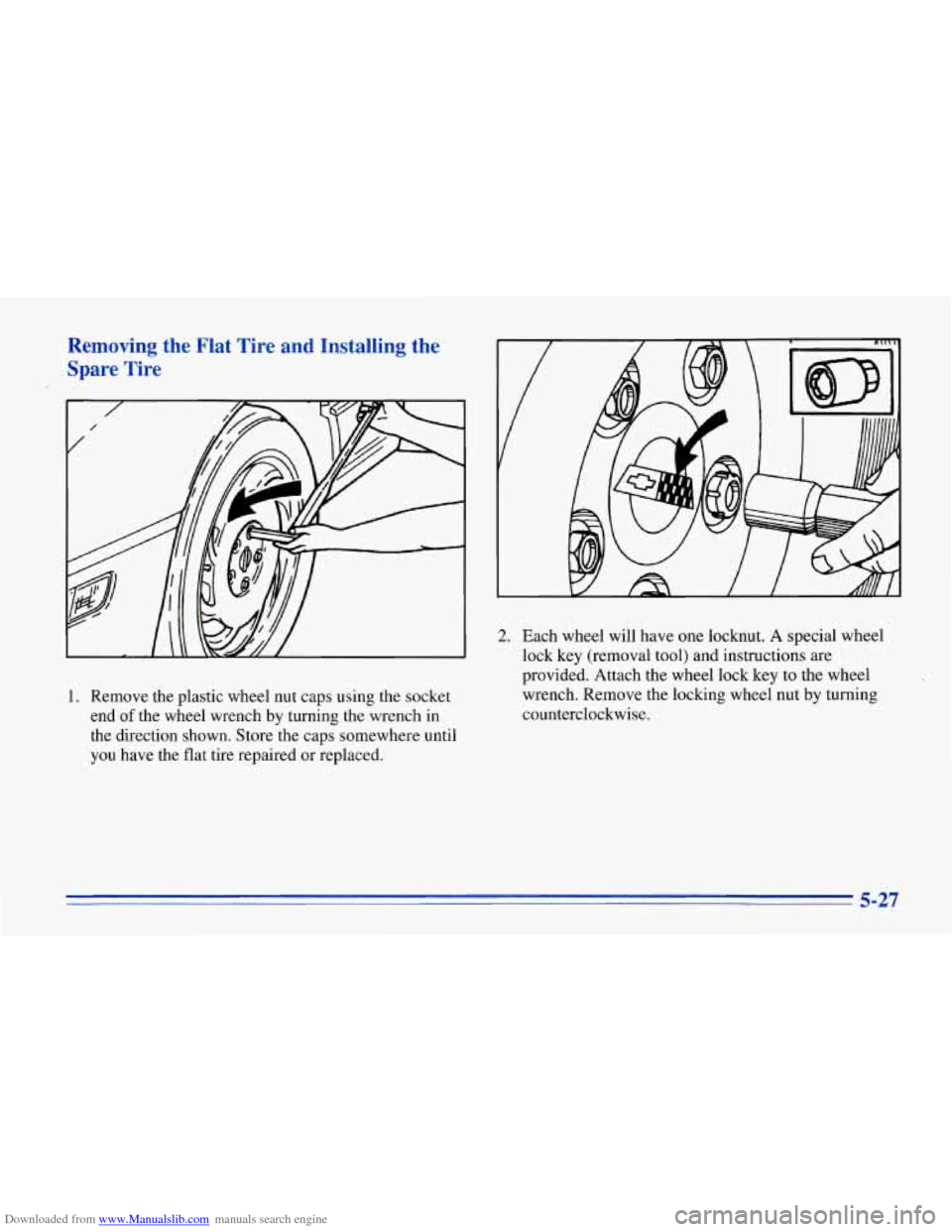
1. Remove the plastic wheel nut caps using the socket
end
of the wheel wrench by turning the wrench in
the direction shown. Store the caps somewhere until
you have the flat tire repaired or replaced.
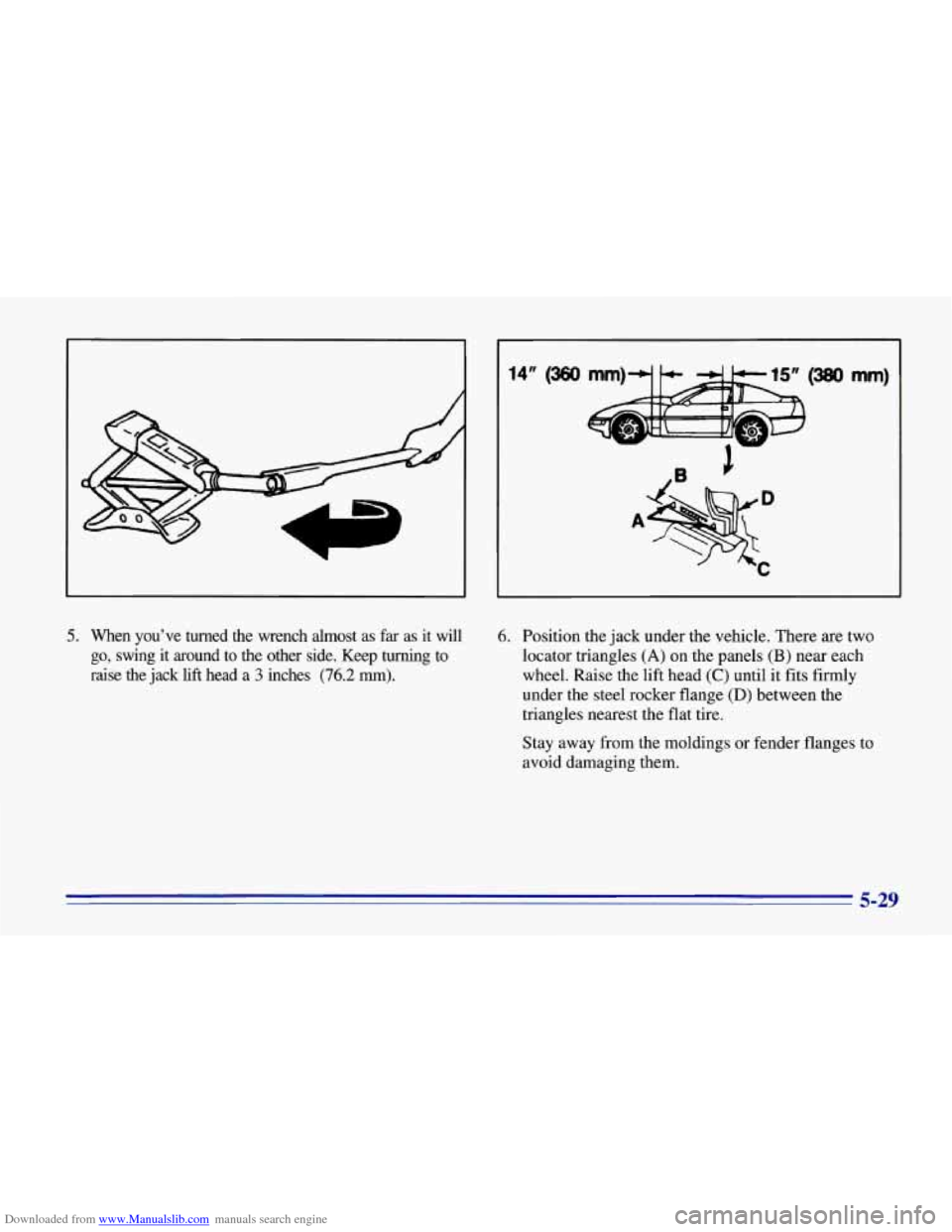
2. Each wheel will have one locknut. A special wheel
lock key (removal tool)
and instructions are
provided. Attach the wheel lock key to the wheel
wrench. Remove the locking wheel nut by turning
counterclockwise.
5-27
Page 220 of 386
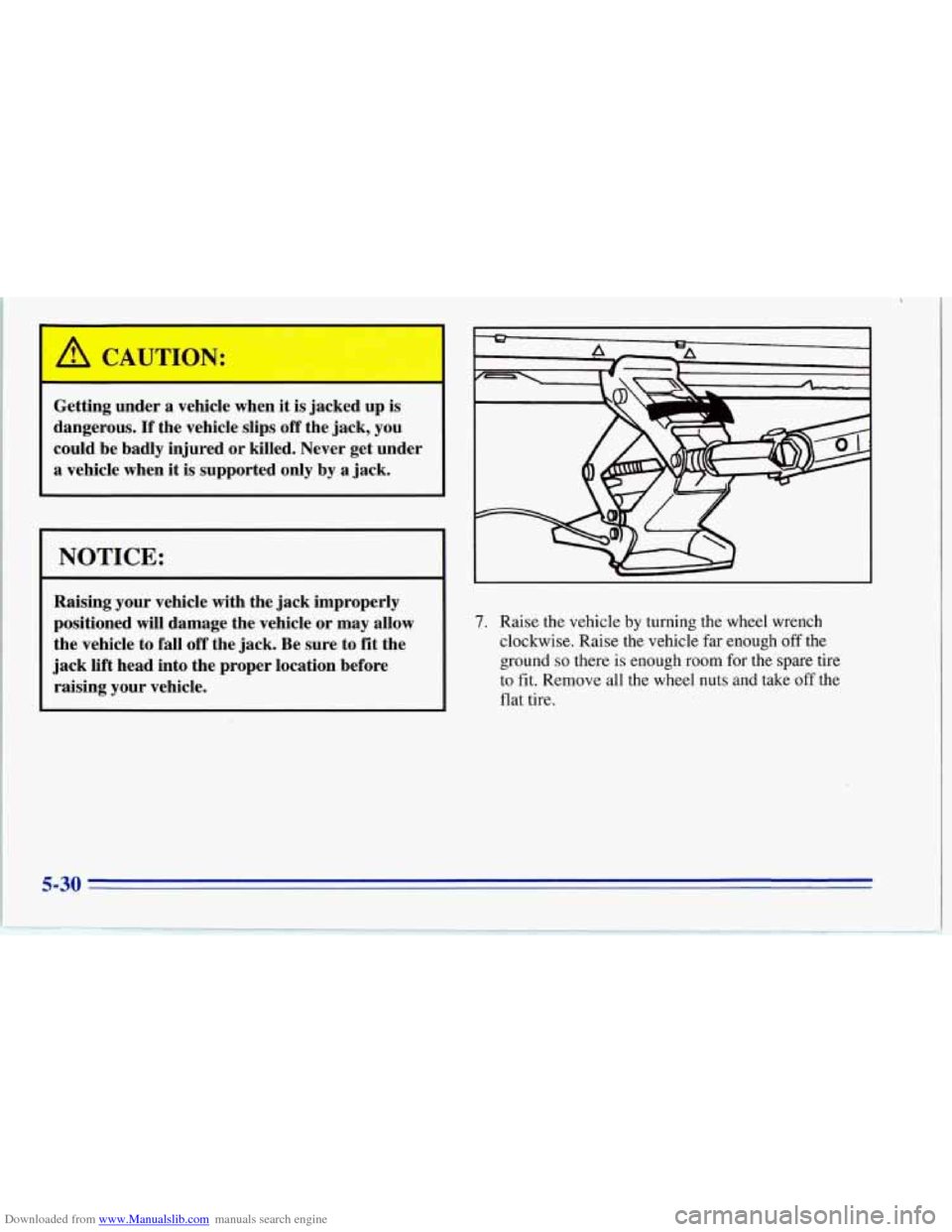
Downloaded from www.Manualslib.com manuals search engine 5. When you’ve turned the wrench almost as far as it will
go, swing it around to the other side. Keep turning to
raise the jack
lift head a 3 inches (76.2 mm).
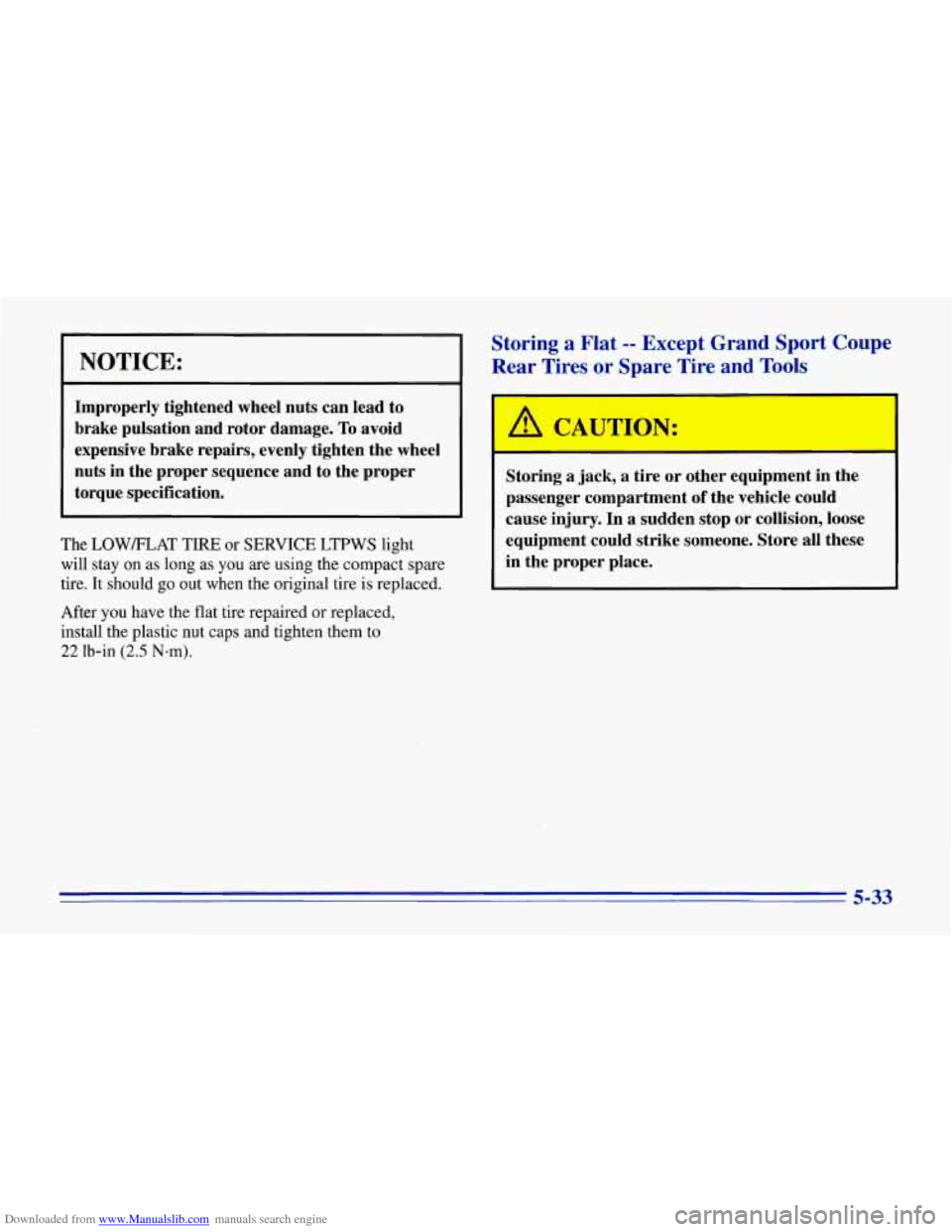
6. Position the jack under the vehicle. There are two
locator triangles
(A) on the panels (B) near each
wheel. Raise the lift head
(C) until it fits firmly
under the steel rocker flange
(D) between the
triangles nearest the flat tire.
Stay away from the moldings or fender flanges to
avoid damaging them.
5-29
Page 221 of 386
Downloaded from www.Manualslib.com manuals search engine Getting under a vehicle when it is jacked up is
dangerous.
If the vehicle slips off the jack, you
could be badly injured or killed. Never get under
a vehicle when it is supported only by a jack.
NOTICE:
Raising your vehicle with the jack improperly
positioned will damage the vehicle or may allow
the vehicle to fall off the jack. Be sure to fit the
jack lift head into the proper location before
raising your vehicle.
7. Raise the vehicle by turning the wheel wrench
clockwise. Raise the vehicle
far enough off the
ground
so there is enough room for the spare tire
to fit. Remove all the wheel
nuts and take off the
flat tire.
5-30
-
Page 224 of 386
Downloaded from www.Manualslib.com manuals search engine NOTICE:
Improperly tightened wheel nuts can lead to
brake pulsation and rotor damage.
To avoid
expensive brake repairs, evenly tighten the wheel
nuts in the proper sequence and to the proper
torque specification.
The LOWPLAT TIRE or SERVICE LTPWS light
will stay on as long as
you are using the compact spare
tire. It should
go out when the original tire is replaced.
After you have the flat tire repaired or replaced,
install the plastic nut caps and tighten them to
22 lb-in (2.5 N-m).
Storing a mat -- Except Grand Sport Coupe
Rear Tires
or Spare Tire and Tools
-A
,A CAUTION:
Storing a jack, a tire or other equipment in the
passenger compartment
of the vehicle could
cause injury. In a sudden stop or collision, loose
equipment could strike someone. Store all these
in the proper place.
5-33
Page 225 of 386
Downloaded from www.Manualslib.com manuals search engine I1
i
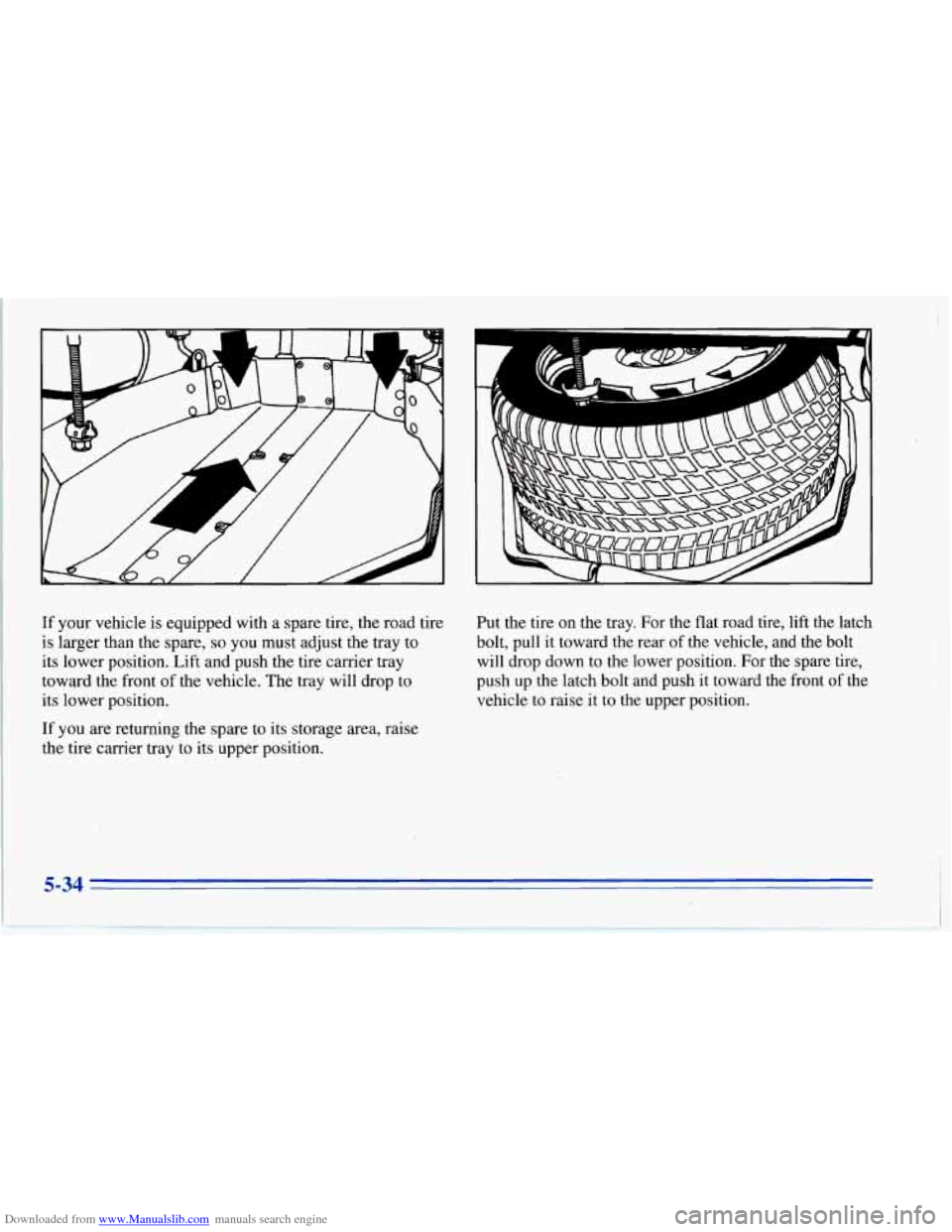
If your vehicle is equipped with a spare tire, the road tire
is larger than the spare,
so you must adjust the tray to
its lower position. Lift and push the tire carrier tray
towqrd the front
of the vehicle. The tray will drop to
its lower position.
If you are returning the spare to its storage area, raise
the tire carrier tray to its upper position. Put
the tire
on the tray. For the flat road tire, lift the latch
bolt, pull it toward the rear
of the vehicle, and the bolt
will drop down to the lower position. For the spare tire,
push up the latch bolt and push it toward the front
of the
vehicle to raise it to the upper position.
5-34
Page 227 of 386
Downloaded from www.Manualslib.com manuals search engine Storing a Flat Grand Sport Coupe Rear
Tire and
Tools
Storing a jack or other equipment in the
passenger compartment
of the vehicle could
cause injury. In a sudden stop or collision, loose
equipment could strike someone. Store all these
in the proper place.
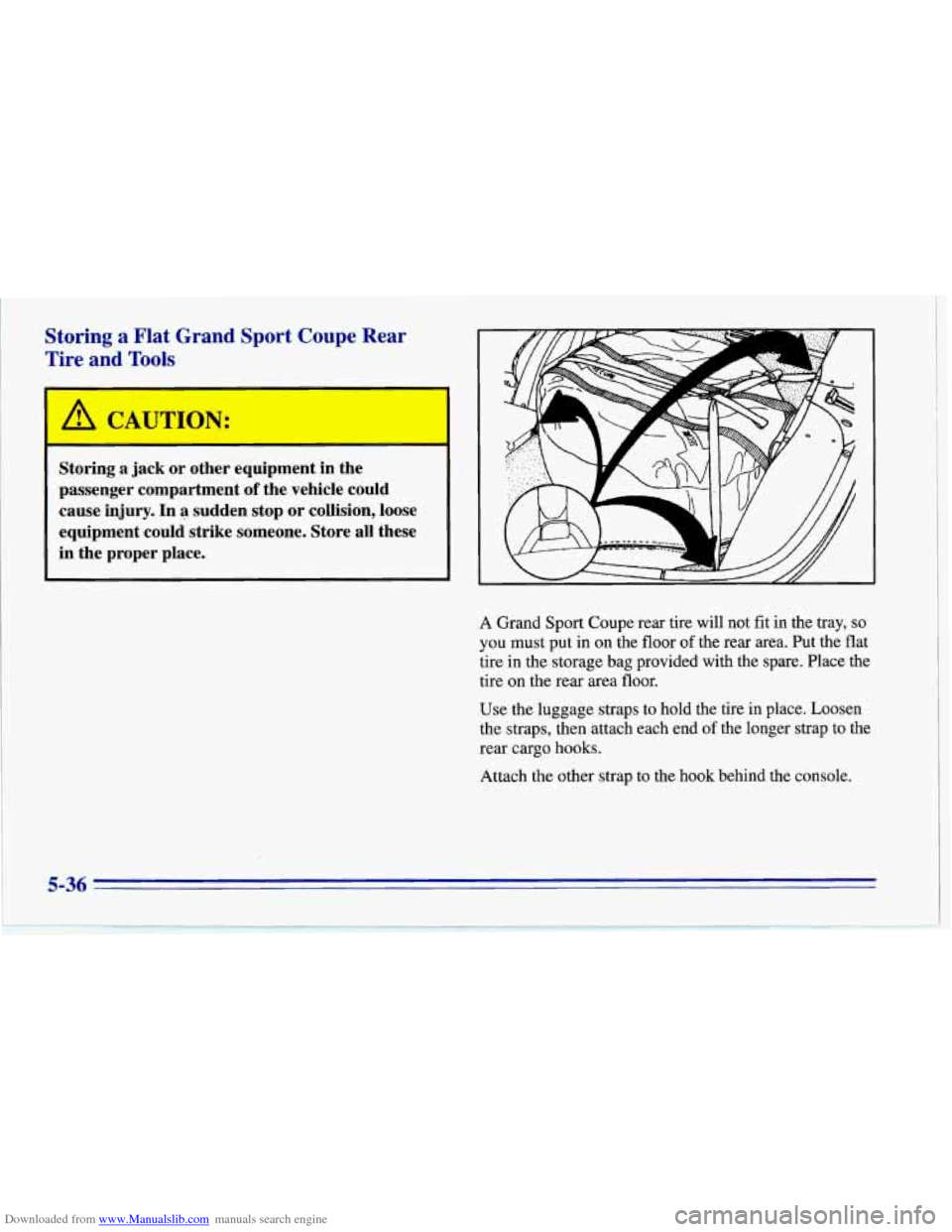
A Grand Sport Coupe rear tire will not fit in the tray, so
you must put in on the floor of the rear area. Put the flat
tire
in the storage bag provided with the spare. Place the
tire on the rear area floor.
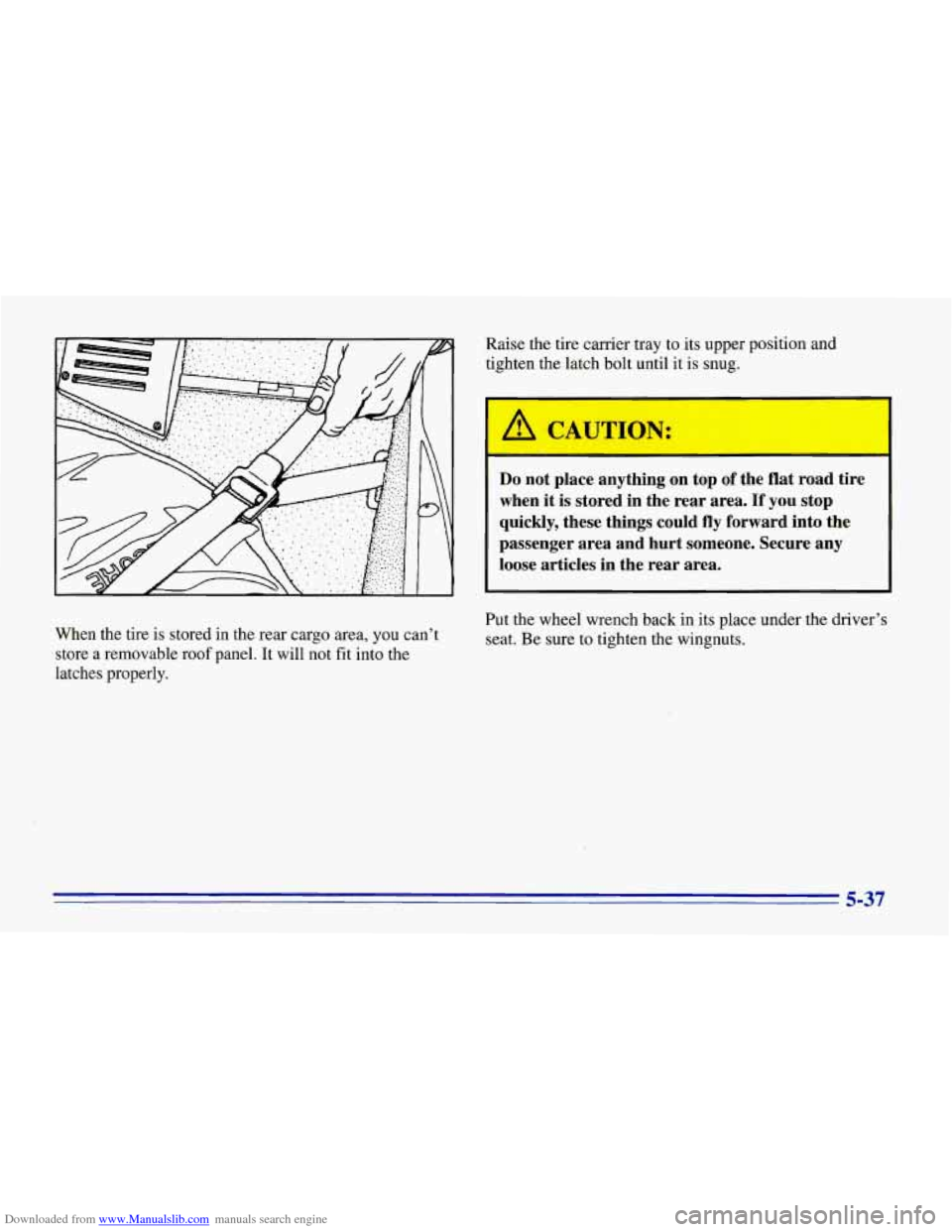
Use the luggage straps to hold the tire in place. Loosen
the straps, then attach each end
of the longer strap to the
rear cargo hooks.
Attach the other strap to the hook behind the console.
Page 228 of 386
Downloaded from www.Manualslib.com manuals search engine When the tire is stored in the rear cargo area, you can’t
store a removable roof panel. It will not fit into the
latches properly. Raise the tire carrier
tray to its upper
position and
tighten the latch bolt until it is snug.
I A CAUTION: A
Do not place anything on top of the flat road tire
when it is stored in the rear area. If you stop
quickly, these things could
fly forward into the
passenger area and hurt someone. Secure any
loose articles in the rear area.
Put the wheel wrench back in its place under the driver’s
seat. Be sure to tighten the wingnuts.
5-37
Page 229 of 386

Downloaded from www.Manualslib.com manuals search engine Put the jack, wheel nut socket and wheel lock key in the
rear storage compartment behind the passenger’s seat.
Make sure the parts are stored properly in the foam
container. Position the jack in the container
so that you
can read the yellow CAUTION label fromthe driver’s
seat. Replace the plastic tray and close the storage
compartment.
NOTICE:
Your Corvette’s radio receiver box is in the rear
storage compartment.
To help avoid damage,
carefully place the jack, socket and wheel lock
key into the foam container in the compartment.
Do not toss or place the items against the radio
receiver box or any wiring.
Compact Spare Tire (If So Equipped)
Although the compact spare tire was fully inflated when
your vehicle was new, it can lose air after a time. Check
the’inflation pressure regularly. It should be
60 psi
(420 Wa).
After installing the compact spare on your vehicle, you should stop as soon as possible and make sure your spare
tire is correctly inflated. The compact spare is made to
perform well at posted speed limits for distances up to
3,000 miles (5 OOO km), so you can finish your trip and
have your full-size tire repaired or replaced where you
want.
Of course, it’s best to replace your spare with a
full-size tire as soon
as you can. Your spare will last
longer and
be in good shape in case you need it again.
When the compact spare is installed, your
vehicle’s handling capabilities will be reduced
during severe maneuvers.
If you drive too fast,
you could lose control
of your vehicle. You or
others could be injured. Don’t drive over
55 mph
(90 km/h) when the compact spare is installed.
5-38