1996 CHEVROLET CAVALIER belt
[x] Cancel search: beltPage 278 of 372
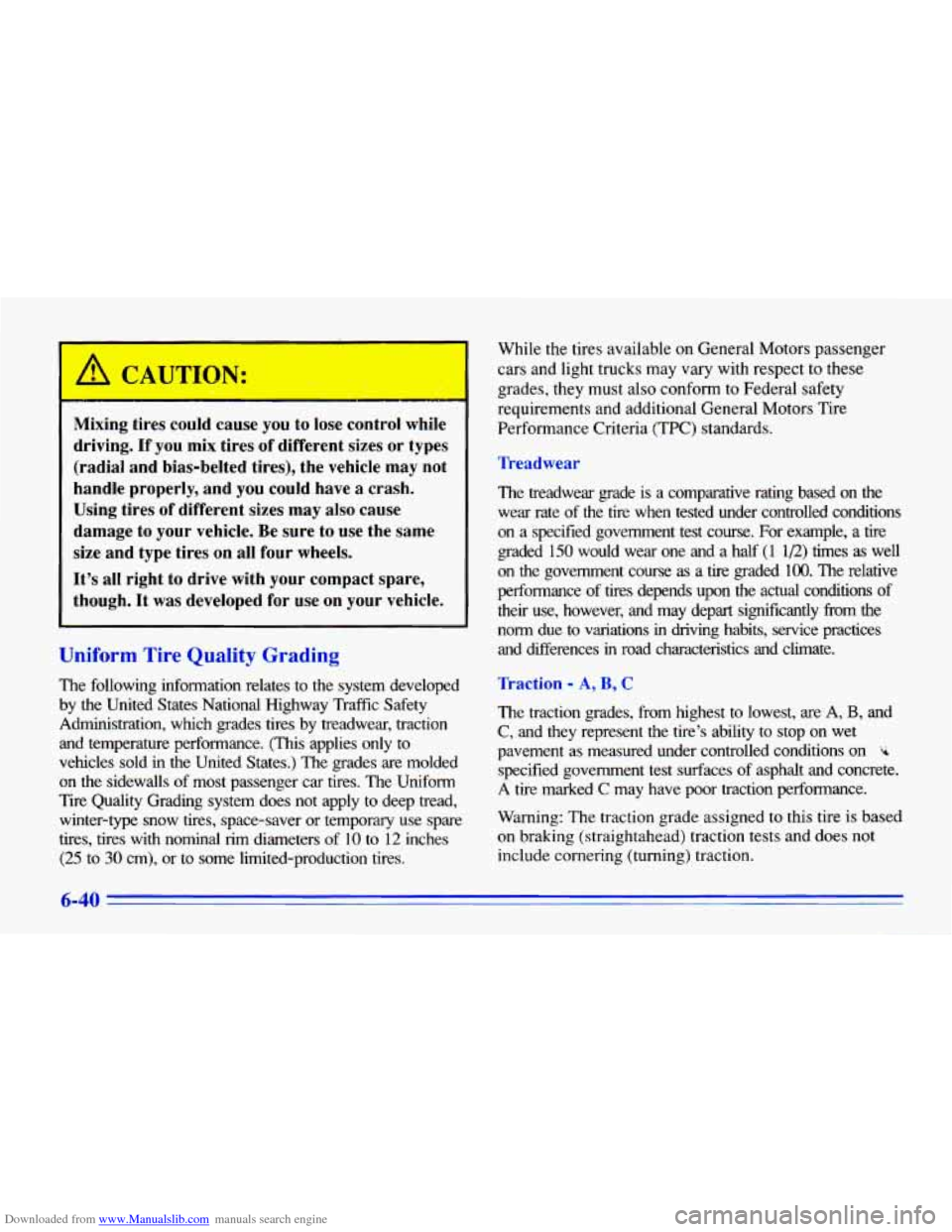
Downloaded from www.Manualslib.com manuals search engine Uniform Tire Quality Grading
The following information relates to the system developed
by the United States National Highway Traffic Safety Administration, which grades tires by treadwear, traction
and temperature performance.
(This applies only to
vehicles sold
in the United States.) The grades are molded
on the sidewalls of most passenger car tires. The Uniform
Tire Quality Grading system does not apply
to deep tread,
A CAUTION:
Mixing tires could cause you to lose control while
driving. If you mix tires of different sizes or types
(radial and bias-belted tires), the vehicle may not
handle properly, and
you could have a crash.
Using tires of different sizes may also cause
damage to your vehicle. Be sure to use the same
size and type tires on all four wheels.
It’s all right to drive with your compact spare,
though. It was developed for use on
your vehicle.
winter-type snow tires, space-saver or temporary use spare
tires, tires with nominal rim diameters of 10 to 12 inches
(25 to 30 cm), or to some limited-production tires. While
the tires available
on General Motors passenger
cars and light trucks may vary with respect
to these
grades, they must also conform
to Federal safety
requirements and additional General Motors Tire
Performance Criteria
(TPC) standards.
Treadwear
The treadwear grade is a comparative rating based on the
wear rate of the tire when tested under controlled conditions
on a specified government test course. For example, a tire
graded 150 would wear one and a half
(1 1/2) times as well
on
the government course as a tire graded 100. The relative
performance
of tires depends upon the actual conditions of
their use, however, and may depart significantly fiom the
norm due
to variations in driving habits, service practices
and differences in road characteristics and climate.
Traction - A, B, C
The traction grades, from highest to lowest, are A, B, and
C, and they represent the tire’s ability to stop on wet
pavement as measured under controlled conditions on
k
specified government test surfaces of asphalt and concrete.
A tire marked C may have poor traction performance.
Warning: The traction grade assigned to this tire is based
on braking (straightahead) traction tests and does not
include cornering (turning) traction.
6-40
Page 284 of 372
Downloaded from www.Manualslib.com manuals search engine 0 If an odor lingers after cleaning vomit or urine,
treat the area with a waterbaking soda solution:
1 teaspoon (5 ml) of baking soda to 1 cup (250 ml)
of lukewarm water.
0 If needed, clean lightly with solvent-type cleaner.
Combination Stains
Stains caused by candy, ice cream, mayonnaise, chili
sauce and unknown stains can
be removed as follows:
0 Carefully scrape off excess stain, then clean with
0 If a stain remains, clean it with solvent-type cleaner.
cool water and allow to dry.
Cleaning Vinyl
Use warm water and
a clean cloth.
Rub with a clean, damp cloth to remove dirt. You
may have to do it more than once. .
0 Things like tar, asphalt and shoe polish will stain if
you don’t get them off quickly. Use a clean cloth and
a
GM VinylLeather Cleaner or equivalent product.
Cleaning the Top of the Instrument Panel
Use only mild soap and water to clean the top surfaces
of the instrument panel. Sprays containing silicones or
waxes may cause annoying reflections in the windshield
and even make it difficult to see through the windshield
under certain conditions.
Care of Safety Belts
Keep belts clean and dry.
I A CAUTION: I
Do not bleach or dye safety belts. If you do, it
may severely weaken them.
In a crash they
might not be able to provide adequate protection.
Clean safety belts only with mild soap and
lukewarm water.
Page 302 of 372
Downloaded from www.Manualslib.com manuals search engine Maintenance Schedule
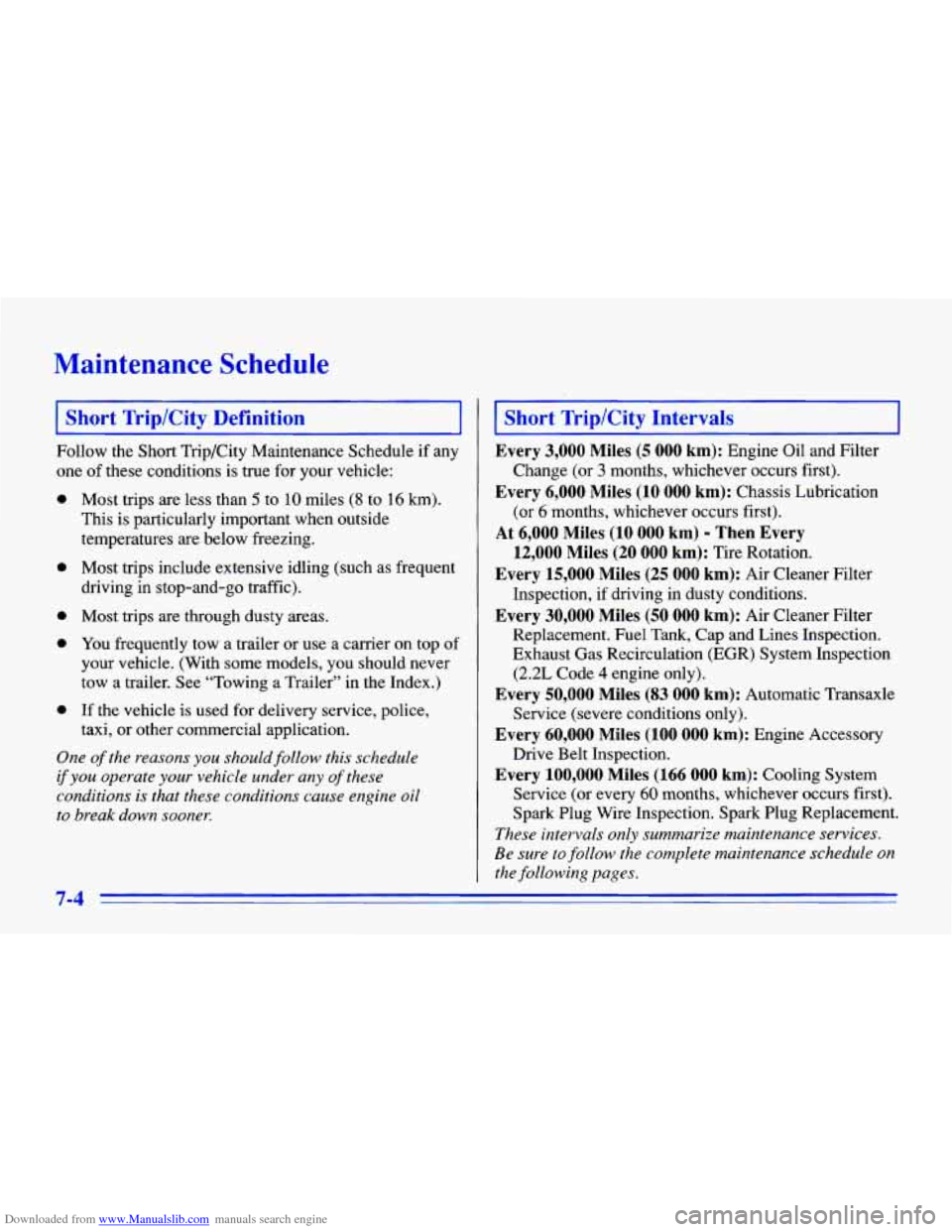
I Short Trip/City Definition
~~
I
Follow the Short Trip/City Maintenance Schedule if any
one of these conditions is true for your vehicle:
0
0
e
0
e
Most trips are less than 5 to 10 miles (8 to 16 km).
This is particularly important when outside
temperatures are below freezing.
Most trips include extensive idling (such as frequent
driving in stop-and-go traffic).
Most trips
are through dusty areas.
You frequently tow
a trailer or use a carrier on top of
your vehicle. (With some models, you should never
tow a trailer. See “Towing a Trailer” in the Index.)
If the vehicle is used for delivery service, police,
taxi, or other commercial application.
One of the reasons you should follow this schedule
if you operate your vehicle under any of these
conditions is that these conditions cause engine oil
to break down sooner.
Short Trip/City Intervals
Every 3,000 Miles (5 000 km): Engine Oil and Filter
Change (or
3 months, whichever occurs first).
Every 6,000 Miles (10 000 km): Chassis Lubrication
(or
6 months, whichever occurs first).
At 6,000 Miles (10 000 km) - Then Every
12,000 Miles (20 000 km): Tire Rotation.
Every 15,000 Miles (25 000 km): Air Cleaner Filter
Inspection,
if driving in dusty conditions.
Every 30,000 Miles (50 000 km): Air Cleaner Filter
Replacement. Fuel Tank, Cap and Lines Inspection.
Exhaust Gas Recirculation (EGR) System Inspection
(2.2L Code 4 engine only).
Every 50,000 Miles (83 000 km): Automatic Transaxle
Service (severe conditions only).
Every 60,000 Miles (100 000 km): Engine Accessory
Drive Belt Inspection.
Every 100,000 Miles (166 000 km): Cooling System
Service (or every
60 months, whichever occurs first).
Spark Plug Wire Inspection. Spark Plug Replacement.
These intervals only summarize maintenance services.
Be sure to follow the complete maintenance schedule
on
the following pages.
7-4
Page 303 of 372
Downloaded from www.Manualslib.com manuals search engine Maintenance Schedule
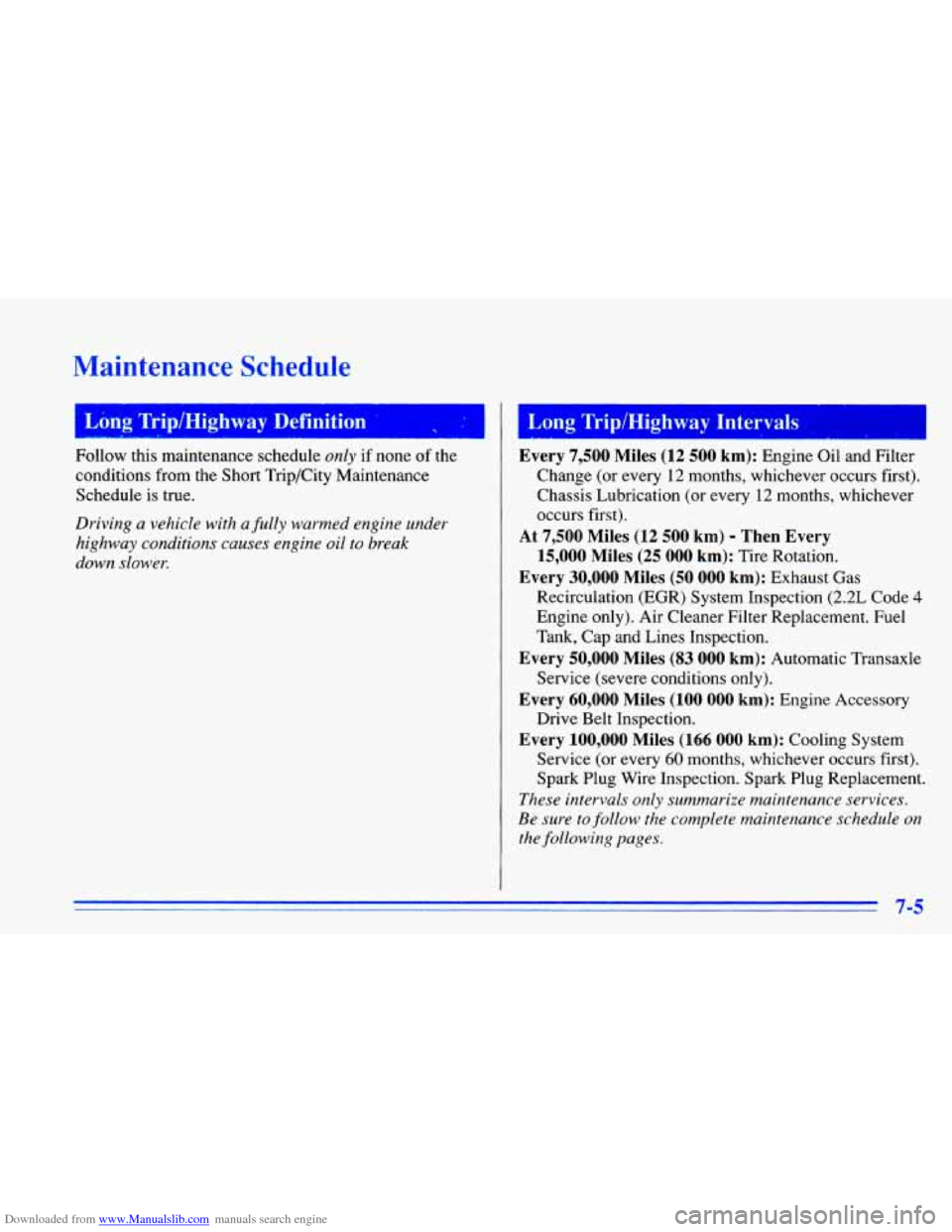
Long Trip/Highway Definition h Long TriplHighway Intervals
Follow this maintenance schedule only if none of LIIG
conditions from the Short Trip/City Maintenance
Schedule is true.
Driving a vehicle with a fully warmed engine under
highway conditions causes engine oil to break
down slower.
nvery 7,500 Miles (12 500 km): Engine Oil and Filter
Change (or every
12 months, whichever occurs first).
Chassis Lubrication (or every
12 months, whichever
occurs first).
At 7,500 Miles (12 500 km) - Then Every
15,000 Miles (25 000 km): Tire Rotation.
Every 30,000 Miles (50 000 km): Exhaust Gas
Recirculation (EGR) System Inspection (2.2L Code 4
Engine only). Air Cleaner Filter Replacement. Fuel
Tank, Cap and Lines Inspection.
Every 50,000 Miles (83 000 km): Automatic Transaxle
Service (severe conditions only).
Every 60,000 Miles (100 000 km): Engine Accessory
Drive Belt Inspection.
Every 100,000 Miles (166 000 km): Cooling System
Service (or every
60 months, whichever occurs first).
Spark Plug Wire Inspection. Spark Plug Replacement.
These intervals only summarize maintenance services.
Be sure
to follow the complete maintenance schedule on
the following pages.
7-5
Page 315 of 372
Downloaded from www.Manualslib.com manuals search engine I Short Trip/City Maintenance Schedule I
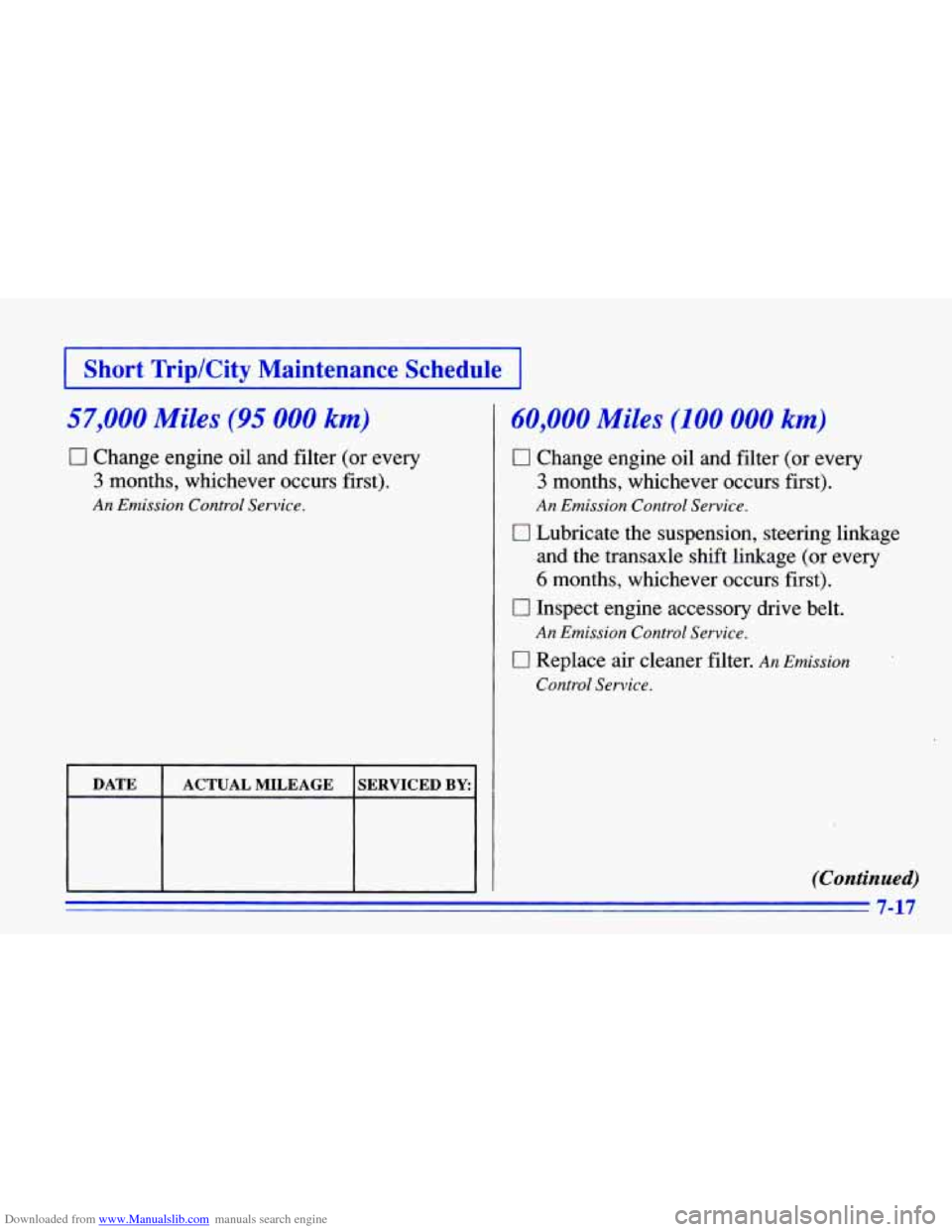
57,000 Miles (95 000 km)
0 Change engine oil and filter (or every
3 months, whichever occurs first).
An Emission Control Service.
DATE
SERVICED BY: ACTUAL MILEAGE
i
60,000 Miles (100 000 km)
0 Change engine oil and filter (or every
3 months, whichever occurs first).
An Emission Control Service.
0 Lubricate the suspension, steering linkage
and the transaxle shift linkage (or every
6 months, whichever occurs first).
0 Inspect engine accessory drive belt.
0 Replace air cleaner filter. An Emission
An
Emission Control Service.
Control Service.
(Continued)
7-17
Page 330 of 372
Downloaded from www.Manualslib.com manuals search engine I Long Trip/Highway Maintenance Schedule
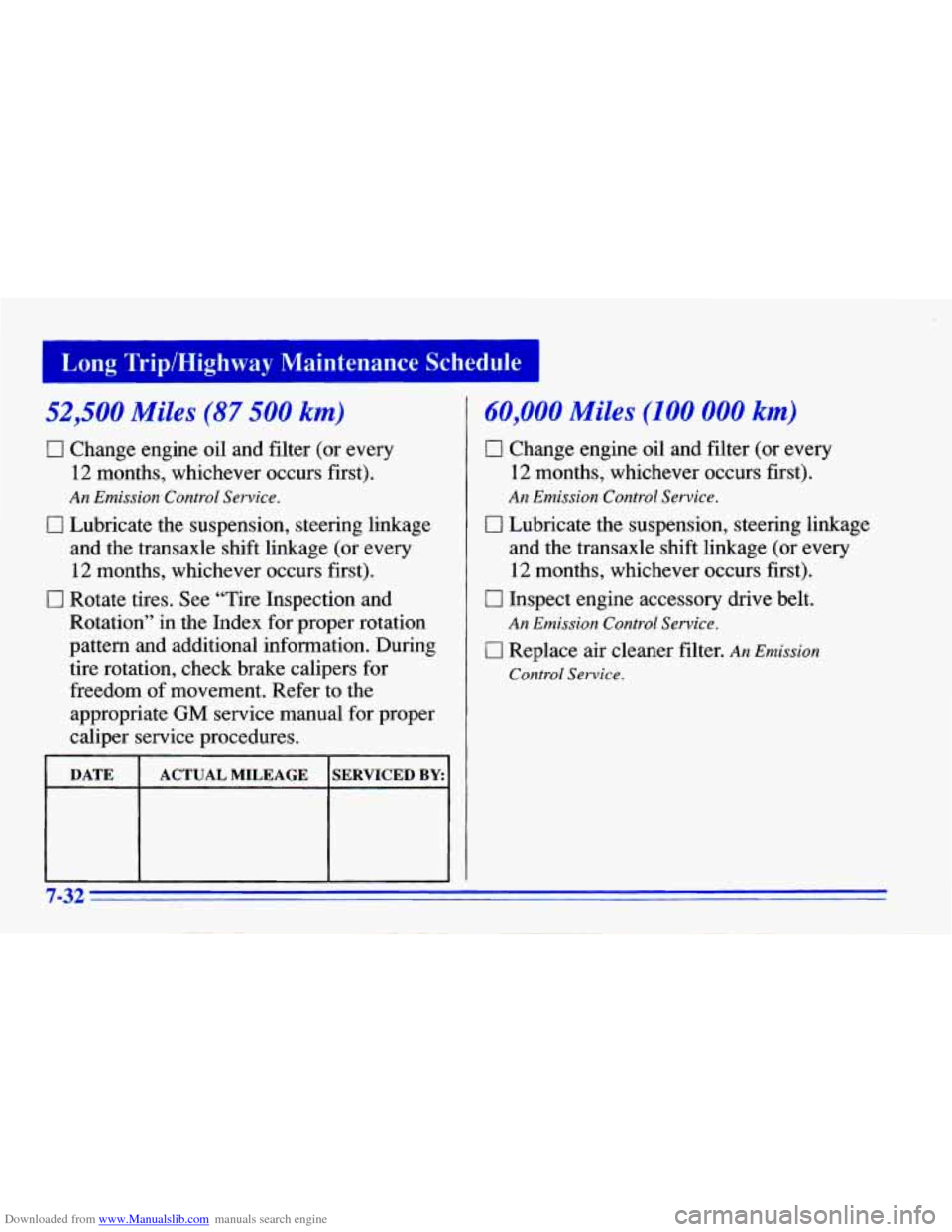
52,500 Miles (87 500 km}
0 Change engine oil and filter (or every
12 months, whichever occurs first).
An Emission Control Service.
0 Lubricate the suspension, steering linkage
and the transaxle shift linkage (or every
12 months, whichever occurs first).
0 Rotate tires. See “Tire Inspection and
Rotation” in the Index for proper rotation
pattern and additional information. During
tire rotation, check brake calipers for
freedom of movement. Refer to the
appropriate
GM service manual for proper
caliper service procedures.
60,000 Miles (100 000 km)
0 Change engine oil and filter (or every
12 months, whichever occurs first).
An Emission Control Service.
0 Lubricate the suspension, steering linkage
and the transaxle shift linkage
(or every
12 months, whichever occurs first).
0 Inspect engine accessory drive belt.
0 Replace air cleaner filter. An Emission
An Emission Control Service.
Control Service.
7-32
Page 336 of 372
Downloaded from www.Manualslib.com manuals search engine Part B: Owner Checks and Services
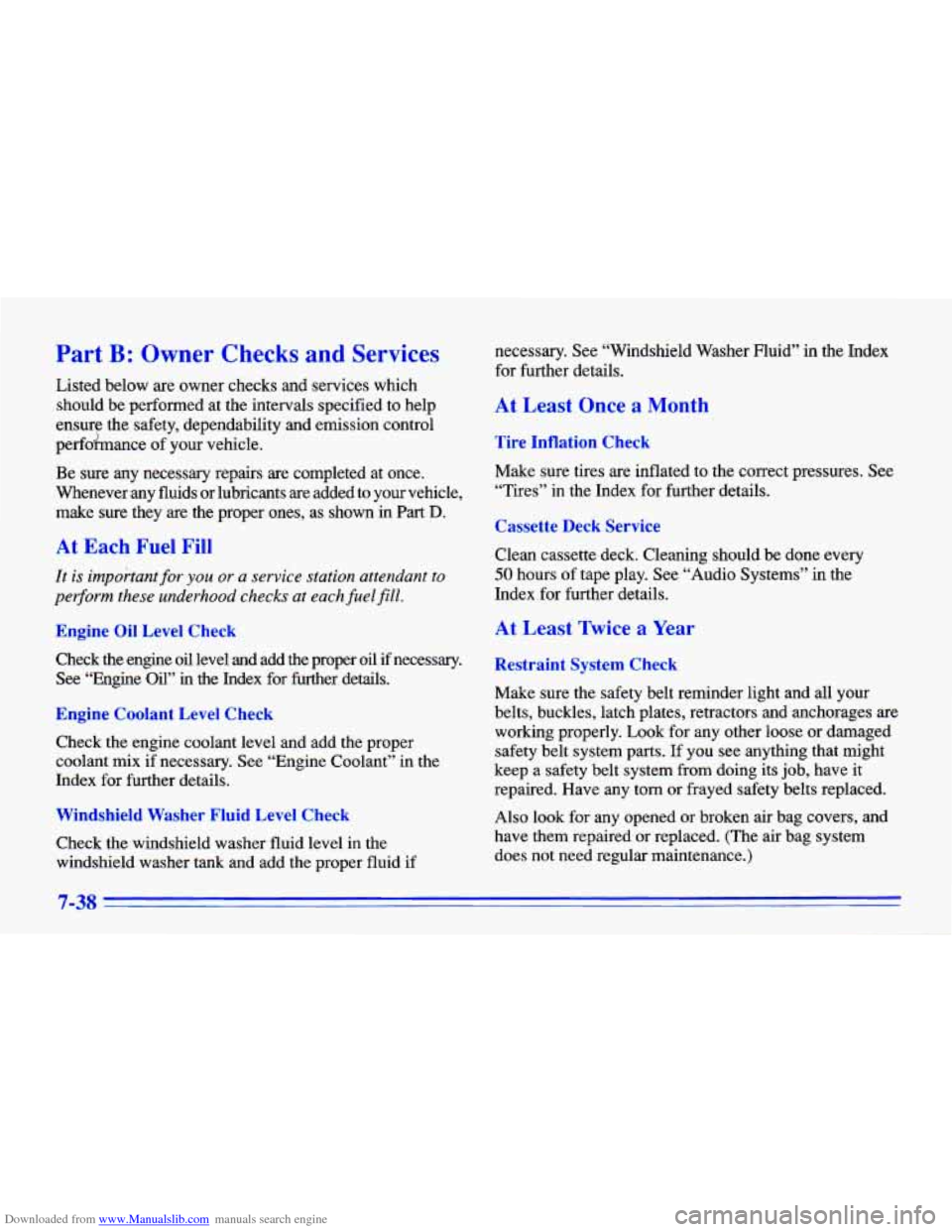
Listed below are owner checks and services which
should be performed at the intervals specified to help
ensure the safety, dependability and emission control
perfoJmance of your vehicle.
Be sure any necessary repairs are completed at once.
Whenever any fluids or lubricants are added to your vehicle,
make sure they are the proper ones, as shown in
Part D.
At Each Fuel Fill
It is important for you or a service station attendant to
pe$orrn these underhood checks at each fuel fill.
Engine Oil Level Check
Check the engine oil level and add the proper oil if necessary.
See ‘Engine Oil”
in the Index for further details.
Engine Coolant Level Check
Check the engine coolant level and add the proper
coolant mix if necessary. See “Engine Coolant” in the
Index for further details.
Windshield Washer Fluid Level Check
Check the windshield washer fluid level in the
windshield washer tank and add the proper fluid if necessary.
See “Windshield Washer Fluid” in the Index
for further details.
At Least Once a Month
Tire Inflation Check
Make sure tires are inflated to the correct pressures. See
“Tires” in the Index for further details.
Cassette Deck Service
Clean cassette deck. Cleaning should be done every
50 hours of tape play. See “Audio Systems” in the
Index for further details.
At Least Twice a Year
Restraint System Check
Make sure the safety belt reminder light and all your
belts, buckles, latch plates, retractors and anchorages are
working properly. Look for any other loose or damaged
safety belt system parts.
If you see anything that might
keep a safety belt system from doing its job, have it
repaired. Have any torn or frayed safety belts replaced.
Also look for any opened or broken air bag covers, and
have them repaired or replaced. (The
air bag system
does not need regular maintenance.)
7-38
Page 365 of 372
Downloaded from www.Manualslib.com manuals search engine Oil Pressure Warning .......................... 2-73
Passlock Warning
........................... 2-75
Safety Belt Reminder
...................... 1.6. 2.65
Loading Your Vehicle
........................... 4-31
Cylinders
................................... 7-39
Door
........................................ 2-3
PowerDoor
.................................. 2-4
Rear Door Security
............................. 2-4
Steering Column Lock Check
................... 7-40
Tr~nk
....................................... 2-7
Low Coolant Warning Light
...................... 2-70
Lowering the Convertible Top Manually
............. 2-57
Lowering Your Convertible Top
................... 2-49
Lubricants and Fluids
............................ 7-43
Lubrication Service. Body
........................ 7-39
Up-Shift
.................................... 2-75
Locks
......................................... 2-3
Key Lock Cylinder Service
..................... 7-39
Maintenance. Normal Replacement
parts ........... 6-60
Maintenance Record ............................ 7-45
Maintenance Schedule
............................ 7- 1
Long Tripmighway Definition ................... 7-5
Long Tripmighway Intervals
..................... 7-5
Owner Checks and Services
..................... 7-38
Periodic Maintenance Inspections
................ 7-42
Recommended Fluids and Lubricants
............. 7-43 Scheduled Maintenance Services
.................. 7-3
Short Trip/City Definition
....................... 7-4
Short Trip/City Intervals
........................ 7-4
Maintenance. Underbody
......................... 6-50
Maintenance When Trailer Towing
................. 4-40
Malfunction Indicator Lamp
...................... 2-71
Manual Front Seat
............................... 1 . 1
Manual Lumbar Support .......................... 1-2
Manual Remote Control Mirror
.................... 2-44
Manual Transaxle
............................... 2-12
Check
...................................... 7-39
Fluid
....................................... 6-19
Shifting
..................................... 2-20
Starting Your Engine
.......................... 2-12
Methanol
...................................... 6-2
Mirrors
....................................... 2-44
Convex Outside
.............................. 2-45
Inside Daymight Rearview
..................... 2-43
Manual Remote Control
........................ 2-44
Power Remote Control
......................... 2-44
MountainRoads
................................ 4-23
Multifunction Lever
............................. 2-30
Neutral. Automatic Transaxle
.................... 2-17
Neutral. Manual Transaxle
........................ 2-21
New Vehicle “Break-In”
.......................... 2-9
Nightvision
................................... 4-16
9- /