1996 CHEVROLET BLAZER check engine
[x] Cancel search: check enginePage 18 of 392
Downloaded from www.Manualslib.com manuals search engine Easy Entry Seat (2-Door Models)
The right front seat of your vehicle makes it easy to get
in
and out of the rear seat.
Tilt the right front seatback completely forward and
Move the seatback to its original position after
the whole seat
will slide
forward,
someone gets into the rear seat area. Then move the
seat rearward
until it locks.
If an easy entry right front seat isn’t locked, it
can move. In a sudden stop or crash, the person
sitting there could be injured. After you’ve used
it, be sure to push rearward on an easy entry seat
to be sure it
is locked.
Rear Seats
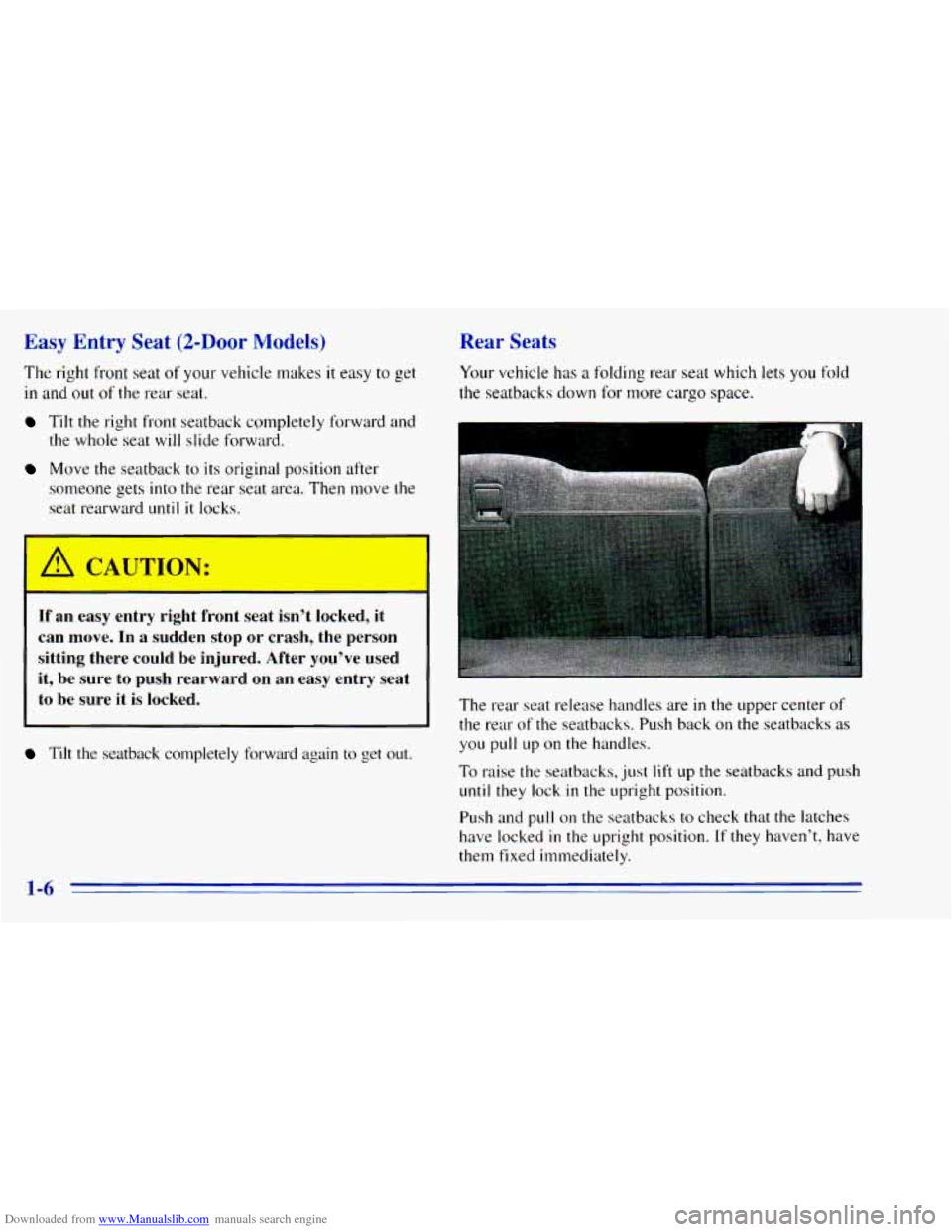
Your vehicle has a folding rear seat which lets you fold
the seatbacks down for more cargo space.
Tilt the seatback completely forward again to get out. The rear seat release handles
are
in the upper center of
the rear
of the seatbacks. Push back on the seatbacks as
you pull up on the handles.
To raise the seatbacks, just
lift up the seatbacks and push
until they lock in the upright position.
Push and pull on the seatbacks to check that
the latches
have locked
in the upright position. If they haven’t, have
them fixed immediately.
1-6
Page 19 of 392
Downloaded from www.Manualslib.com manuals search engine Safety Belts: They’re for Everyone
This part of the manual tells you how to use safety belts
properly.
It also tells you some things you should not do
with safety belts.
And
it explains the Supplemental Inflatable Restraint
(SIR), or a‘ ; sq :m.
-
I A CAUTION:
Don’t let anyone ride where he or she can’t wear
a safety belt properly. If you are in a crash and
you’re not wearing a safety belt, your injuries
can be much worse.
You can hit things inside the
vehicle
or be ejected from it. You can be seriously
injured or killed. In the same crash, you might
not be
if you are buckled up. Always fasten your
safety belt, and check that your passengers’ belts
are fastened properly too.
1
Your vehicle has a light
that comes on as a reminder
to buckle up. (See “Safety
Belt Reminder Light”
in
the Index.)
In most states and Canadian provinces, the law says to
wear safety belts. Here’s
why: They work.
You never know if you’ll be in a crash. If you do have a
crash,
you don’t know if it will be a bad one.
A few crashes are mild, and some crashes can be so
serious that even buckled up a person wouldn’t survive.
But most crashes are
in between. In many of them, people
who buckle up can survive and sometimes walk away.
Without belts they could have been badly
hurt or killed.
After more than
25 years of safety belts in vehicles,
the facts are clear.
In most crashes buckling up does
matter
... a lot!
1-7
Page 31 of 392
Downloaded from www.Manualslib.com manuals search engine CAUTION: (Continued)
Air bags are designed to work only in moderate to
severe crashes where the front of your vehicle hits
something. They aren’t designed to inflate
at all in
rollover, rear, side or low-speed frontal crashes.
Everyone in your vehicle, including the driver,
should wear
a safety belt properly -- whether or
not there’s an air bag for that person.
Air bags inflate with great force, faster than the
blink
of an eye. If, you’re too close to an inflating
air bag, it could seriously injure you. Safety belts
help keep you in position for an air bag inflation
in
a crash. Always wear your safety belt, even
with an air bag, and sit as far back as you can
~ while still maintaining control of your vehicle.
AIR
BAG
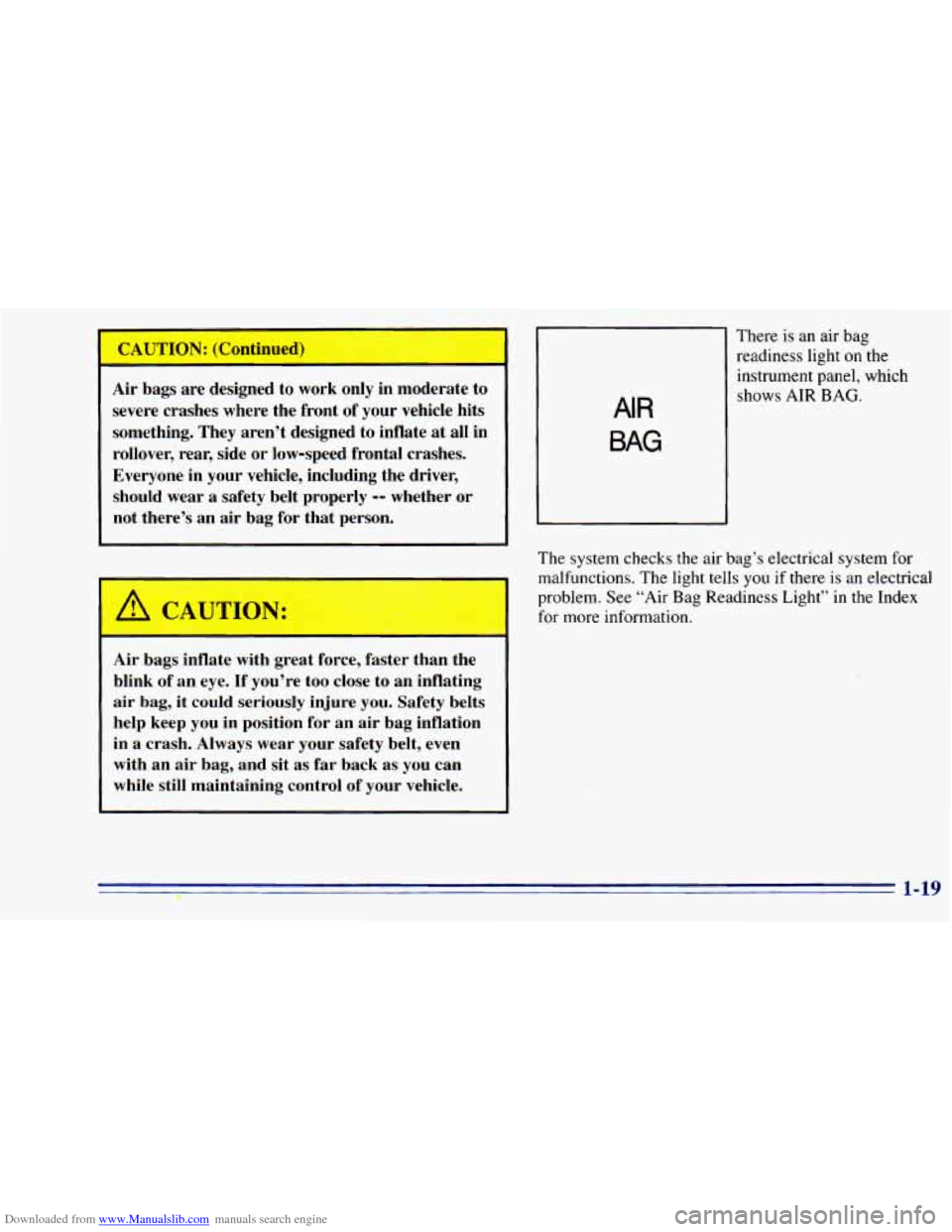
There is an air bag
readiness light on
the
instrument panel, which
shows
AIR BAG.
The system checks the air bag’s electrical system for
malfunctions. The light tells you
if there is an electrical
problem. See “Air Bag Readiness Light’’
in the Index
for more information.
(L 1-19
Page 57 of 392
Downloaded from www.Manualslib.com manuals search engine Safety Belt Extender
If the vehicle’s safety belt will fasten around you, you
should use
it.
But if a safety belt isn’t long enough to fasten, your
dealer will order
you an extender. It’s free. When you go
in to order it, take the heaviest coat
you will wear, so the
extender will be long enough for
you. The extender will
be just for you, and just for the seat in your vehicle that
you choose. Don’t let someone else use it, and use it
only for the seat it is made to fit. To wear it, just attach it
to the regular safety belt.
Checking Your Restraint Systems
Now and then, make sure the safety belt reminder light
and all your belts, buckles, latch plates, retractors and
anchorages are working properly.
Look for any other
loose or damaged safety belt system parts. If
you see
anything that might keep
a safety belt system from
doing its
job, have it repaired.
Torn or frayed safety belts may not protect you
in a
crash. They can rip apart under impact forces.
If a belt is
torn or frayed, get a new one right away.
Also look for any opened or broken air bag covers, and
have
them repaired or replaced. (The air bag system
does not need regular maintenance.)
1-45
Page 63 of 392

Downloaded from www.Manualslib.com manuals search engine Keyless Entry System (Option)
If your vehicle has this option, you can lock and unlock
your doors or unlock your rear endgate from up to
30 feet (9 m) away using the key chain transmitter
supplied with your vehicle.
Your Keyless Entry System operates
on a radio
frequency subject
to Federal Communications
Commission (FCC) Rules.
This device complies with Part 15 of the FCC Rules.
Operation is subject to
the following two conditions:
(1) This device may not cause harmful interference,
and
(2) This device must accept any interference
received, including interference that may cause
undesired operation.
Should interference to this system occur, try this:
Check to determine if battery replacement is
necessary. See the instructions on battery
replacement.
0 Check the distance. You may be too Far from your
vehicle. This product has
a maximum range.
0 Check the location. Other vehicles or objects may be
blocking the signal.
0 See your GM dealer or a qualified technician
for service.
Changes or modifications to this system by other than an
authorized service facility could void authorization to
use this equipment.
Operation
When you press UNLOCK, the driver’s door and
endgate
will unlock automatically. If you press
UNLOCK again within five seconds, all doors will
unlock. Press LOCK to lock all the doors.
Press the REAR button twice
within 3 1/2 seconds to
unlock and unlatch the endgate glass. If your vehicle has
an automatic transmission, the transmission must be
in
PARK (P) or NEUTRAL (N). If your vehicle has a
manual transmission, you must engage parking brake.
2-5
Page 64 of 392

Downloaded from www.Manualslib.com manuals search engine Matching Transmitter(s) To Your Vehicle
Each key chain transmitter is coded to prevent another
transmitter from unlocking your vehicle.
If a transmitter
is lost or stolen, a replacement can be purchased through
your dealer. Remember
to bring any remaining
transmitters with
you when you go to your dealer. When
the dealer matches
the replacement transmitter to your
vehicle, any remaining transmitters must also be
matched. Once the new transmitter is coded,
the lost
transmitter will not unlock your vehicle. Each vehicle
can have only two transmitters matched to
it.
Battery Replacement
Under normal use, the batteries in your key chain
transmitter should last about two years.
You can tell the batteries are weak if the transmitter
won’t work at the normal range in any location. If you
have
to get close to your vehicle before the transmitter
works, it’s probably time
to change the batteries.
To replace the batteries in the Keyless Entry transmitter:
I. Insert a dime in the slot between the covers of the
transmitter housing near the key ring hole. Remove
the bottom by twisting the dime.
Duracell@-type batteries
(DL2016 or equivalent),
positive side down.
2. Remove and replace the batteries with two
3. Align the covers and snap them together.
4. Check the operation of the transmitter.
2-6
Page 72 of 392
Downloaded from www.Manualslib.com manuals search engine Manual Transmission
The ge ector should be in NEUTRAL (N). Hold
the clutch pedal to the floor and start the engine. Your
vehicle won’t start
if the clutch pedal is not all the way
down
-- that’s a safety feature.
1. Without pushing the accelerator pedal, turn your
ignition key to START. When the engine starts, let
go of the key. The idle speed
will go down as’ your
engine gets warm.
NOTICE:
Holding your key in START for longer than
15 seconds at a time will cause your battery to
be drained much sooner. And the excessive heat
can damage your starter motor.
2. If it doesn’t start right away, hold your key in
START. If it doesn’t start in
10 seconds, push the
accelerator pedal all the way down for five more
seconds, or until it starts.
3. If your engine still won’t start (or starts but then
stops), wait
15 seconds and start over.
When the engine starts, let
go of the key and the
accelerator pedal.
NOTICE:
Your engine is designed to work with the
electronics in your vehicle. If you add electrical
parts or accessories, you could change the
way
the engine operates. Before adding electrical
equipment, check with your dealer. If you don’t,
your engine might not perform properly.
If you ever have to have your vehicle towed, see
the part
of this manual that tells how to do it
without damaging your vehicle. See “Towing
Your Vehicle’’ in the Index.
2-14
Page 81 of 392
Downloaded from www.Manualslib.com manuals search engine The front axle portion of the diagram on the indicator
will light up when
you shift into four-wheel drive. A
slight delay between shifting and the pattern’s lighting
is normal. If the pattern does
not light up, or if the front
axle lights do not go out after
you shift out of
four-wheel drive, have your dealer check your system.
Turn the INT LIGHTS switch located to the right of
your headlamp switch to dim your transfer case
indicator light when your headlamps or parking lamps
are
on. This will also cause your instrument panel
lights
to dim.
2HI: This setting is for driving in most street and
highway situations. Your front axle is
not engaged in
two-wheel drive.
4HI: This setting engages your front axle to help drive
your vehicle. Use 4HI when you need extra traction,
such as on snowy or icy roads, or in most off-road
situations.
N SET PARK BRAKE: Shift to this neutral setting
only when your vehicle needs
to be towed.
4LO: This setting also engages your front axle to give
you extra traction and provides extra gear reduction.
You may never need 4LO. It sends the maximum power
to all four wheels. You might choose 4LO if you were
driving off-road in sand, mud or deep snow and
climbing
or descending steep hills.
You can shift from 2HI to 4HI or from 4HI to 2HI while
the vehicle
is moving. Do not press the transfer case
shift lever button when shifting from 2HI to 4HI or from
4HI
to 2HI. Your front axle will engage faster if you
take your foot off of the accelerator for a few seconds
after
you shift.
To shift your transfer case into N SET PARK BRAKE:
1. Stop the vehicle and shift your transmission into
NEUTRAL
(N).
2. Set the parking brake. Your vehicle can roll unless
3. Pull the transfer case shift lever into N SET
the brakes are applied.
PARK BRAKE.
2-23