Page 24 of 392
Downloaded from www.Manualslib.com manuals search engine How to Wear Safety Belts Properly
Adults
This part is only for people of adult size.
Be aware that there are special things to know about safety belts and children.
And there are different rules for
smaller children and babies, If a child will be riding in
your vehicle, see the part of this manual called
“Children.” Follow
those rules for everyone’s protection.
First,
you’ll want to know which restraint systems your
vehicle has.
We’ll start with the driver position.
Driver Position
This part describes the driver’s restraint system.
Lap-Shoulder Belt
The driver has a lap-shoulder belt. Here’s how to wear
it properly.
1. Close and lock the door.
2. Adjust the seat (to see how, see “Seats” in the Index)
so you can sit up straight.
:, .... : -
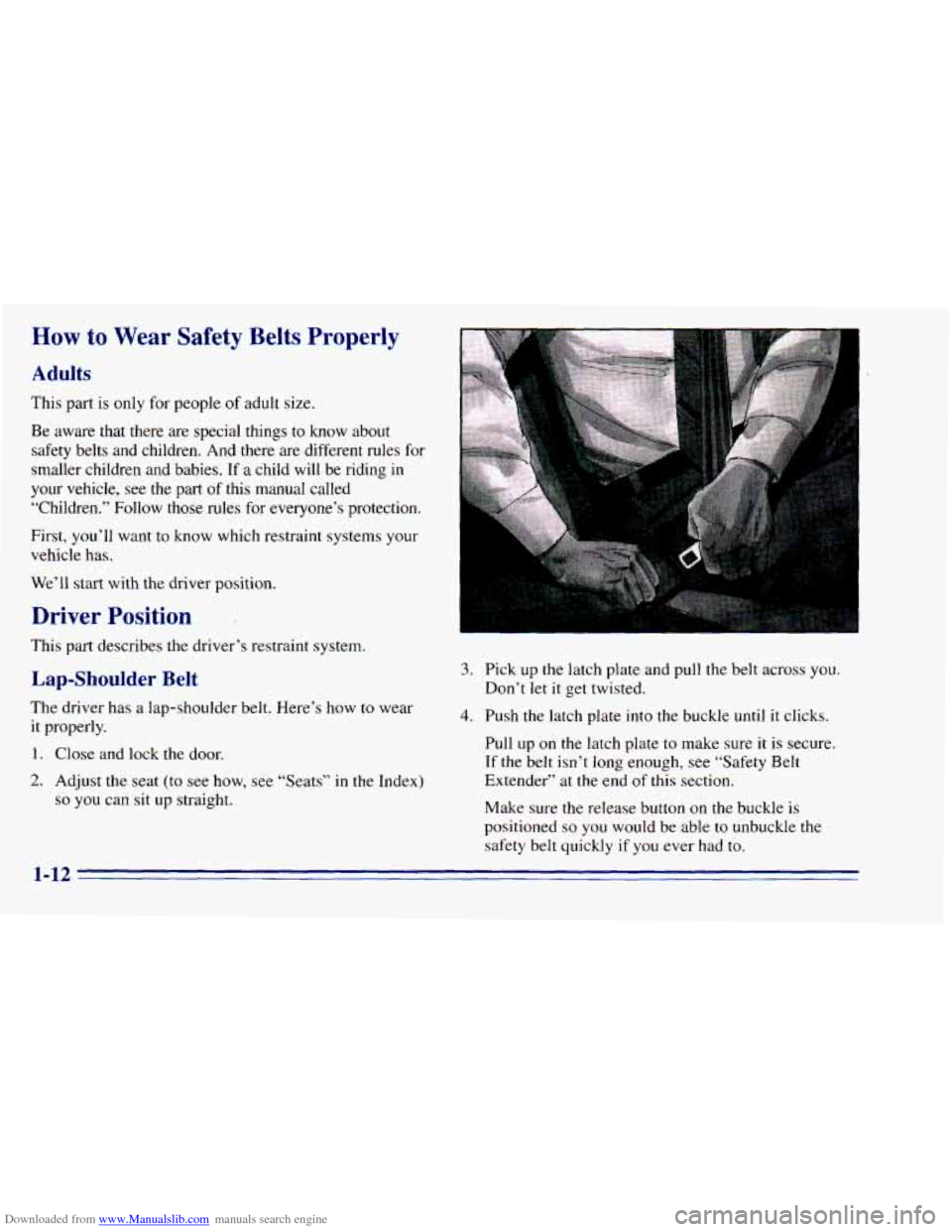
3. Pick up the latch plate and pull the be
Don’t let it get twisted.
:It across you.
4. Push the latch plate into the buckle until it clicks.
Pull
up on the latch plate to make sure it is secure.
If
the belt isn’t long enough, see “Safety Belt
Extender” at the end
of this section.
Make sure
the release button on the buckle is
positioned so you would be able to unbuckle the
safety belt quickly
if you ever had to.
1-12
Page 25 of 392
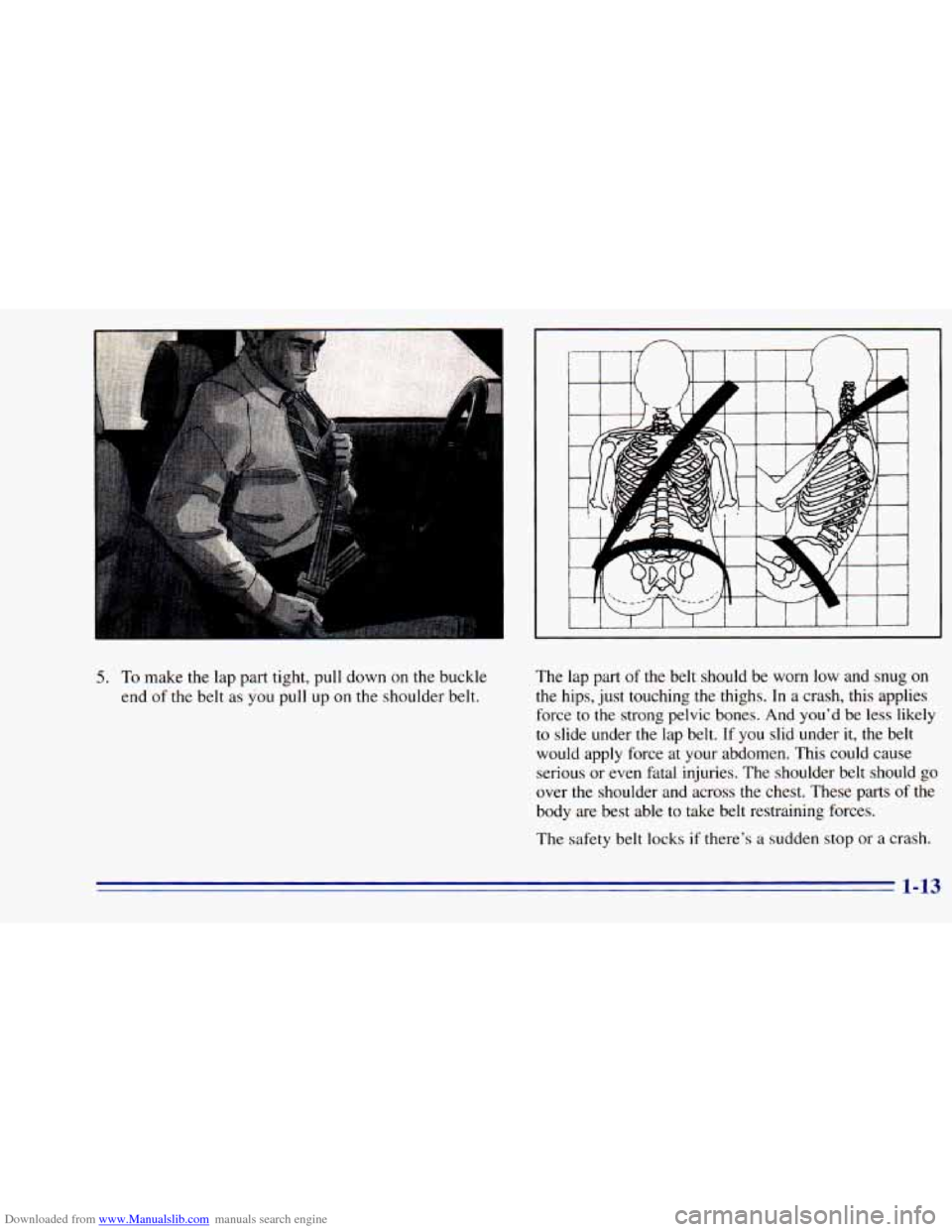
Downloaded from www.Manualslib.com manuals search engine 5. To make the lap part tight, pull down on the buckle
end of the belt as you pull up on the shoulder belt. The
lap part of the belt should be worn low and snug on
the hips, just touching the thighs. In a crash, this applies
force
to the strong pelvic bones. And you’d be less likely
to slide under the
lap belt. If you slid under it, the belt
would apply force at your abdomen. This could cause
serious
or even fatal injuries. The shoulder belt should go
over the shoulder and across the chest. These parts of the
body are best able to take belt restraining forces.
The safety belt locks if there’s a sudden stop or a crash.
1-13
Page 26 of 392
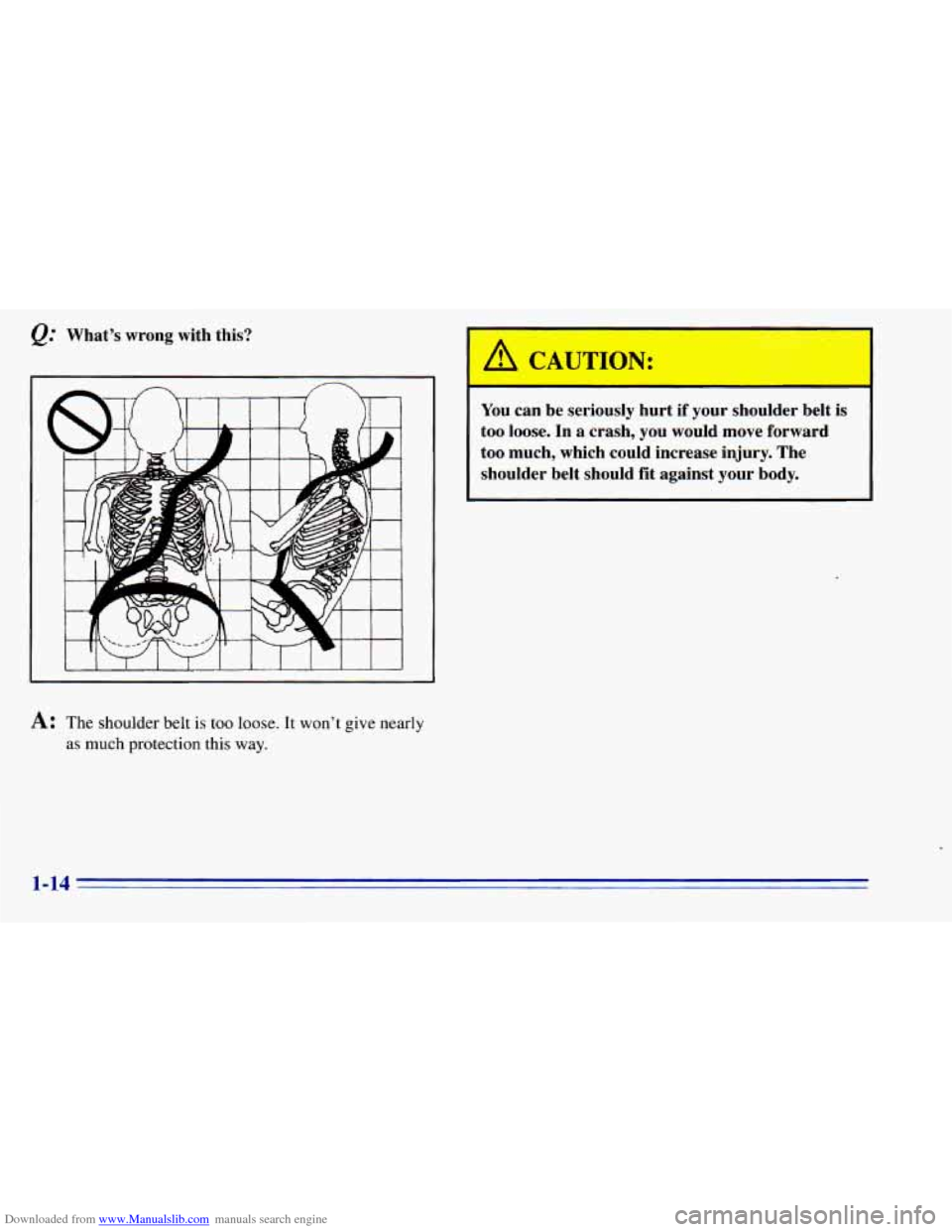
Downloaded from www.Manualslib.com manuals search engine @' What's wrong with this? .
A CAUTION: I
You can be seriously hurt if your shoulder belt is
too loose. In a crash, you would move forward
too much, which could increase injury. The
shoulder belt should fit against your body.
A: The shoulder belt is too loose. It won't give nearly
as much protection this way.
1-14
Page 27 of 392
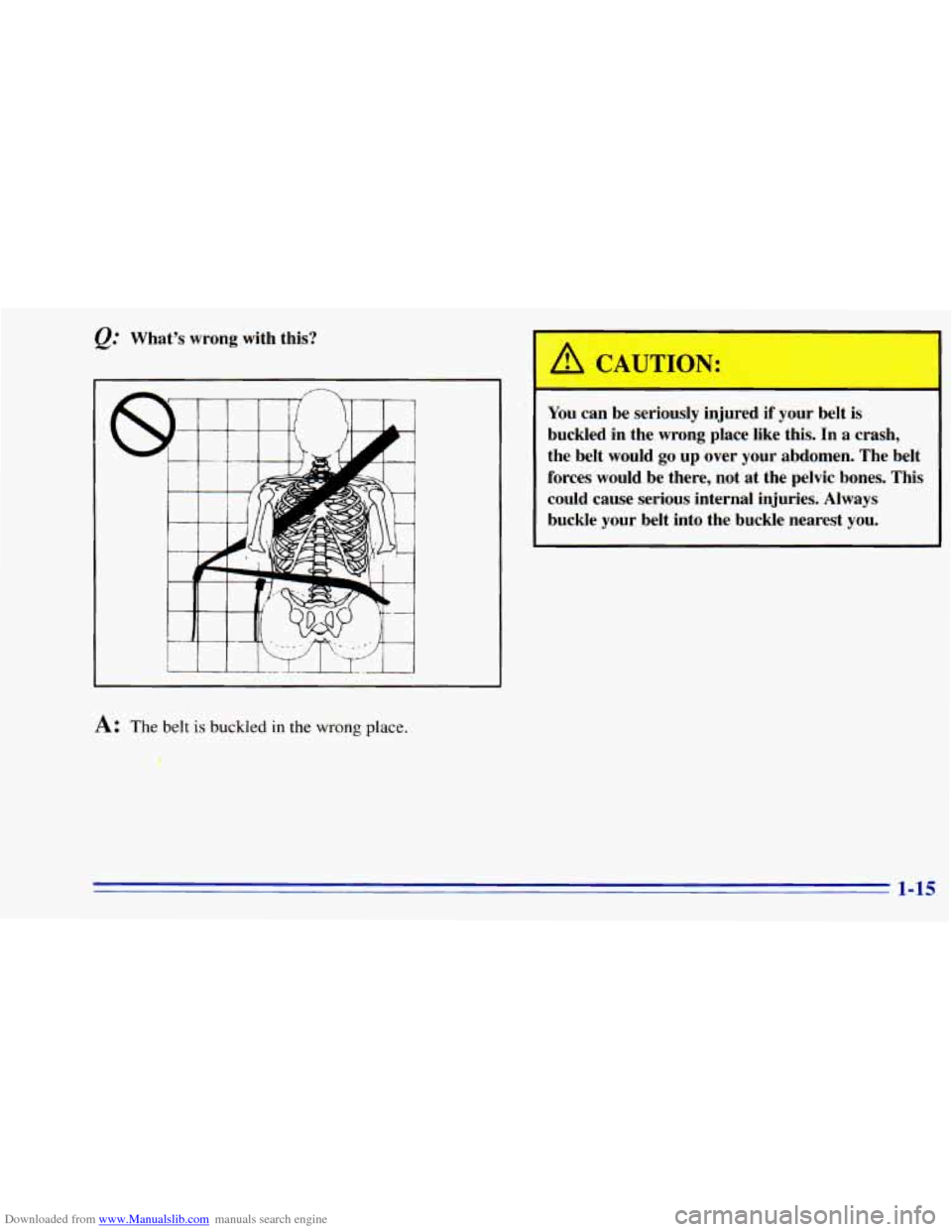
Downloaded from www.Manualslib.com manuals search engine &: What’s wrong with this?
A: The belt is buckled in the wrong place.
P
I
You can be seriously injured if your belt is
buckled in the wrong place like this.
In a crash,
the belt would go up over your abdomen. The belt
forces would be there, not at the pelvic bones. This
could cause serious internal injuries. Always
buckle your belt into the buckle nearest you.
1-15
Page 28 of 392
Downloaded from www.Manualslib.com manuals search engine ---
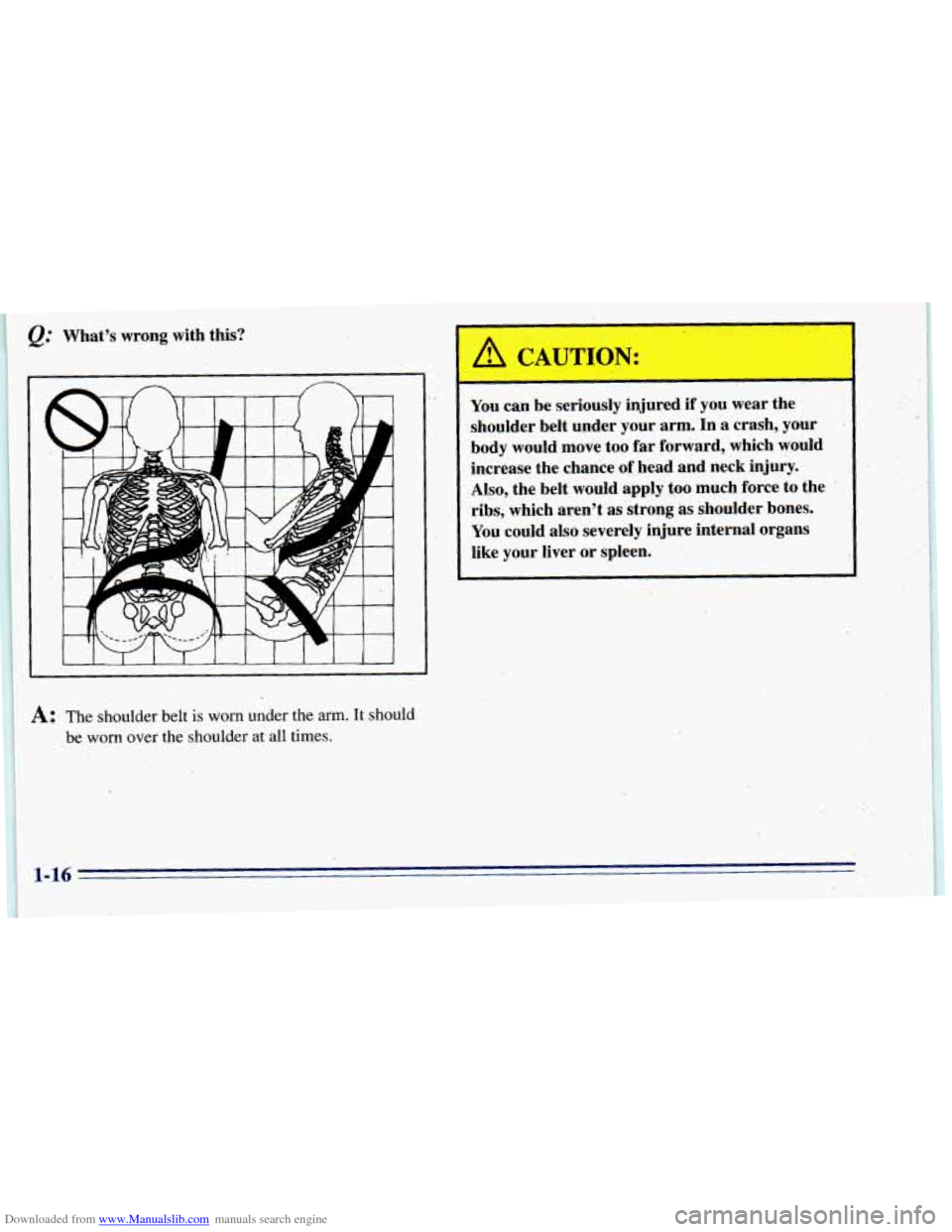
You can be seriously injured if you wear the
shoulder belt under your arm. In
a crash, your ~
body would move .too far forward, which would
increase the chance
of head and neck injury.
Also, the belt would apply
too much force to the
ribs, which aren't as'strong
as shoulder bones.
You could also severely injure internal organs
like your liver or spleen.
,I
A: The shoulder belt is worn under the arm. It should
, . be worn over the shoulder at all times.
.. . .
Page 29 of 392
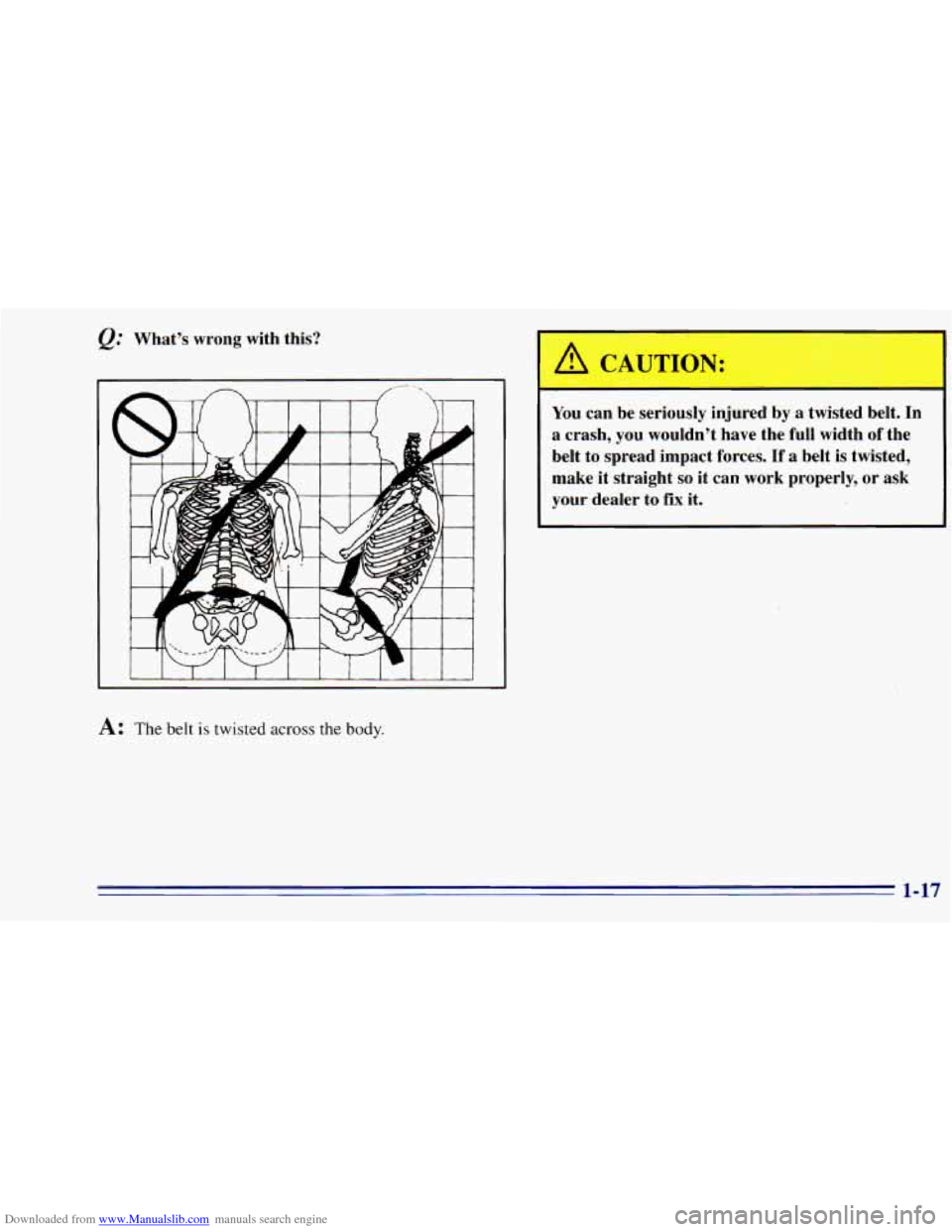
Downloaded from www.Manualslib.com manuals search engine What’s wrong with this?
A: The belt is twisted across the body.
I
You can be seriously injured by a twisted belt. In
a crash, you wouldn’t have the full width of the belt to spread impact forces. If a belt
is twisted,
make
it straight so it can work properly, or ask
your dealer to
fix it.
1-17
Page 30 of 392
Downloaded from www.Manualslib.com manuals search engine L
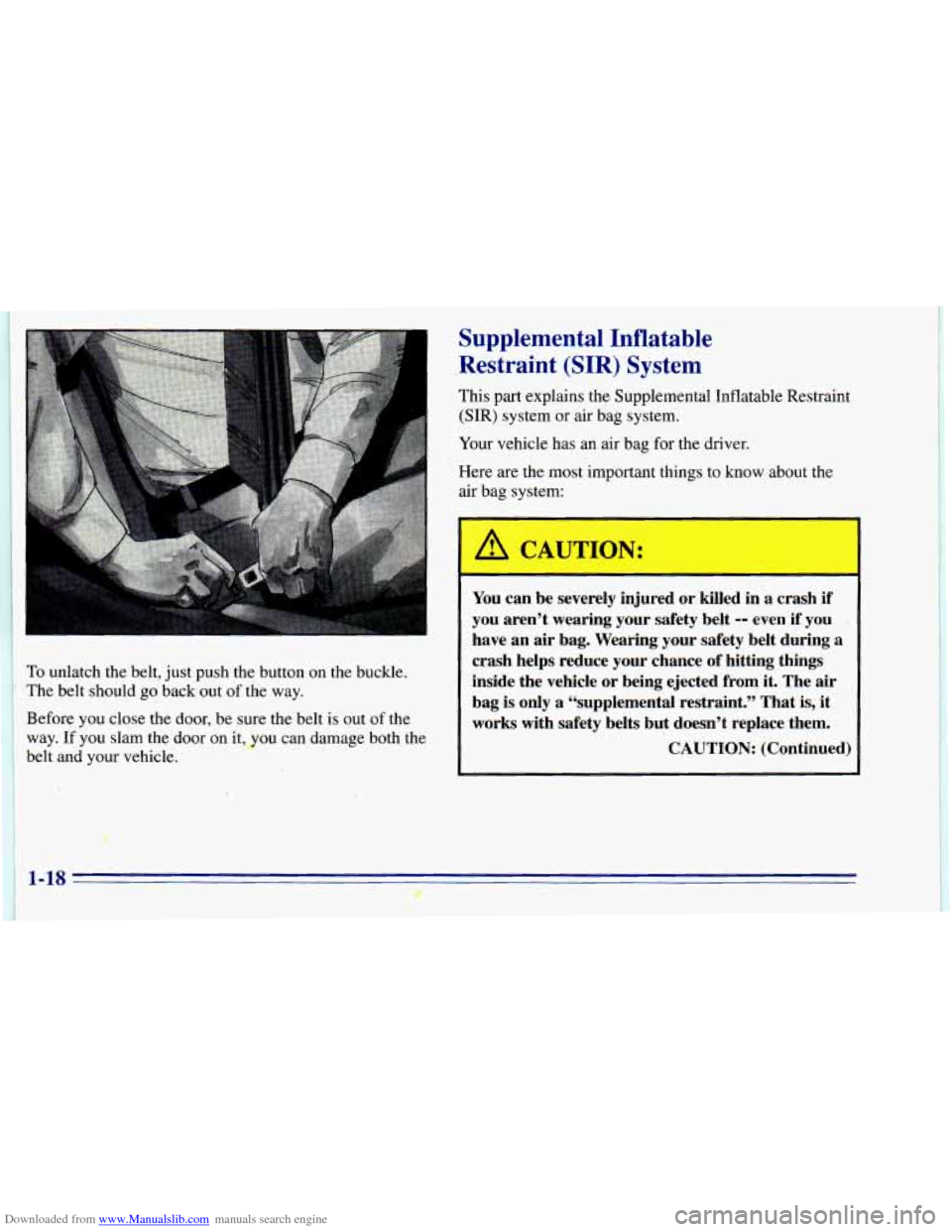
To unlatch the belt, just push the button on the buckle.
‘I The belt should go back out of the way.
Before you close the door, be sure the belt is out of the
way. If
you slam the door on it,Jou can damage both the
belt
and your vehicle.
Supplemental Inflatable
,Restraint (SIR) System
This part explains the Supplemental Inflatable Restraint
(SIR) system or air bag system.
Your vehicle has an air bag for the driver.
Here are the most important things to know about the
air bag system:
A CAUTION:
You can be severely injured or killed in a crash if
you aren’t wearing your safety belt
-- even if you
have
an air bag. Wearing your safety belt dwring a
crash helps reduce your chance
of hitting things
inside the vehicle or being ejected from it. The air
bag is only a “supplemental restraint.” That
is, it
works with safety belts but doesn’t replace them.
CAUTION: (Continued)
Page 31 of 392
Downloaded from www.Manualslib.com manuals search engine CAUTION: (Continued)
Air bags are designed to work only in moderate to
severe crashes where the front of your vehicle hits
something. They aren’t designed to inflate
at all in
rollover, rear, side or low-speed frontal crashes.
Everyone in your vehicle, including the driver,
should wear
a safety belt properly -- whether or
not there’s an air bag for that person.
Air bags inflate with great force, faster than the
blink
of an eye. If, you’re too close to an inflating
air bag, it could seriously injure you. Safety belts
help keep you in position for an air bag inflation
in
a crash. Always wear your safety belt, even
with an air bag, and sit as far back as you can
~ while still maintaining control of your vehicle.
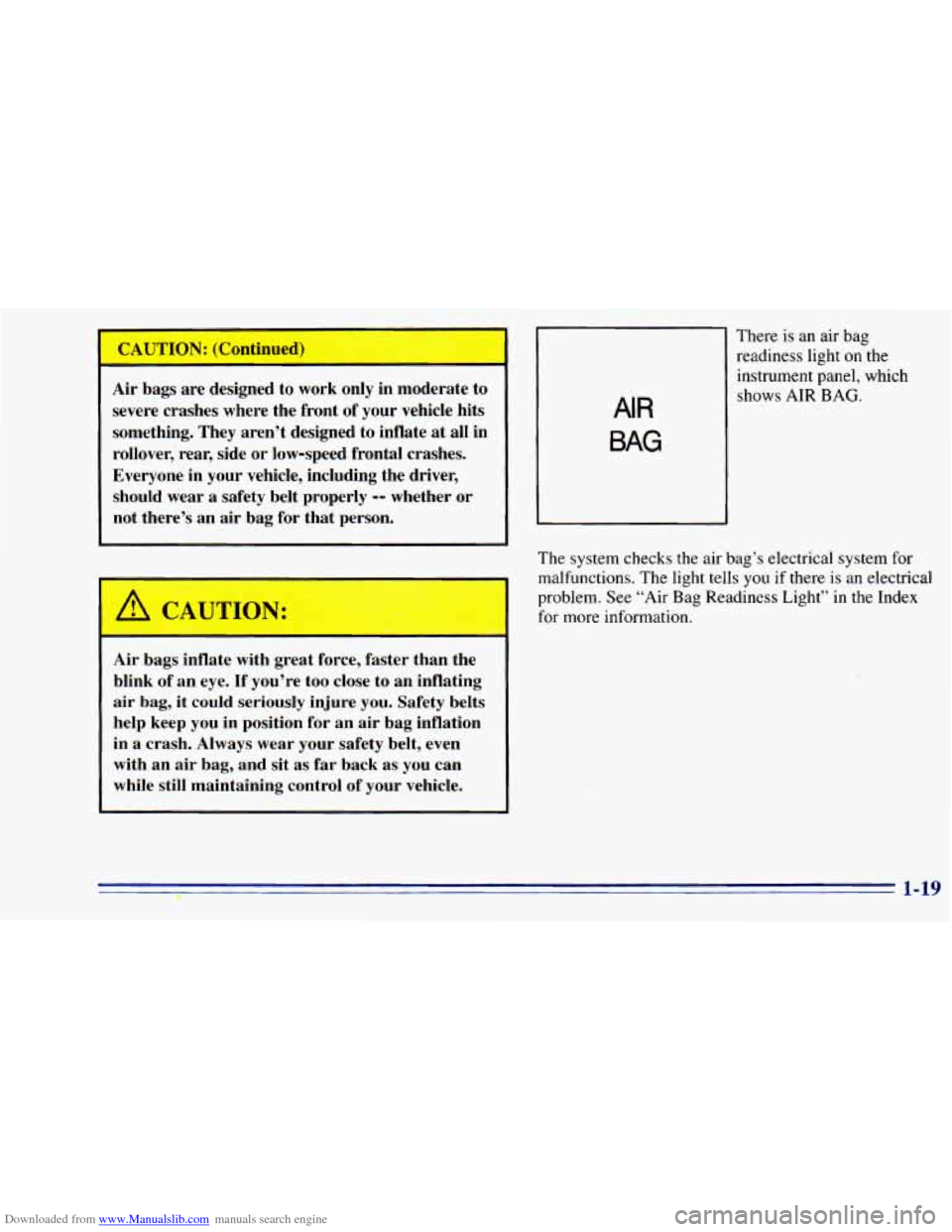
AIR
BAG
There is an air bag
readiness light on
the
instrument panel, which
shows
AIR BAG.
The system checks the air bag’s electrical system for
malfunctions. The light tells you
if there is an electrical
problem. See “Air Bag Readiness Light’’
in the Index
for more information.
(L 1-19